Multi-bank statement aggregation is the process of parsing, normalizing, and combining bank statements from multiple financial institutions into a single unified cash flow view. For lenders and underwriters, it eliminates double-counting from interbank transfers, surfaces cross-account fraud patterns, and produces the accurate net revenue picture that single-account analysis cannot provide.
What you'll learn
- Most established small businesses operate across multiple bank accounts, meaning single-account underwriting may capture only 30–60% of actual revenue
- Interbank transfer deduplication is the most critical step in multi-bank aggregation — failing to remove transfers inflates apparent deposits with phantom revenue
- Combined average daily balance, calculated as the sum of per-day balances across all accounts, is the most important single metric for MCA underwriters
- Fraud patterns including circular transfers, NSF hiding, and MCA position stacking are structurally invisible in single-account review but surface immediately in cross-account analysis
- Document-based aggregation is the default requirement for MCA and small business lending because open banking opt-in rates among SMB applicants often fall below 50%
Multi-bank statement aggregation is the process of parsing, normalizing, and combining bank statements from multiple financial institutions into a single unified cash flow view. For lenders and underwriters, it eliminates double-counting from interbank transfers, surfaces cross-account fraud patterns, and produces the accurate net revenue picture that single-account analysis cannot provide.
What Is Multi-Bank Statement Aggregation?
Multi-bank statement aggregation means taking bank statements from two or more institutions, parsing them into structured data, and merging that data into one consolidated view. The output is a single unified transaction timeline, a combined balance history, and aggregate metrics across every account a business holds.
This matters because most businesses don't bank in one place. A restaurant may hold a Chase operating account, a Wells Fargo payroll account, and a separate Stripe settlement account. Reviewing only one of these doesn't give you a picture of the business — it gives you a fragment.
The process starts with bank statement parsing — converting PDF statements into machine-readable structured data. Aggregation builds on that foundation by merging parsed data from multiple institutions into a single coherent view.
Document-Based vs. Open Banking Aggregation
There are two ways to aggregate multi-account financial data. Open banking APIs like Plaid and Finicity pull live transaction data directly from bank systems. This requires applicant consent and bank connectivity — and works well for ongoing monitoring of active accounts.
Document-based aggregation parses PDF or scanned statements that an applicant submits. It works for any applicant, any bank, and any historical time period — regardless of whether the institution supports an API connection. For a detailed breakdown of when each approach fits, see our guide on open banking vs. bank statement parsing for MCA.
The critical difference: open banking suits real-time monitoring after loan origination. Document-based aggregation suits point-in-time underwriting where you need three to twelve months of historical statement data. In MCA and small business lending, open banking opt-in rates among applicants often fall below 50% — making document-based aggregation the default requirement, not an alternative.
Why Multi-Account Businesses Are the Norm, Not the Exception
Most established small businesses separate their finances across multiple accounts. According to FDIC survey data, the majority of small businesses with more than five employees hold accounts at more than one institution. This isn't financial complexity — it's standard operating practice.
A business with $2 million in annual revenue might route merchant card processing settlements to one account, run ACH payroll from a second, and hold operating reserves in a third. Underwriting any single account gives you an incomplete — and often misleading — picture of the business's actual cash position.
When a lender reviews only one account for a business that operates across three, they may see as little as 30 to 60 percent of actual revenue. That's not a margin of error. That's a fundamentally different business than the one that actually exists.
Why Businesses Operate Across Multiple Bank Accounts
Account segmentation isn't unusual behavior — it's how businesses manage financial risk and operational clarity. Understanding why businesses hold multiple accounts helps underwriters know which accounts to request and how to interpret what they see.
The most common account types in multi-bank business structures are:
- Operating accounts — day-to-day revenue deposits and vendor payments
- Payroll accounts — funded periodically via ACH transfer to limit exposure if the account is compromised
- Merchant processing accounts — Stripe, Square, or PayPal settlements often land in dedicated accounts separate from operating cash
- Savings and reserve accounts — tax reserves, owner distributions, and cash buffers at the same or a different institution
- Secondary institution accounts — many businesses maintain a local credit union account alongside a national bank account
How Account Segmentation Affects Underwriting Accuracy
Consider a business routing all merchant card sales to a Stripe-linked Chase account while running ACH payables through a Wells Fargo operating account. If your underwriting team reviews only the Wells Fargo statement, they see outflows but limited inflows. The business looks undercapitalized. It isn't.
The average daily balance calculation is particularly vulnerable to this problem. A single-account ADB may be 40 to 70 percent lower than the true cross-account average. That gap directly affects advance amounts, factor rates, and approval decisions.
NSF analysis suffers the same distortion. A business may show zero NSFs in the account submitted for underwriting while maintaining chronic overdraft activity in a secondary payroll account — or vice versa.
What Happens When Lenders Miss Accounts
Two types of errors result from incomplete account collection. The first is systematic underestimation of revenue, which leads to declined deals that should have been approved — lost deal flow and a competitive disadvantage.
The second error is more dangerous: systematic overestimation caused by failing to remove interbank transfers. A business moving $50,000 between accounts every month shows $600,000 in phantom annual deposits if both accounts are naively combined without transfer deduplication. That's a credit risk disguised as a healthy applicant.
The Core Challenge: Building One Picture From Many Sources
Aggregating multi-bank statements isn't just a data-merging exercise. It requires solving several technical problems simultaneously — problems that grow in complexity as the number of accounts and institutions increases.
The primary challenges are:
- Format inconsistency — Chase, Bank of America, and Wells Fargo all structure their statement PDFs differently. Regional banks and credit unions add hundreds more variations.
- Date range gaps — one account may have January through March statements while another only covers February through April
- Overlapping periods — statements sometimes overlap by a few days and require deduplication without data loss
- Missing months — applicants frequently submit incomplete statement sets for secondary accounts
- Field naming inconsistency — one bank labels a field "Transaction Date," another uses "Posting Date," another uses "Value Date" — and these aren't always equivalent
- Scale — manually reconciling 3 accounts × 3 months means 9 PDFs with potentially thousands of line items
Format Normalization Across 900+ Bank Templates
Every bank produces statements in its own layout. The differences between Chase, Bank of America, and Wells Fargo statement formats are significant enough that a parser built for one won't reliably handle the others. Scale that to regional banks and credit unions — many of which print statements from legacy core banking systems — and the format variation becomes enormous.
OCR-based parsing must handle scanned statements with varying image quality, page rotation, and partial redactions. Template-matching parsers break whenever a bank updates its statement layout. AI-based template-free parsing adapts to format variations without requiring manual template maintenance — a critical capability for any lender processing high volumes.
The field mapping requirement alone is substantial: transaction date, posting date, description, debit amount, credit amount, and running balance must all be extracted and standardized to a common schema regardless of source institution. The scale of 900+ bank format support required to do this reliably is one of the most underappreciated technical challenges in the space.
Automatic format detection
No configuration required • Just upload and go
Handling Overlapping or Missing Statement Periods
Before aggregating, establish a canonical date window — typically the longest common period covered by all submitted accounts. If Account A covers January through June and Account B covers March through June, the canonical window for cross-account comparison is March through June.
Missing months must be flagged explicitly, not silently omitted. A missing February statement for Account B might represent the highest-revenue month in Account A — and the gap in Account B may be deliberate. Flag it and request the missing statement before proceeding.
Overlapping statement dates — where December 28 through January 3 transactions appear on both the December and January statements — require deduplication by matching on transaction date, amount, and description. Partial period statements should be normalized to per-day rates before comparison across accounts.
Step-by-Step: How to Build a Unified Cash Flow View
No competitor provides this methodology in detail — which is exactly why manual multi-bank analysis remains error-prone in most lending operations. Here's the complete process, from statement collection through unified report output.
Step 1: Collect and Validate the Complete Statement Set
Request statements for all accounts covering the same time window — typically three to six months for MCA underwriting, twelve months for SBA loans. Don't accept a partial set and proceed. Missing accounts are where the most consequential errors originate.
For each statement, verify:
- Business name matches across all accounts
- EIN or account holder matches
- No months are missing within the requested window
- The closing balance of month N matches the opening balance of month N+1 (continuity check)
Look for signals of hidden accounts. If the operating account shows payroll ACH origination debits, a separate payroll account almost certainly exists — request it. If you see Stripe or Square settlement credits in one account, confirm there isn't a separate merchant processing account you haven't received.
Step 2: Parse and Normalize Each Statement to a Common Schema
Parse each PDF into structured data: date, description, debit amount, credit amount, running balance, and account identifier. Use posting date consistently across all accounts — not transaction initiation date — to avoid reporting the same transaction twice in edge cases where initiation and posting span different days.
Tag every transaction with its source account identifier before any merging begins. This tagging is what makes deduplication and per-account reporting possible after aggregation.
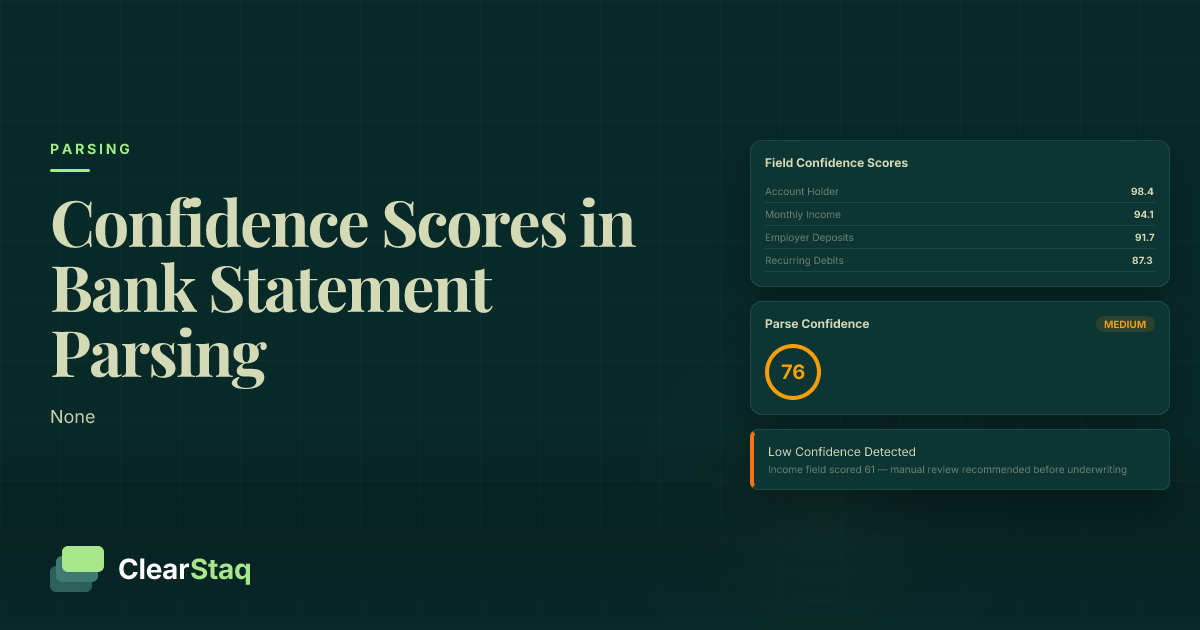
Apply confidence scores on parsed data at this stage. Low-confidence parsed values — fields where the parser is uncertain — should be flagged for human review before entering the aggregated view. A misread transaction amount that enters the unified ledger unchecked will corrupt your aggregate metrics.
For high-volume workflows, batch processing multiple bank statements simultaneously rather than sequentially reduces processing time significantly and maintains consistent schema application across all parsed outputs.
Step 3: Identify and Remove Interbank Transfers
This is the most critical step. An interbank transfer appears as a debit in Account A and a credit in Account B on the same or adjacent business day for the same amount. Both legs of the transfer must be removed from the aggregated deposit and withdrawal totals before calculating any revenue metrics.
The matching logic for duplicate transaction detection across accounts works as follows:
- Match on exact amount within a ±1 business day window
- Check whether a known account number suffix appears in the memo or description field of either transaction
- Score the match: exact match on all fields = high confidence; amount and date only = probable match requiring review
- Remove confirmed transfer pairs from deposit and withdrawal totals
- Flag probable matches for analyst review — don't silently include or exclude them
Unmatched large credits that resemble transfers — round numbers, timing consistent with periodic funding — should be flagged rather than automatically included in revenue totals.
Step 4: Merge Into a Chronological Unified Ledger
Combine all normalized, transfer-stripped transactions from all accounts into a single date-sorted ledger. Each row retains its source account tag so per-account views remain available alongside the aggregate.
Calculate a synthetic combined running balance: the sum of end-of-day balances across all accounts for each calendar day in the period. This is your true liquidity picture. Group transactions by month to produce monthly inflow, outflow, and net cash flow across the aggregated view.
Step 5: Calculate Aggregate Metrics and Produce the Unified Report
From the unified ledger, calculate the key metrics your underwriting or credit analysis requires:
| Metric | Calculation | What It Signals |
|---|---|---|
| Combined Average Daily Balance | Sum of daily combined balances ÷ number of days | True liquidity across all accounts |
| Net Monthly Deposits | External credits minus external debits, post transfer removal | True revenue entering the business |
| Monthly Cash Flow Trend | Month-over-month change in net deposits | Growth or decline trajectory |
| Aggregate NSF Frequency | Total NSF events across all accounts | Cash management behavior across the full business |
| Revenue Concentration | Largest single deposit ÷ total deposits | Client concentration risk or lumpy income pattern |
See Multi-Bank Aggregation in Action
Upload statements from multiple accounts and watch ClearStaq parse, normalize, deduplicate transfers, and produce a unified cash flow view in seconds. Start your free trial — no credit card required.
The Interbank Transfer Problem (And How to Solve It)
The single most common error in manual multi-bank analysis is counting interbank transfers as revenue. It's not a minor distortion. A business moving $30,000 from its operating account to its payroll account every two weeks generates $780,000 in apparent annual deposits when both accounts are naively summed. That money never entered the business — it just moved within it.
See our detailed guide on duplicate transaction detection for a full technical breakdown of deduplication methodology. The summary of the problem: interbank transfers are common, inconsistently labeled, and genuinely difficult to identify manually at any meaningful scale.
Why Manual Identification Fails at Scale
A business with three accounts and six months of statements may contain 50 to 100 interbank transfers buried in 2,000 or more total transactions. Manual reviewers miss them — not because of inattention, but because the same transfer can look completely different on each side of the transaction.
The debit in Account A might appear as "Online Transfer to Business Checking." The matching credit in Account B might appear as "ACH Credit — [Business Legal Name]." Without looking at both statements simultaneously and matching on amount and date, the connection is invisible.
Amount variations compound the problem. A transfer of $9,999.72 instead of $10,000 — common when ACH fees are deducted — won't be caught by a reviewer scanning for round-number matches. And false positives are equally dangerous: removing a legitimate third-party payment that happens to match a transfer pattern removes real revenue from your analysis.
Automated Deduplication: How the Matching Algorithm Works
Automated transfer deduplication applies a multi-signal matching approach:
- Primary match: exact amount + posting date within ±1 business day across any two submitted accounts
- Secondary match: known account number suffix appearing in any field of the candidate transaction
- Confidence scoring: matches meeting all criteria are flagged as confirmed transfers and removed; matches meeting only amount + date criteria are flagged as probable and surfaced for review
- Residual flagging: large round-number credits without matching debits in the dataset are flagged as unverified — potentially legitimate revenue, potentially an unreported account
This approach catches the transfer pairs that manual review misses while avoiding the false-positive problem that would remove legitimate revenue from your analysis. The accuracy gap between automated and manual deduplication grows rapidly as account count and transaction volume increase.
Understanding the difference between apparent gross revenue and true revenue vs. gross revenue in MCA underwriting starts with getting this deduplication step right.
Key Metrics to Extract From an Aggregated Cash Flow View
Once you have a clean unified ledger, the analytical output should address three categories of metrics: balance and liquidity, revenue and cash flow, and MCA-specific risk signals. Here's how each is calculated from aggregated data and how the aggregated number differs from a single-account view.
Balance and Liquidity Metrics
The combined average daily balance calculation is the most important single number for MCA underwriters. It's calculated as the sum of end-of-day balances across all accounts for each calendar day, divided by the total number of days in the analysis period. This is not the average of each account's ADB — it's a true combined daily balance calculation.
Other critical balance metrics from the aggregated view:
- Minimum combined balance — the lowest point the business's total cash position reached across the analysis period. A business with $200K in Account A and a -$5K overdraft in Account B has a real liquidity stress signal even if Account A looks healthy in isolation.
- Negative balance days — count of days where any single account went negative, even if the combined balance was positive. Chronic overdrafts in any account signal poor cash management.
- End-of-period trend — is the combined balance growing, flat, or declining? A declining trend across six months tells a different story than a healthy snapshot at month-end.
Revenue and Cash Flow Metrics
Net monthly deposits — external credits minus external debits after transfer removal — is the true revenue figure for the business across all accounts. This is the number that should drive factor rate decisions, not gross deposits from any single account.
Monthly cash flow trend shows whether the business is growing, stable, or declining. Plot net deposits month-over-month across all accounts combined. A business whose primary account shows steady deposits while aggregate deposits are declining may be shifting revenue between accounts — a pattern worth investigating.
Aggregate NSF frequency matters more than per-account NSF counts. A business with zero NSFs in the account it chose to submit but chronic overdraft activity across two other accounts is not a low-risk borrower. The NSF fees and negative balance days that appear in secondary accounts are just as relevant as those in the primary account submitted for review.
MCA-Specific Underwriting Metrics From Aggregated Data
MCA underwriting requires several metrics that can only be accurately calculated with complete multi-account data:
- True net revenue: external deposits minus owner draws, loan repayments, and interbank transfers across all accounts
- Existing MCA payment detection: recurring fixed-amount debits matching MCA repayment patterns in any account — not just the primary account submitted
- Position stacking signals: multiple lender ACH debits appearing across different accounts — each account may show one lender while the aggregate reveals three
- Debt service as a percentage of gross revenue: total MCA payments across all accounts divided by total net deposits — this ratio is meaningless if calculated on one account when payments are split across three
For the complete set of metrics and decision criteria, see our MCA underwriting checklist.
Fraud Signals That Only Appear in Multi-Bank Analysis
This is where multi-bank aggregation moves from useful to essential. Certain fraud patterns are structurally invisible when statements are reviewed one at a time. They only surface when all accounts are analyzed simultaneously.
Revenue Splitting to Obscure NSF Patterns
Fraudulent applicants route revenue to a "clean" account while allowing NSFs to accumulate in a secondary account they expect underwriters to overlook. The primary account looks healthy — strong deposits, positive balance, no overdrafts. The secondary account tells a completely different story.
Single-account review of the primary account produces exactly the misleading picture the applicant intends. Multi-bank analysis catches the NSF-heavy secondary account and reveals the business's true cash management behavior. The key is aggregating NSF frequency across all submitted accounts — an NSF in any account is a risk signal, not just NSFs in the account that was featured.
Circular Transfers to Inflate Apparent Balances
A sophisticated applicant moves the same funds back and forth between two accounts in the days before statement cut-off to inflate the period-end balance. On any single statement, the ending balance looks healthy. The circular transfer pattern only appears when both statements are analyzed together.
These circular transfer and kiting patterns are detectable through amount-date matching across accounts. The signature is funds leaving Account A and returning to Account A within three to five business days via Account B — net of any legitimate activity in that window. No single-statement review catches this pattern. Cross-account matching does.
MCA Position Stacking Hidden Across Accounts
Applicants with multiple existing MCA positions split repayments across accounts so no single account shows the full debt service burden. Account A shows one lender's daily ACH debits. Account B shows two others. Neither account alone triggers a stacking flag because neither account alone shows an alarming debt service ratio.
The aggregated view reveals the total MCA repayment as a percentage of net deposits — often a ratio that would immediately decline the deal if any underwriter saw it. Cross-account MCA position stacking detection requires correlating fixed-amount recurring debits across all submitted accounts simultaneously. It cannot be done on individual statements.
Seasonality Manipulation and Revenue Shifting
A declining business may temporarily concentrate revenue into one account to present a strong primary account while masking overall revenue decline. The "show" account looks stable or growing. The aggregate shows total deposits declining month over month.
Detection requires comparing the trend in any single account to the aggregate trend. Divergence — where one account's deposits are flat or growing while aggregate deposits are falling — is a red flag worth investigating. Revenue smoothing and artificial cash flow patterns in the aggregate view often reveal what a carefully curated single-account submission was designed to hide.
Open Banking vs. Document-Based Aggregation: Which Approach Fits Your Workflow?
Both approaches solve the multi-account visibility problem — but they solve it in different contexts. The right choice depends on your lending product, your applicant profile, and what data you actually need.
When Open Banking Aggregation Is the Right Choice
Open banking API aggregation works best for:
- Consumer lending and mortgage origination where Plaid or Finicity integration is standard and expected
- Ongoing post-origination monitoring — real-time balance data and transaction feeds for continuous risk scoring
- Short-term consumer credit where current account status matters more than historical statement analysis
- Applicants with primary accounts at major national banks with strong API connectivity
When Document-Based Aggregation Is the Right Choice
Document-based aggregation is the correct choice for most MCA and small business lending workflows. Here's why why lenders are moving from Plaid to bank statement parsing in SMB contexts:
- MCA applicants often bank at smaller institutions not supported by open banking providers
- Historical data requirements beyond 12 to 24 months exceed open banking API lookback limits
- Small business applicants decline API connectivity at high rates — document submission is the path of least resistance
- Compliance-driven underwriting where auditors require document-based evidence rather than API pull records
- Credit unions, community banks, and international institutions have limited or no API support
Many lenders adopt a hybrid model: document-based aggregation for initial underwriting, open banking for post-approval monitoring. This approach captures the advantages of both methods without forcing applicants through a connection flow they won't complete.
How ClearStaq Handles Multi-Bank Statement Aggregation
ClearStaq's bank statement parsing platform is built for multi-bank workflows from the ground up — not retrofitted from a single-account parser. Here's what that means in practice.
Batch Parsing and Unified JSON Output
Submit all statements from a multi-bank applicant in a single API call. ClearStaq parses all submitted statements in parallel — no sequential processing, no waiting for one statement to finish before the next begins. Each parsed statement returns a normalized JSON object with a consistent schema regardless of source institution, covering 900+ bank formats without manual template creation.
The account_id field tags each transaction with its source institution before aggregation. This tagging persists through the unified output so you can generate both per-account breakdowns and aggregate views from the same dataset.
Webhook delivery means parsed results arrive as each statement finishes processing — enabling real-time pipeline construction for lenders handling high application volumes. For more on the parallel processing architecture, see batch processing multiple bank statements.
Confidence Scores and Transfer Deduplication
Every parsed field carries a confidence score on parsed data. Fields where the parser has lower certainty — often in scanned or low-quality statements — are flagged before they enter the aggregated view. Uncertain data doesn't silently corrupt your aggregate metrics.
Automated interbank transfer detection identifies probable transfer pairs across all submitted accounts without analyst intervention. Both legs of each confirmed transfer are excluded from deposit and withdrawal totals before aggregate metric calculation.
ClearStaq applies 27 fraud signals across the full multi-bank dataset simultaneously — not run on each statement in isolation. Cross-account fraud patterns including circular transfers, NSF hiding, and position stacking appear in the aggregate fraud report, not buried in per-statement outputs that require manual cross-referencing.
All processing runs under SOC2 compliance for bank statement processing, ensuring secure handling of multi-institution financial data. Review available pricing plans to find the right tier for your application volume.
Ready to Automate Multi-Bank Cash Flow Analysis?
Stop manually reconciling statements from multiple institutions. ClearStaq parses, normalizes, deduplicates transfers, and produces a unified cash flow view across all of your applicant's accounts — in seconds, not hours. Start your free trial today.
Frequently Asked Questions
What is multi-bank statement aggregation?
Multi-bank statement aggregation is the process of parsing bank statements from multiple financial institutions and combining them into a single unified cash flow view. It removes interbank transfers to eliminate double-counting and produces accurate aggregate metrics — such as combined average daily balance and net monthly deposits — across all of a business's accounts.
How do you avoid double-counting when consolidating bank statements from multiple accounts?
The key step is identifying and removing interbank transfers — transactions where money moves between the applicant's own accounts. These appear as a debit in one account and a matching credit in another on the same or adjacent business day. Automated tools match transfer pairs by amount and date; both legs are then excluded from deposit and withdrawal totals before calculating aggregate metrics.
How do I consolidate bank statements from multiple accounts?
Collect statements covering the same time period for all accounts, parse each into structured data with a consistent schema, remove interbank transfers, then merge all transactions into a single date-sorted ledger. Calculate a combined running balance by summing end-of-day balances across all accounts. Automated aggregation tools handle the parsing, normalization, and deduplication steps without manual reconciliation.
What software aggregates bank statements from multiple banks?
Automated bank statement parsing platforms like ClearStaq aggregate statements from multiple institutions by parsing PDFs into structured data, normalizing fields to a common schema, detecting and removing interbank transfers, and delivering a unified JSON output. These tools support hundreds of bank formats and apply fraud detection across the full multi-account dataset.
How do MCA underwriters handle applicants with multiple bank accounts?
MCA underwriters should collect statements for all business accounts, not just the primary operating account. After parsing and normalizing all statements, interbank transfers are removed to prevent double-counting. The underwriter then works from a unified ledger showing combined average daily balance, true net deposits, aggregate NSF frequency, and total MCA repayment obligations across all accounts.
What fraud signals are unique to multi-bank applicants?
Several fraud patterns only surface in cross-account analysis: revenue splitting to hide NSF activity in secondary accounts, circular transfers between accounts to inflate period-end balances, and MCA position stacking split across accounts so no single account shows the full debt service burden. None of these patterns are detectable in single-account statement review.
Frequently Asked Questions
What is multi-bank statement aggregation?
Multi-bank statement aggregation is the process of parsing bank statements from multiple financial institutions and combining them into a single unified cash flow view. It removes interbank transfers to eliminate double-counting and produces accurate aggregate metrics — such as combined average daily balance and net monthly deposits — across all of a business's accounts.
How do you avoid double-counting when consolidating bank statements from multiple accounts?
The key step is identifying and removing interbank transfers — transactions where money moves between the applicant's own accounts. These appear as a debit in one account and a matching credit in another on the same or adjacent business day. Automated tools match transfer pairs by amount and date; both legs are then excluded from deposit and withdrawal totals before calculating aggregate metrics.
How do I consolidate bank statements from multiple accounts?
Collect statements covering the same time period for all accounts, parse each into structured data with a consistent schema, remove interbank transfers, then merge all transactions into a single date-sorted ledger. Calculate a combined running balance by summing end-of-day balances across all accounts. Automated aggregation tools handle parsing, normalization, and deduplication without manual reconciliation.
What software aggregates bank statements from multiple banks?
Automated bank statement parsing platforms like ClearStaq aggregate statements from multiple institutions by parsing PDFs into structured data, normalizing fields to a common schema, detecting and removing interbank transfers, and delivering a unified JSON output. These tools support hundreds of bank formats and apply fraud detection across the full multi-account dataset.
How do MCA underwriters handle applicants with multiple bank accounts?
MCA underwriters should collect statements for all business accounts, not just the primary operating account. After parsing and normalizing all statements, interbank transfers are removed to prevent double-counting. The underwriter then works from a unified ledger showing combined average daily balance, true net deposits, aggregate NSF frequency, and total MCA repayment obligations across all accounts.
What fraud signals are unique to multi-bank applicants?
Several fraud patterns only surface in cross-account analysis: revenue splitting to hide NSF activity in secondary accounts, circular transfers between accounts to inflate period-end balances, and MCA position stacking split across accounts so no single account shows the full debt service burden. None of these patterns are detectable in single-account statement review.
ClearStaq Team
Product Team
The ClearStaq team builds AI-powered tools for bank statement parsing, fraud detection, and income verification.