What you'll learn
- Bank statement parsing extracts financial data from PDFs in seconds instead of the 15-45 minutes manual review requires per statement.
- Accuracy rates above 99% are achievable with modern machine learning models trained on millions of documents.
- Fraud detection layers catch document manipulation that human reviewers miss, including metadata inconsistencies and mathematical errors.
- MCA brokers using automated parsing review 3-5x more applications per day while reducing data entry errors.
- API-first platforms integrate with existing CRMs and underwriting systems without disrupting current workflows.
- Credit-based pricing models make costs predictable at 1 credit per document regardless of page count.
Bank statement parsing is the automated extraction of financial data from bank statement PDFs into structured, analyzable formats. Software reads each page, identifies deposits, withdrawals, running balances, and account metadata, then outputs the data as JSON, CSV, or direct API responses. Lenders use bank statement parsing to assess cash flow, verify income, and make underwriting decisions in minutes instead of hours.
You'll Learn
- The technical process behind bank statement parsing and extraction
- Key financial metrics that parsers extract for lending decisions
- Features that separate basic parsers from enterprise-grade platforms
- How MCA brokers and alternative lenders use parsing in underwriting workflows
- Red flags that indicate a statement may be fraudulent or manipulated
Bank Statement Parsing Defined
Parsing converts unstructured document data into structured output. A bank statement PDF contains all the information a lender needs, but that information sits trapped in a format designed for human eyes, not software systems.
The parsing process involves multiple stages. First, optical character recognition (OCR) converts the visual document into machine-readable text. Then, extraction algorithms identify and categorize each data element: dates, amounts, descriptions, running balances. Classification models sort transactions into categories like deposits, withdrawals, fees, and transfers. Validation checks confirm mathematical accuracy. The final output flows into downstream systems for financial analysis and credit decisions.
Raw transaction data alone doesn't tell lenders much. A $50,000 deposit could be revenue, a loan, or a transfer from another account. Parsing software must distinguish between these categories to produce metrics that inform lending decisions.
The Manual Review Problem
Underwriters reviewing bank statements by hand face a tedious, error-prone task. A single 3-month statement from a business checking account contains 200-500 transactions. The reviewer must identify each deposit, verify it against stated revenue, spot NSF fees, calculate average daily balances, and flag suspicious patterns.
Claim: Manual bank statement review consumes significant underwriter time.
Stat: Experienced underwriters spend 15-45 minutes per bank statement, according to a 2023 survey of MCA industry professionals by deBanked.
Manual review creates bottlenecks. MCA brokers receive 50-200 applications per day during peak periods. Each application includes 3-6 months of bank statements. The math doesn't work. Either underwriters rush through reviews and miss critical details, or applications sit in queues while merchants wait for funding.
Human reviewers also make mistakes. Fatigue leads to miscounted deposits. Unfamiliar bank formats cause confusion. Subtle fraud signals blend into hundreds of legitimate transactions. A 2022 PYMNTS study found that manual document processing in financial services carries a 2-5% error rate, with errors concentrated in high-volume, repetitive tasks.
Automated parsing addresses both speed and accuracy. ClearStaq extracts complete transaction data in under 5 seconds per statement. The same document that takes an underwriter 30 minutes to review becomes structured data before they finish their coffee.
Technical Architecture of Bank Statement Parsing
Modern bank statement parsers combine multiple technologies to achieve high accuracy across diverse document formats.
Optical Character Recognition
OCR converts visual text into machine-readable characters. Bank statements present OCR challenges that general-purpose engines struggle with. Dense tables, inconsistent spacing, and mixed fonts require specialized models trained on financial documents.
Native digital PDFs (statements downloaded from online banking portals) produce cleaner OCR output than scanned paper documents. Image quality, resolution, and scanning artifacts all affect extraction accuracy. Enterprise parsers apply preprocessing to correct skew, enhance contrast, and remove noise before OCR processing.
Template Recognition and Machine Learning
Banks format statements differently. Chase places running balances in the rightmost column. Bank of America includes them inline with each transaction. Wells Fargo uses distinct headers for deposits and withdrawals. A parser must recognize each format and apply the correct extraction logic.
Early parsing systems relied on rigid templates, one per bank. Adding a new bank required manual template creation. Modern systems use machine learning models that learn structural patterns across thousands of document examples. These models adapt to format variations within the same bank and generalize to new banks with minimal training data.
ClearStaq supports 900+ bank formats through this approach. The platform's models learn from millions of parsed statements, improving accuracy with each document processed.
Transaction Classification
Raw extraction produces a list of transactions with dates, amounts, and descriptions. Classification assigns each transaction to a category: revenue deposit, loan proceeds, transfer, fee, withdrawal, or other. This classification enables the financial metrics that lenders care about.
Transaction descriptions vary across banks and businesses. "POS PURCHASE 7-ELEVEN #12345" is a purchase. "DEPOSIT STRIPE TRANSFER" is likely revenue. "TRANSFER FROM SAVINGS" isn't income. Classification models parse description text, consider transaction patterns, and apply business rules to assign accurate categories.
Validation and Reconciliation
Parsed data must be mathematically consistent. Opening balance plus deposits minus withdrawals should equal closing balance. Each transaction should produce the stated running balance. Parsing errors show up as reconciliation failures.
Validation also catches document manipulation. Fraudsters editing transaction amounts often forget to update running balances. A parsed statement where calculations don't reconcile signals potential fraud. ClearStaq's fraud detection layer includes mathematical validation as one of 27 fraud signals.
Data Points Extracted from Bank Statements
Lenders need specific metrics to assess creditworthiness. Bank statement parsing extracts the raw data; analysis features calculate the metrics.
Account Information
- Account holder name and business name
- Account number (masked or full)
- Bank name and routing number
- Statement period (start and end dates)
- Account type (checking, savings, money market)
Balance Metrics
- Opening balance
- Closing balance
- Average daily balance across the statement period
- Minimum balance reached
- Number of days with negative balance
Average daily balance indicates cash reserves. MCA lenders use this metric to gauge repayment capacity. A business with $50,000 in monthly revenue but a $2,000 average balance operates with thin margins. The same revenue with a $25,000 average balance suggests healthier cash management.
Deposit Analysis
- Total deposits
- Deposit count
- Average deposit size
- Deposits by category (revenue, transfers, loans)
- Deposit consistency (standard deviation across weeks)
True revenue differs from total deposits. A $500,000 total might include $200,000 in transfers from other accounts, $50,000 in loan proceeds, and $250,000 in actual business revenue. Parsers that distinguish these categories give lenders accurate revenue figures.
Withdrawal and Expense Patterns
- Total withdrawals
- Recurring payments (rent, loans, subscriptions)
- Cash withdrawals
- Transfer outflows
Risk Indicators
- NSF (non-sufficient funds) fee count
- Overdraft occurrences
- Returned check count
- Negative balance days
- Large unexplained deposits
NSF count serves as a leading indicator of cash flow stress. A business with 5+ NSF fees per month struggles to manage obligations. Lenders weight this signal heavily in MCA underwriting because it predicts future payment difficulties.
Features That Separate Basic and Enterprise Parsers
Free and low-cost parsers handle simple use cases. Commercial lending requires more.
Accuracy Rates
Basic parsers achieve 85-95% accuracy on common bank formats. This sounds acceptable until you calculate the impact. At 90% accuracy on a 300-transaction statement, 30 transactions contain errors. An underwriter must review every extraction to catch mistakes.
Enterprise parsers target 99%+ accuracy. ClearStaq maintains 99.5% accuracy across supported formats. This accuracy level makes automated workflows viable because exceptions are rare rather than routine.
Format Coverage
Regional banks, credit unions, and international institutions use formats that basic parsers don't recognize. A lender serving diverse merchant populations needs broad coverage.
ClearStaq supports 900+ bank formats and adds new formats within 24-48 hours upon request. This coverage prevents the workflow disruptions that occur when an application arrives with an unsupported statement format.
Fraud Detection
Basic parsers extract data without analyzing authenticity. Enterprise platforms include fraud detection as a core feature.
Document-level fraud signals include PDF metadata inconsistencies, font mismatches, image manipulation artifacts, and mathematical reconciliation failures. Behavioral fraud signals span unusual transaction patterns, deposits inconsistent with stated business type, and cash flow anomalies.
ClearStaq runs 27 fraud signals across two layers: document integrity checks and behavioral pattern analysis. This catches the Photoshopped deposits, synthetic statements, and manipulated totals that human reviewers miss.
Speed
Processing time matters at scale. A parser that takes 30 seconds per statement creates different operational constraints than one completing extraction in 5 seconds.
ClearStaq averages under 5 seconds per document, including fraud analysis. High-volume operations process thousands of statements per hour without infrastructure bottlenecks.
API Architecture
Manual upload interfaces work for occasional use. Lending operations need API access for workflow automation.
ClearStaq provides REST APIs, JavaScript and Python SDKs, and webhooks for event-driven integrations. Teams connect parsing to existing CRMs, underwriting platforms, and custom applications. Pre-built connectors for Salesforce and QuickBooks accelerate common integrations.
Bank Statement Parsing in MCA Underwriting
Merchant cash advance underwriting relies on bank statement analysis more than traditional credit metrics. MCA providers advance funds against future receivables, so current cash flow matters more than credit history.
A typical MCA application includes 3-6 months of bank statements. The underwriter needs to verify stated revenue, assess cash flow stability, identify existing debt obligations, and spot fraud indicators. Manual review of this documentation takes 45-90 minutes per application.
Automated parsing compresses this timeline. ClearStaq extracts and analyzes a 6-month statement set in under 30 seconds. The platform outputs a financial scorecard with key metrics: true revenue, average daily balance, NSF count, negative balance days, and deposit consistency.
Capital Gurus, the company behind ClearStaq, built the platform to solve their own underwriting challenges. Processing thousands of MCA applications required faster, more accurate document analysis than available tools provided. The platform reflects lessons learned from millions of parsed statements and thousands of funding decisions.
Underwriting Workflow Integration
MCA brokers integrate parsing into application intake. Merchants upload statements through a portal or email. The parsing system extracts data and generates preliminary analysis before an underwriter sees the file. Underwriters review flagged exceptions rather than processing every transaction manually.
This workflow enables underwriters to review 3-5x more applications per day. Time shifts from data entry to decision-making. Skilled underwriters apply judgment to edge cases while automation handles routine extraction.
Manual vs. Automated Parsing Comparison
| Factor | Manual Review | Automated Parsing |
|---|---|---|
| Time per statement | 15-45 minutes | 3-10 seconds |
| Error rate | 2-5% | 0.5% or less |
| Consistency | Varies by reviewer, time of day, fatigue | Identical output for identical input |
| Fraud detection | Relies on reviewer experience and attention | Systematic checks on 27+ signals |
| Scalability | Linear with headcount | Thousands of documents per hour |
| Cost per document | $5-15 (loaded labor cost) | $0.50-2 (platform fee) |
| Integration | Manual data entry into systems | API feeds data directly to CRMs and underwriting tools |
The comparison isn't close. Automated parsing wins on speed, accuracy, consistency, and cost. Manual review persists in organizations that haven't prioritized the integration work or that process low document volumes.
ClearStaq's Approach to Bank Statement Parsing
ClearStaq combines extraction, analysis, and fraud detection in a unified platform built for lending workflows.
Extraction Performance
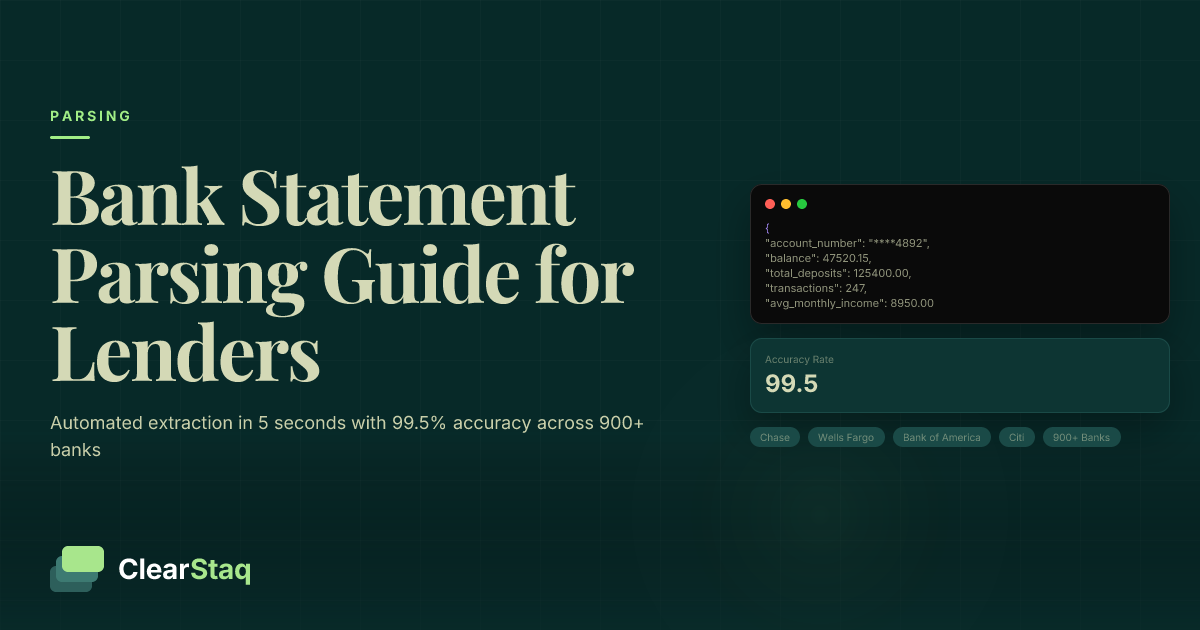
The platform parses statements in under 5 seconds with 99.5% accuracy across 900+ bank formats. These aren't marketing numbers. Capital Gurus validates accuracy weekly against ground-truth datasets drawn from their own lending operations.
Financial Scorecard
Beyond raw extraction, ClearStaq generates a financial scorecard for each statement set. Key metrics include:
- True revenue (deposits minus transfers and loans)
- Average daily balance
- NSF and overdraft counts
- Negative balance days
- Deposit consistency score
- Cash flow trend (improving, stable, declining)
Underwriters see a one-page summary instead of scrolling through hundreds of transactions. Financial analysis features highlight the metrics that matter for lending decisions.
Fraud Detection Layers
ClearStaq runs 27 fraud signals organized into two detection layers.
Document integrity checks analyze PDF metadata, font consistency, image artifacts, and mathematical accuracy. A statement with mismatched creation dates, inconsistent fonts, or calculations that don't reconcile triggers alerts.
Behavioral pattern analysis examines transaction patterns across the statement period. Unusual deposit clustering, round-number deposits inconsistent with business type, and cash flow patterns that don't match stated industry all raise flags.
The dual-layer approach catches both crude manipulation (Photoshopped numbers) and sophisticated fraud (synthetic statements generated with accurate arithmetic).
Integration Options
ClearStaq provides multiple integration paths:
- REST API with JSON responses for custom integrations
- JavaScript and Python SDKs for faster development
- Webhooks for event-driven architectures
- Salesforce connector for CRM integration
- QuickBooks connector for accounting workflows
Teams build integrations in days. The API documentation includes working code examples and sandbox access for testing.
Pricing Model
ClearStaq uses credit-based pricing. One credit parses one document, regardless of page count or complexity. Volume tiers reduce per-credit costs for high-volume operations. This flat-rate model makes costs predictable and eliminates surprises from lengthy statements.
Visit the pricing page for current tier rates and volume discounts.
Use Cases Beyond MCA Lending
Bank statement parsing serves multiple industries and applications.
Alternative Lending
Equipment financing, invoice factoring, and revenue-based financing all require cash flow verification. Parsing automates the document analysis that underpins these credit decisions.
CPAs and Accountants
Accountants reconciling bank statements against client records use parsing to eliminate manual data entry. The same technology that speeds underwriting accelerates bookkeeping workflows. Tax return parsing handles the other major document type in accounting workflows.
Financial Institutions
Banks and credit unions verify income and cash flow for mortgage applications, business loans, and credit lines. Parsing reduces the documentation burden on both applicants and loan officers.
Property Management
Landlords verifying tenant income parse bank statements to confirm employment deposits match stated salary. This reduces fraud in rental applications.
Implementation Considerations
Adopting bank statement parsing requires decisions about integration depth, workflow changes, and staff training.
Start with the API
Most teams start with manual uploads to validate accuracy and learn the platform. API integration follows once the team understands the output format and exception handling requirements.
Define Exception Handling
No parser achieves 100% accuracy on 100% of documents. Damaged PDFs, unusual bank formats, and image quality issues produce extraction failures or low-confidence results. Define escalation paths before going live.
Train Staff on New Workflows
Underwriters accustomed to manual review need training on the new workflow. They'll spend more time on judgment calls and less time on data entry. This shift requires adjustment.
Measure Impact
Track metrics before and after implementation. Applications processed per day, error rates, and fraud detection rates quantify ROI. Most teams see 3-5x throughput improvement within 30 days.
Getting Started
ClearStaq offers free trial access for teams evaluating the platform. Upload sample statements, review extraction accuracy, and test API integration in a sandbox environment.
Start your free trial to parse your first statement in minutes.
Key Takeaways
- Bank statement parsing extracts financial data from PDFs in seconds instead of the 15-45 minutes manual review requires per statement.
- Accuracy rates above 99% are achievable with modern machine learning models trained on millions of documents.
- Fraud detection layers catch document manipulation that human reviewers miss, including metadata inconsistencies and mathematical errors.
- MCA brokers using automated parsing review 3-5x more applications per day while reducing data entry errors.
- API-first platforms integrate with existing CRMs and underwriting systems without disrupting current workflows.
- Credit-based pricing models make costs predictable at 1 credit per document regardless of page count.
Frequently Asked Questions About Bank Statement Parsing
Accuracy expectations for automated bank statement parsing
Top-tier parsing platforms achieve 99%+ accuracy on most bank formats. ClearStaq maintains 99.5% accuracy across 900+ supported banks. Accuracy depends on PDF quality, bank format complexity, and the parser's machine learning models. Scanned documents with low resolution produce more errors than native digital PDFs.
Fraud detection capabilities in bank statement parsers
Advanced parsers include fraud detection layers that analyze metadata, font consistency, mathematical accuracy, and behavioral patterns. ClearStaq runs 27 fraud signals across document-level and behavioral-level checks, catching manipulated totals, Photoshopped transactions, and synthetic statements that human reviewers miss.
Processing time for bank statement parsing
Modern cloud-based parsers extract data from a 3-month bank statement in 3-10 seconds. ClearStaq averages under 5 seconds per document. Legacy on-premise solutions or manual review take 15-45 minutes per statement. The speed difference compounds across high-volume operations.
Technical requirements for using parsing software
Most platforms offer browser-based uploads for non-technical users and API access for developers. ClearStaq provides a drag-and-drop interface for individual documents plus REST APIs, SDKs, and webhooks for teams building automated workflows. You can start parsing in minutes without writing code.
Bank format coverage across parsing platforms
Coverage varies by vendor. Basic parsers handle 50-100 major banks. ClearStaq supports 900+ bank formats including regional banks, credit unions, and international institutions. The platform adds new formats within 24-48 hours upon request.
Cost structure for bank statement parsing services
Pricing models include per-document fees, monthly subscriptions, and enterprise contracts. ClearStaq uses credit-based pricing where 1 credit equals 1 document, with volume discounts for higher tiers. This flat-rate model makes costs predictable regardless of statement length or complexity.
Integration options for existing software systems
Most commercial parsers offer API access. ClearStaq provides REST APIs, JavaScript and Python SDKs, and webhooks that connect to Salesforce, QuickBooks, custom CRMs, and underwriting platforms. Teams build integrations in days, not months.
Start Parsing Bank Statements in Minutes
ClearStaq extracts financial data from bank statements in under 5 seconds with 99.5% accuracy. Join MCA brokers and lenders who process thousands of documents per day.
Frequently Asked Questions
How accurate is automated bank statement parsing?
Top-tier parsing platforms achieve 99%+ accuracy on most bank formats. ClearStaq maintains 99.5% accuracy across 900+ supported banks. Accuracy depends on PDF quality, bank format complexity, and the parser's machine learning models. Scanned documents with low resolution produce more errors than native digital PDFs.
Can bank statement parsers detect fraudulent documents?
Yes. Advanced parsers include fraud detection layers that analyze metadata, font consistency, mathematical accuracy, and behavioral patterns. ClearStaq runs 27 fraud signals across document-level and behavioral-level checks, catching manipulated totals, Photoshopped transactions, and synthetic statements that human reviewers miss.
How long does bank statement parsing take?
Modern cloud-based parsers extract data from a 3-month bank statement in 3-10 seconds. ClearStaq averages under 5 seconds per document. Legacy on-premise solutions or manual review take 15-45 minutes per statement. The speed difference compounds across high-volume operations.
Do I need technical skills to use bank statement parsing software?
No. Most platforms offer browser-based uploads for non-technical users and API access for developers. ClearStaq provides a drag-and-drop interface for individual documents plus REST APIs, SDKs, and webhooks for teams building automated workflows. You can start parsing in minutes without writing code.
Which bank formats do parsers support?
Coverage varies by vendor. Basic parsers handle 50-100 major banks. ClearStaq supports 900+ bank formats including regional banks, credit unions, and international institutions. The platform adds new formats within 24-48 hours upon request.
How much does bank statement parsing cost?
Pricing models include per-document fees, monthly subscriptions, and enterprise contracts. ClearStaq uses credit-based pricing where 1 credit equals 1 document, with volume discounts for higher tiers. This flat-rate model makes costs predictable regardless of statement length or complexity.
Can I integrate bank statement parsing with my existing software?
Most commercial parsers offer API access. ClearStaq provides REST APIs, JavaScript and Python SDKs, and webhooks that connect to Salesforce, QuickBooks, custom CRMs, and underwriting platforms. Teams build integrations in days, not months.
ClearStaq Team
Document Intelligence Platform
The ClearStaq team builds AI-powered tools for bank statement parsing, fraud detection, and income verification.