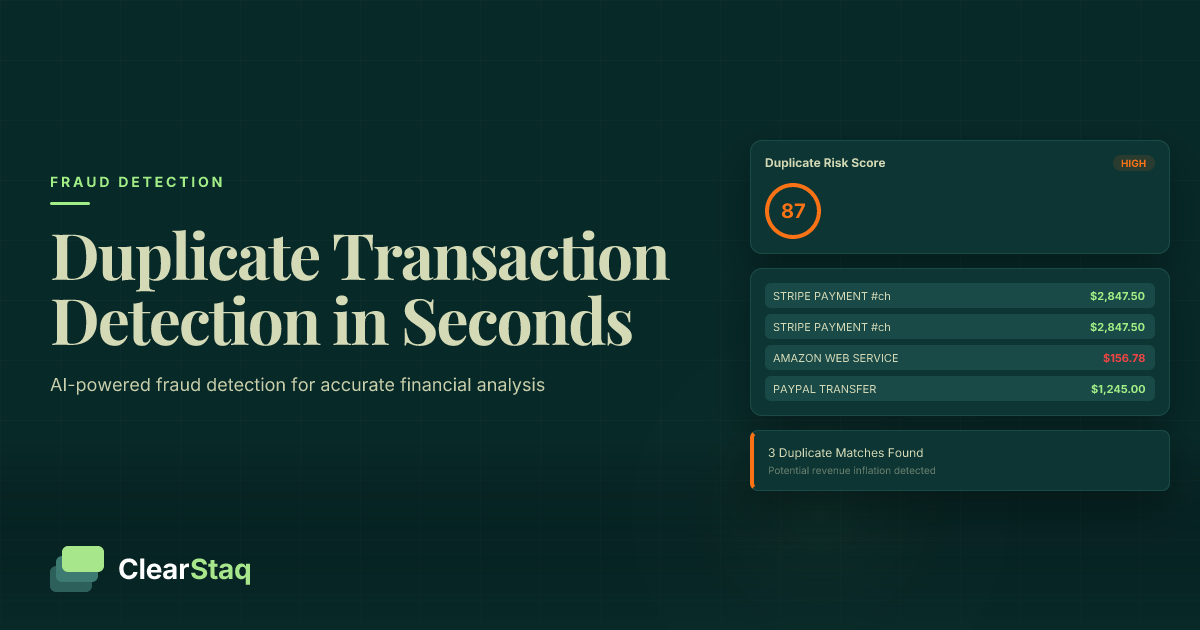
Duplicate transaction detection identifies identical or near-identical transactions in bank statements that can inflate revenue calculations and mask cash flow problems. Automated systems analyze amount, date, description, and merchant data to catch duplicates in seconds using fuzzy matching algorithms that detect even partial matches and formatting variations.
What you'll learn
- Duplicate transactions can inflate revenue by 15-20% in business bank statements, affecting lending decisions
- AI-powered fuzzy matching detects partial duplicates that manual review misses with 95%+ accuracy
- Automated systems process entire bank statements and identify duplicates in 2-3 seconds
- Five common causes include payment processing errors, system integration issues, and manual entry mistakes
- Real-time duplicate detection during parsing prevents inflated cash flow calculations in underwriting
Duplicate transaction detection identifies identical or near-identical transactions in bank statements that can inflate revenue calculations and mask cash flow problems. Automated systems analyze amount, date, description, and merchant data to catch duplicates in seconds using fuzzy matching algorithms that detect even partial matches and formatting variations.
What Are Duplicate Transactions?
Duplicate transactions are identical or near-identical entries that appear multiple times in bank statements, either by mistake or design. Unlike legitimate recurring payments such as subscriptions or loan installments, duplicates represent the same single transaction recorded more than once.
These duplicates can occur anywhere in a business's financial records — from credit card processing errors to manual data entry mistakes. During bank statement parsing, these duplicates often hide in plain sight, inflating revenue figures and creating misleading cash flow pictures for lenders and investors.
Duplicate vs. Recurring Transactions
The distinction between duplicates and recurring transactions is crucial for accurate financial analysis:
- Duplicates: Unintentional copies of the same transaction (e.g., a $500 payment appearing twice on the same day due to processing error)
- Recurring: Legitimate scheduled payments that repeat by design (e.g., monthly $500 rent payments)
Automated systems must distinguish between these scenarios to avoid flagging legitimate business operations as duplicates. This requires analyzing patterns in timing, amounts, and merchant details to understand transaction intent.
Where Duplicates Hide in Bank Statements
Duplicates don't always appear as obvious identical entries. They can manifest in several ways:
- Same-day duplicates: Identical transactions on the same date with matching amounts and descriptions
- Cross-day duplicates: The same transaction appearing on consecutive days due to processing delays
- Partial amount matches: Transactions with slight amount variations (e.g., $100.00 vs. $100.01) due to formatting inconsistencies
- Description variations: Same transaction with slightly different merchant names or reference codes
The Hidden Cost of Double-Counted Revenue
Undetected duplicate transactions create a domino effect that can compromise lending decisions and business operations. When duplicates inflate revenue figures, they paint an unrealistic picture of business performance that can lead to poor financial decisions.
For businesses seeking financing, duplicates can result in loan approvals based on inflated cash flow projections. This puts both borrowers and lenders at risk — borrowers may receive funding they can't realistically repay, while lenders face higher default rates.
Impact on MCA Underwriting
Merchant Cash Advance providers rely heavily on daily sales calculations for underwriting decisions. When duplicate transactions inflate these numbers, the consequences are immediate and costly:
- Inflated daily sales: A $1,000 duplicate detected across 30 days means $30,000 in false revenue
- Skewed factor rates: Providers may offer better rates based on artificially high sales volumes
- Increased default risk: Businesses struggle to meet repayment schedules when actual revenue is lower than projected
Effective cash flow analysis depends on identifying these duplicates before they distort lending decisions. Even a 2% duplicate rate can shift approval decisions for marginal borrowers.
Accounting and Tax Implications
Beyond lending, duplicates create accounting headaches that can trigger compliance issues:
- Double-counting income: Inflated revenue figures affect tax calculations and business valuations
- Tax liability issues: Businesses may face penalties for reporting inflated income, even if unintentional
- Audit red flags: Auditors often identify duplicate patterns, leading to deeper investigations and compliance costs
Accurate true revenue calculations require systematic duplicate detection to ensure financial statements reflect actual business performance.
5 Common Causes of Duplicate Transactions
Understanding why duplicates occur helps businesses implement better prevention strategies. Each cause requires different detection approaches and prevention measures.
1. Payment Processing Errors
Payment processors handle millions of transactions daily, making errors inevitable. Common processing issues include:
- Double submission: Customer accidentally submits payment twice due to slow page loading
- Network timeouts: Transaction appears to fail but actually processes, leading to retry attempts
- Retry logic failures: Automated retry systems don't recognize successful payments, causing duplicates
2. System Integration Issues
Modern businesses use multiple financial systems that must communicate seamlessly. Integration problems create duplicates when:
- API call duplicates: Same transaction data sent multiple times due to connection issues
- Database sync errors: Data replication creates duplicate records across systems
- Multiple system entries: Transaction recorded in both source and destination systems
3. Manual Entry Mistakes
Human error remains a significant source of duplicates, especially in businesses with manual transaction recording:
- Data entry errors: Staff accidentally enter the same transaction twice
- Copy-paste errors: Spreadsheet operations create unintended duplicates
- Import duplicates: Files imported multiple times without proper validation
4. Bank Processing Glitches
Even banks experience technical issues that can create statement duplicates:
- Statement generation errors: Same transaction appears multiple times in downloaded statements
- Clearing house issues: ACH or wire transfer problems create duplicate records
- Cross-system duplicates: Transactions appear in both pending and cleared sections
5. Fraudulent Duplicate Creation
In some cases, duplicates are intentionally created to inflate revenue figures:
- Revenue inflation: Businesses manually add duplicate entries to improve loan applications
- Statement manipulation: PDF editing to create false duplicates
- Double-entry fraud: Recording same transaction in multiple accounts or periods
Manual vs. Automated Duplicate Detection
The difference between manual and automated duplicate detection is dramatic in both time investment and accuracy rates. Understanding these differences helps businesses choose the right approach for their needs.
The Manual Review Process
Manual duplicate detection typically involves several time-intensive steps:
- Export transactions from bank statements or accounting software
- Sort data by amount, date, or description in spreadsheet tools
- Visual scanning for identical or similar entries
- Cross-reference suspicious transactions across multiple data points
- Document findings and remove confirmed duplicates
This process can take 2-4 hours per statement for experienced analysts, and accuracy depends heavily on human attention to detail. The limitations of manual bank statement review become apparent when processing volume increases.
Limitations of Manual Detection
Human reviewers face several challenges that impact detection effectiveness:
- Error rates: Studies show manual review misses 15-20% of partial duplicates
- Time constraints: Pressure to process quickly leads to overlooked duplicates
- Partial match failures: Humans struggle with variations in formatting or slight amount differences
- Inconsistent criteria: Different reviewers apply different standards for what constitutes a duplicate
Benefits of Automation
Automated duplicate detection addresses manual review limitations:
- Speed: Process entire bank statements in 2-3 seconds regardless of transaction count
- Accuracy: Consistent application of detection rules with 95%+ accuracy rates
- Fuzzy matching: Detect partial duplicates and formatting variations human reviewers miss
- Scale handling: Process thousands of statements without performance degradation
- Consistent criteria: Apply same detection standards across all reviews
See ClearStaq's Duplicate Detection in Action
Upload a bank statement and watch our AI identify duplicates in seconds — including partial matches manual reviews miss. Start your free trial today.
How AI-Powered Duplicate Detection Works
Modern duplicate detection relies on sophisticated algorithms that go far beyond simple exact matching. AI-powered fraud detection systems analyze multiple transaction attributes simultaneously to identify duplicates with high confidence.
ClearStaq's fraud detection platform uses advanced fuzzy matching algorithms that understand the nuances of real-world transaction data, where perfect matches are rare and variations are common.
Fuzzy Matching Algorithms
Fuzzy matching algorithms form the foundation of effective duplicate detection:
- String similarity comparison: Algorithms compare transaction descriptions using techniques like Levenshtein distance to measure character-by-character differences
- Phonetic matching: Detect merchant names that sound similar but are spelled differently (e.g., "McDonald's" vs. "McDonalds")
- Formatting normalization: Remove common variations like extra spaces, different date formats, or currency symbols before comparison
These algorithms assign similarity scores rather than simple yes/no matches, allowing for nuanced duplicate detection that adapts to real-world data messiness.
Multi-Field Analysis
Effective duplicate detection analyzes multiple transaction attributes:
| Data Point | Matching Criteria | Tolerance Level |
|---|---|---|
| Amount | Exact or within $0.01 | 0.1% variance |
| Date | Same day or ±2 business days | 48-hour window |
| Description | 85%+ string similarity | Fuzzy matching |
| Reference ID | Exact match when present | No tolerance |
The system weights each field based on reliability — exact amount matches carry more weight than description similarities, while reference IDs provide definitive confirmation when available.
Confidence Scoring
Rather than binary duplicate/not duplicate decisions, AI systems provide confidence scores:
- High confidence (90-100%): Exact amount, date, and description matches
- Medium confidence (70-89%): Strong amount and date match with similar descriptions
- Low confidence (50-69%): Amount match with dissimilar descriptions or distant dates
- No match (<50%): Insufficient similarity across key fields
This scoring approach allows users to set appropriate thresholds based on their risk tolerance and processing requirements.
Implementing Duplicate Detection in Your Workflow
Successful duplicate detection implementation requires careful integration with existing systems and workflows. The goal is seamless automation that enhances rather than disrupts current processes.
API Integration
The ClearStaq API provides straightforward duplicate detection integration:
POST /api/v1/parse
Upload bank statement for parsing with duplicate detection enabled
Response includes:
• All detected duplicates with confidence scores
• Transaction groupings and match explanations
• Flagged entries for manual review
The API handles all major bank statement formats automatically, applying consistent duplicate detection rules regardless of source bank or statement structure.
Real-Time Processing
For businesses requiring immediate duplicate alerts, webhook alerts provide instant notifications:
- Instant alerts: Receive notifications within seconds of duplicate detection
- Configurable thresholds: Set custom confidence levels for different alert types
- Rich context: Alerts include transaction details, confidence scores, and match explanations
Webhooks integrate with existing notification systems, CRM platforms, and workflow management tools to ensure duplicates are addressed promptly.
Custom Configuration
Different industries and use cases require tailored duplicate detection settings:
- Industry-specific rules: Restaurants may have legitimate same-day duplicates from split payments, while service businesses should flag them
- Amount thresholds: Focus detection on larger transactions that significantly impact financial analysis
- Time windows: Adjust acceptable date ranges based on typical payment processing delays
Best Practices for Duplicate Prevention
While detection systems catch existing duplicates, prevention strategies reduce their occurrence. The most effective approach combines system-level controls with process improvements and regular monitoring.
System Configuration
Proper system setup prevents many duplicate scenarios:
- Payment processing settings: Configure timeout periods and retry logic to prevent double submissions
- Database constraints: Implement unique indexes that prevent identical transaction records
- API rate limiting: Control submission frequency to prevent accidental duplicate API calls
Process Controls
Establish procedures that minimize human error:
- Import validation: Verify transaction files haven't been imported previously
- Manual entry protocols: Require confirmation steps for high-value transactions
- Regular audits: Monthly reviews to identify and address systematic duplicate sources
Comprehensive comprehensive fraud detection includes duplicate monitoring as part of broader financial integrity checks.
Frequently Asked Questions
How do you identify duplicate transactions?
Duplicate transactions are identified by comparing multiple data points including transaction amounts, dates, descriptions, and merchant information using fuzzy matching algorithms. Automated systems can detect exact and partial duplicates with over 95% accuracy.
What causes duplicate transactions in bank statements?
Common causes include payment processing errors, system integration issues, manual entry mistakes, bank processing glitches, and in some cases, fraudulent duplicate creation to inflate revenue figures.
Can banks automatically detect duplicate payments?
Most banks have basic duplicate detection for immediate duplicates, but advanced detection for partial matches, cross-day duplicates, and formatting variations typically requires specialized software with AI-powered matching algorithms.
How quickly can automated systems detect duplicates?
Modern AI-powered systems can detect duplicates in real-time during bank statement parsing, typically processing entire statements and flagging duplicates within 2-3 seconds regardless of transaction volume.
What's the difference between duplicate and recurring transactions?
Duplicate transactions are unintentional copies of the same transaction, while recurring transactions are legitimate scheduled payments like subscriptions or loan payments that occur regularly by design.
Ready to Eliminate Duplicate Transaction Risk?
Stop missing duplicate transactions that inflate borrower revenue. ClearStaq's duplicate detection catches what manual reviews miss — every single time.
Frequently Asked Questions
How do you identify duplicate transactions?
Duplicate transactions are identified by comparing multiple data points including transaction amounts, dates, descriptions, and merchant information using fuzzy matching algorithms. Automated systems can detect exact and partial duplicates with over 95% accuracy.
What causes duplicate transactions in bank statements?
Common causes include payment processing errors, system integration issues, manual entry mistakes, bank processing glitches, and in some cases, fraudulent duplicate creation to inflate revenue figures.
Can banks automatically detect duplicate payments?
Most banks have basic duplicate detection for immediate duplicates, but advanced detection for partial matches, cross-day duplicates, and formatting variations typically requires specialized software with AI-powered matching algorithms.
How quickly can automated systems detect duplicates?
Modern AI-powered systems can detect duplicates in real-time during bank statement parsing, typically processing entire statements and flagging duplicates within 2-3 seconds regardless of transaction volume.
What's the difference between duplicate and recurring transactions?
Duplicate transactions are unintentional copies of the same transaction, while recurring transactions are legitimate scheduled payments like subscriptions or loan payments that occur regularly by design.
ClearStaq Team
Product Team
The ClearStaq team builds AI-powered tools for bank statement parsing, fraud detection, and income verification.