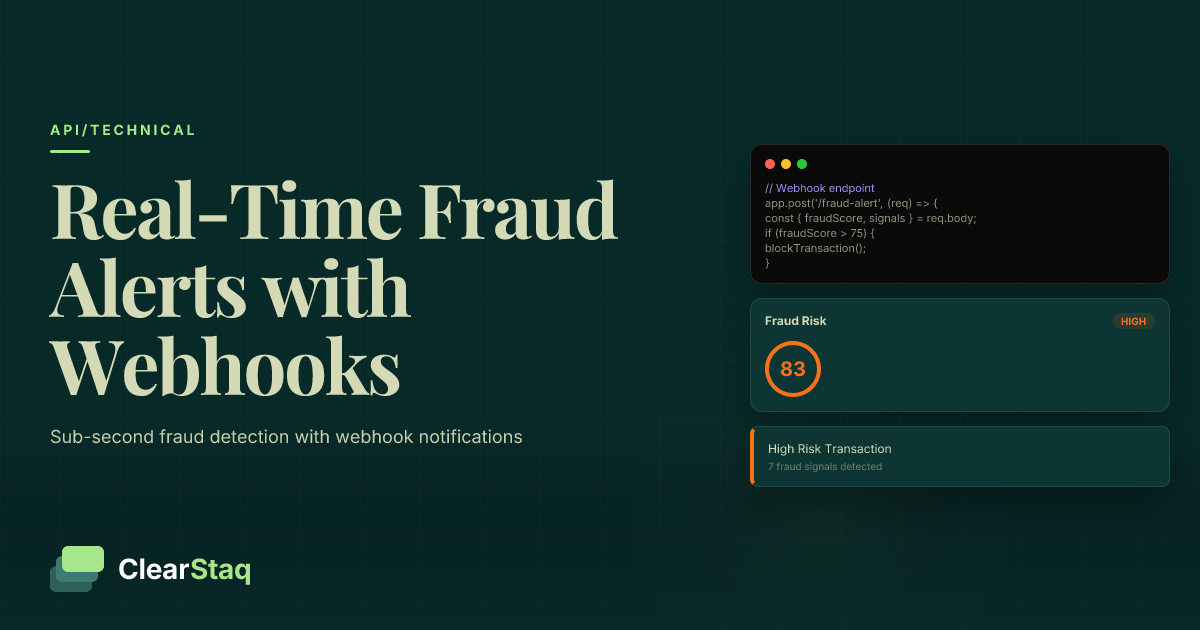
Real-time fraud alerts APIs use webhooks to instantly screen bank statements and notify applications when fraud is detected. ClearStaq's system analyzes 27 fraud signals in under one second, sending webhook notifications with detailed fraud scores and signal breakdowns to enable immediate risk assessment and decision-making.
What you'll learn
- Real-time fraud alerts deliver results in under one second versus hours for batch processing
- Webhooks push fraud notifications instantly, eliminating polling delays and reducing system load by 99%
- ClearStaq analyzes 27 fraud signals simultaneously for comprehensive bank statement screening
- Webhook payloads include fraud scores, confidence levels, and detailed evidence for immediate risk assessment
- Real-time detection prevents fraudulent loan approvals during the critical vulnerability window
Real-time fraud alerts APIs use webhooks to instantly screen bank statements and notify applications when fraud is detected. ClearStaq's system analyzes 27 fraud signals in under one second, sending webhook notifications with detailed fraud scores and signal breakdowns to enable immediate risk assessment and decision-making.
What Are Real-Time Fraud Alerts?
Real-time fraud alerts are instant notifications sent when fraud is detected in financial documents. Unlike traditional batch processing that can take hours or days to identify fraudulent bank statements, real-time systems analyze documents immediately upon upload and trigger alerts within seconds.
The cost of delayed fraud detection in lending is staggering. The Association of Certified Fraud Examiners reports that organizations lose 5% of their revenue to fraud annually. For MCA companies and alternative lenders, a single fraudulent bank statement can result in losses ranging from $25,000 to $500,000 per loan.
Real-time fraud alerts consist of two key components: a detection engine that analyzes documents for fraud detection signals, and a notification system that instantly delivers results to your application. This combination enables immediate risk assessment and decision-making during the underwriting process.
The Evolution from Batch to Real-Time
Traditional batch processing fraud detection operates on scheduled intervals, checking documents every few hours or overnight. This delay creates a window of vulnerability where fraudulent applications can slip through before detection occurs.
Real-time detection eliminates this vulnerability by analyzing documents the moment they're submitted. Modern systems can process bank statements and identify fraud patterns in under one second, allowing lenders to make instant decisions about application risk.
Use Cases for Instant Fraud Alerts
Instant fraud alerts are particularly valuable in high-volume lending scenarios. MCA underwriters can automatically flag suspicious applications before manual review, preventing fraudulent loans from advancing through the pipeline.
Loan application processing benefits from immediate fraud screening, allowing lenders to request additional documentation or decline applications in real-time. Document verification workflows can trigger alerts for altered PDFs, manipulated transactions, or suspicious formatting patterns instantly.
How Webhooks Enable Instant Fraud Detection
Webhooks are the delivery mechanism that makes real-time fraud alerts possible. Instead of your application repeatedly polling an API to check for results (pull model), webhooks push notifications directly to your system the moment fraud is detected.
Event-driven architecture forms the backbone of webhook-based fraud detection. When a document is uploaded, it triggers a processing event. The fraud detection engine analyzes the document, and upon completion, fires a webhook event containing the fraud assessment results.
The webhook payload structure includes comprehensive fraud data: overall fraud scores, individual signal breakdowns, confidence levels, and specific evidence details. This rich data enables sophisticated integration with existing underwriting workflows and automated decision engines.
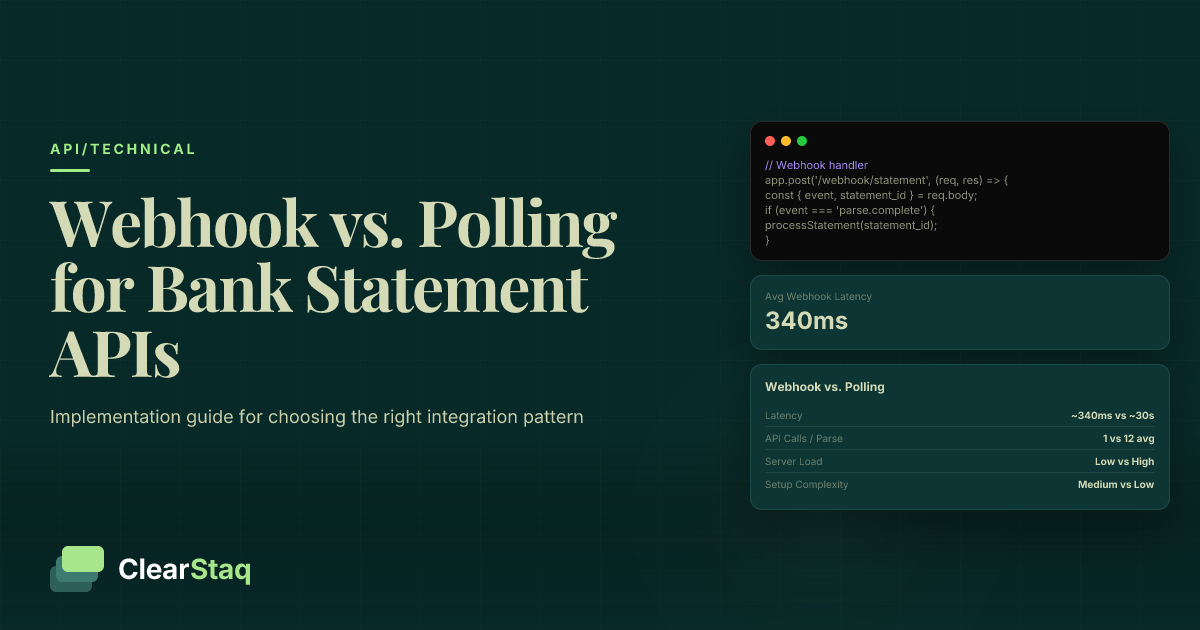
Webhook vs Polling: Why Push Notifications Win
Latency comparison reveals webhooks' significant advantage. Polling-based systems typically check for results every 30-60 seconds, creating potential delays of up to one minute. Webhooks deliver results in under 100 milliseconds from detection completion.
Resource efficiency favors webhooks dramatically. Polling requires continuous API calls whether results are ready or not, consuming bandwidth and API rate limits. Webhooks only fire when there's actual data to deliver, reducing system load by up to 99%.
Real-time guarantees are only possible with push notifications. Webhooks ensure your system receives fraud alerts the instant they're available, enabling true real-time risk assessment and immediate response capabilities.
Event-Driven Fraud Detection Architecture
Document upload triggers initiate the fraud detection pipeline. When a bank statement is submitted via API, the system immediately queues it for processing while returning a tracking ID for status monitoring.
The processing pipeline analyzes 27 different fraud signals simultaneously, checking for PDF manipulation, transaction anomalies, formatting inconsistencies, and metadata tampering. This parallel processing enables sub-second analysis completion.
Alert dispatch occurs immediately upon processing completion. The system constructs a detailed webhook payload containing all fraud findings and delivers it to your configured endpoint via secure HTTPS POST request.
Setting Up Real-Time Bank Statement Screening
API configuration for fraud detection begins with endpoint setup. Configure your fraud detection parameters, including sensitivity thresholds, specific signal types to monitor, and alert triggers that match your risk tolerance.
Webhook endpoint setup requires a secure HTTPS URL that can receive POST requests. Your endpoint should be designed to handle rapid-fire notifications during high-volume periods and implement proper error handling for failed deliveries.
Testing your integration starts with sample documents containing known fraud patterns. Use test bank statements with intentional alterations to verify your webhook receives proper notifications and your application processes them correctly.
Configuring Fraud Detection Parameters
Fraud score thresholds determine when alerts are triggered. Set your threshold based on risk tolerance: scores above 70 typically indicate high fraud probability, while scores between 40-70 suggest moderate risk requiring additional review.
Signal sensitivity settings allow fine-tuning of individual fraud detection components. You can adjust sensitivity for specific signals like font consistency checking, balance calculation verification, or transaction pattern analysis based on your portfolio's characteristics.
Alert filtering options help prevent notification fatigue. Configure filters to only receive alerts for specific fraud types, score ranges, or document categories relevant to your underwriting workflow.
Webhook Security Best Practices
HTTPS requirements are non-negotiable for fraud alert webhooks. All webhook endpoints must use SSL/TLS encryption to protect sensitive fraud data during transmission. Configure your server to reject any non-HTTPS webhook attempts.
Signature verification ensures webhook authenticity. Implement HMAC signature validation using your secret key to verify that webhook requests actually originate from the fraud detection system and haven't been tampered with in transit.
IP whitelisting provides an additional security layer. Configure your firewall to only accept webhook requests from approved IP ranges, preventing potential spoofing attempts or unauthorized access to your fraud alert endpoint.
{
  "status": "success",
  "fraud_score": 57,
  "transactions": 47,
  "bank": "Chase",
  "processing_time_ms": 238
}Ready to implement real-time fraud detection?
Explore our ClearStaq API documentation to see webhook examples and start your integration.
Understanding Fraud Alert Payloads
Webhook payloads for fraud alerts contain comprehensive fraud assessment data structured for immediate actionability. The payload includes overall fraud scores, confidence levels, individual signal breakdowns, and detailed evidence for detected fraud indicators.
Document metadata accompanies fraud assessment data, providing context about the analyzed file. This includes original filename, file size, page count, bank format detected, and processing timestamp for audit trail purposes.
The payload structure follows JSON format with nested objects for different fraud categories. Signal groups include document integrity, transaction analysis, formatting consistency, and metadata examination, each containing specific findings and scores.
Fraud Score and Confidence Metrics
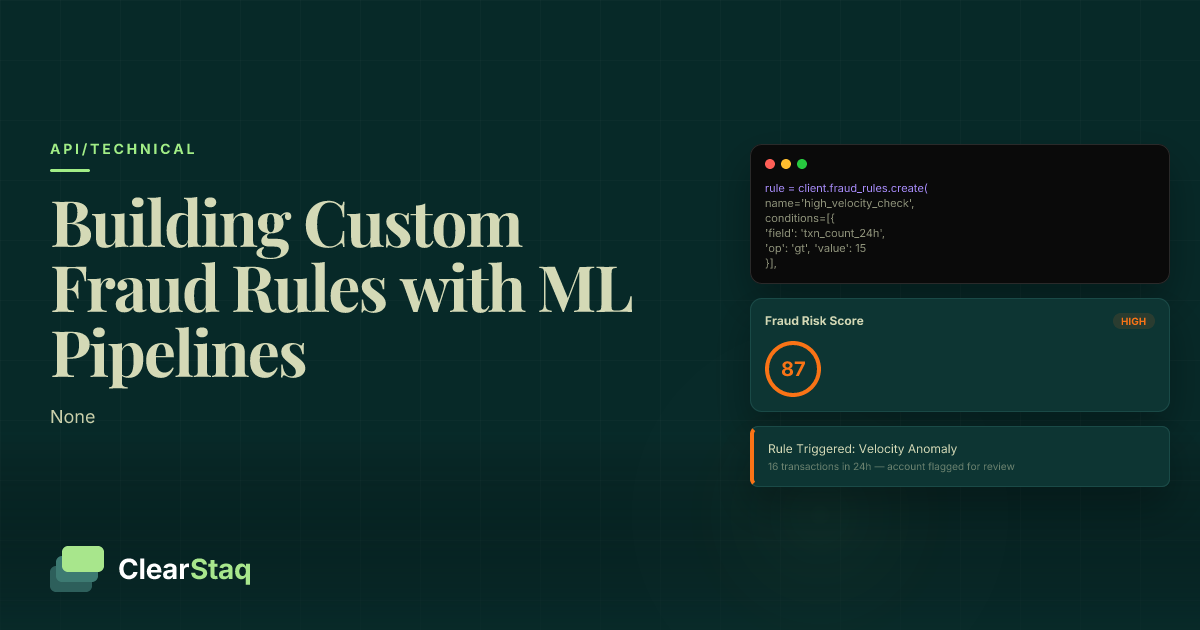
The fraud score ranges from 0-100, where 0 indicates no fraud detected and 100 represents definitive fraud evidence. Scores above 70 typically warrant immediate attention, while scores between 40-70 suggest moderate risk requiring human review.
Confidence levels accompany each score, indicating the system's certainty in its assessment. High confidence (95%+) scores enable automated decision-making, while lower confidence scores may require additional verification or manual review.
Risk categorization translates numeric scores into business-friendly labels: "Low Risk" (0-30), "Moderate Risk" (31-69), "High Risk" (70-89), and "Critical Risk" (90-100). These categories align with typical underwriting workflows and decision thresholds.
27 Fraud Signals in the Payload
Individual signal breakdown provides granular insight into specific fraud indicators detected. The webhook payload includes scores for all 27 fraud detection signals, enabling detailed analysis of document authenticity.
Signal categories organize findings into logical groups: PDF manipulation detection, font consistency analysis, transaction pattern verification, balance calculation checking, and metadata examination. Each category contains multiple specific signals with individual scores and evidence.
| Signal Category | Signals Included | Detection Focus |
|---|---|---|
| Document Integrity | 8 signals | PDF manipulation, font consistency, layout analysis |
| Transaction Analysis | 12 signals | Pattern detection, amount verification, timing analysis |
| Formatting Consistency | 4 signals | Bank format validation, structure verification |
| Metadata Examination | 3 signals | Creation details, software fingerprints |
Evidence details accompany each signal score, providing specific information about detected anomalies. This might include exact pixel differences in fonts, transaction amounts that don't match running balances, or metadata inconsistencies that suggest document alteration.
Real-Time vs Batch Processing: The Speed Advantage
Latency comparison reveals the dramatic difference between real-time and batch fraud detection. Real-time systems deliver results in under one second, while batch processing can take 4-24 hours depending on scheduling intervals and processing queue length.
Customer experience improves significantly with instant fraud detection. Real-time alerts enable immediate application decisions, reducing customer waiting times from hours to seconds. This speed improvement can increase conversion rates by 15-25% for legitimate applications.
The impact on fraud prevention is substantial. Real-time detection closes the window of vulnerability where fraudulent applications might be approved before batch processing identifies them. Every minute of delay increases potential fraud exposure.
Performance Benchmarks
ClearStaq's sub-second response times consistently deliver fraud assessments in under 800 milliseconds for standard bank statements. Complex multi-page documents with extensive transaction histories complete analysis within 1.2 seconds.
Industry comparisons show significant performance advantages for AI-powered fraud detection systems. Traditional rule-based systems require 5-30 seconds per document, while machine learning approaches achieve sub-second processing speeds.
Scalability metrics demonstrate that modern fraud detection APIs can handle thousands of concurrent documents without performance degradation. Horizontal scaling enables processing of 10,000+ documents per hour while maintaining sub-second response times.
Business Impact of Speed
Fraud prevention windows shrink dramatically with delayed detection. A fraudulent application approved due to slow batch processing can result in immediate fund disbursement, making recovery nearly impossible. Real-time detection prevents this scenario entirely.
Customer satisfaction correlates directly with application processing speed. Instant fraud screening enables same-day loan decisions, improving customer experience and competitive positioning in fast-moving markets like MCA lending.
Operational efficiency gains from real-time fraud alerts include reduced manual review time, fewer false positives requiring investigation, and streamlined underwriting workflows. Teams can focus on legitimate applications while automated systems handle obvious fraud cases.
Security and Reliability Considerations
Webhook delivery guarantees ensure fraud alerts reach your system reliably. Modern webhook systems implement exponential backoff retry mechanisms, attempting delivery multiple times over increasing intervals if initial requests fail.
Data encryption protects sensitive fraud information during transmission. All webhook payloads use TLS 1.2+ encryption, and sensitive data within payloads can be additionally encrypted using field-level encryption for maximum security.
System uptime requirements for fraud detection are critical in lending operations. Look for providers offering 99.9%+ uptime SLAs with automated failover mechanisms to backup processing centers during outages.
Webhook Delivery Reliability
Retry mechanisms handle temporary endpoint unavailability gracefully. Standard retry policies attempt delivery up to 5 times over 24 hours using exponential backoff: immediate, 1 minute, 10 minutes, 1 hour, and 6 hours later.
Dead letter queues capture webhooks that fail all retry attempts, preventing data loss. Failed webhooks are stored for manual review and redelivery once endpoint issues are resolved, ensuring no fraud alerts are permanently lost.
Delivery confirmations provide visibility into webhook success rates. Monitor delivery metrics to identify endpoint issues early and ensure your fraud alert pipeline maintains optimal performance.
Data Privacy and Compliance
PII handling in fraud alerts requires careful attention to privacy regulations. Webhook payloads should minimize personally identifiable information, focusing on fraud indicators rather than raw financial data when possible.
Data retention policies govern how long fraud detection results are stored. Implement appropriate retention schedules aligned with business needs and regulatory requirements, typically 7-10 years for financial services.
Regulatory compliance includes adherence to SOC2 compliance standards, GDPR requirements where applicable, and industry-specific regulations like PCI DSS for payment-related fraud detection systems.
Implementation Best Practices
Webhook endpoint design patterns should follow idempotency principles, handling duplicate deliveries gracefully. Implement proper request validation, response codes, and processing acknowledgment to ensure reliable fraud alert handling.
Error handling and monitoring are essential for production fraud detection systems. Log all webhook deliveries, track processing times, and implement alerting for failed deliveries or processing errors that could impact fraud detection coverage.
Load balancing distributes high-volume fraud detection across multiple processing endpoints. Implement queue management and rate limiting to handle traffic spikes during busy application periods without overwhelming your systems.
Monitoring and Alerting
Webhook delivery tracking provides operational visibility into your fraud detection pipeline. Monitor delivery success rates, response times, and error patterns to identify issues before they impact business operations.
Performance monitoring should track end-to-end fraud detection latency, from document upload through webhook delivery. Set alerting thresholds for response times exceeding your service level agreements.
Alert fatigue prevention requires thoughtful configuration of fraud detection thresholds. Tune your settings to balance fraud detection sensitivity with operational workload, preventing notification overload that can reduce response effectiveness.
Scaling for High Volume
Queue management becomes critical during high-volume periods like application rushes or seasonal lending peaks. Implement proper queue sizing, prioritization, and overflow handling to maintain performance under load.
Rate limiting protects both your systems and the fraud detection API from overload. Configure appropriate request rates based on your processing capacity and API provider limits to ensure consistent performance.
Load distribution across multiple webhook endpoints enables horizontal scaling of fraud alert processing. Use load balancers to distribute webhook deliveries across multiple servers for improved reliability and performance.
How ClearStaq Delivers Real-Time Fraud Alerts
ClearStaq's fraud detection engine analyzes all 27 fraud signals in parallel, completing comprehensive bank statement screening in under one second. This speed enables true real-time risk assessment during application processing workflows.
Support for 900+ bank formats ensures comprehensive fraud detection across your entire applicant base. The system recognizes format-specific fraud patterns and adapts detection algorithms accordingly, maintaining accuracy across diverse bank statement types.
Detailed webhook payloads provide actionable fraud intelligence with specific evidence for detected indicators. Each alert includes fraud scores, confidence levels, individual signal breakdowns, and evidence details needed for immediate risk assessment.
ClearStaq's Fraud Detection Speed
Sub-second processing is achieved through optimized algorithms and parallel signal analysis. The system processes multiple fraud detection signals simultaneously rather than sequentially, dramatically reducing total analysis time.
Parallel signal analysis examines document integrity, transaction patterns, formatting consistency, and metadata simultaneously. This approach enables comprehensive fraud detection without compromising speed performance.
Optimized algorithms leverage machine learning models trained specifically on bank statement fraud patterns. These models identify suspicious indicators faster and more accurately than traditional rule-based systems.
Integration Examples
MCA underwriting workflows benefit from instant fraud screening that flags suspicious applications before manual review. Underwriters receive immediate notifications about high-risk documents, enabling efficient resource allocation.
Automated decision engines can incorporate real-time fraud scores into lending algorithms, automatically declining applications with fraud scores above defined thresholds or routing them for enhanced due diligence.
Risk scoring systems integrate fraud detection results with other risk factors to calculate comprehensive applicant scores. Real-time fraud alerts enable dynamic risk assessment that adapts to new fraud patterns as they emerge.
Integration with existing underwriting workflow systems is straightforward using webhook notifications. The ClearStaq API platform provides comprehensive documentation and examples for rapid implementation.
Frequently Asked Questions
How fast are real-time fraud alerts?
ClearStaq's real-time fraud alerts are delivered in under one second. The system analyzes 27 fraud signals simultaneously and sends webhook notifications immediately when fraud is detected, enabling instant risk assessment.
What data is included in a fraud alert webhook?
Fraud alert webhooks include the overall fraud score (0-100), confidence level, breakdown of all 27 individual fraud signals with scores, document metadata, and specific evidence details for detected fraud indicators.
How reliable are webhook fraud notifications?
ClearStaq webhooks include delivery guarantees with automatic retries, dead letter queues for failed deliveries, and delivery confirmations. The system maintains 99.9% uptime with enterprise-grade reliability.
Can real-time fraud alerts integrate with existing underwriting systems?
Yes. Real-time fraud alerts via webhooks can integrate with any system that accepts HTTP POST requests. Common integrations include underwriting platforms, loan management systems, and automated decision engines.
What security measures protect fraud alert webhooks?
Webhooks use HTTPS encryption, signature verification for authenticity, IP whitelisting, and comply with SOC2 standards. All fraud data is encrypted in transit and PII is handled according to privacy regulations.
Stop waiting hours for fraud results
ClearStaq's real-time fraud alerts give you instant protection with sub-second response times. Start your free trial today.
Frequently Asked Questions
How fast are real-time fraud alerts?
ClearStaq's real-time fraud alerts are delivered in under one second. The system analyzes 27 fraud signals simultaneously and sends webhook notifications immediately when fraud is detected, enabling instant risk assessment.
What data is included in a fraud alert webhook?
Fraud alert webhooks include the overall fraud score (0-100), confidence level, breakdown of all 27 individual fraud signals with scores, document metadata, and specific evidence details for detected fraud indicators.
How reliable are webhook fraud notifications?
ClearStaq webhooks include delivery guarantees with automatic retries, dead letter queues for failed deliveries, and delivery confirmations. The system maintains 99.9% uptime with enterprise-grade reliability.
Can real-time fraud alerts integrate with existing underwriting systems?
Yes. Real-time fraud alerts via webhooks can integrate with any system that accepts HTTP POST requests. Common integrations include underwriting platforms, loan management systems, and automated decision engines.
What security measures protect fraud alert webhooks?
Webhooks use HTTPS encryption, signature verification for authenticity, IP whitelisting, and comply with SOC2 standards. All fraud data is encrypted in transit and PII is handled according to privacy regulations.
ClearStaq Team
Engineering Team
The ClearStaq team builds AI-powered tools for bank statement parsing, fraud detection, and income verification.