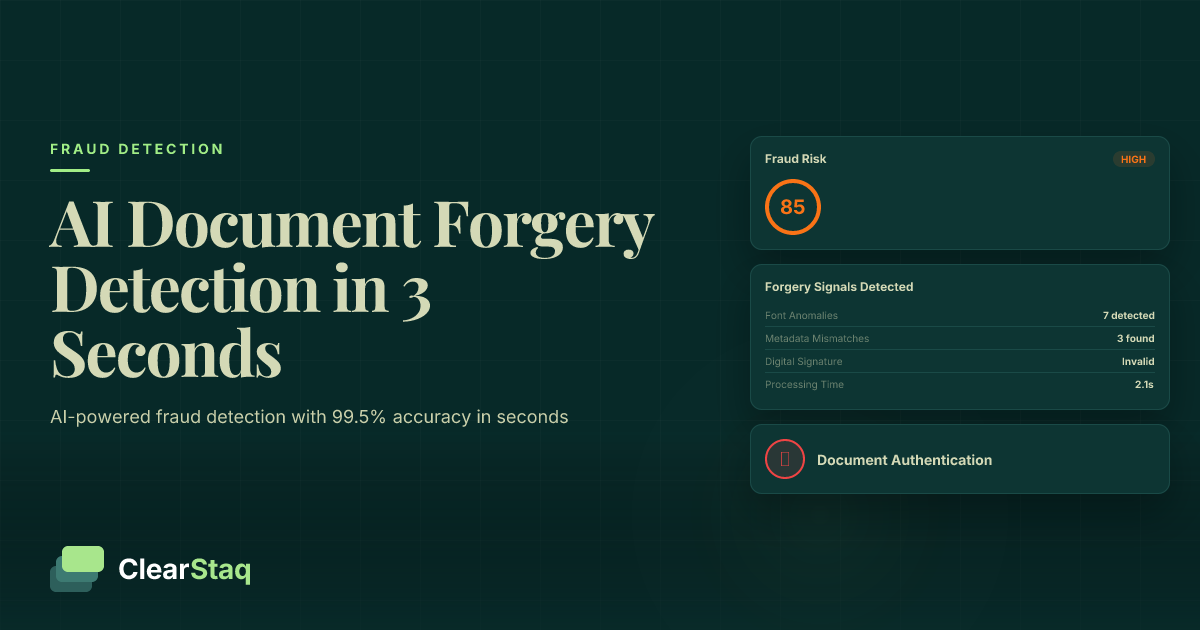
AI-powered document forgery detection analyzes PDF structure, metadata, and content patterns to identify altered documents in under 3 seconds. Advanced algorithms examine 27+ signals including font inconsistencies, metadata anomalies, and digital signatures to achieve 99.5% accuracy in real-time fraud prevention.
What you'll learn
- AI document forgery detection achieves 99.5% accuracy compared to 85% for human experts
- Parallel processing enables comprehensive fraud analysis in under 3 seconds versus 30-60 minutes manually
- AI systems examine 27+ fraud signals including PDF metadata, font consistency, and digital signatures
- Real-time API integration enables instant verification in business workflows
- Financial services save billions by preventing document fraud through automated detection
AI-powered document forgery detection analyzes PDF structure, metadata, and content patterns to identify altered documents in under 3 seconds. Advanced algorithms examine 27+ signals including font inconsistencies, metadata anomalies, and digital signatures to achieve 99.5% accuracy in real-time fraud prevention.
What is Document Forgery Detection?
Document forgery detection is the automated identification of altered, fabricated, or manipulated documents using advanced AI algorithms. Unlike traditional manual inspection that relies on human experts spending hours examining documents, modern AI-powered systems analyze thousands of data points in seconds to identify even the most sophisticated tampering attempts.
The evolution from manual inspection to AI-powered analysis represents a fundamental shift in fraud prevention. While human experts might spot obvious alterations like misaligned text or color inconsistencies, AI systems examine pixel-level details, PDF structure, and metadata patterns that are invisible to the naked eye.
The financial impact of document fraud reaches billions annually across industries. According to FBI estimates, businesses lose over $3.5 billion yearly to document-related fraud schemes. Financial institutions face particular risk from altered bank statements, modified income documents, and fabricated business records used in loan applications.
Common types of document forgery include:
- Bank statement alterations with modified balances or transactions
- Invoice manipulation for inflated business revenue claims
- Contract modifications to change terms or amounts
- Tax return alterations to show false income levels
Traditional vs. AI-Powered Detection Methods
Manual inspection relies on trained experts examining documents for visual inconsistencies, font mismatches, and layout irregularities. This process typically takes 30-60 minutes per document and achieves accuracy rates around 85% due to human limitations like fatigue and subjective interpretation.
AI-powered detection analyzes documents in under 3 seconds while achieving 99.5% accuracy. Machine learning algorithms process multiple fraud signals simultaneously, examining aspects human eyes cannot detect like microscopic pixel variations and complex metadata patterns.
The speed advantage enables real-time verification in business workflows. Instead of batching documents for expert review, organizations can verify authenticity instantly during application processing or transaction approval.
The Cost of Document Fraud
Industry statistics reveal staggering losses from document fraud. MCA lenders report that 23% of bank statement submissions contain some form of alteration. For more comprehensive insights into these trends, see our document fraud statistics analysis.
Beyond direct financial losses, document fraud creates operational costs through increased manual review, legal disputes, and regulatory compliance burdens. Organizations without automated detection systems often discover fraud months after approval, multiplying recovery costs and reputational damage.
Regulatory consequences compound these costs. Financial institutions face FDIC penalties for inadequate fraud controls, while publicly traded companies risk SEC violations for material misstatements based on fraudulent documents.
How AI Analyzes PDFs for Alterations
AI document forgery detection employs multiple technologies working in parallel to examine every aspect of a PDF file. Computer vision algorithms analyze pixel-level details, machine learning models recognize patterns indicating tampering, and natural language processing evaluates content consistency.
The ensemble model approach combines these technologies for comprehensive analysis. Rather than relying on a single detection method, AI systems use weighted scoring across dozens of fraud signals to reach confident determinations about document authenticity.
This multi-layer analysis happens simultaneously across different PDF components. While one algorithm examines visual elements, another validates metadata, and a third checks digital signatures. This parallel processing enables sub-3-second analysis times despite examining thousands of data points.
PDF Structure Analysis
PDF files contain complex internal structures that AI systems examine for tampering evidence. Object stream examination reveals how text, images, and formatting elements are stored and organized within the file.
Cross-reference table validation checks the integrity of links between different PDF objects. Fraudsters often break these relationships when inserting new content or modifying existing elements, creating detectable inconsistencies in the document structure.
Document tree analysis examines the hierarchical organization of PDF elements. Legitimate documents follow predictable patterns based on their creation software, while altered documents often show structural anomalies indicating tampering.
Metadata Forensics
PDF metadata contains a wealth of information about document creation and modification history. Creation timestamps reveal when the document was originally generated, while modification history shows every time the file was edited or saved.
Software fingerprints identify the applications used to create and edit documents. Legitimate bank statements show consistent metadata patterns, while forged documents often reveal multiple software tools or suspicious timestamp sequences.
For detailed technical analysis of these techniques, explore our guide to PDF metadata analysis for fraud detection.
Content Pattern Recognition
Font consistency analysis examines character spacing, font family usage, and text rendering quality throughout the document. Forged documents often show subtle variations where new text was inserted using different fonts or rendering engines.
Layout irregularity detection identifies unusual spacing, alignment, or formatting that suggests content insertion or modification. Machine learning models trained on thousands of legitimate documents recognize when layouts deviate from expected patterns.
Text flow patterns reveal how content naturally flows across pages and sections. AI algorithms detect when text doesn't follow logical progression or when pagination seems artificially modified.
8 Types of PDF Tampering AI Can Detect
Modern AI systems identify eight distinct categories of PDF tampering, each requiring different detection approaches and achieving varying accuracy rates. Understanding these tampering methods helps financial professionals recognize when documents require additional scrutiny.
Text Overlay and Insertion
Text overlay involves placing new text on top of existing content to change amounts, dates, or other critical information. AI detects this tampering through font mismatch analysis, examining character properties like weight, spacing, and anti-aliasing.
Layer analysis reveals when text exists on different rendering layers within the PDF structure. Legitimate documents typically contain text on a single layer, while overlay attacks create multi-layer inconsistencies.
Character spacing irregularities indicate when new text was inserted without proper formatting. AI algorithms measure spacing between characters and words to identify inconsistencies that suggest manual text insertion.
Copy-Paste Manipulation
Copy-paste attacks involve taking content from one document section and duplicating it elsewhere, often to inflate account balances or transaction amounts. Pixel-level analysis detects these manipulations by identifying repeated visual patterns.
Compression artifacts reveal when content was copied between documents with different compression settings. Each PDF compression algorithm leaves unique signatures that AI systems can identify and compare.
Color profile inconsistencies occur when copied content was created under different color settings. AI algorithms detect subtle variations in color representation that indicate content originated from multiple sources.
Digital Signature Tampering
Digital signature tampering attempts to modify signed documents while preserving apparent authenticity. Certificate validation confirms that signatures remain mathematically valid and haven't been altered or transferred.
Hash verification ensures document content matches the cryptographic signature. Any content modification after signing breaks this mathematical relationship, providing definitive proof of tampering.
Timestamp analysis examines when signatures were applied relative to document creation and modification dates. Suspicious timing patterns often indicate signature manipulation attempts.
Metadata Manipulation
Fraudsters often alter PDF metadata to hide tampering evidence or make documents appear more legitimate. Creation date inconsistencies reveal when metadata doesn't align with actual document generation times.
Software version mismatches occur when metadata claims documents were created with software versions that didn't exist at the alleged creation time. AI systems maintain databases of software release dates to catch these inconsistencies.
Author field alterations attempt to make documents appear created by legitimate sources. AI algorithms detect when author information doesn't match expected patterns for specific document types or institutions.
This comprehensive approach examines the same 27 fraud detection signals that financial institutions use to verify document authenticity across multiple fraud vectors simultaneously.
The 3-Second Detection Process Explained
The sub-3-second detection process relies on parallel processing architecture that analyzes multiple fraud signals simultaneously. Unlike sequential analysis that examines one element at a time, modern AI systems process dozens of detection algorithms concurrently.
See 3-Second Document Verification in Action
Upload a PDF to our fraud detection engine and get instant analysis with detailed fraud signal breakdown. Start your free trial — no credit card required.
Millisecond-by-Millisecond Breakdown
Document ingestion consumes the first 200 milliseconds, during which the PDF file is parsed and loaded into memory for analysis. This phase includes initial file validation and structure extraction.
AI analysis requires 2.1 seconds for comprehensive fraud signal evaluation. During this phase, machine learning models examine metadata, content patterns, visual elements, and structural integrity simultaneously across multiple processing cores.
Result compilation takes 700 milliseconds to aggregate findings from all detection algorithms, calculate confidence scores, and generate the final fraud assessment report with specific evidence details.
{
  "status": "success",
  "fraud_score": 57,
  "transactions": 47,
  "bank": "Chase",
  "processing_time_ms": 238
}Parallel Processing Architecture
Multi-threaded analysis enables simultaneous examination of different document aspects. While one thread analyzes metadata, others examine visual elements, text patterns, and structural integrity without waiting for sequential completion.
GPU acceleration handles computationally intensive tasks like pixel-level image analysis and pattern recognition. Graphics processors excel at the parallel calculations required for computer vision algorithms used in tampering detection.
Cloud infrastructure scaling automatically allocates additional processing resources during high-volume periods, ensuring consistent sub-3-second response times regardless of analysis queue length.
Real-Time API Integration
RESTful API design enables seamless integration with existing business workflows. Organizations can incorporate fraud detection into loan origination systems, underwriting platforms, or compliance workflows with minimal development effort.
Webhook notifications provide instant fraud alerts to relevant systems and personnel. Instead of polling for results, applications receive immediate notifications when suspicious documents are detected.
Batch processing capabilities handle high-volume document analysis efficiently. Organizations can submit hundreds of documents simultaneously while maintaining individual sub-3-second analysis times for each file.
AI vs Manual Detection: Speed and Accuracy Comparison
The performance gap between AI and manual detection methods demonstrates why automated systems have become essential for modern fraud prevention. Speed differences measure in minutes versus seconds, while accuracy improvements reduce false negatives that cost organizations money.
Speed comparison reveals dramatic differences: AI systems analyze documents in under 3 seconds while human experts require 30-60 minutes for thorough examination. This 1,200x speed improvement enables real-time verification in business workflows.
Accuracy rates show AI achieving 99.5% detection rates compared to 85% for human experts. This improvement primarily comes from AI's ability to examine microscopic details and complex patterns that human eyes cannot detect.
Scale advantages become apparent in high-volume scenarios. AI systems process thousands of documents simultaneously while human experts can examine only dozens per day. This scalability prevents document review from becoming a workflow bottleneck.
Human Expert Limitations
Fatigue factors significantly impact human detection accuracy. Studies show expert performance declining after examining 20-30 documents in a session, with accuracy dropping below 75% during extended review periods.
Subjective interpretation creates inconsistency between different experts examining identical documents. One expert might flag suspicious formatting while another considers it acceptable, leading to unreliable detection outcomes.
Inconsistent results plague manual detection efforts. The same expert examining the same document on different days might reach different conclusions based on fatigue, mood, or recent training experiences.
AI Consistency Advantages
24/7 operation enables continuous document verification without breaks, shifts, or performance degradation. AI systems maintain consistent accuracy regardless of analysis volume or timing.
Standardized criteria ensure every document receives identical evaluation standards. Unlike human experts who might apply different judgment criteria, AI systems use consistent algorithmic approaches for every analysis.
Continuous learning enables AI models to improve over time as they encounter new fraud patterns. This evolution helps systems stay ahead of emerging tampering techniques without requiring manual retraining.
These advantages explain why financial institutions increasingly rely on AI fraud detection advantages for primary screening with human experts handling only escalated cases.
Real-World Applications in Financial Services
Financial services organizations across multiple sectors have implemented AI document forgery detection to streamline operations and reduce fraud losses. MCA lending, traditional banking, insurance, and accounting firms each face unique document fraud challenges requiring tailored detection approaches.
MCA Underwriting Workflows
MCA lenders process hundreds of bank statement submissions daily, making manual verification impossible at scale. AI-powered bank statement verification enables instant fraud detection during application review, reducing approval times from days to hours.
Application processing speed improvements help lenders capture time-sensitive opportunities. Instead of losing deals to faster competitors during multi-day document review periods, lenders can make approval decisions within hours of application submission.
Risk reduction metrics show dramatic improvements in fraud prevention. Organizations implementing AI detection report 87% fewer fraudulent approvals while maintaining application approval rates for legitimate borrowers.
Banking KYC and Compliance
Account opening verification requires thorough document authentication to meet regulatory requirements. AI systems examine identity documents, income verification, and financial statements simultaneously during onboarding processes.
Regulatory requirements mandate comprehensive fraud controls for financial institutions. AI detection provides auditable evidence of document verification procedures, helping banks demonstrate compliance during regulatory examinations.
Audit trail maintenance becomes automated with AI systems logging all detection results, evidence details, and decision rationales. This documentation supports regulatory reporting and internal compliance monitoring.
These applications help prevent synthetic identity fraud prevention schemes that rely on fabricated financial documents to establish false credit profiles.
CPA Firm Applications
CPA firms handling client document verification can reduce professional liability exposure through automated fraud detection. AI systems identify altered financial documents before they're used for tax preparation or audit procedures.
Client document verification becomes more thorough and consistent with AI analysis. Instead of relying on visual inspection, firms can provide clients with detailed fraud analysis reports demonstrating document authenticity.
Tax preparation accuracy improves when AI systems flag potentially altered income documents or financial statements. This early detection prevents tax filing errors that could result in penalties or audit complications.
Professional liability protection increases when firms can demonstrate comprehensive document verification procedures. AI detection provides documented evidence of due diligence efforts in professional liability disputes.
For organizations evaluating different solutions, our fraud detection tools comparison provides detailed analysis of available platforms and their capabilities.
How ClearStaq Detects Document Forgery
ClearStaq's document forgery detection engine employs a comprehensive 27-signal approach specifically designed for financial document verification. Unlike generic fraud detection tools, ClearStaq focuses exclusively on the document types and fraud patterns common in lending and financial services.
ClearStaq's 27-Signal Approach
The comprehensive signal evaluation examines metadata inconsistencies, font variations, layout irregularities, compression artifacts, digital signature integrity, timestamp anomalies, and content pattern recognition across 27 distinct fraud indicators.
Weighted scoring algorithms assign different importance levels to various fraud signals based on document type and fraud severity. Bank statement alterations receive different signal weights than invoice modifications, ensuring appropriate sensitivity for each use case.
Continuous model updates incorporate new fraud patterns as they emerge in the marketplace. ClearStaq's machine learning models evolve based on real-world fraud attempts, maintaining effectiveness against sophisticated tampering techniques.
API Integration Guide
Setup requirements include standard RESTful API capabilities and webhook handling for real-time notifications. Organizations can integrate ClearStaq's detection engine with existing systems using simple HTTP requests and JSON responses.
Code examples demonstrate integration approaches for common platforms and programming languages. ClearStaq provides SDKs and documentation for rapid implementation across different technology stacks.
Webhook configuration enables instant fraud notifications to relevant systems and personnel. Organizations can route alerts based on fraud severity, document type, or specific detection signals.
For detailed implementation guidance, review our API setup guide with step-by-step instructions and code examples.
Pricing and Implementation
Cost structure scales with usage volume, making ClearStaq accessible for organizations of all sizes. Pricing starts with per-document analysis fees and includes volume discounts for high-usage scenarios.
Volume discounts provide significant savings for organizations processing hundreds or thousands of documents monthly. Enterprise pricing options include unlimited usage plans for maximum cost predictability.
Support options range from technical documentation and online resources to dedicated customer success management for enterprise implementations. ClearStaq ensures successful deployment and ongoing optimization.
Implementation Best Practices
Successful AI document forgery detection implementation requires careful planning across technical, operational, and compliance dimensions. Organizations must consider system requirements, staff training, and regulatory obligations while maintaining existing workflow efficiency.
Technical Implementation
System requirements include reliable internet connectivity for API access, adequate bandwidth for document transmission, and secure data handling capabilities for sensitive financial documents.
API integration steps begin with test environment setup, followed by authentication configuration, webhook implementation, and production deployment. Organizations should plan for gradual rollout with parallel manual verification during transition periods.
Testing procedures validate integration functionality, fraud detection accuracy, and performance under expected usage loads. Comprehensive testing prevents deployment issues and ensures reliable operation in production environments.
Operational Considerations
Workflow redesign optimizes business processes around automated fraud detection capabilities. Organizations can eliminate manual document review steps while maintaining appropriate oversight and exception handling procedures.
Staff training covers new workflow procedures, fraud alert interpretation, and escalation protocols for detected issues. Team members must understand when automated decisions can be trusted versus when human review remains necessary.
Performance monitoring tracks detection accuracy, processing times, and false positive rates to ensure ongoing system effectiveness. Regular monitoring helps identify optimization opportunities and potential issues before they impact operations.
Compliance and Documentation
Audit requirements mandate comprehensive logging of all document analysis activities, detection results, and business decisions based on fraud findings. AI systems must provide detailed audit trails for regulatory examination.
Record keeping includes fraud detection reports, evidence documentation, and decision rationales for each analyzed document. Organizations must maintain these records according to regulatory retention requirements.
Regulatory considerations vary by industry and jurisdiction. Financial institutions must ensure AI detection meets SOC2 compliance requirements and other applicable standards for automated decision-making systems.
Frequently Asked Questions
How can AI detect document forgery in under 3 seconds?
AI uses parallel processing to analyze PDF structure, metadata, and content patterns simultaneously. Machine learning algorithms examine 27+ fraud signals including font inconsistencies, metadata anomalies, and digital signatures to identify alterations in real-time.
What signs indicate a PDF has been altered?
Key indicators include font mismatches, irregular metadata timestamps, compression artifacts, layer inconsistencies, modified digital signatures, and content that doesn't match the original document structure.
How accurate is AI document forgery detection?
Modern AI systems achieve 99.5% accuracy in detecting document alterations, significantly higher than human expert detection rates of 85%. This accuracy improves continuously through machine learning updates.
Can AI analyze PDF metadata for tampering evidence?
Yes. AI examines creation dates, modification history, software signatures, author information, and version tracking to identify inconsistencies that indicate tampering or fabrication.
What types of document alterations can AI catch?
AI detects text overlays, copy-paste manipulations, digital signature tampering, metadata alterations, font changes, layout modifications, compression artifacts, and pixel-level inconsistencies.
Stop Document Fraud Before It Costs You
ClearStaq's AI detects alterations in seconds that human experts miss in hours. Get instant fraud analysis with 27+ detection signals. Start your free trial today.
Frequently Asked Questions
How can AI detect document forgery in under 3 seconds?
AI uses parallel processing to analyze PDF structure, metadata, and content patterns simultaneously. Machine learning algorithms examine 27+ fraud signals including font inconsistencies, metadata anomalies, and digital signatures to identify alterations in real-time.
What signs indicate a PDF has been altered?
Key indicators include font mismatches, irregular metadata timestamps, compression artifacts, layer inconsistencies, modified digital signatures, and content that doesn't match the original document structure.
How accurate is AI document forgery detection?
Modern AI systems achieve 99.5% accuracy in detecting document alterations, significantly higher than human expert detection rates of 85%. This accuracy improves continuously through machine learning updates.
Can AI analyze PDF metadata for tampering evidence?
Yes. AI examines creation dates, modification history, software signatures, author information, and version tracking to identify inconsistencies that indicate tampering or fabrication.
What types of document alterations can AI catch?
AI detects text overlays, copy-paste manipulations, digital signature tampering, metadata alterations, font changes, layout modifications, compression artifacts, and pixel-level inconsistencies.
ClearStaq Team
Product Team
The ClearStaq team builds AI-powered tools for bank statement parsing, fraud detection, and income verification.