The best document fraud detection tools for MCA brokers in 2026 include ClearStaq, Socure DocV, DataVisor, SentiLink, and Jumio. These platforms use AI to analyze PDF metadata, detect altered documents, and integrate with MCA workflows for real-time fraud scoring with 99%+ accuracy rates.
What you'll learn
- Document fraud costs the MCA industry $2.1 billion annually with sophisticated manipulation techniques
- AI-powered fraud detection achieves 99.5%+ accuracy compared to 23% for manual review
- ClearStaq leads MCA-specific features with 27 fraud signals and real-time API processing
- Pricing ranges from $0.50-$5.00 per document with ROI exceeding 300-500% through fraud prevention
- Implementation requires pilot programs, team training, and workflow integration for optimal results
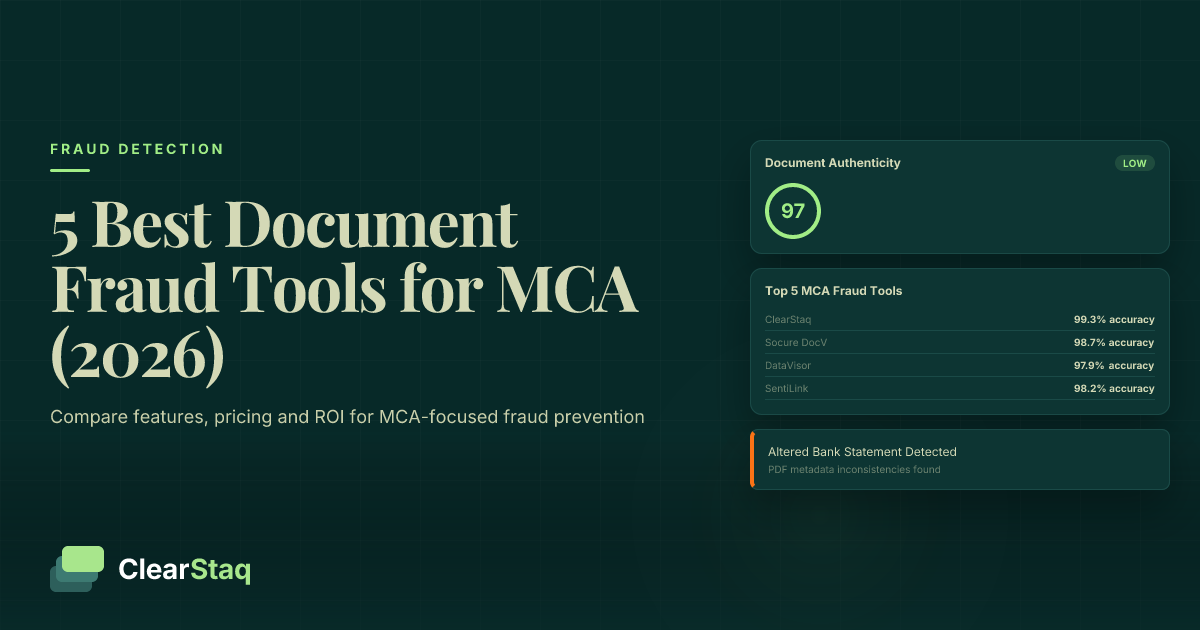
The best document fraud detection tools for MCA brokers in 2026 include ClearStaq, Socure DocV, DataVisor, SentiLink, and Jumio. These platforms use AI to analyze PDF metadata, detect altered documents, and integrate with MCA workflows for real-time fraud scoring with 99%+ accuracy rates.
Why MCA Brokers Need Document Fraud Detection Tools
Document fraud costs the MCA industry $2.1 billion annually, with altered bank statements and fabricated financial documents becoming increasingly sophisticated. For MCA brokers processing dozens of applications daily, manual review isn't just time-consuming—it's dangerously unreliable.
The Rising Cost of Document Fraud in MCA
Recent industry data reveals the average fraudulent MCA application involves $47,000 in funding, with sophisticated fraud rings targeting multiple brokers simultaneously. Default rates on fraudulent advances exceed 85%, compared to 12% for legitimate deals. Beyond direct losses, brokers face damaged ISO relationships, increased scrutiny from funders, and potential legal liability.
The surge in document manipulation tools has made fraud detection exponentially harder. What once required specialized skills now takes minutes with readily available PDF editors. Professional fraud rings operate with template libraries, consistent formatting, and even fake business entities complete with websites and phone numbers.
Most Common Document Fraud Techniques
Bank statement alteration remains the primary fraud vector, accounting for 73% of detected cases. Fraudsters modify deposit amounts to inflate revenue, remove negative balances, or insert fake transactions. Modern PDF manipulation leaves no visible traces—fonts match perfectly, running balances calculate correctly, and formatting appears authentic.
Template-based fraud represents an emerging threat where criminals use legitimate statement templates filled with fabricated data. These documents pass basic visual inspection because they're built from authentic formats. Tax return manipulation follows similar patterns, with inflated income figures and altered business expenses.
Why Manual Detection Fails
Human reviewers catch only 23% of sophisticated document fraud, according to industry studies. Even experienced underwriters miss subtle PDF metadata changes, pixel-level alterations, and mathematical inconsistencies that automated systems detect instantly. Time pressure compounds the problem—manual review of a three-month bank statement package takes 45-60 minutes, while automated analysis completes in seconds.
Inconsistent review standards create additional vulnerabilities. Different analysts apply varying scrutiny levels, especially during high-volume periods. Without standardized detection protocols, fraud patterns that one reviewer catches might slip past another. This inconsistency becomes a roadmap for sophisticated fraudsters who test multiple brokers until finding weaknesses.
How Document Fraud Detection Software Works
Modern fraud detection platforms combine multiple analysis layers to catch document manipulation that human eyes miss. The technology examines documents at the code level, pixel level, and pattern level simultaneously, creating a comprehensive fraud risk assessment in seconds.
Technical Detection Methods
Metadata forensics forms the foundation of automated detection. Every PDF contains hidden metadata revealing creation dates, modification history, and software signatures. Legitimate bank statements show consistent metadata patterns—they're generated by specific banking systems at regular intervals. Altered documents display telltale signs: modification timestamps after the statement date, consumer PDF editing software signatures, or metadata inconsistencies between pages.
Image analysis operates at the pixel level, detecting font inconsistencies invisible to human reviewers. Banking systems use specific fonts at precise sizes with exact spacing. Even minor deviations—a slightly different font weight or character spacing—indicate manipulation. Advanced systems also detect compression artifacts around altered numbers and alignment issues from copy-paste operations.
Mathematical validation provides another detection layer. Every bank statement follows strict mathematical rules: running balances must calculate correctly, transaction sequences must be logical, and statement periods must align with banking patterns. Automated systems verify these calculations instantly across hundreds of transactions.
AI vs Rule-Based Detection
Traditional rule-based systems rely on predefined criteria: flag round-number deposits, check for specific keywords, verify formatting standards. While effective for basic fraud, rules can't adapt to new manipulation techniques. Fraudsters quickly learn these rules and craft documents to bypass them.
Machine learning models analyze millions of legitimate and fraudulent documents, learning subtle patterns that distinguish authentic from altered documents. These systems improve continuously, adapting to new fraud techniques as they emerge. False positive rates with AI-powered systems average 1.8%, compared to 8-12% for rule-based systems.
The best platforms combine both approaches. Rules catch obvious fraud quickly, while AI identifies sophisticated manipulation. This layered approach provides 99.5% detection accuracy while maintaining processing speeds under 3 seconds per document.
Real-Time vs Batch Processing
MCA brokers need instant decisions to remain competitive. Real-time processing via API enables fraud detection within existing workflows—documents upload directly from application portals, analysis happens automatically, and results return immediately. This speed advantage often determines which broker wins the deal.
Batch processing suits high-volume operations reviewing hundreds of applications overnight. These systems queue documents for analysis during off-hours, delivering comprehensive fraud reports by morning. While slower than real-time analysis, batch processing offers cost advantages for large portfolios.
For comprehensive protection, many brokers implement both: real-time screening for initial applications and batch processing for deeper analysis. This dual approach balances speed with thoroughness, catching both obvious and sophisticated fraud attempts. Integration capabilities determine success—the best tools offer flexible APIs supporting both processing modes within existing MCA underwriting best practices.
5 Best Document Fraud Detection Tools for MCA Brokers
After analyzing dozens of platforms and interviewing MCA brokers nationwide, we've identified the five most effective document fraud detection tools for the industry. Each excels in specific areas, from MCA-focused features to enterprise-scale processing.
1. ClearStaq - Best for MCA-Specific Features
ClearStaq stands out with 27 fraud detection signals specifically calibrated for MCA underwriting. The platform analyzes bank statements, tax returns, and financial documents through MCA-specific lenses, catching fraud patterns generic tools miss.
Key Features:
- Real-time API processing (under 2 seconds)
- 900+ bank format recognition
- MCA stacking detection across statements
- PDF metadata deep analysis
- Automated fraud scoring with detailed explanations
Pricing: Starting at $0.85 per document with volume discounts. Free trial includes 100 document analyses.
Best For: MCA brokers processing 50-5,000 applications monthly who need specialized fraud detection integrated with existing workflows. The platform's fraud detection platform connects directly to popular MCA CRMs and LOS systems.
2. Socure DocV - Best Enterprise Solution
Socure DocV brings enterprise-grade document verification to high-volume operations. The platform processes millions of documents monthly for major financial institutions, offering unmatched scalability and reliability.
Key Features:
- Government ID verification alongside financial documents
- Global document support (195 countries)
- Batch processing up to 100,000 documents daily
- SOC 2 Type II compliance
- White-label options for ISO programs
Pricing: Enterprise contracts start at $15,000/month with custom volume pricing.
Best For: Large MCA funders and ISO aggregators processing thousands of applications daily. Requires dedicated implementation team and 4-6 week setup period.
3. DataVisor - Best for Advanced AI
DataVisor pioneered unsupervised machine learning for fraud detection, identifying new fraud patterns without pre-labeled training data. This approach catches emerging fraud techniques before they spread industry-wide.
Key Features:
- Unsupervised learning detects unknown fraud patterns
- Real-time scoring API with sub-second response
- Multi-document correlation analysis
- Fraud ring detection across applications
- Custom model training for specific MCA patterns
Pricing: Starting at $5,000/month plus $1.20 per document analyzed.
Best For: Tech-forward MCA companies wanting cutting-edge AI capabilities. Requires technical expertise for optimal configuration.
4. SentiLink - Best for Identity Verification
SentiLink specializes in synthetic identity fraud, a growing threat where criminals create entirely fictional businesses. The platform excels at connecting document fraud with identity verification for comprehensive application screening.
Key Features:
- Synthetic identity detection algorithms
- Credit application fraud prevention
- Real person verification
- Banking relationship validation
- Consortium data from 300+ lenders
Pricing: $2.50-4.00 per comprehensive verification including document and identity analysis.
Best For: MCA brokers facing synthetic identity fraud or needing combined document and identity verification.
5. Jumio - Best for Document Diversity
Jumio supports 200+ document types across 195 countries, making it ideal for MCA brokers working with diverse industries or international clients. The platform's mobile-first approach enables field verification.
Key Features:
- 200+ supported document types
- Mobile SDK for on-site verification
- Liveness detection for photo verification
- Multi-language support
- Biometric authentication options
Pricing: $1.50-3.00 per verification depending on document type and volume.
Best For: MCA brokers serving diverse industries or requiring mobile/field verification capabilities.
See ClearStaq's Fraud Detection in Action
Ready to see ClearStaq's 27 fraud signals in action? Upload a bank statement to our demo environment and get instant fraud analysis. Start your free trial — no credit card required.
Key Features to Look For
Selecting document fraud detection software requires understanding which features directly impact MCA operations. Beyond basic fraud detection, the right platform must integrate seamlessly with your workflow while maintaining accuracy standards that protect your business.
Must-Have Technical Features
PDF analysis depth separates professional-grade tools from basic scanners. Look for platforms examining multiple PDF layers: visible content, hidden metadata, embedded fonts, and compression patterns. PDF metadata analysis should include creation timestamps, modification history, and software signatures across all pages.
Pattern recognition accuracy determines whether you catch sophisticated fraud or drown in false positives. Leading platforms achieve 99%+ accuracy through multi-signal analysis. Essential signals include mathematical validation, font consistency checking, format verification, and temporal pattern analysis. Ask vendors for specific accuracy metrics on your document types.
Processing speed impacts deal flow. Real-time analysis (under 5 seconds) keeps applicants engaged while maintaining thorough fraud detection. Batch processing should handle 1,000+ documents hourly for overnight portfolio reviews. API response times under 2 seconds enable seamless integration without workflow delays.
MCA Workflow Integration
Loan Origination System (LOS) compatibility transforms fraud detection from a separate step into an invisible safeguard. Native integrations with popular MCA platforms like Salesforce Financial Services Cloud, nCino, or proprietary systems eliminate manual document handling. Look for pre-built connectors or well-documented APIs.
CRM integration captures fraud signals within existing customer records. When fraud detection operates inside your CRM, analysts see risk scores alongside application data. This context improves decision-making and creates audit trails for compliance. Webhook support enables real-time CRM updates as documents process.
Automated decisioning rules convert fraud scores into actionable workflows. Configure automatic approvals for low-risk applications, flag medium-risk cases for review, and instantly reject high-risk submissions. The best platforms support custom rule creation matching your risk tolerance and can leverage AI fraud detection capabilities for dynamic threshold adjustment.
Reporting and Analytics
Fraud trend analysis reveals patterns across your portfolio. Monthly reports should highlight emerging fraud techniques, geographic concentrations, and industry-specific risks. Visual dashboards make trends immediately apparent, enabling proactive policy adjustments.
Performance metrics track your fraud prevention effectiveness. Key indicators include detection rates, false positive ratios, processing times, and analyst productivity gains. Compare metrics monthly to ensure continuous improvement. Leading platforms provide automated reports customized for MCA operations.
Audit capabilities satisfy compliance requirements and support investigations. Complete audit logs should capture every document analyzed, fraud signals detected, analyst actions taken, and final decisions. Export capabilities in standard formats ensure compatibility with compliance systems.
Pricing and ROI Considerations
Document fraud detection software pricing varies dramatically based on features, volume, and deployment model. Understanding total costs and measuring ROI ensures you select a solution that strengthens your bottom line rather than straining it.
Cost Comparison by Tool
Per-document pricing dominates the MCA market, typically ranging from $0.50 to $5.00 per analysis. Entry-level tools charging under $1.00 per document often lack MCA-specific features. Professional platforms like ClearStaq price at $0.85-2.00 per document, including comprehensive fraud analysis and API access.
| Platform | Pricing Model | Cost Range | Volume Discounts | Contract Terms |
|---|---|---|---|---|
| ClearStaq | Per document | $0.85-1.50 | 30% at 10,000/mo | Monthly |
| Socure DocV | Enterprise | $15,000+/mo | Custom | Annual |
| DataVisor | Platform + usage | $5,000/mo + $1.20 | 20% at 5,000/mo | Annual |
| SentiLink | Per verification | $2.50-4.00 | Tiered | Quarterly |
| Jumio | Per document | $1.50-3.00 | 25% at 10,000/mo | Monthly |
Monthly subscriptions suit consistent volumes, while per-document pricing accommodates fluctuation. Most vendors offer hybrid models combining base subscriptions with usage charges. Negotiate volume commitments for significant discounts—30-50% reductions are common above 10,000 documents monthly.
Calculating Fraud Prevention ROI
Average fraud losses per incident reach $47,000 in MCA, making prevention highly profitable. If fraud detection prevents just one fraudulent advance monthly, ROI exceeds 500% for most platforms. Beyond direct loss prevention, consider efficiency gains from automated processing.
Manual review costs $15-25 per application in analyst time. Automated fraud detection reduces this to under $3 including software costs. For 1,000 monthly applications, automation saves $12,000-22,000 in labor costs alone. Factor in faster processing times that win more deals and ROI calculations become even more compelling.
Compliance cost avoidance provides additional value. Regulatory violations from missed fraud can trigger fines exceeding $100,000. Documented fraud detection processes with audit trails demonstrate due diligence, reducing regulatory risk. Insurance premiums often decrease with proven fraud detection systems.
Hidden Costs to Consider
Implementation fees range from zero for self-service platforms to $50,000+ for enterprise deployments. Factor setup costs into first-year ROI calculations. Some vendors require professional services for integration, adding $10,000-25,000 to initial investment.
Training costs accumulate quickly if platforms require extensive user education. Budget 20-40 hours of training time per analyst, plus ongoing support. Platforms with intuitive interfaces and strong documentation minimize these hidden expenses. Choose vendors offering included training to control costs.
API usage overage charges can surprise growing brokers. Understand rate limits and overage pricing before committing. Some platforms charge 2-3x standard rates for usage beyond monthly allowances. Negotiate higher base allowances or uncapped plans if you anticipate growth.
Implementation Best Practices
Successful fraud detection implementation requires more than selecting the right software. The most effective MCA brokers follow structured rollout plans that minimize disruption while maximizing fraud prevention impact.
Setting Up Your First Fraud Detection Pilot
Start with a 30-day pilot program analyzing 10-20% of your application volume. Select a representative sample including various industries, funding amounts, and geographic regions. This controlled approach reveals platform effectiveness without risking entire operations.
Define clear success metrics before starting: target 95%+ detection accuracy, under 2% false positive rate, and 80% analyst time savings. Track every flagged document to verify fraud detection accuracy. Compare automated results against your best manual reviewers to establish baselines.
Prepare test datasets containing known fraudulent and legitimate documents from past applications. This controlled testing validates detection accuracy before live deployment. Include edge cases like poor scan quality, unusual formats, and international banks to stress-test capabilities.
Training Your Team
Effective training transforms fraud detection from a black box into a powerful ally. Start by explaining how automated detection enhances rather than replaces human judgment. Show analysts how to interpret fraud signals, understanding why documents get flagged.
Create escalation procedures for borderline cases. When fraud scores fall between clear approval and rejection, establish review protocols. Senior analysts should handle complex cases initially, building institutional knowledge. Document decisions to train junior staff and refine detection parameters.
Regular training refreshers keep teams sharp as fraud techniques evolve. Monthly reviews of caught fraud attempts educate staff on emerging patterns. Share success stories where automated detection prevented losses. This positive reinforcement builds platform confidence and adoption.
Optimizing Detection Accuracy
Fine-tuning detection thresholds balances fraud prevention with customer experience. Start with vendor-recommended settings, then adjust based on your risk tolerance. Track false positive rates weekly, aiming for under 2% while maintaining high detection rates.
Implement feedback loops where analysts report detection errors. False positives indicate overly sensitive settings, while missed fraud suggests threshold increases. Quality platforms learn from this feedback, automatically adjusting algorithms. Manual rule overrides handle exceptions without compromising general protection.
Model retraining schedules depend on volume and fraud evolution. High-volume operations should retrain monthly, incorporating new fraud patterns. Smaller brokers can extend to quarterly updates. Work with vendors on custom training using your specific fraud cases for optimal accuracy.
Frequently Asked Questions
What is the best document fraud detection software for MCA brokers?
ClearStaq leads for MCA-specific features with 27 fraud signals and stacking detection. For enterprise scale, Socure DocV offers robust processing. DataVisor excels in AI-powered detection for high-volume operations.
How much does document fraud detection software cost?
Pricing ranges from $0.50-$5.00 per document analyzed, depending on volume and features. Enterprise solutions start around $10,000/month. ROI typically achieves 300-500% through fraud prevention and efficiency gains.
Can AI detect altered bank statements with 100% accuracy?
Leading AI tools achieve 99.5%+ accuracy in detecting altered documents through PDF metadata analysis, pixel-level examination, and pattern recognition. No tool is 100% accurate, but AI significantly outperforms manual review.
Which fraud detection tools integrate with MCA platforms?
ClearStaq offers native MCA integrations and real-time APIs. Socure DocV and DataVisor provide REST APIs for custom integration. Most tools require development work to integrate with proprietary MCA systems.
How do fraud detection tools prevent false positives?
Modern tools use machine learning trained on millions of documents, adjustable sensitivity thresholds, and multiple detection signals to reduce false positives to under 2% while maintaining high fraud detection rates.
Ready to Automate Fraud Detection?
Stop losing money to document fraud. ClearStaq's MCA-specific fraud detection catches what generic tools miss — with instant API results and 99.5% accuracy. Start your free trial today.
Frequently Asked Questions
What is the best document fraud detection software for MCA brokers?
ClearStaq leads for MCA-specific features with 27 fraud signals and stacking detection. For enterprise scale, Socure DocV offers robust processing. DataVisor excels in AI-powered detection for high-volume operations.
How much does document fraud detection software cost?
Pricing ranges from $0.50-$5.00 per document analyzed, depending on volume and features. Enterprise solutions start around $10,000/month. ROI typically achieves 300-500% through fraud prevention and efficiency gains.
Can AI detect altered bank statements with 100% accuracy?
Leading AI tools achieve 99.5%+ accuracy in detecting altered documents through PDF metadata analysis, pixel-level examination, and pattern recognition. No tool is 100% accurate, but AI significantly outperforms manual review.
Which fraud detection tools integrate with MCA platforms?
ClearStaq offers native MCA integrations and real-time APIs. Socure DocV and DataVisor provide REST APIs for custom integration. Most tools require development work to integrate with proprietary MCA systems.
How do fraud detection tools prevent false positives?
Modern tools use machine learning trained on millions of documents, adjustable sensitivity thresholds, and multiple detection signals to reduce false positives to under 2% while maintaining high fraud detection rates.
ClearStaq Team
Product Team
The ClearStaq team builds AI-powered tools for bank statement parsing, fraud detection, and income verification.