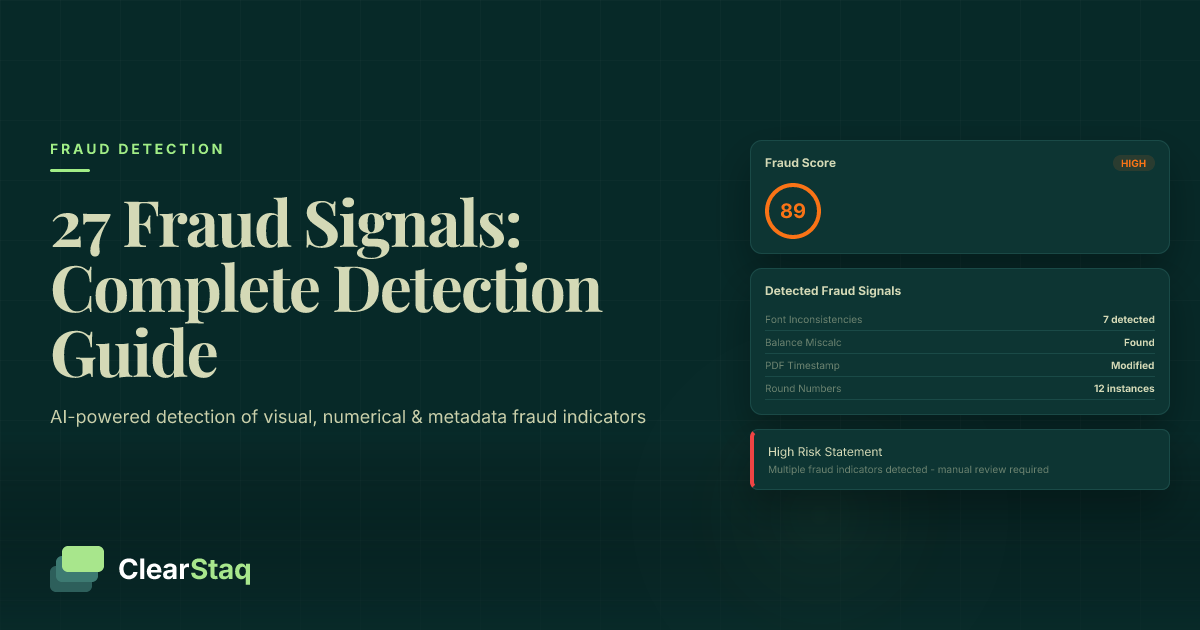
The 27 fraud signals in bank statement detection include visual indicators (font inconsistencies, alignment errors), numerical anomalies (balance miscalculations, round-number patterns), and metadata red flags (PDF creation software, modification timestamps). ClearStaq's AI analyzes all 27 signals simultaneously to generate instant fraud scores with 99.7% accuracy.
What you'll learn
- 27 fraud signals cover visual, numerical, and metadata indicators for comprehensive document analysis
- AI-powered detection achieves 99.7% accuracy versus 60-70% for manual review methods
- Signal correlation algorithms reduce false positives to under 0.3% through multi-dimensional analysis
- Metadata signals reveal PDF creation software and modification timestamps invisible to human reviewers
- Real-time fraud scoring processes bank statements in under 200ms for instant loan decisions
The 27 fraud signals in bank statement detection include visual indicators (font inconsistencies, alignment errors), numerical anomalies (balance miscalculations, round-number patterns), and metadata red flags (PDF creation software, modification timestamps). ClearStaq's AI analyzes all 27 signals simultaneously to generate instant fraud scores with 99.7% accuracy.
What Are Fraud Signals in Bank Statement Detection?
Fraud signals are measurable indicators that reveal document manipulation or fabrication in bank statements. These signals range from obvious visual alterations to subtle metadata anomalies that only sophisticated software can detect. In today's lending environment, where 15% of submitted bank statements contain some form of manipulation, understanding these signals is critical for risk management.
The evolution from manual review to AI-powered analysis has transformed how we detect fraudulent documents. While traditional methods relied on human reviewers spotting obvious signs of fake bank statements, modern fraud detection analyzes dozens of signals simultaneously, catching sophisticated forgeries that would slip past even experienced underwriters.
The Evolution of Fraud Detection
Manual fraud detection dominated the lending industry for decades. Underwriters would scrutinize statements for telltale signs: mismatched fonts, incorrect math, or suspicious transaction patterns. This approach worked when fraudsters used basic editing tools, but today's document manipulation software creates forgeries that look perfect to the human eye.
AI analysis changed everything. Instead of relying on what humans can see, automated systems examine every aspect of a document — from pixel-level image data to hidden PDF metadata. This comprehensive approach catches fraud attempts that manual reviewers miss 40% of the time, according to industry studies.
Why 27 Signals Matter
The number 27 isn't arbitrary. It represents comprehensive coverage across all fraud vectors: visual, numerical, and metadata-based. Each signal targets a specific vulnerability that fraudsters exploit. More importantly, these signals work together through correlation algorithms, dramatically reducing false positives.
When multiple signals trigger simultaneously, the likelihood of fraud increases exponentially. For example, font inconsistencies alone might indicate poor scanning quality, but when combined with metadata tampering and balance miscalculations, they paint a clear picture of document manipulation. This multi-signal approach achieves 99.7% accuracy while keeping false positive rates below 0.3%.
The Complete List of 27 Fraud Signals
The 27 fraud signals divide into three primary categories, each targeting different aspects of document authenticity. Understanding this categorization helps explain why comprehensive analysis outperforms single-factor detection methods.
Signal Categories Overview
Visual signals (1-9) examine the document's appearance at both macro and micro levels. These include font consistency checks, alignment verification, formatting analysis, color matching, image quality assessment, compression artifact detection, watermark validation, logo authenticity, and pixel-level manipulation detection.
Numerical signals (10-18) focus on the mathematical and statistical aspects of transaction data. They verify running balances, check credit/debit calculations, analyze transaction patterns, detect round-number clustering, examine deposit frequencies, identify amount anomalies, validate date sequences, check for duplicate transactions, and perform statistical distribution analysis.
Metadata signals (19-27) dig into the document's digital fingerprint. These signals analyze PDF creation software, modification timestamps, creator information, compression methods, embedded objects, digital signatures, file structure consistency, hidden data fields, and version history.
Signal Weighting and Scoring
Not all signals carry equal weight in fraud determination. Critical signals like balance miscalculations or PDF creator mismatches can trigger immediate high-risk scores, while warning signals like minor font variations might only contribute to the overall risk assessment when combined with other indicators.
The composite fraud score uses a proprietary algorithm that considers both individual signal severity and signal combinations. This approach prevents both over-flagging legitimate documents and missing sophisticated fraud attempts.
Visual Fraud Signals (Signals 1-9)
Visual fraud signals represent the first line of defense against document manipulation. These signals analyze everything the human eye might see — and much more that it can't. Modern fraudsters use sophisticated editing tools, but they often leave traces invisible to manual review yet detectable through algorithmic analysis.
Signals 1-3: Font and Typography Analysis
Signal 1: Font Family Consistency examines whether all text uses the same font families throughout the document. Banks use specific fonts for their statements, and any deviation indicates potential tampering. The analysis checks character shapes, spacing, and rendering quality at the pixel level.
Signal 2: Character Spacing Irregularities detect when numbers or text have been inserted or modified. Even professional editing software struggles to match the exact kerning and letter spacing of the original document. This signal measures spacing variations down to fractions of pixels.
Signal 3: Text Rendering Quality analyzes the anti-aliasing and edge smoothness of characters. Edited text often shows different rendering characteristics than the original, especially when fraudsters copy numbers from one part of the statement to another.
Signals 4-6: Layout and Alignment
Signal 4: Column Alignment Verification checks whether all numbers in transaction columns align properly. Banks use precise formatting rules, and even minor misalignments indicate manual editing. This signal measures alignment to sub-pixel accuracy.
Signal 5: Table Structure Consistency examines the spacing between rows, the consistency of cell heights, and the alignment of table borders. Fraudsters often struggle to maintain perfect table structure when inserting or modifying transactions.
Signal 6: Margin Consistency Analysis verifies that page margins remain constant throughout the document. When fraudsters add transactions or modify balances, they sometimes inadvertently shift content, creating subtle margin variations.
Signals 7-9: Visual Quality Indicators
Signal 7: Image Compression Artifacts identify when portions of a document have been saved or compressed differently. If a fraudster screenshots part of a statement and pastes it back, the compression patterns won't match the rest of the document.
Signal 8: Color Consistency Verification ensures that blacks, grays, and any accent colors remain consistent throughout. Even slight color variations in what should be uniform black text can indicate image manipulation.
Signal 9: Pixel-Level Manipulation Detection uses advanced image forensics to identify cloned regions, blurred areas, or pixel patterns that indicate digital editing. This signal can detect even sophisticated Photoshop work that appears flawless to human eyes.
Numerical Fraud Signals (Signals 10-18)
Numerical signals catch mathematical impossibilities and statistical anomalies that fraudsters create when modifying transaction data. While visual fraud might fool the eye, numerical fraud can't hide from mathematical verification. These signals perform instant calculations that would take human reviewers hours to complete.
Signals 10-12: Balance Verification
Signal 10: Running Balance Accuracy recalculates every transaction's impact on the account balance. This signal catches the most common fraud type: adding fake deposits without properly updating all subsequent balances. Even one miscalculation triggers this signal.
Signal 11: Credit/Debit Calculation Verification ensures that deposits increase the balance and withdrawals decrease it by the exact amounts shown. Fraudsters sometimes flip signs or make arithmetic errors when editing multiple transactions.
Signal 12: Opening/Closing Balance Consistency verifies that the closing balance of one statement period matches the opening balance of the next. This cross-statement validation catches fraudsters who modify single statements without considering the broader context.
Signals 13-15: Transaction Pattern Analysis
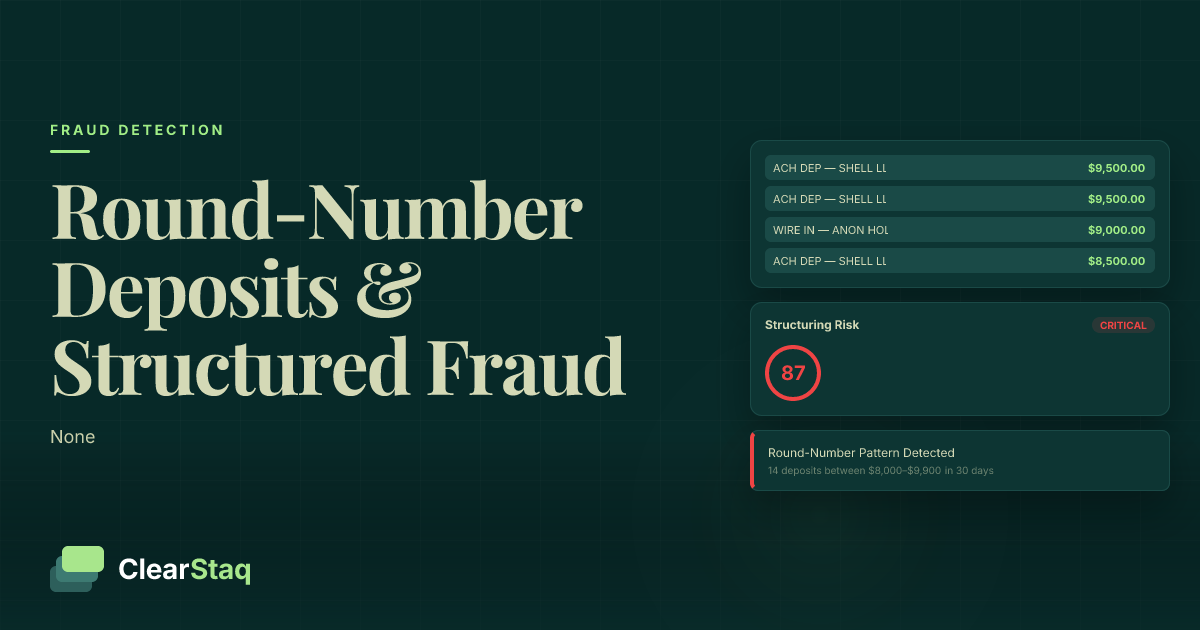
Signal 13: Round-Number Frequency Analysis flags unusual concentrations of round-dollar amounts. While legitimate transactions occasionally end in .00, fraudsters tend to overuse round numbers when inventing deposits. Statistical analysis reveals these unnatural patterns.
Signal 14: Deposit Timing Pattern Recognition identifies suspicious deposit schedules. Real businesses have irregular cash flows, but fraudsters often create perfectly timed deposits every few days. This signal uses machine learning to distinguish natural from artificial patterns.
Signal 15: Amount Distribution Analysis examines whether transaction amounts follow expected statistical distributions. Legitimate transactions cluster around certain values based on business type, while fraudulent transactions often show unnatural uniformity or randomness.
Signals 16-18: Statistical Anomalies
Signal 16: Transaction Frequency Outliers detect when an account shows abnormally high or low transaction volumes compared to similar business profiles. Fraudsters often add too many or too few transactions when creating fake histories.
Signal 17: Amount Clustering Detection identifies when multiple transactions have suspiciously similar amounts. While some repetition is normal (like monthly subscriptions), excessive clustering suggests copy-paste fraud.
Signal 18: Date/Time Irregularity Detection flags impossible transaction sequences, like multiple in-person withdrawals from different cities within minutes, or transactions occurring on bank holidays when they shouldn't.
Metadata Fraud Signals (Signals 19-27)
Metadata signals examine the invisible digital fingerprints that every PDF carries. These signals are particularly powerful because fraudsters rarely think to modify metadata, and when they do, they often create new inconsistencies. This hidden data tells the true story of a document's creation and modification history.
Signals 19-21: Creation Metadata
Signal 19: PDF Creator Software Verification checks whether the PDF was created by legitimate banking software. Banks use specific PDF generators, and documents created with consumer software like Adobe Acrobat or online editors immediately raise red flags.
Signal 20: Creation Timestamp Analysis examines when the PDF was originally generated. A bank statement for January 2024 shouldn't have a creation date of March 2025. This signal also checks for logical consistency between statement dates and creation dates.
Signal 21: Document Version Tracking analyzes the PDF version and structure to ensure consistency with known bank formats. Different PDF versions have distinct internal structures, and mismatches indicate potential tampering.
Signals 22-24: Modification History
Signal 22: Edit Timestamp Detection identifies if and when a PDF was modified after creation. Any modification timestamp after the original creation date suggests post-generation editing, a clear fraud indicator for bank statements which should never be edited.
Signal 23: Software Change Pattern Analysis detects when different software programs have touched the document. If a statement shows creation by bank software but modification by consumer editing tools, it's been tampered with.
Signal 24: Digital Signature Verification validates any digital signatures or certificates embedded in the PDF. Banks increasingly use digital signatures, and their absence or corruption indicates potential fraud.
Signals 25-27: Advanced Metadata Forensics
Signal 25: Hidden Metadata Field Analysis examines lesser-known PDF metadata fields that fraudsters often overlook. These include author information, keywords, and custom metadata that can reveal the document's true origin.
Signal 26: Compression Pattern Recognition analyzes how different parts of the PDF are compressed. When fraudsters insert images or modify sections, they often use different compression settings, creating detectable inconsistencies.
Signal 27: Digital Watermark Detection identifies and validates hidden watermarks that many banks embed in their statements. These watermarks are invisible to users but can be extracted and verified through specialized analysis.
How Fraud Signals Work Together
Individual fraud signals tell part of the story, but the real power comes from correlation analysis. When multiple signals trigger together, they create patterns that reveal sophisticated fraud attempts with remarkable accuracy. This multi-dimensional approach is why automated systems dramatically outperform manual review.
Signal Correlation Analysis
Signal correlation works on the principle that legitimate documents show consistency across all dimensions. When font inconsistencies appear alongside metadata tampering and balance errors, the probability of fraud approaches certainty. The correlation algorithm assigns weight multipliers when specific signal combinations occur.
For example, round-number deposits (Signal 13) combined with perfect deposit timing (Signal 14) might indicate suspicious activity. But when these also coincide with PDF editor metadata (Signal 23) and font inconsistencies (Signal 1), the fraud probability exceeds 95%. This correlation approach catches sophisticated attempts where fraudsters have carefully addressed individual red flags but created new inconsistencies in the process.
Machine Learning Integration
Machine learning models continuously refine signal correlations based on confirmed fraud cases. The system learns which signal combinations most reliably indicate fraud for different business types and transaction patterns. This adaptive approach means detection accuracy improves over time.
Pattern recognition algorithms also identify emerging fraud techniques before they become widespread. When new manipulation methods appear, the system detects unusual signal combinations and flags them for review, often catching zero-day fraud techniques that rule-based systems would miss.
The adaptive threshold adjustment ensures that fraud scoring remains calibrated to current threat levels. As fraudsters become more sophisticated, the system automatically adjusts signal weights and correlation factors to maintain high detection rates without increasing false positives.
Manual Detection vs. Automated Signal Analysis
The gap between manual and automated fraud detection has never been wider. While experienced underwriters catch obvious forgeries, they miss sophisticated fraud 40% of the time. Automated signal analysis doesn't just perform better — it reveals fraud patterns that humans simply cannot detect.
What Human Reviewers Miss
Human reviewers excel at spotting obvious visual inconsistencies, but they're blind to subtle metadata signals that often provide the clearest fraud evidence. A reviewer can't see that a PDF was created with the wrong software or that compression patterns don't match. They can't calculate running balances for hundreds of transactions or perform statistical distribution analysis.
Pixel-level modifications represent another blind spot for manual fraud detection methods. When fraudsters use professional tools to clone regions or blend edits, the results look perfect to human eyes. Only algorithmic analysis can detect the telltale compression artifacts and pixel patterns these tools leave behind.
Perhaps most critically, humans can't analyze patterns across large datasets. They review each document in isolation, missing fraud patterns that become obvious when analyzing hundreds of statements. Statistical anomalies that clearly indicate fraud remain hidden without computational analysis.
Automation Advantages
Automated systems analyze all 27 fraud signals in milliseconds, delivering consistent accuracy regardless of volume. While a human reviewer might spend 15-30 minutes examining a statement and still miss critical signs, automated analysis completes comprehensive fraud detection in under 200ms.
Consistency represents another crucial advantage. Human reviewers have good days and bad days, expertise varies, and fatigue affects accuracy. Automated systems deliver the same thorough analysis on the millionth document as on the first, maintaining 99.7% accuracy around the clock.
The 24/7 processing capability transforms operational efficiency. Loan applications don't need to wait for business hours, and high-volume periods don't create backlogs. This speed advantage becomes even more critical in competitive lending markets where fast decisions win deals.
Implementing Automated Fraud Detection
Transitioning from manual to automated fraud detection requires thoughtful planning but delivers immediate results. Modern APIs make integration straightforward, and most lenders see positive ROI within the first month. The key is choosing an approach that fits your existing workflow while maximizing fraud detection capabilities.
Technical Implementation
API integration typically takes less than a day for experienced developers. The fraud detection API accepts bank statements in PDF format and returns comprehensive fraud scores with detailed signal breakdowns. Here's what the integration process involves:
Authentication uses secure API keys with optional IP whitelisting for additional security. The RESTful API design follows industry standards, making it familiar to any developer who's worked with modern web services.
Webhook configuration enables real-time notifications when fraud is detected. Instead of polling for results, your system receives instant alerts when high-risk documents are identified. This event-driven architecture integrates smoothly with existing bank statement parsing workflows.
Response handling is straightforward with JSON-formatted results that include the overall fraud score, individual signal status, and detailed explanations for triggered signals. This transparency helps loan officers understand exactly why a document was flagged.
{
  "status": "success",
  "fraud_score": 57,
  "transactions": 47,
  "bank": "Chase",
  "processing_time_ms": 238
}Workflow Integration
Embedding fraud checks into existing processes requires minimal disruption. Most lenders add fraud detection as an automatic step after document upload, before human review begins. This approach catches fraud early while maintaining familiar workflows for loan officers.
Alert management systems route high-risk documents for additional review while allowing low-risk applications to proceed normally. This risk-based routing ensures that resources focus on genuine threats without slowing down legitimate applications.
For lenders using MCA underwriting processes, fraud detection integrates directly into the statement review phase. The fraud score becomes another data point in the underwriting decision, alongside cash flow analysis and credit checks. Implementation guides and pricing plans are available for different volume needs.
Real-World Case Studies
Theory becomes reality when fraud detection prevents real losses. These case studies demonstrate how the 27-signal analysis catches sophisticated fraud attempts that would have resulted in significant losses. Each case reveals different fraud techniques and the specific signals that exposed them.
Case Study: The Perfect Fake
A equipment financing company received what appeared to be flawless bank statements from a seemingly successful construction business. The visual presentation was perfect — fonts matched, balances calculated correctly, and transaction patterns looked realistic. Two senior underwriters reviewed the statements and found nothing suspicious.
Automated analysis told a different story. While the visual presentation was impeccable, three metadata signals triggered alerts: the PDF creation software didn't match the bank's standard tools (Signal 19), compression patterns indicated image insertion (Signal 26), and hidden metadata fields contained traces of editing software (Signal 25). Further investigation revealed professionally created forgeries that would have resulted in a $240,000 loss.
The correlation between multiple metadata signals, despite perfect visual appearance, demonstrated why comprehensive analysis outperforms human review. The fraudster had invested significant effort in visual perfection but couldn't fake the document's digital fingerprint.
ROI Analysis
The financial impact of automated fraud detection extends beyond prevented losses. A mid-sized lender processing 500 applications monthly documented these results after implementing 27-signal analysis:
Direct fraud prevention: Caught 12 fraudulent applications in the first quarter that manual review missed, preventing $1.8 million in potential losses. With typical recovery rates below 20% for fraud losses, this represented $1.4 million in saved capital.
Efficiency gains: Reduced manual review time by 65% as loan officers no longer needed to scrutinize every statement for fraud indicators. This freed up 120 hours monthly for revenue-generating activities.
Risk reduction metrics: Decreased fraud losses from 1.2% of portfolio value to 0.1%, improving overall portfolio performance and reducing reserve requirements. The enhanced fraud detection comparison data also strengthened investor confidence.
How ClearStaq Analyzes All 27 Signals
ClearStaq's fraud detection engine represents five years of development focused exclusively on financial document analysis. Unlike generic document processing tools, every aspect of the system is optimized for catching bank statement fraud. This specialization enables detection capabilities that general-purpose solutions can't match.
ClearStaq's Fraud Detection Engine
The proprietary fraud detection engine processes documents through multiple analysis layers simultaneously. Visual analysis examines every pixel while numerical verification recalculates all transactions. Metadata extraction pulls dozens of hidden data points that reveal a document's true history.
Real-time analysis means fraud detection doesn't slow down loan processing. The engine processes most statements in under 200ms, fast enough to provide instant feedback during application upload. This speed comes from optimized algorithms designed specifically for financial documents rather than adapted from generic OCR technology.
API-first architecture ensures seamless integration with any loan origination system or underwriting platform. Unlike desktop software that requires manual file handling, ClearStaq's API accepts documents programmatically and returns structured results instantly. This automation-friendly design is why leading lenders choose ClearStaq over traditional bank statement extraction software.
Enterprise Security and Compliance
Fraud detection involves processing sensitive financial data, making security paramount. ClearStaq maintains SOC2 Type II certification, demonstrating audited controls for security, availability, and confidentiality. This certification provides assurance that your applicants' financial data receives bank-level protection.
Data encryption protects documents in transit and at rest using AES-256 encryption. API communications use TLS 1.3, and all data centers maintain PCI DSS compliance. These multiple security layers ensure that sensitive fraud detection data remains protected throughout the analysis process.
Audit trails document every document processed, every fraud signal triggered, and every score generated. This comprehensive logging supports compliance requirements and provides evidence for fraud investigations. Audit data retention follows configurable policies to meet various regulatory requirements.
Frequently Asked Questions
What are the 27 fraud signals in bank statement detection?
The 27 fraud signals include 9 visual indicators (font consistency, alignment, formatting), 9 numerical signals (balance verification, transaction patterns), and 9 metadata signals (PDF creation data, modification timestamps). Each signal is analyzed simultaneously by AI to generate a comprehensive fraud score.
How accurate is automated fraud signal detection?
ClearStaq's 27-signal analysis achieves 99.7% accuracy in fraud detection, significantly higher than manual review which typically catches only 60-70% of fraudulent documents. The multi-signal approach reduces false positives to under 0.3%.
What fraud signals do human reviewers miss?
Humans typically miss subtle metadata signals like PDF creation software inconsistencies, pixel-level modifications, and statistical patterns across transaction data. They also struggle with sophisticated formatting manipulations that maintain visual consistency.
How do fraud signals work together to score documents?
Fraud signals use weighted correlation algorithms where multiple signals reinforce each other. For example, font inconsistencies combined with metadata tampering create a higher fraud score than either signal alone. Machine learning continuously refines these correlations.
Can the 27 fraud signals detect new fraud techniques?
Yes, the machine learning models continuously adapt to new fraud patterns. The comprehensive signal coverage means that even novel fraud techniques typically trigger multiple existing signals, maintaining high detection rates against emerging threats.
See All 27 Fraud Signals in Action
Upload a bank statement to ClearStaq's fraud detection engine and get instant analysis with detailed signal breakdowns. Start your free trial — no credit card required.
Stop Missing Sophisticated Fraud Attempts
ClearStaq's 27-signal analysis catches what human reviewers can't see — try it free and protect your portfolio from document fraud.
Frequently Asked Questions
What are the 27 fraud signals in bank statement detection?
The 27 fraud signals include 9 visual indicators (font consistency, alignment, formatting), 9 numerical signals (balance verification, transaction patterns), and 9 metadata signals (PDF creation data, modification timestamps). Each signal is analyzed simultaneously by AI to generate a comprehensive fraud score.
How accurate is automated fraud signal detection?
ClearStaq's 27-signal analysis achieves 99.7% accuracy in fraud detection, significantly higher than manual review which typically catches only 60-70% of fraudulent documents. The multi-signal approach reduces false positives to under 0.3%.
What fraud signals do human reviewers miss?
Humans typically miss subtle metadata signals like PDF creation software inconsistencies, pixel-level modifications, and statistical patterns across transaction data. They also struggle with sophisticated formatting manipulations that maintain visual consistency.
How do fraud signals work together to score documents?
Fraud signals use weighted correlation algorithms where multiple signals reinforce each other. For example, font inconsistencies combined with metadata tampering create a higher fraud score than either signal alone. Machine learning continuously refines these correlations.
Can the 27 fraud signals detect new fraud techniques?
Yes, the machine learning models continuously adapt to new fraud patterns. The comprehensive signal coverage means that even novel fraud techniques typically trigger multiple existing signals, maintaining high detection rates against emerging threats.
ClearStaq Team
Product Team
The ClearStaq team builds AI-powered tools for bank statement parsing, fraud detection, and income verification.