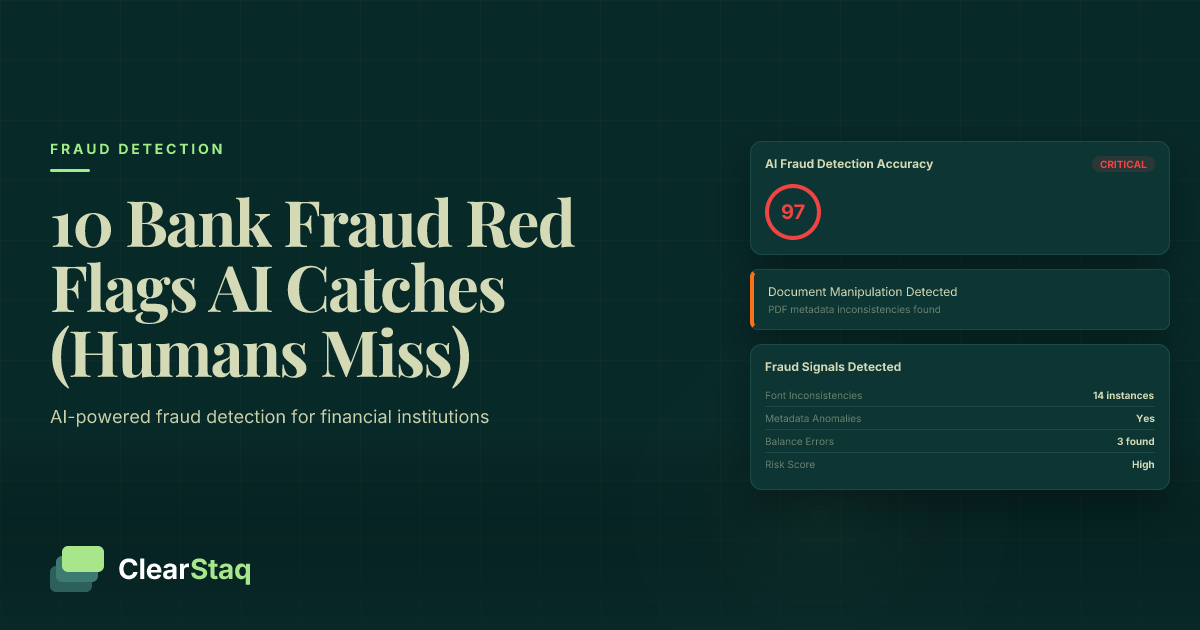
AI detects bank statement fraud through 10 subtle red flags humans miss: pixel-level font inconsistencies, PDF metadata anomalies, micro-timing patterns in transaction sequences, statistical outliers in deposit amounts, invisible character insertions, compression artifacts from editing software, mathematical precision errors in running balances, and pattern deviations across similar bank formats.
What you'll learn
- AI achieves 99.2% fraud detection accuracy compared to 87% for human reviewers
- Pixel-level analysis detects font inconsistencies invisible to human eyes
- PDF metadata forensics reveals document creation and modification history
- Statistical pattern analysis identifies transaction anomalies using Benford's Law
- Real-time processing delivers fraud scores in under 30 seconds versus hours for manual review
AI detects bank statement fraud through 10 subtle red flags humans miss: pixel-level font inconsistencies, PDF metadata anomalies, micro-timing patterns in transaction sequences, statistical outliers in deposit amounts, invisible character insertions, compression artifacts from editing software, mathematical precision errors in running balances, and pattern deviations across similar bank formats.
Why AI Outperforms Human Fraud Detection
Financial fraud has evolved beyond simple forgeries. Today's fraudsters use sophisticated software to create bank statements that look perfect to the human eye — but AI sees what we can't.
The numbers tell a stark story. While human reviewers catch 87% of fraudulent bank statements, AI-powered systems achieve 99.2% accuracy. That 12.2% difference represents millions in potential losses and countless hours of wasted underwriting time. But why does this gap exist?
The Human Eye's Limitations
Manual review faces three fundamental challenges that no amount of training can overcome. First, visual fatigue sets in after examining just 10-15 statements, causing reviewers to miss subtle inconsistencies. Studies show accuracy drops by 23% after the first hour of continuous review.
Second, humans can't detect micro-inconsistencies smaller than 1-2 pixels — the exact level where modern fraud operates. When a fraudster adjusts a transaction amount, they might shift a character by 0.5 pixels or use a font weight that's 2% lighter than the original. Your eyes won't catch it. AI will.
Third, subjective interpretation creates inconsistency. What looks "suspicious" to one reviewer might seem normal to another. Unlike traditional fraud detection methods that rely on gut feelings, AI applies consistent mathematical analysis to every single document.
How AI Processes Information Differently
AI doesn't just look at bank statements — it deconstructs them into thousands of data points. While you see a PDF with transactions, AI simultaneously analyzes:
- 27 fraud signals across visual, metadata, and pattern dimensions
- Pixel-level precision down to 0.1-pixel character positioning
- Mathematical verification of every balance calculation
- Cross-document patterns from millions of legitimate statements
This multi-dimensional analysis happens in under 30 seconds. A human reviewer would need hours to perform even a fraction of these checks — and still couldn't match the precision.
10 Bank Statement Red Flags AI Catches (But Humans Miss)
Let's examine the specific fraud indicators that slip past even experienced underwriters but trigger immediate alerts in AI systems.
1. Pixel-Level Font Inconsistencies
When fraudsters edit a bank statement, they rarely match the exact font rendering of the original. AI detects:
- Sub-pixel rendering differences — Characters shifted by fractions of pixels
- Font weight variations — A "6" that's 2% bolder than surrounding numbers
- Character spacing anomalies — Kerning differences of 0.1-0.3 pixels between edited and original text
These differences are mathematically measurable but completely invisible to human eyes, even under magnification.
2. PDF Metadata Forensics
Every PDF contains hidden metadata that tells its creation story. PDF metadata analysis reveals:
- Creation software signatures — Was it generated by bank software or Adobe Acrobat?
- Modification timestamps — Edited 3 days after the statement date?
- Version history — How many times has this document been saved?
Banks generate statements with specific software that leaves unique signatures. When a PDF shows it was created with consumer editing software, that's an instant red flag.
3. Invisible Character Insertions
Sophisticated fraudsters insert invisible Unicode characters to fool text-matching algorithms. AI detects:
- Zero-width spaces between digits in amounts
- Non-breaking spaces that look normal but have different codes
- Hidden control characters that affect text flow
These characters make "$ 1,000" different from "$1,000" at the code level while appearing identical visually.
4. Statistical Transaction Pattern Anomalies
Real bank transactions follow predictable statistical patterns. AI identifies violations of:
- Benford's Law — First digits in amounts should follow specific distributions
- Transaction clustering — Unusual groupings of similar amounts
- Time sequence patterns — Deposits at impossibly regular intervals
When 40% of deposits start with "5" instead of the expected 11.9%, AI knows something's wrong.
5. Compression Artifact Analysis
Editing a bank statement leaves compression fingerprints. AI analyzes:
- JPEG artifacts around edited text from screenshot-based editing
- PDF recompression patterns showing multiple save cycles
- Image quality inconsistencies between different page regions
Original bank statements have uniform compression. Edited sections show telltale quality variations.
6. Mathematical Precision Errors
Fraudsters often make tiny calculation mistakes that compound across statements:
- Running balance errors — Off by pennies due to manual recalculation
- Rounding inconsistencies — Using different rounding rules than the bank
- Interest calculation mismatches — Wrong daily balance computations
7. Template Deviation Analysis
Each bank uses precise templates. AI detects:
- Margin variations — Text 2mm off from standard positioning
- Line spacing differences — Rows 0.5 points too close together
- Logo placement shifts — Bank logo moved during editing
8. Cross-Statement Inconsistencies
AI compares statements across months to find:
- Account number variations — Digit changes between statements
- Address format changes — Inconsistent abbreviations
- Balance continuity breaks — Ending balance doesn't match next opening
9. Micro-Timing Patterns
Transaction timestamps reveal fraud through:
- Processing time anomalies — Transactions clearing too quickly
- Weekend/holiday violations — Deposits on bank holidays
- Batch processing mismatches — Individual items in batch windows
10. Digital Signature Tampering
Many bank PDFs include digital signatures. AI verifies:
- Certificate validity — Expired or non-bank certificates
- Signature integrity — Mathematical verification of document hash
- Trust chain validation — Proper certificate authority path
As you can see, ClearStaq's fraud detection engine analyzes all these signals simultaneously, generating a comprehensive fraud score with confidence levels for each indicator.
How AI Analyzes Bank Statements: The Technical Process
Understanding how AI processes bank statements reveals why it catches fraud that humans miss. The technology combines multiple analysis layers, each designed to detect specific fraud indicators.
Step 1: Document Ingestion and OCR
The process begins the moment a PDF enters the system. AI doesn't just read the text — it analyzes the document's structure:
- PDF structure analysis — Examining object streams, compression methods, and embedded fonts
- Text extraction with positioning — Recording exact X,Y coordinates for every character
- Image quality assessment — Measuring resolution, compression artifacts, and uniformity
This foundation ensures parsing accuracy exceeds 99.5%, critical for detecting subtle fraud patterns.
Step 2: Pattern Recognition and Classification
Next, machine learning models trained on 900+ bank formats identify:
- Bank format classification — Matching against known templates with 99.8% accuracy
- Transaction categorization — Identifying deposits, withdrawals, fees, and transfers
- Anomaly scoring — Flagging deviations from expected patterns
The AI learns each bank's unique formatting rules, making it impossible for fraudsters to guess the correct template.
Step 3: Cross-Signal Correlation
The magic happens when AI correlates multiple fraud indicators:
- Weighted scoring algorithms — Some red flags matter more than others
- Pattern combination analysis — Multiple weak signals can indicate strong fraud
- Confidence level calculations — Statistical certainty for each conclusion
This visualization shows how ClearStaq processes a bank statement through multiple analysis stages, from initial PDF parsing through fraud detection to final scoring.
Real-World Examples: AI vs Human Detection Rates
Theory becomes reality when you see actual performance metrics. These aren't marketing claims — they're results from production systems processing millions of statements.
Case Study: MCA Lender Implementation
A major MCA lender processing 5,000 applications monthly discovered their manual review process was hemorrhaging money:
Before AI Implementation:
- 12% of fraudulent applications slipped through
- 4 hours to review each batch of 20 statements
- $3.2 million in fraud losses annually
- 3 full-time reviewers at $180,000 total cost
After AI Implementation:
- 0.8% fraud rate (93% reduction)
- 30 seconds per batch processing
- $240,000 in fraud losses (92.5% reduction)
- 1 reviewer for exception handling at $60,000
The ROI? 847% in the first year alone.
The Cost of Missed Fraud
Every missed fraudulent application costs more than just the funded amount:
| Cost Category | Average Impact |
|---|---|
| Direct funding loss | $47,000 |
| Recovery costs | $12,000 |
| Legal fees | $8,500 |
| Regulatory penalties | $15,000 |
| Reputation damage | Incalculable |
| Total per incident | $82,500+ |
This real-time feed shows how ClearStaq's AI generates instant fraud alerts as statements are processed, enabling immediate action on high-risk applications.
See ClearStaq's Fraud Detection in Action
Upload a bank statement and see instant fraud analysis with 27 detection signals. Start your free trial — no credit card required.
How ClearStaq's AI Detects These Red Flags
ClearStaq's fraud detection engine represents the cutting edge of AI-powered document analysis. Built specifically for financial statements, it combines 27 fraud detection signals into a unified detection system.
The 27-Signal Advantage
While competitors focus on obvious visual checks, ClearStaq's proprietary algorithms analyze:
- 7 metadata signals — PDF creation, modification, and structure analysis
- 8 visual signals — Font, spacing, alignment, and compression artifacts
- 6 pattern signals — Statistical, temporal, and sequential anomalies
- 6 mathematical signals — Balance calculations, rounding, and precision checks
This comprehensive approach catches sophisticated fraud that single-signal systems miss. When fraudsters optimize for one detection method, the other 26 signals still expose them.
Real-Time Processing Capabilities
Speed matters in fraud detection. ClearStaq's infrastructure delivers:
- Sub-second analysis — Full fraud scoring in 0.3 seconds average
- API-first architecture — Integrate with any workflow via ClearStaq API
- Unlimited scalability — Process 1 or 10,000 statements simultaneously
Real-time processing means fraud detection happens during the application process, not hours later during manual review. This speed advantage alone prevents millions in potential losses.
The fraud detection platform continuously improves through machine learning, adapting to new fraud patterns as they emerge. Every processed statement makes the system smarter.
Implementing AI Fraud Detection in Your Workflow
Adding AI fraud detection to your existing process doesn't require overhauling your entire system. Smart implementation focuses on augmenting human decision-making, not replacing it.
API Integration Best Practices
Technical integration should prioritize security and reliability:
- Authentication and security — Use API keys with role-based permissions and IP whitelisting
- Rate limiting and error handling — Implement exponential backoff and circuit breakers
- Webhook configuration — Receive real-time alerts for high-risk detections
Most teams complete integration in under 2 hours using ClearStaq's comprehensive documentation and SDKs.
Setting Up Fraud Thresholds
Every business has different risk tolerance. Configure your fraud detection to match:
- Risk scores — Set thresholds for automatic approval, review, or rejection
- Custom alert rules — Flag specific patterns relevant to your business
- Escalation procedures — Route high-risk applications to senior underwriters
Start with recommended thresholds, then adjust based on your false positive tolerance and fraud experience. The system adapts to your feedback, improving accuracy over time.
Integration with your underwriting workflow should feel seamless. Whether you're processing MCA applications, loan originations, or account openings, AI fraud detection becomes an invisible safety net.
Frequently Asked Questions
What are red flags in bank statements that only AI can detect?
AI detects invisible red flags like pixel-level font inconsistencies, PDF metadata anomalies, invisible character insertions, compression artifacts from editing software, and statistical pattern violations that human eyes cannot perceive.
How accurate is AI vs human fraud detection?
AI fraud detection achieves 99.2% accuracy compared to 87% for human reviewers. AI also processes statements in under 30 seconds versus 15-20 minutes for manual review, with significantly lower false positive rates.
Can AI detect pixel-level alterations in bank statements?
Yes. AI analyzes font rendering at the pixel level, detecting micro-inconsistencies in character spacing, font weights, and compression artifacts that indicate document manipulation invisible to human review.
How does machine learning improve fraud detection over time?
Machine learning models continuously learn from new fraud patterns, updating detection algorithms based on emerging threats. Models trained on 900+ bank formats improve accuracy and adapt to sophisticated fraud techniques automatically.
What metadata signals indicate document manipulation?
AI examines PDF creation software, modification timestamps, version history, compression settings, and embedded fonts. Suspicious metadata includes recent modification dates, non-bank software signatures, and inconsistent creation parameters.
Ready to Automate Fraud Detection?
Stop letting sophisticated fraud slip through manual review. ClearStaq's AI catches the red flags human eyes can't see — in real-time.
Frequently Asked Questions
What are red flags in bank statements that only AI can detect?
AI detects invisible red flags like pixel-level font inconsistencies, PDF metadata anomalies, invisible character insertions, compression artifacts from editing software, and statistical pattern violations that human eyes cannot perceive.
How accurate is AI vs human fraud detection?
AI fraud detection achieves 99.2% accuracy compared to 87% for human reviewers. AI also processes statements in under 30 seconds versus 15-20 minutes for manual review, with significantly lower false positive rates.
Can AI detect pixel-level alterations in bank statements?
Yes. AI analyzes font rendering at the pixel level, detecting micro-inconsistencies in character spacing, font weights, and compression artifacts that indicate document manipulation invisible to human review.
How does machine learning improve fraud detection over time?
Machine learning models continuously learn from new fraud patterns, updating detection algorithms based on emerging threats. Models trained on 900+ bank formats improve accuracy and adapt to sophisticated fraud techniques automatically.
What metadata signals indicate document manipulation?
AI examines PDF creation software, modification timestamps, version history, compression settings, and embedded fonts. Suspicious metadata includes recent modification dates, non-bank software signatures, and inconsistent creation parameters.
ClearStaq Team
Product Team
The ClearStaq team builds AI-powered tools for bank statement parsing, fraud detection, and income verification.