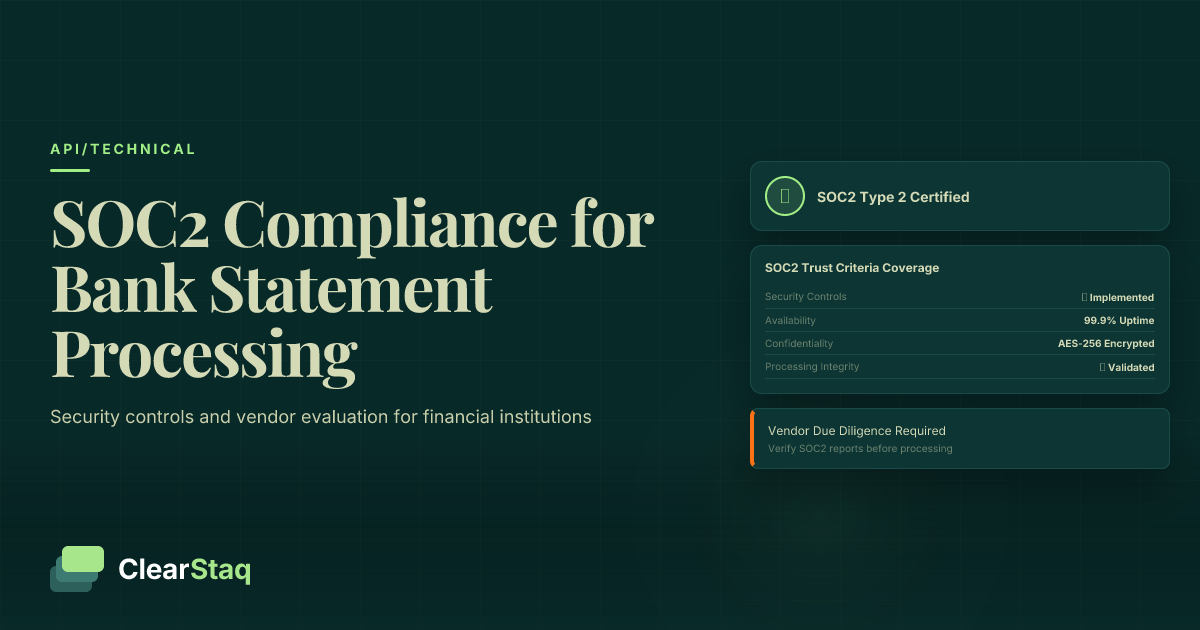
SOC2 compliance for bank statement processing ensures financial institutions meet security, availability, and confidentiality standards when handling sensitive financial documents. Lenders must verify their document processing vendors have SOC2 Type 2 certification to protect customer data and maintain regulatory compliance across automated parsing and fraud detection workflows.
What you'll learn
- SOC2 Type 2 audits test control effectiveness over 6-12 months, not just point-in-time assessment
- FFIEC guidance requires lenders to verify vendor security controls for third-party data processing
- The five trust principles (security, availability, processing integrity, confidentiality, privacy) create comprehensive protection
- SOC2 audit costs range $15,000-$50,000 with annual recertification requirements
- Financial document processing requires specialized controls beyond generic IT security measures
SOC2 compliance for bank statement processing ensures financial institutions meet security, availability, and confidentiality standards when handling sensitive financial documents. Lenders must verify their document processing vendors have SOC2 Type 2 certification to protect customer data and maintain regulatory compliance across automated parsing and fraud detection workflows.
What is SOC2 Compliance?
SOC2 (Service Organization Control 2) is a comprehensive security framework created by the American Institute of CPAs (AICPA) to ensure service organizations properly safeguard customer data. Unlike generic security certifications, SOC2 compliance bank statement processing specifically addresses how financial technology companies handle sensitive financial documents throughout their entire lifecycle.
The framework establishes strict criteria for how organizations design and implement controls around data security, availability, processing integrity, confidentiality, and privacy. For lenders evaluating document processing vendors, SOC2 certification provides third-party validation that critical security measures are not just promised but actively maintained and audited.
SOC2 Type 1 vs Type 2: Key Differences
Understanding the distinction between SOC2 Type 1 and Type 2 audits is crucial when evaluating vendors. A Type 1 audit provides a snapshot assessment—it verifies that security controls exist and are properly designed at a specific point in time. Think of it as checking that all the locks on your doors work on inspection day.
A Type 2 audit goes much deeper. Auditors test the operational effectiveness of controls over an extended period, typically 6-12 months. This ensures security measures work consistently in real-world conditions, not just during preparation for an audit. For SOC2 Type 2 financial data handling, this extended testing period validates that sensitive bank statements remain protected through every processing stage.
Who Needs SOC2 Compliance
SOC2 compliance has become the gold standard for any organization handling sensitive data in the cloud. The primary candidates include cloud service providers storing financial documents, SaaS companies processing customer information, and document processing vendors analyzing bank statements.
For financial services specifically, any vendor touching customer financial data—from initial document upload through parsing, analysis, and storage—should maintain SOC2 certification. This includes API providers, fraud detection platforms, and automated underwriting systems that process bank statements as part of their workflow.
Why Lenders Need SOC2 Compliance
Financial institutions face mounting regulatory pressure to secure customer data across their entire technology stack. While lenders themselves may not require SOC2 certification, federal guidelines mandate strict oversight of any third-party vendors handling sensitive financial information. This creates a ripple effect where bank statement processing compliance becomes essential for maintaining your own regulatory standing.
The stakes are particularly high in lending. A single data breach involving bank statements can expose years of transaction history, account numbers, and spending patterns. Beyond immediate financial losses, institutions face regulatory penalties, class-action lawsuits, and devastating reputational damage that can take years to rebuild.
FFIEC Guidance on Third-Party Risk Management
The Federal Financial Institutions Examination Council (FFIEC) explicitly requires financial institutions to implement comprehensive vendor management programs. These guidelines demand initial due diligence before onboarding any vendor, plus ongoing monitoring throughout the relationship.
For document processing vendors, FFIEC expects lenders to verify security controls, review audit reports, and ensure vendors maintain appropriate insurance coverage. SOC2 Type 2 reports provide standardized documentation that satisfies these requirements, making vendor assessments more straightforward and defensible during regulatory examinations.
The Cost of Non-Compliance
Working with non-compliant vendors exposes lenders to severe consequences. Regulatory fines for data breaches can reach millions of dollars, with penalties increasing based on the number of affected customers and severity of negligence. Recent data security incidents in the lending industry demonstrate how quickly breaches can spiral into existential threats.
Beyond direct financial penalties, reputational damage often proves more costly. Customers who lose trust after a data breach rarely return, and negative publicity can deter new business for years. The true cost of partnering with non-compliant vendors extends far beyond any savings from choosing cheaper, less secure options.
The 5 SOC2 Trust Principles Explained
SOC2 compliance centers on five trust principles that create comprehensive security coverage. Each principle addresses specific risks in handling sensitive financial data, working together to ensure complete protection throughout the document processing lifecycle.
Security forms the foundation, protecting information and systems against unauthorized access. Availability ensures systems remain operational and accessible as promised in service agreements. Processing Integrity guarantees that system processing is complete, valid, accurate, and timely. Confidentiality protects information designated as confidential throughout its lifecycle. Finally, Privacy addresses personal information collection, use, retention, disclosure, and disposal according to the organization's privacy notice.
Security Controls for Financial Data
Security controls for financial data security standards go beyond basic password protection. Modern SOC2 requirements demand multi-layered defenses including role-based access controls that limit data exposure to authorized personnel only. Encryption must protect data both in transit (during upload/download) and at rest (in storage), using industry-standard algorithms like AES-256.
Network security requires firewalls, intrusion detection systems, and regular vulnerability scanning. Physical security of data centers, employee background checks, and security awareness training round out the comprehensive controls needed to achieve SOC2 certification for financial data handling.
Processing Integrity in Document Handling
Processing integrity ensures that every bank statement moves through the system accurately and completely. This includes data validation at each processing step, comprehensive error handling to prevent data corruption, and detailed audit trails tracking every action taken on a document.
For automated parsing systems, processing integrity means maintaining accuracy rates above 99%, implementing quality checks at each stage, and providing clear error reporting when issues occur. The entire processing pipeline must be designed to prevent, detect, and correct any errors that could compromise data accuracy.
SOC2 for Bank Statement Processing
Bank statement processing presents unique security challenges that standard SOC2 controls must be adapted to address. These documents contain complete financial histories, making them prime targets for fraudsters and requiring specialized protection throughout the processing workflow. Secure document processing demands controls specifically designed for financial document characteristics.
The complexity increases when considering automated parsing, fraud detection, and data extraction workflows. Each processing stage introduces potential vulnerabilities that SOC2 controls must address, from the initial document upload through final data delivery via API or webhook.
Document Upload and Storage Security
The security journey begins the moment a user uploads a bank statement. All uploads must use TLS 1.3 encryption to prevent interception during transmission. Once received, documents require immediate encryption at rest using separate encryption keys per customer to limit breach impact.
Storage systems must implement strict access logging, recording who accessed which documents and when. Data retention policies should automatically purge documents after the agreed retention period, reducing long-term exposure risk. Backup systems require the same encryption and access controls as primary storage.
Processing Pipeline Security
Secure API endpoints form the backbone of compliant document processing. Each API call must authenticate using OAuth 2.0 or similar secure protocols, with rate limiting preventing abuse. For asynchronous processing, secure webhook implementation ensures results reach only authorized endpoints.
Error handling deserves special attention—error messages must never expose sensitive data or system internals that could aid attackers. Processing environments should be isolated, preventing one customer's data from ever being accessible to another, even in error conditions.
Fraud Detection Data Handling
When implementing secure fraud detection, the analysis workflow must maintain data confidentiality while performing deep inspection. This requires secure analysis environments that process documents in isolation, preventing cross-contamination between different customers' data.
Fraud detection results themselves become sensitive data requiring protection. These results must be encrypted, access-controlled, and audit-logged just like the original documents. The challenge lies in maintaining security without sacrificing the real-time performance lenders expect from modern fraud detection systems.
How to Evaluate Vendor SOC2 Reports
Not all SOC2 reports are created equal. When evaluating potential vendors for SOC2 audit requirements lending operations, you need to look beyond the certificate on their website. A thorough evaluation requires reviewing the actual audit report, understanding any exceptions noted, and verifying the audit scope covers your specific use case.
Start by confirming the report is current—SOC2 Type 2 audits typically cover a 12-month period and should be no more than 12 months old. Verify which trust principles are included; while security is mandatory, ensure availability and processing integrity are also covered for document processing vendors.
SOC2 Report Components
A complete SOC2 Type 2 report contains four critical sections. The management assertion is the vendor's claim about their controls' effectiveness. The independent auditor's opinion provides third-party validation of these claims. Control descriptions detail each security measure in place, while test results show how auditors verified control effectiveness over time.
Pay special attention to the auditor's opinion section. A "clean" or "unqualified" opinion means all controls operated effectively. Any qualifications or exceptions require careful review to understand their impact on your security requirements.
Vendor Due Diligence Checklist
Create a standardized checklist for evaluating document processing vendors. Request the most recent SOC2 Type 2 report, not just a certificate. Ask about any exceptions or control failures noted in the report and what remediation steps were taken.
Inquire about the audit firm—reputable firms like PwC, Deloitte, EY, or specialized security auditors provide more credible assessments. Verify that the audit scope specifically includes document processing workflows, not just general IT controls. Request evidence of how they handle audit findings and their process for continuous improvement.
Need to see SOC2 compliance in action?
Book a demo to review ClearStaq's security controls and compliance documentation.
Common SOC2 Red Flags
Several warning signs indicate potentially inadequate security controls. Qualified audit opinions suggest auditors found significant issues with control effectiveness. Material weaknesses indicate control failures that could result in data breaches or service disruptions.
Outdated certifications raise immediate concerns—if a vendor can't maintain current compliance, what else are they neglecting? Be wary of vendors who share only SOC2 certificates without providing full reports, or those whose audits exclude critical trust principles like availability or processing integrity. When comparing compliant fraud detection tools, these red flags can quickly narrow your options.
SOC2 Implementation: Costs and Timeline
Understanding SOC2 costs and timelines helps set realistic expectations, whether you're evaluating vendors or considering certification for your own organization. Initial SOC2 Type 2 certification typically costs between $15,000 and $50,000, with significant variation based on company size and complexity.
The investment extends beyond audit fees. Organizations must dedicate internal resources to implement controls, document procedures, and gather evidence. Many companies hire consultants to guide preparation, adding $20,000-$40,000 to the total cost. Annual recertification runs roughly 60-70% of initial certification costs.
Audit Timeline and Phases
The journey to SOC2 Type 2 certification follows three distinct phases. The readiness assessment phase (2-4 months) involves gap analysis, control implementation, and documentation. During this phase, organizations identify missing controls and implement necessary security measures.
The Type 1 audit (1-2 months) provides a point-in-time assessment, validating that controls are properly designed. Finally, the Type 2 observation period (6-12 months) tests operational effectiveness, with auditors reviewing evidence that controls functioned consistently throughout the period.
Cost Factors
Several variables affect SOC2 audit costs. Company size directly impacts complexity—more employees, systems, and data mean more controls to test. System complexity matters too; organizations with multiple data centers, complex architectures, or numerous third-party integrations face higher costs.
The number of trust principles included significantly affects pricing. While most start with just security, adding availability, processing integrity, confidentiality, and privacy can nearly double audit costs. However, for document processing vendors, including all five principles often proves worthwhile to meet customer requirements.
ClearStaq's SOC2 Type 2 Compliance
ClearStaq maintains rigorous SOC2 Type 2 compliance through annual audits covering all five trust principles. Our commitment to security goes beyond checking boxes—we've built our entire secure API platform with financial-grade security as the foundation, not an afterthought.
Our clean audit opinions demonstrate consistent control effectiveness across document upload, processing, fraud detection, and data delivery. We make our redacted SOC2 reports available to customers, providing transparency into our security controls and audit results.
Security Architecture
ClearStaq's security architecture implements defense-in-depth principles at every layer. End-to-end encryption protects documents from upload through processing and storage, using AES-256 encryption with unique keys per customer. Multi-factor authentication secures all user and API access, preventing unauthorized access even if credentials are compromised.
We conduct quarterly penetration testing by independent security firms, going beyond SOC2 requirements to proactively identify and remediate potential vulnerabilities. Our security team monitors threats 24/7, ensuring rapid response to any suspicious activity.
Document Processing Controls
Every bank statement processes in isolated environments, preventing any possibility of data leakage between customers. Our architecture ensures that even in error conditions, one customer's data never becomes visible to another.
Comprehensive audit trails track every document interaction, from initial upload through parsing, fraud analysis, and eventual deletion. These immutable logs support both security investigations and compliance reporting. Our data retention policies automatically purge documents after the customer-specified period, reducing long-term exposure risk.
API Security
The ClearStaq API security features implement bank-grade protections. OAuth 2.0 authentication ensures secure, revocable access tokens. Rate limiting prevents abuse while maintaining performance for legitimate usage. IP allowlisting adds an extra security layer for customers requiring restricted access.
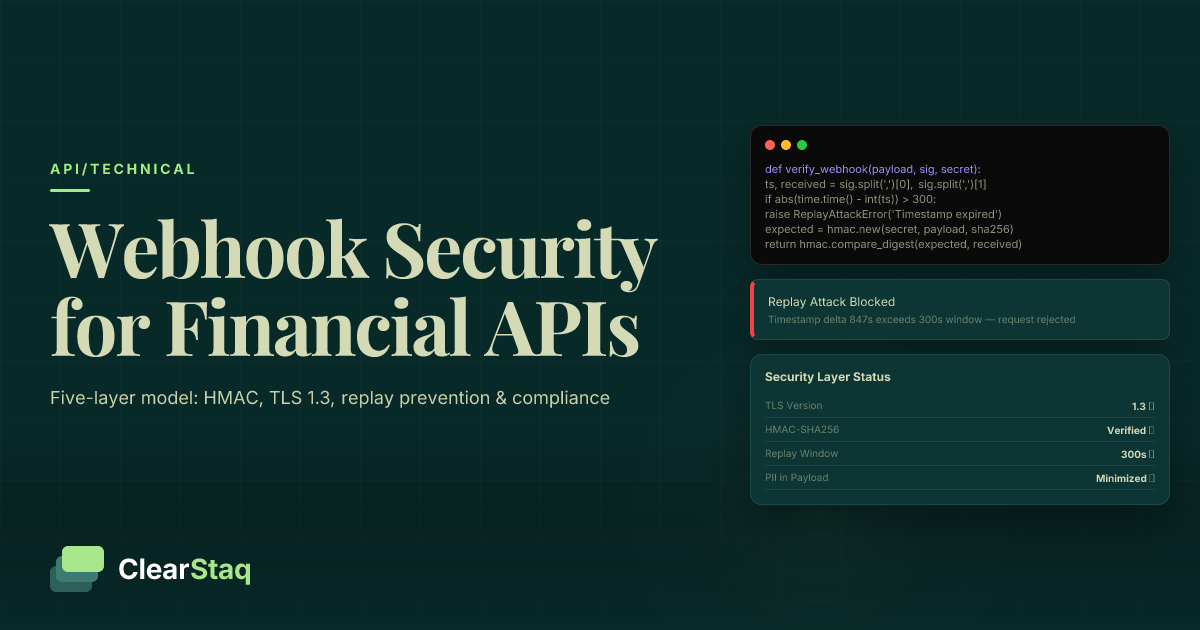
Our webhook implementation includes request signing, ensuring callbacks reach only verified endpoints. All API communications use TLS 1.3, and we maintain strict cipher suite policies that exceed industry standards.
{
  "status": "success",
  "fraud_score": 57,
  "transactions": 47,
  "bank": "Chase",
  "processing_time_ms": 238
}Frequently Asked Questions
What is SOC2 Type 2 compliance?
SOC2 Type 2 is an audit that evaluates the operational effectiveness of a service organization's controls over a period of time (typically 6-12 months), ensuring security, availability, and confidentiality standards are consistently met.
Do lenders need SOC2 compliance?
While lenders aren't required to be SOC2 compliant themselves, FFIEC guidance requires financial institutions to ensure their third-party vendors handling sensitive data maintain appropriate security controls, making SOC2 compliance essential for vendor selection.
How much does SOC2 audit cost?
SOC2 Type 2 audits typically cost between $15,000-$50,000 depending on company size, system complexity, and number of trust principles included, with annual recertification required.
What are SOC2 controls for financial data?
Key controls include encryption of data in transit and at rest, multi-factor authentication, access logging, secure API endpoints, regular penetration testing, and comprehensive audit trails for all data processing activities.
Is SOC2 required for bank statement processing?
While not legally mandated, SOC2 compliance is considered industry standard for any vendor processing financial documents, as it demonstrates adequate security controls required by banking regulations and due diligence requirements.
Ready to Partner with a SOC2-Compliant Provider?
Don't risk non-compliance with your document processing vendor. ClearStaq's SOC2 Type 2 certification ensures your bank statement processing meets the highest security standards.
Frequently Asked Questions
What is SOC2 Type 2 compliance?
SOC2 Type 2 is an audit that evaluates the operational effectiveness of a service organization's controls over a period of time (typically 6-12 months), ensuring security, availability, and confidentiality standards are consistently met.
Do lenders need SOC2 compliance?
While lenders aren't required to be SOC2 compliant themselves, FFIEC guidance requires financial institutions to ensure their third-party vendors handling sensitive data maintain appropriate security controls, making SOC2 compliance essential for vendor selection.
How much does SOC2 audit cost?
SOC2 Type 2 audits typically cost between $15,000-$50,000 depending on company size, system complexity, and number of trust principles included, with annual recertification required.
What are SOC2 controls for financial data?
Key controls include encryption of data in transit and at rest, multi-factor authentication, access logging, secure API endpoints, regular penetration testing, and comprehensive audit trails for all data processing activities.
Is SOC2 required for bank statement processing?
While not legally mandated, SOC2 compliance is considered industry standard for any vendor processing financial documents, as it demonstrates adequate security controls required by banking regulations and due diligence requirements.
ClearStaq Team
Product Team
The ClearStaq team builds AI-powered tools for bank statement parsing, fraud detection, and income verification.