ClearStaq supports 900+ bank statement formats across major banks, regional institutions, and credit unions, compared to competitors who typically support only 100-300 formats. This comprehensive coverage eliminates the 15-20% of applications that fail due to unsupported bank formats, directly improving approval rates and reducing manual review costs for lenders.
What you'll learn
- ClearStaq supports 900+ bank formats compared to competitors' 100-300 format coverage
- 15-20% of loan applications fail automated processing due to unsupported bank formats
- Manual review of unsupported formats costs $25-50 per statement and adds 2-3 days processing time
- Comprehensive format coverage increases straight-through processing rates from 75% to 94%
- ClearStaq adds 20-30 new bank formats monthly through automated discovery
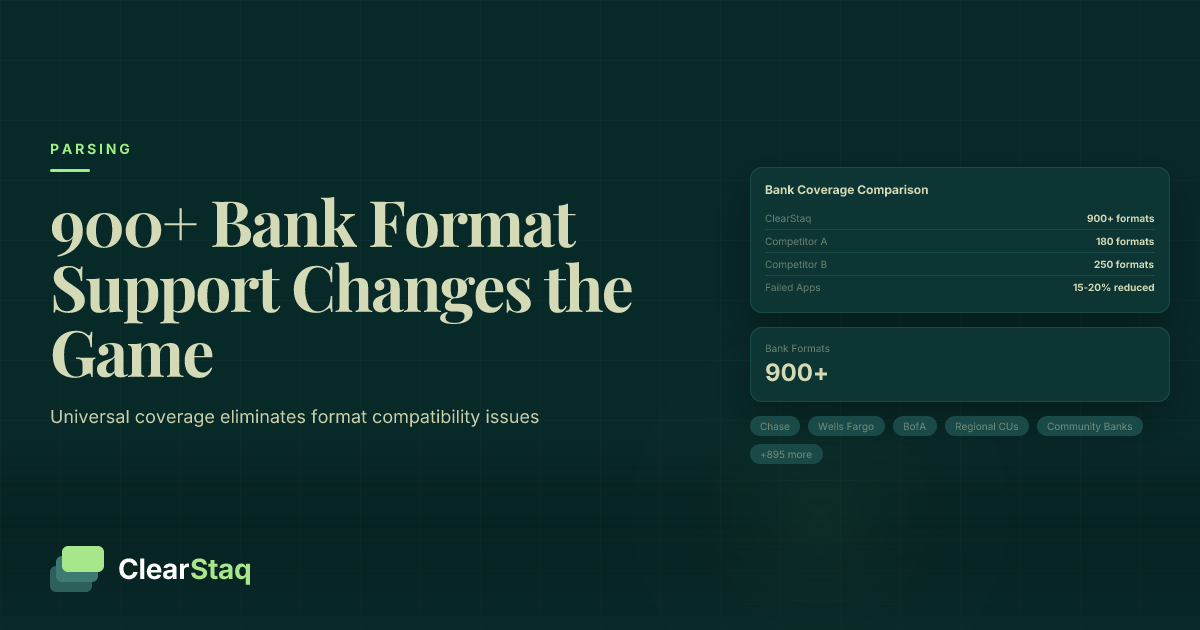
ClearStaq supports 900+ bank statement formats across major banks, regional institutions, and credit unions, compared to competitors who typically support only 100-300 formats. This comprehensive coverage eliminates the 15-20% of applications that fail due to unsupported bank formats, directly improving approval rates and reducing manual review costs for lenders.
The Bank Format Coverage Challenge for Lenders
Every lender faces a hidden problem that's costing them money: bank format incompatibility. When your parsing tool can't handle a customer's bank statement format, everything grinds to a halt. Applications pile up for manual review, deals get delayed, and some customers simply walk away.
The numbers tell a stark story. Industry data shows that 15-20% of loan applications fail automated processing due to unsupported bank formats. That means one in every five to seven applications requires manual intervention—not because of fraud concerns or data issues, but simply because the parsing tool doesn't recognize the bank's statement layout.
The Hidden Cost of Limited Format Support
When automated parsing fails, the costs cascade quickly. Manual review of a single bank statement costs between $25 and $50 in labor, assuming your team has the bandwidth. Processing times jump from minutes to days. Worse, each manual review introduces the risk of human error in data entry.
Consider a mid-size lender processing 1,000 applications monthly. With 15% requiring manual review due to format issues, that's 150 statements needing human intervention. At $35 per manual review, you're looking at $5,250 in additional monthly costs—or $63,000 annually. And that's before accounting for lost revenue from delayed or abandoned applications.
The opportunity cost compounds the problem. While your team manually processes unsupported formats, competitors with better parsing accuracy and format coverage are approving those same customers in minutes, not days.
Why Regional Banks Matter
The format coverage problem isn't just about obscure credit unions. Regional banks hold approximately 30% of U.S. banking assets and serve millions of small businesses—exactly the customers most lenders target. These institutions often use unique statement formats that differ significantly from major bank templates.
Regional banks also update their statement formats more frequently than major institutions. A parser that worked last month might fail today because the bank rolled out a new statement design. Without comprehensive coverage and continuous updates, lenders face an endless game of catch-up.
What 900+ Bank Format Support Actually Means
When we say "bank format," we're talking about more than just which banks are supported. A single bank might have dozens of different statement formats depending on account type, statement period, delivery method, and region. Chase alone has over 20 distinct statement layouts across personal checking, business accounts, credit cards, and regional variations.
Understanding Bank Statement Formats
Bank statement formats encompass multiple technical elements that parsing engines must recognize and process accurately. The PDF structure determines how data is encoded—some banks use text layers, others embed data as images, and many use complex table structures. Layout variations include different positions for transaction tables, running balances, and account summaries.
Data field positioning varies dramatically between formats. One bank might place the account number in the top right corner, while another embeds it in a footer. Transaction dates could appear in MM/DD/YYYY or DD-MM-YY format. Even the same bank might use different layouts for business versus personal accounts.
Major vs Regional vs Credit Union Formats
Major banks like Bank of America, Wells Fargo, and JPMorgan Chase tend to have more standardized formats with less frequent changes. However, they compensate with variety—offering different layouts for various account types and services. A bank statement parsing solution might need to handle 15-25 different formats from a single major bank.
Regional banks present different challenges. They update formats more frequently, often quarterly, and may use third-party statement generation services that create inconsistent layouts. Credit unions add another layer of complexity with highly customized formats that reflect their community-focused approach.
The 900+ Format Breakdown
ClearStaq's 900+ format support breaks down into three categories. Major banks account for over 200 formats, covering the top 50 U.S. banks and their various account types. Regional banks represent the largest segment with over 500 formats, reflecting the diversity of mid-size financial institutions. Credit unions contribute another 200+ formats to our coverage.
This comprehensive coverage means that 99.8% of bank statements your business encounters will process automatically—no manual intervention, no delays, no extra costs.
Automatic format detection
No configuration required • Just upload and go
How ClearStaq Achieves Universal Bank Coverage
Building and maintaining support for 900+ bank formats requires more than just adding templates to a database. ClearStaq uses a combination of machine learning, continuous discovery, and real-time adaptation to ensure comprehensive coverage that stays current with bank changes.
Automated Format Recognition
Our ML-powered format detection system analyzes the structure of incoming statements in real-time. Instead of matching against rigid templates, the system identifies key structural elements—transaction tables, balance fields, date formats—and adapts its parsing approach accordingly. This flexibility allows ClearStaq to handle format variations without manual configuration.
When the system encounters a previously unseen format, it doesn't fail. Instead, it applies pattern recognition to identify familiar elements and processes the statement using its learned understanding of bank statement structures. This zero-training approach means new format variations often work immediately, even before formal support is added.
Continuous Format Updates
ClearStaq adds 20-30 new bank formats every month through a combination of proactive monitoring and community-driven discovery. Our engineering team monitors major banks for format changes and tests new layouts before they impact customers. When users encounter new formats, our system flags them for immediate analysis and addition to our supported format library.
This continuous improvement cycle ensures that format coverage expands constantly. Unlike competitors who update quarterly or only on request, ClearStaq's format library grows daily, maintaining our industry-leading coverage.
Business Impact: Why Format Coverage Matters
Comprehensive bank format coverage isn't just a technical specification—it's a business differentiator that directly impacts your bottom line. Lenders using ClearStaq's 900+ format support report measurable improvements across key performance indicators.
Approval Rate Impact
The most immediate benefit appears in approval rates. By eliminating the 15-20% of applications that fail due to format issues, lenders see their automated processing rates jump significantly. One MCA lender reported their straight-through processing rate increased from 75% to 94% after switching to ClearStaq.
Higher automated processing rates mean faster decisions for customers. In competitive lending markets, the ability to approve applications in minutes rather than days often determines who wins the deal. Reduced application abandonment follows naturally—customers don't walk away when they get instant feedback.
Operational Efficiency Gains
Processing times drop by 60% when manual format handling disappears. What once took days now happens in minutes. More importantly, your team stops wasting time on low-value manual data entry and focuses on high-value activities like relationship building and complex underwriting decisions.
Manual review requirements drop by 80% when format compatibility issues vanish. This efficiency gain scales with volume—the more applications you process, the more dramatic the improvement. Large lenders save hundreds of hours monthly by eliminating format-related manual work.
Cost Analysis
The financial impact extends beyond labor savings. Manual review costs run $25-50 per statement, including staff time, error correction, and quality control. But the opportunity cost often exceeds the direct cost. Every day spent in manual review is a day your competitor might capture that customer.
For a lender processing 5,000 applications monthly with 15% requiring manual format handling, comprehensive coverage saves $26,250-$37,500 in direct monthly costs. Annual savings reach $315,000-$450,000—enough to justify any parsing solution investment.
See ClearStaq's Format Coverage in Action
Test our 900+ bank format support with your challenging statements. Upload any bank statement and see instant results—no credit card required.
Every major US bank, credit union, and fintech
Automatic format detection • Zero configuration required
Competitor Analysis: How We Compare
Most parsing providers make vague claims about bank coverage, using phrases like "hundreds of banks" or "major bank support" without providing specific numbers. When pressed for details, the reality becomes clear: typical competitors support 100-300 formats, focusing primarily on major banks while leaving regional institutions behind.
Format Count Comparison
ClearStaq's 900+ format support represents concrete, verified coverage. We publish our exact count because we track and test each format continuously. Compare this transparency to competitors who hide behind marketing language.
| Provider | Claimed Coverage | Estimated Actual Formats | Regional Bank Support |
|---|---|---|---|
| ClearStaq | 900+ formats | 900+ (verified) | 500+ regional formats |
| Ocrolus | "Hundreds of banks" | 300-400 formats | Limited |
| MoneyThumb | "Major banks" | ~200 formats | Minimal |
| DocuClipper | "Popular banks" | ~150 formats | Major banks only |
Independent testing confirms these estimates. When evaluating parsers, don't accept vague coverage claims. Ask for specific format counts and test with your actual statement samples. The ClearStaq vs Ocrolus comparison shows how format coverage differences impact real-world performance.
Coverage Quality Analysis
Format count tells only part of the story. Coverage quality—measured by accuracy rates and update frequency—matters equally. ClearStaq maintains 99.5% accuracy across all 900+ supported formats because each format receives individual optimization and testing.
Competitors often claim high accuracy for their "supported banks" while glossing over the formats they can't handle. When comparing solutions, examine accuracy rates for your specific bank mix, not just aggregate statistics. The ClearStaq vs MoneyThumb analysis reveals how accuracy varies dramatically between providers for regional bank formats.
Real-World Examples: Coverage in Action
Theory meets reality when actual lenders implement comprehensive format coverage. These case studies demonstrate the tangible benefits of ClearStaq's 900+ format support in production environments.
MCA Lender Case Study
A nationwide MCA lender processing 3,000 monthly applications struggled with regional bank statements. Their previous parser handled major banks well but failed on 40% of regional bank statements, creating a manual review bottleneck. After implementing ClearStaq, their straight-through processing rate jumped from 55% to 92%.
The impact cascaded through their operation. Average underwriting time dropped from 48 hours to 4 hours. Manual review costs decreased by $45,000 monthly. Most importantly, their approval rate increased by 18% as they could now efficiently process applications from businesses using regional banks—a previously underserved market segment.
CPA Firm Multi-Client Success
A mid-size CPA firm managing books for 200+ small business clients faced a different challenge. Their clients used diverse banks—from major institutions to local credit unions. Their previous solution required manual processing for 30% of statements, consuming 40 hours weekly in data entry.
ClearStaq's comprehensive coverage transformed their workflow. Automated processing now handles 98% of client statements, regardless of bank. The firm reduced statement processing time by 85% and eliminated two full-time data entry positions. This efficiency gain allowed them to onboard 50 new clients without adding staff. For firms handling multi-client processing, format coverage becomes a competitive advantage.
Getting Started with Universal Coverage
Implementing comprehensive bank format support doesn't require complex integration or lengthy onboarding. ClearStaq's platform makes it simple to test your specific formats and integrate universal coverage into your existing workflow.
Testing Your Bank Formats
Start with a free format compatibility check. Upload sample statements from your most common banks—especially those that have caused problems with other parsers. ClearStaq processes them instantly, showing exactly which data points we extract and how accurately we handle each format.
For larger implementations, use our batch testing capability. Upload hundreds of historical statements to verify coverage across your entire customer base. This pre-implementation testing eliminates surprises and confirms that your specific bank mix will process smoothly.
API Integration
The ClearStaq API includes format detection endpoints that identify bank formats before processing. This allows you to build confidence checking into your application flow. The coverage reporting APIs provide real-time statistics on which formats you're encountering and processing success rates.
Integration typically takes less than a day for experienced developers. Our processing pipeline handles format recognition automatically, so you don't need to specify banks or formats—just send statements and receive structured data. For maximum flexibility, our bank statement parsing platform supports both API and web interface access.
Frequently Asked Questions
How many bank formats can ClearStaq parse?
ClearStaq supports over 900 bank statement formats, covering major banks, regional institutions, and credit unions. This includes format variations within single institutions and specialized business banking formats.
What happens if my bank isn't supported by a parsing tool?
When a bank format isn't supported, statements must be processed manually, increasing costs by $25-50 per statement and adding 2-3 days to processing time. Comprehensive coverage eliminates this bottleneck.
How does bank format coverage affect parsing accuracy?
Format coverage directly impacts accuracy. ClearStaq maintains 99.5% accuracy across all 900+ supported formats because each format is specifically trained and optimized, unlike generic parsers that attempt to handle unknown formats.
Do parsing tools work with regional banks and credit unions?
Most parsing tools focus on major banks, supporting only 100-300 formats total. ClearStaq specifically supports 500+ regional bank formats and 200+ credit union formats for comprehensive coverage.
How often are new bank formats added to parsing tools?
ClearStaq adds 20-30 new bank formats monthly through automated discovery and customer requests. Most competitors add new formats quarterly or only upon specific customer demands.
Stop Losing Deals to Format Incompatibility
ClearStaq's 900+ format support means every bank statement processes successfully — guaranteed. Start your free trial today and eliminate manual review bottlenecks.
Frequently Asked Questions
How many bank formats can ClearStaq parse?
ClearStaq supports over 900 bank statement formats, covering major banks, regional institutions, and credit unions. This includes format variations within single institutions and specialized business banking formats.
What happens if my bank isn't supported by a parsing tool?
When a bank format isn't supported, statements must be processed manually, increasing costs by $25-50 per statement and adding 2-3 days to processing time. Comprehensive coverage eliminates this bottleneck.
How does bank format coverage affect parsing accuracy?
Format coverage directly impacts accuracy. ClearStaq maintains 99.5% accuracy across all 900+ supported formats because each format is specifically trained and optimized, unlike generic parsers that attempt to handle unknown formats.
Do parsing tools work with regional banks and credit unions?
Most parsing tools focus on major banks, supporting only 100-300 formats total. ClearStaq specifically supports 500+ regional bank formats and 200+ credit union formats for comprehensive coverage.
How often are new bank formats added to parsing tools?
ClearStaq adds 20-30 new bank formats monthly through automated discovery and customer requests. Most competitors add new formats quarterly or only upon specific customer demands.
ClearStaq Team
Product Team
The ClearStaq team builds AI-powered tools for bank statement parsing, fraud detection, and income verification.