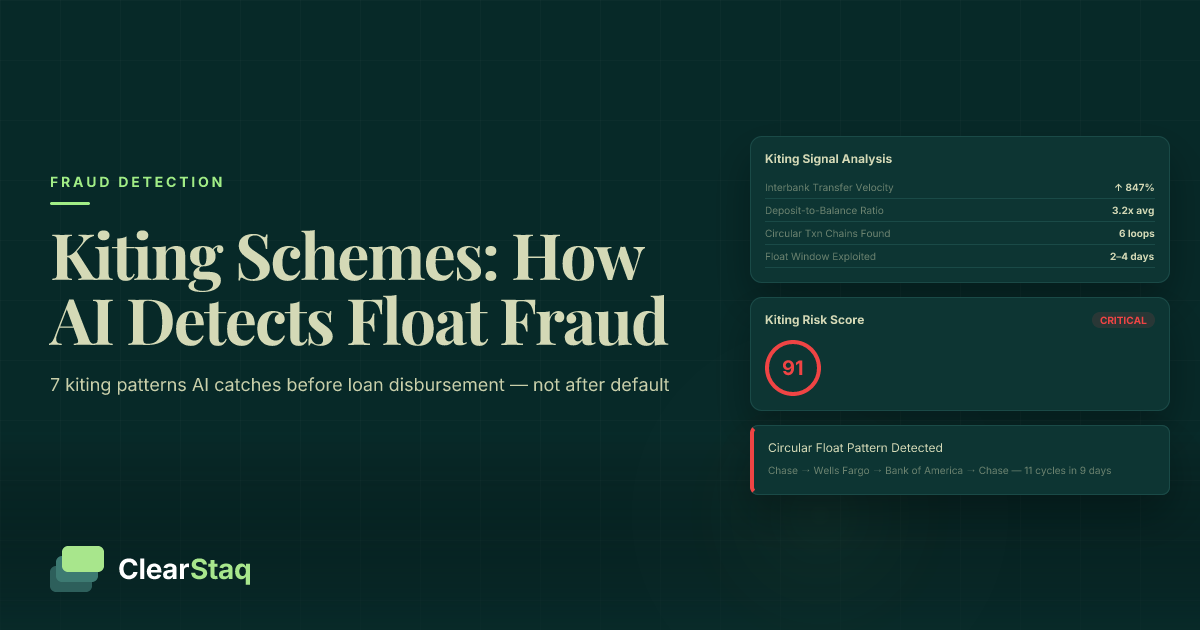
Check kiting detection identifies float-based fraud where a business artificially inflates account balances by cycling funds between accounts during clearing delays. Modern AI systems detect kiting by analyzing interbank transfer velocity, deposit-to-balance ratios, and circular transaction patterns across submitted bank statements — flagging schemes before loan disbursement, not after default.
What you'll learn
- Check kiting exploits Regulation CC float windows to create phantom balances that inflate apparent creditworthiness during underwriting review
- Seven co-occurring bank statement patterns — including escalating transfer size, Thursday/Friday deposit clustering, and circular fund-flow graphs — reliably identify active kiting schemes
- Same-day ACH compressed but did not eliminate kiting windows; sophisticated fraudsters now use mixed-rail strategies combining ACH and paper checks to maintain exploitable float gaps
- Manual underwriters cannot detect circular transfer networks because they review one account at a time — the defining fraud signal only appears when multiple submitted statements are analyzed together
- AI systems compute interbank transfer ratios, deposit concentration metrics, and cross-account graph structures in seconds, enabling pre-disbursement kiting detection at lending scale
Check kiting detection identifies float-based fraud where a business artificially inflates account balances by cycling funds between accounts during clearing delays. Modern AI systems detect kiting by analyzing interbank transfer velocity, deposit-to-balance ratios, and circular transaction patterns across submitted bank statements — flagging schemes before loan disbursement, not after default.
What Is a Kiting Scheme? (And Why It Still Works in 2026)
A check kiting scheme exploits the float window — the delay between when a deposit is recorded and when funds are actually collected — to create phantom balances that don't exist. The fraudster writes a check against funds that haven't cleared, deposits that check into a second account, and uses the temporary phantom balance to cover obligations or fool lenders into believing the business has more cash than it does.
Despite faster payments, kiting remains a serious threat in 2026. Same-day ACH compressed the float window but didn't eliminate it. Weekends extend clearing delays. Not every transaction qualifies for accelerated settlement. Fraudsters have adapted their timing accordingly — and the losses fall on lenders who approved loans based on inflated balances.
Federal law treats kiting as bank fraud under 18 U.S.C. § 1344, carrying penalties of up to 30 years imprisonment and $1 million in fines. The legal risk doesn't deter determined fraudsters — it just means they're more careful about building schemes that look legitimate. Our analysis of bank statement fraud in MCA lending shows float manipulation schemes are among the most consistently underdetected fraud types in small business lending.
How the Float Window Creates Phantom Balances
The mechanics are straightforward. Account A writes a check to Account B. Before that check clears, Account B shows the deposited amount as available — creating a phantom balance, funds that appear present but haven't been collected. Account B then writes a check back to Account A to cover the overdraft before it hits. The cycle repeats.
Each cycle must grow larger than the last. The original overdraft from Account A must be covered, plus the new float gap created by the returning check. The scheme accelerates mathematically toward collapse: the kite size doubles every few cycles. At scale, a business-level kite can reach hundreds of thousands of dollars within weeks.
Business accounts are prime targets for this scheme. Higher transaction limits, greater baseline transaction volume, and less automated monitoring at the account level all make it easier for a kiter to hide growing transfer sizes within what looks like normal operating activity.
Simple vs. Corporate Kiting: Scale and Complexity
Simple kiting involves two accounts at one or two institutions, typically small dollar amounts, often one individual. Banks catch this relatively quickly through internal monitoring — the pattern is obvious when you can see both sides of the transfer.
Corporate kiting operates across multiple accounts at multiple institutions, sometimes involving shell entities or multiple authorized signatories. The kiter deliberately spreads the scheme across banks to prevent any single institution from seeing the complete circular pattern. Each bank sees only its side of the transfers — large, regular deposits that look like healthy cash flow.
Multi-bank corporate kiting is where manual detection breaks down completely. No single bank has the full picture. And when a borrower submits bank statements to a lender, the lender sees only what the borrower provides — which rarely includes the accounts at the other institutions completing the circle.
How Float Manipulation Creates Phantom Balances
Regulation CC — the Federal Reserve's funds availability rule — is the legal framework that kiting schemes exploit. Under Federal Reserve Regulation CC, banks must make deposited funds available to customers within defined timeframes, even before those funds are actually collected from the paying institution. That gap between availability and collection is the kiting opportunity.
Understanding the specific Reg CC hold periods is essential for understanding how kiting windows are engineered. The table below shows the standard availability schedule that creates exploitable float:
| Deposit Type | Availability Requirement | Kiting Exploitability |
|---|---|---|
| Cash, wire transfers, government checks | Next business day | Low — clears too fast |
| Local checks (same Fed district) | 2 business days | Medium — 1-2 day float window |
| Non-local checks | Up to 5 business days | High — 3-5 day window |
| ACH credits (standard) | Next business day | Medium — return window extends exposure |
| ACH credits (same-day) | Same day (hours) | Low — but batch windows create gaps |
The key principle: banks must make funds available before they are collected. A business exploiting this rule can withdraw funds from Account B the moment the deposit clears for availability — days before the underlying check clears from Account A.
How Regulation CC Creates the Exploitable Window
Reg CC distinguishes between "local" and "non-local" checks based on which Federal Reserve district the paying bank sits in. Local checks carry a 2-day availability requirement. Non-local checks can be held up to 5 business days. A kiter deliberately chooses accounts at banks in different Fed districts to maximize the float window on each cycle.
Banks are permitted to delay availability for deposits that exceed $5,525 in a single day, for accounts less than 30 days old, or when there is reasonable cause to suspect a check won't be paid. But these exceptions require the bank to act proactively — and in a high-volume business account, individual transactions rarely trigger manual review.
Why Same-Day ACH Changed — But Didn't End — Kiting
Same-day ACH settlement, expanded significantly in 2021, compressed the standard float window from 1-2 business days to hours for qualifying transactions. That should have killed kiting. It didn't.
Not all ACH transactions qualify for same-day settlement. Transactions over $1 million per item are excluded. Batch cutoff windows mean transactions submitted after the second daily cutoff settle the next day. Weekends create a built-in 48-hour float extension that no same-day ACH rule eliminates.
Sophisticated kiters have adapted with mixed-rail strategies: ACH transfers on Monday through Wednesday, paper checks deposited on Thursday and Friday to exploit the weekend float extension. They also mix transaction instruments — some ACH, some check — to disrupt the velocity patterns that automated monitoring systems are tuned to catch. No competitor has addressed this adaptation publicly. It's a real and current threat that makes modern kiting detection fundamentally different from the manual techniques developed in the 2000s. For more on how modern schemes exploit ACH payment rails, see our guide to ACH fraud in business lending.
Modern Kiting Variants: Beyond the Paper Check
Classic check kiting required physical checks and relied on mail float and bank processing delays. Modern float fraud schemes operate across digital payment rails, involve multiple institutions, and can be specifically designed to appear on bank statements as legitimate business activity. Underwriters reviewing submitted statements for loan applications are the last line of defense before funds are disbursed.
There are four primary kiting variants active in business banking today:
- Classic check kiting — Paper checks between accounts, exploiting non-local hold periods
- ACH kiting — Exploiting ACH return windows and batch processing gaps
- Hybrid rail kiting — Mixed ACH/check strategies designed to evade single-rail monitoring
- Loan-application kiting — Submitting statements during an active cycle to inflate apparent balance and cash flow for underwriting purposes
ACH Kiting: How Digital Rails Extended the Scheme
ACH kiting exploits the return window rather than the availability window. When an ACH credit is deposited, funds become available quickly. But the ACH return process allows the paying institution to reverse the transaction for up to 2 business days (R01-R09 return codes). This creates a window where funds appear settled and available but can still be recalled.
A typical ACH kiting cycle: a company initiates an ACH credit from Account A to Account B. Account B shows funds as available within hours. The business withdraws or transfers from Account B before the ACH return window closes at Account A. Account A initiates a new ACH credit back to Account B — and the cycle continues.
Same-institution ACH transfers clear faster, which drives cross-institution scheme design: kiters deliberately use accounts at different banks to keep the return window open longer and prevent either institution from seeing the full loop. ACH transaction volume is enormous, making individual transfers invisible in the noise.
Loan-Application Kiting: The Underwriter's Blind Spot
This is the variant that matters most for lenders — and the one no competitor has addressed. A borrower submits a 3-month bank statement window that coincides with an active kiting cycle. What the statement shows: an elevated average daily balance, large regular deposits that are actually interbank transfers, and apparent cash flow that looks healthy or even impressive.
What the statement hides: the circular nature of the deposits, the escalating transfer size across weeks, and the accounts at other institutions that are completing the loop. To a manual reviewer, this business looks creditworthy. The loan is approved. The kiting scheme collapses 30-90 days later — after disbursement, before the first payment.
This is why duplicate transaction detection matters: the same funds cycling between accounts inflate apparent revenue by recording the same money multiple times across the submitted statement period. The circular pattern is mathematically present in the data — but only visible to a system analyzing all submitted statements together.
The cross-account linkage logic that maps MCA stacking networks applies directly to kiting detection: when funds originate in Account A, appear in Account B, and return to Account A within a short window, the circular graph structure is the fraud signal — regardless of what payment rail the transfers used.
7 Bank Statement Patterns That Reveal a Kiting Scheme
No single pattern confirms kiting. Each of the seven signals below can have an innocent explanation. What makes kiting detectable — and what distinguishes AI-driven analysis from manual review — is the co-occurrence of multiple signals in the same statement period. Three or more of these patterns appearing together elevates the risk score dramatically.
Patterns 1–4: Transfer and Balance Anomalies
Pattern 1 — Abnormally High Interbank Transfer Frequency. A legitimate business makes interbank transfers occasionally — payroll funding, vendor payments, account consolidation. A kiting scheme generates daily or near-daily large transfers between accounts at different institutions. When the ratio of interbank debits to total debits exceeds baseline norms for the business type and size, it's a primary kiting indicator.
Pattern 2 — Deposit-to-Collected Balance Divergence. Kiting inflates the stated ledger balance while the actual collected balance remains low. Large deposits appear, but when you compute average collected balance against gross deposits over the period, the ratio is abnormally compressed. This is the mathematical signature of phantom funds cycling through the account — a pattern invisible to reviewers looking at the stated balance alone.
Pattern 3 — Round-Dollar Transfer Patterns. Legitimate interbank transfers tend to correspond to invoices, payroll amounts, or specific vendor obligations — irregular amounts. Kiting transfers are often round numbers: $10,000, $25,000, $50,000. These amounts are chosen for convenience, not business purpose. Round-dollar deposit patterns across a statement period flag for manual follow-up in any robust detection program.
Pattern 4 — Escalating Transfer Size Over Time. The kite must grow to cover each prior cycle's overdraft. A statement showing week-over-week increases in interbank transfer amounts is exhibiting the mathematical hallmark of an accelerating scheme. A week-one transfer of $20,000 becomes $30,000 in week two, $45,000 in week three — the escalation curve is the scheme's countdown timer.
Patterns 5–7: Timing and Velocity Red Flags
Pattern 5 — Thursday/Friday Deposit Clustering. When a disproportionate share of large interbank deposits occur on Thursday and Friday, it indicates deliberate exploitation of the weekend float extension. Deposits on Friday don't clear until the following Monday or Tuesday — creating 3-4 days of phantom balance. Statistical analysis of deposit day-of-week distribution makes this pattern measurable rather than subjective.
Pattern 6 — Low or Negative End-of-Day Balance Despite High Activity. Kiting creates high gross transaction volume but balances near zero at the close of each business day. The stated average daily balance may look acceptable because large morning deposits offset low closing balances. But analyzing intraday balance trajectory reveals the pattern: funds arrive, are immediately transferred out, and the account closes near zero consistently.
Pattern 7 — Circular Transfer Network Across Submitted Accounts. When a borrower submits statements from multiple business accounts, AI can map the fund flow between them. Funds originating in Account A, deposited into Account B, returned to Account A within 1-3 business days form a directed circular graph. This is only detectable when multiple statements are analyzed together — a capability that requires automated cross-account analysis, not manual review of individual PDFs. It's also where structuring patterns in business bank statements frequently co-occur, since kiters often segment transfer amounts to stay below monitoring thresholds.
The heatmap above illustrates how signal co-occurrence drives risk classification. One pattern in isolation produces a low-risk flag. Four or five co-occurring signals — transfer frequency, escalating amounts, Thursday clustering, near-zero daily closing balances, and circular graph structure — combine into a high-risk score that warrants immediate escalation before disbursement.
See Kiting Pattern Detection in Action
ClearStaq's fraud engine analyzes all 7 kiting indicators simultaneously — across every transaction in every submitted statement. Upload a bank statement and see instant fraud scoring with full signal breakdown. Start your free trial — no credit card required.
Why Manual Detection Fails (And How Often It's Too Late)
Manual underwriting review has a structural flaw: reviewers examine one statement at a time. They see Account A's activity in isolation. They never see Account B. The circular nature of the transfers — the defining feature of a kiting scheme — is architecturally invisible to any reviewer looking at a single account's records.
The FDIC Supervisory Insights on kiting detection documents the examiner-grade techniques — kite rider analysis, transaction ratio method, average collected balance analysis — that can surface kiting patterns from bank records. These techniques are powerful. But they require a dedicated analyst with access to transaction-level data from all accounts in the scheme, and hours of computation time. At the volume of applications that modern lenders process, this capacity simply doesn't exist.
The Underwriter's Dilemma: High Volume Looks Like Health
Kiting creates exactly the financial profile that loan underwriting is designed to reward. Elevated average daily balance. High gross deposit volume. Regular, large inflows. Apparent cash flow consistency. A business in the middle of an active kiting scheme appears more creditworthy than a legitimate business with the same actual cash position.
This is what makes kiting particularly dangerous in lending contexts. It doesn't just hide fraud — it actively mimics health. Manual reviewers have no baseline for what a "normal" interbank transfer frequency looks like for a $2 million revenue business in the HVAC industry. Anomalies are invisible without quantitative context. These artificial cash flow patterns are engineered to pass manual review — and they consistently do.
The ghost balance problem compounds this: the stated balance in a kiting scheme includes uncollected funds that will be reversed. The ledger balance overrepresents actual cash position. A reviewer approving a line of credit based on average daily balance is approving credit against funds that, in some cases, have never existed as collected cash.
When Detection Happens vs. When It Needs to Happen
Banks typically detect kiting through internal account monitoring — often 3-6 weeks into a scheme, after unusual transfer patterns have accumulated enough data to trigger rule-based alerts. This is too late for the lender who has already disbursed funds based on a statement from that period.
The pre-disbursement review window is the only moment when detection prevents loss. Once a loan is funded against a kited balance, the lender's exposure is the full principal amount. When the scheme collapses — typically when one institution freezes the account or the kiter can't sustain the escalating transfer sizes — the business fails, the bank accounts go to zero, and the lender has an unsecured claim against an insolvent borrower.
The detection timeline matters enormously: schemes typically collapse 30-90 days after loan disbursement, which is also before the first payment is due. The lender's first indication that something is wrong may be a missed payment — by which point the collateral, if any, is the only recovery path.
How AI Detects Float-Based Fraud in Real Time
Automated kiting detection works by computing specific measurable signals from transaction-level data and comparing them against dynamic baselines — not by applying static rules that sophisticated kiters can learn to avoid. The distinction matters: rule-based systems are defeated by scheme adaptation; pattern-based AI systems detect the underlying mathematical structure that kiting always produces, regardless of which payment rails the fraudster uses.
Transaction Velocity and Ratio Analysis at Scale
Three core ratios form the computational foundation of kiting detection:
- Interbank transfer ratio: interbank debits ÷ total debits. A legitimate business operating with one primary account might show 5-15% interbank transfer activity. A kiting scheme often pushes this ratio above 40-60%.
- Deposit concentration ratio: the largest single deposit source's share of total deposits. When one counterparty — often the other kiting account — represents 30-50% of all inflows, it's anomalous.
- Collected balance ratio: average collected balance ÷ average ledger balance. A significant divergence between these figures — the ledger showing higher than collected — indicates phantom funds cycling through the account.
AI computes these ratios across 90 days of transactions in seconds. Thresholds are dynamic: the system benchmarks each ratio against business type, revenue size, and industry vertical to reduce false positives. A real estate holding company has a legitimately high interbank transfer ratio; a sole-proprietor service business does not. These are among ClearStaq's 27 fraud signals computed for every submitted bank statement.
Multi-Account Graph Detection: Mapping the Kite Network
When a borrower submits statements from multiple business accounts, AI constructs a directed graph of fund flows between them. Each account is a node. Each interbank transfer is a directed edge. Circular graph structures — Account A → Account B → Account A, or A → B → C → A — are mathematically flagged as potential kiting networks.
This is the most powerful kiting detection capability available — and the one completely unavailable to manual reviewers. A human analyst looking at two separate PDFs can't track dollar amounts across documents and identify when the same funds appear as a debit in one and a deposit in another within a 48-hour window. An AI system performs this graph construction automatically, across every transaction in every submitted statement simultaneously.
ClearStaq performs this analysis across 900+ bank formats. The same circular transfer pattern is detected whether the accounts are at Chase, Bank of America, or a regional credit union — because the pattern analysis works at the transaction-data level, not the format level. Document integrity is verified in parallel through PDF metadata analysis, which can detect whether a statement has been altered to remove or obscure transactions that would reveal the circular pattern.
The fraud score visualization above shows how individual kiting signals — velocity anomalies, ratio divergence, circular graph flags, timing clustering, PDF integrity — are each scored independently and combined into a single composite risk score with a component-level breakdown. Underwriters see exactly which signals fired and with what severity, giving them a defensible basis for the disbursement decision.
What Underwriters Should Look for Before Loan Disbursement
Knowing what kiting looks like is only useful if it translates into a concrete pre-disbursement workflow. The following framework applies whether your team is using automated detection tools or conducting enhanced manual review on flagged applications.
The Pre-Disbursement Kiting Checklist
Before approving any business loan application, run through these specific checks for kiting indicators:
- Request all business account statements. If the applicant mentions multiple operating accounts — even in passing — all statements should be submitted and cross-analyzed. A borrower who submits only one account while running a kiting scheme between two is providing an incomplete picture by design.
- Calculate interbank transfer frequency. Count the number of large transfers (above $5,000) between accounts at different institutions in the review period. More than 3-4 per week warrants additional scrutiny.
- Verify large deposit sources. For every deposit above $10,000, confirm that it corresponds to an identifiable revenue event — customer payment, contract disbursement, insurance proceeds. Deposits that trace back to another business account the applicant controls are not revenue.
- Compare stated average daily balance against collected balance. If the bank statement shows average daily balance figures, ask whether those figures reflect ledger balance or collected balance. The gap between them is where phantom funds live.
- Check deposit day-of-week distribution. A healthy business receives deposits across the week. A disproportionate clustering of large deposits on Thursday and Friday indicates deliberate float timing.
- Cross-reference debits and deposits across submitted statements. If the same dollar amount appears as a debit in Account A and a deposit in Account B on the same or adjacent dates — particularly if this pattern repeats — you're looking at potential circular transfers.
These checks integrate directly with the broader workflow for verifying business bank accounts before loan disbursement and complement any MCA underwriting checklist your team is already using.
When to Pause, Escalate, or Decline
Not every kiting signal requires the same response. The decision framework should be proportional to signal co-occurrence:
| Signals Detected | Recommended Action | Documentation Required |
|---|---|---|
| 1-2 individual signals | Flag for senior underwriter review; request additional documentation or bank verification | Note signals identified, documentation requested |
| 3+ co-occurring signals | Pause disbursement; initiate enhanced due diligence; consider SAR filing | Full signal inventory; decision rationale |
| Circular transfer network confirmed | Decline application; document findings; initiate SAR within required timeframe | SAR narrative with transaction-level evidence |
The SAR obligation doesn't end with declining the loan. If kiting is suspected, BSA requirements may mandate reporting regardless of the lending decision. Document all findings contemporaneously — signal descriptions, transaction dates, dollar amounts, and the disposition decision. That documentation becomes the SAR narrative and the defense of your BSA program's reasonableness if examiners ask.
Regulatory Obligations: SARs, Reg CC, and BSA Compliance
Detecting kiting creates compliance obligations — not just for banks, but for non-bank lenders with AML program requirements. Understanding those obligations before a kiting scheme surfaces is essential. Finding out about SAR requirements after you've declined an application and discarded the records is a regulatory problem of its own.
SAR Filing Requirements for Kiting
The BSA mandates SAR filing when a financial institution knows, suspects, or has reason to suspect that a transaction involves funds from illegal activity, is designed to evade reporting requirements, or lacks a lawful purpose. Check kiting meets this standard unambiguously — it's federal bank fraud.
The filing thresholds are specific: $5,000 for transactions involving an insider, $25,000 for other suspicious activity. A kiting scheme operating at business scale almost always exceeds the $25,000 threshold within a few cycles. The SAR must be filed within 30 calendar days of detecting the suspicious activity — or 60 days if no suspect can be identified.
The SAR narrative should include: specific transaction dates and amounts, account numbers, the interbank transfer pattern detected, the specific signals that indicated circular fund flow, and the basis for suspecting kiting rather than legitimate activity. FinCEN's guidance in FIN-2014-A006 provides specific direction on SAR narratives for check fraud and kiting-related activity.
SAR filers receive safe harbor protection from civil liability under 31 U.S.C. § 5318(g)(3), provided the filing is made in good faith. File, document, and do not disclose the filing to the subject — the tipping-off prohibition applies.
Building a Defensible Detection Program
Regulators reviewing your BSA/AML program expect documented procedures for transaction monitoring that include kiting indicators. The FFIEC BSA/AML Examination Manual sets the compliance standard, and examiners evaluate both the existence of monitoring controls and their effectiveness at detecting the schemes they're designed to catch.
AI-driven detection systems provide something manual programs cannot: auditable, transaction-level evidence of every signal evaluated and every threshold compared. When an examiner asks why a particular application didn't result in a SAR, you can produce the computed signal scores, the thresholds applied, and the analyst disposition notes. That level of documentation is difficult or impossible to reconstruct from manual review processes.
Detection programs should also be updated as scheme variants evolve. The mixed-rail kiting strategies emerging in response to same-day ACH require detection logic tuned to cross-rail patterns, not just single-instrument velocity. Building an AML transaction monitoring program that stays current with scheme evolution is an ongoing compliance function, not a one-time implementation project. For broader context on how AML compliance checks fit together, kiting detection sits within a larger transaction monitoring and due diligence framework.
How ClearStaq Catches Kiting Patterns That Manual Review Misses
ClearStaq's fraud detection platform operationalizes everything described in this guide — not as a manual checklist, but as an automated analysis that runs on every submitted statement before a disbursement decision is made.
The system computes all seven kiting indicators described above, cross-references signals against dynamic baselines by business type and industry, and produces a composite fraud score with component-level breakdown — in seconds, not hours. When multiple statements are submitted for the same borrower, cross-account graph analysis runs automatically, mapping fund flows between accounts and flagging circular transfer networks that no manual reviewer would detect.
From PDF to Fraud Score: The ClearStaq Workflow
The detection process follows five steps, all automated:
- Parse and normalize: Bank statements submitted as PDFs are parsed across 900+ bank formats — no manual data entry, no format-specific configuration. Chase, Bank of America, Wells Fargo, and regional credit unions all produce normalized transaction data from the same pipeline.
- Compute transaction-level signals: Velocity, interbank transfer ratios, deposit concentration, collected-to-ledger balance divergence, timing distribution, escalation curves — all computed across the full statement period simultaneously.
- Run cross-account graph analysis: When multiple statements are present, a directed fund-flow graph is constructed automatically. Circular structures are mathematically flagged with graph analysis, not pattern matching against static rules.
- Check PDF metadata integrity: Document metadata, font consistency, pixel-level artifact analysis, and editing history are checked in parallel to detect statements altered to remove or modify transactions that would reveal a kiting pattern.
- Generate composite fraud score: All signals are combined into a single risk score with component breakdown — so underwriters see exactly which signals fired, at what severity, and with which supporting transactions as evidence.
Total processing time: seconds per application. This enables pre-disbursement screening at the volume a modern lender actually operates — without adding analyst headcount or slowing the origination funnel.
What ClearStaq Flags That Human Eyes Cannot See
Several of the most powerful kiting signals are simply undetectable through manual review, regardless of reviewer skill:
- Kite escalation curve: Week-over-week transfer size growth is mathematically present in the transaction sequence but visually invisible in a table. No human reviewer scans a month of transactions and calculates the rate of change. An AI system does it in milliseconds.
- Circular transfer graph: The circular pattern only exists when you analyze multiple submitted statements simultaneously and match debits in one account to deposits in another by date and amount. This is architecturally impossible in a single-statement review workflow.
- Thursday/Friday deposit clustering: Statistical analysis of deposit day-of-week distribution across a 90-day period produces a precise measurement of timing skew. A manual reviewer might notice "a lot of Friday deposits" — AI measures the deviation from expected distribution and scores it.
- Ghost balance detection: Comparing ledger balance trajectory against collected balance trajectory across the full statement period reveals the divergence pattern that phantom funds create. This requires computing two separate balance series from transaction data — automated, not visual.
- Interbank transfer ratio anomaly: Computed against 900+ bank-specific and industry-specific baselines, this ratio identifies whether the applicant's interbank activity is anomalous for a business of their type — not just anomalous in absolute terms.
These capabilities address the core gap in every competitor's detection methodology: the bank statement fraud red flags AI catches are precisely the ones that don't appear in a manual review workflow. Kiting is designed to look legitimate to human reviewers. It's not designed to withstand quantitative analysis at the transaction graph level.
For teams ready to deploy this capability, the integration of fraud detection into a loan origination workflow is straightforward via ClearStaq's API — results are returned before the underwriting decision, not queued for post-disbursement review.
Frequently Asked Questions
What is check kiting in business banking?
Check kiting is a form of bank fraud where a business exploits the float window — the delay between when a deposit is recorded and when funds are collected — to create artificial balances across multiple accounts. Funds cycle between accounts, each deposit covering the previous overdraft before it clears. In business banking contexts, kiting often involves multiple accounts at different institutions to prevent any single bank from seeing the complete pattern.
How do banks detect check kiting?
Banks use internal transaction monitoring to flag unusual interbank transfer frequency, accounts with consistently low collected balances despite high deposit volume, and round-dollar transfer patterns. Examiner-grade techniques include kite rider analysis, transaction ratio method, and average collected balance analysis — documented by the FDIC. AI systems now automate these techniques at scale, computing interbank transfer ratios and fund-flow graphs across multiple accounts in seconds.
What are the signs of a kiting scheme in bank statements?
Seven key indicators: (1) abnormally high interbank transfer frequency, (2) deposit-to-collected balance divergence, (3) round-dollar transfer patterns, (4) escalating transfer size over time, (5) Thursday/Friday deposit clustering, (6) near-zero end-of-day balances despite high gross activity, and (7) circular transfer networks visible when multiple account statements are analyzed together. No single signal is definitive — co-occurrence of three or more is the reliable fraud signal.
Is check kiting illegal?
Yes. Check kiting is prosecuted as bank fraud under 18 U.S.C. § 1344, which carries penalties of up to 30 years imprisonment and $1 million in fines. It also triggers BSA/AML reporting obligations for financial institutions that detect suspected kiting activity, including mandatory SAR filing within 30 days of detection.
Can AI detect check kiting accurately?
Yes — and AI outperforms manual detection on specific kiting signals. AI systems compute interbank transfer ratios, deposit concentration metrics, and collected-versus-ledger balance divergence across 90 days of transactions in seconds. More importantly, AI can construct cross-account fund-flow graphs when multiple bank statements are submitted together, identifying circular transfer networks that are completely invisible to reviewers analyzing accounts individually.
What is the difference between check kiting and wire fraud?
Check kiting exploits clearing float — the time between a deposit being recorded and funds being collected — through interbank transfer cycles. Wire fraud involves using false pretenses to obtain funds electronically, typically in a single transaction rather than through a cycling scheme. Kiting creates phantom balances across time; wire fraud typically involves a discrete deceptive transfer. Both are federal crimes, but they trigger different monitoring signals and SAR narrative requirements.
When should a lender file a SAR for suspected kiting?
A SAR must be filed within 30 calendar days of detecting suspicious activity that meets the $25,000 threshold for non-insider transactions. If kiting is suspected from bank statement analysis — even if the loan application is declined — the BSA reporting obligation exists independently of the credit decision. If no suspect is identified, the filing deadline extends to 60 days. Document all signals detected and the specific transactions that triggered suspicion — this becomes the SAR narrative.
Ready to Catch Kiting Before It Becomes a Loss?
ClearStaq detects all 7 kiting indicators — interbank transfer velocity, collected balance divergence, circular fund-flow graphs, escalation curves, and more — across every submitted bank statement before disbursement. Stop approving loans against phantom balances. Start your free trial today.
Frequently Asked Questions
What is check kiting in business banking?
Check kiting is a form of bank fraud where a business exploits the float window — the delay between when a deposit is recorded and when funds are collected — to create artificial balances across multiple accounts. Funds cycle between accounts, each deposit covering the previous overdraft before it clears. In business banking, kiting often spans multiple accounts at different institutions to prevent any single bank from seeing the complete pattern.
How do banks detect check kiting?
Banks use internal transaction monitoring to flag unusual interbank transfer frequency, consistently low collected balances despite high deposit volume, and round-dollar transfer patterns. Examiner-grade techniques include kite rider analysis, transaction ratio method, and average collected balance analysis. AI systems now automate these techniques at scale, computing interbank transfer ratios and fund-flow graphs across multiple accounts in seconds.
What are the signs of a kiting scheme in bank statements?
Seven key indicators: abnormally high interbank transfer frequency, deposit-to-collected balance divergence, round-dollar transfer patterns, escalating transfer size over time, Thursday/Friday deposit clustering, near-zero end-of-day balances despite high gross activity, and circular transfer networks visible when multiple account statements are analyzed together. No single signal is definitive — co-occurrence of three or more is the reliable fraud signal.
Is check kiting illegal?
Yes. Check kiting is prosecuted as bank fraud under 18 U.S.C. § 1344, carrying penalties of up to 30 years imprisonment and $1 million in fines. It also triggers BSA/AML reporting obligations for financial institutions that detect suspected kiting activity, including mandatory SAR filing within 30 days of detection.
Can AI detect check kiting accurately?
Yes — and AI outperforms manual detection on specific kiting signals. AI systems compute interbank transfer ratios, deposit concentration metrics, and collected-versus-ledger balance divergence across 90 days of transactions in seconds. More importantly, AI constructs cross-account fund-flow graphs when multiple bank statements are submitted together, identifying circular transfer networks that are completely invisible to reviewers analyzing accounts individually.
What is the difference between check kiting and wire fraud?
Check kiting exploits clearing float through interbank transfer cycles that create phantom balances across time. Wire fraud involves using false pretenses to obtain funds electronically, typically in a single transaction rather than a cycling scheme. Both are federal crimes, but they trigger different monitoring signals and SAR narrative requirements.
When should a lender file a SAR for suspected kiting?
A SAR must be filed within 30 calendar days of detecting suspicious activity exceeding the $25,000 threshold for non-insider transactions. The BSA reporting obligation exists independently of the credit decision — declining the loan does not eliminate the filing requirement. If no suspect is identified, the deadline extends to 60 days. Document all detected signals and specific transactions contemporaneously to support the SAR narrative.
ClearStaq Team
Product Team
The ClearStaq team builds AI-powered tools for bank statement parsing, fraud detection, and income verification.