Structuring shows up as a pattern, not a single transaction — and most underwriters miss it because they're reading statements one month at a time instead of looking at the full deposit rhythm.
This guide walks through the exact steps for spotting structuring patterns in business bank statements: which deposit clusters to flag, what timing tells you, and where automated signal detection catches what a manual scan won't.
TL;DR
Structuring means breaking large cash deposits into smaller amounts to duck the $10,000 Currency Transaction Report (CTR) threshold — a felony under 31 U.S.C. § 5324 even when the underlying funds are legitimate. To spot it in business bank statements, scan for deposits clustered between $8,000 and $9,999, same-day multi-deposit patterns across branches, and round-number amounts that repeat weekly. Verdict: manual review catches obvious cases; automated signal detection (like ClearStaq's 27+ fraud signals) catches the subtle ones in under 5 seconds per statement. In 2026, structuring remains one of the top reasons MCA and small-business loans get flagged post-funding.
Why this matters
Structuring isn't rare. It shows up in cash-heavy businesses — restaurants, salons, contractors, auto repair — where an owner deposits $9,500 on Monday and another $9,200 on Tuesday instead of one $18,700 deposit. Sometimes it's tax avoidance. Sometimes it's laundering. Either way, a lender who funds a structured account is underwriting on numbers that don't reflect the real cash position, and a bank that ignores repeated sub-threshold deposits carries its own BSA exposure.
The cost of missing it isn't hypothetical. A single misread statement can mean funding a business that's already under federal scrutiny, or approving a merchant cash advance against revenue that's inflated by round-tripped deposits. In 2026, with statement volume up across MCA and alt-lending channels, manual review teams simply don't have the hours to eyeball twelve months of transactions per file.
What you'll need
- At least 12 months of business bank statements — 3-month snapshots hide seasonal structuring
- A transaction-level export (CSV or parsed PDF), not just summary balances
- A reference list of the account holder's stated business type, to judge whether cash volume is plausible
- A CTR threshold reference ($10,000) and your institution's internal SAR filing policy
- Optional but faster: a parsing tool that flags deposit clustering automatically, like ClearStaq
The steps
1. Pull the full 12-month statement history
Three months of statements will not show a structuring pattern that repeats on a six-week cycle. Pull the full year, even if the loan application only requires three.
Why it matters: structuring often tracks payroll or supplier cycles — an owner structures deposits the week before a big cash payout, then goes quiet for a month. A 3-month window catches maybe one occurrence. A 12-month window catches the pattern.
Common mistake: reviewers stop at the statements the applicant submitted. If the file only has 3 months, request the rest before final approval.
2. Flag every deposit between $8,000 and $9,999
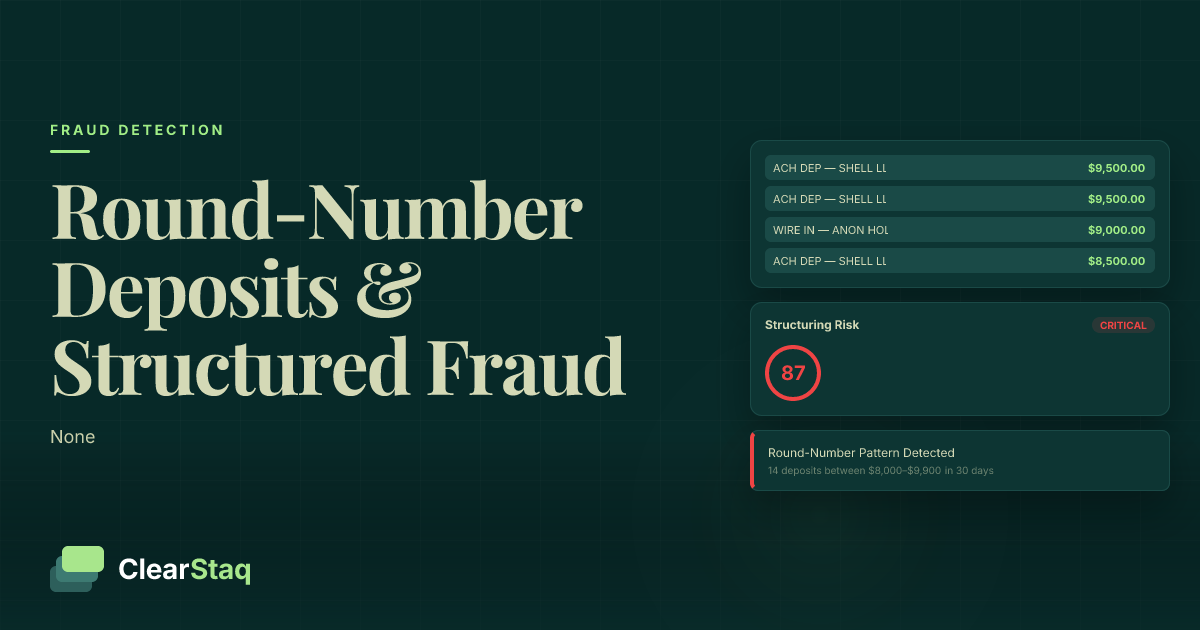
This is the single highest-signal range. Deposits repeatedly landing just under the $10,000 CTR threshold — especially $9,000, $9,500, $9,800 — are the clearest structuring tell.
Why it matters: a business with genuinely variable cash flow deposits irregular amounts — $6,200 one week, $14,800 the next. A business structuring deposits clusters tightly under $10,000 with unnatural precision.
Instruction: sort all deposits descending, isolate the $8,000-$9,999 band, and count occurrences per month. Three or more in a single month is a hard flag.
3. Check for same-day multiple deposits
Structuring frequently splits one large cash amount into two or three deposits made the same day, sometimes at different branches.
Why it matters: a single business rarely needs two same-day deposits under $10,000 unless it's deliberately avoiding a report. Legitimate businesses deposit once per day, once per shift at most.
Instruction: group transactions by date, sum same-day deposit totals, and check whether any single day's combined deposits exceed $10,000 while no individual deposit does.
4. Look for round-number repetition
Real cash businesses deposit whatever came in that day — $4,187.32, $6,940.15. Structured deposits often round to the nearest hundred or thousand because the amount was chosen, not counted.
Why it matters: round numbers repeating weekly ($9,000, $9,000, $9,000) signal a deliberate ceiling, not organic revenue.
Common mistake: dismissing round numbers as coincidence in a single month. The pattern only becomes meaningful across multiple consecutive statements.
5. Cross-reference deposit timing against the business's actual cycle
A retail business with weekend foot traffic should show weekend-heavy deposits. A B2B contractor billing on net-30 terms should show monthly, not daily, deposit spikes.
Why it matters: structuring often ignores the business's real cash cycle because the deposits are manufactured, not earned. A mismatch between stated business type and deposit timing is a secondary flag worth investigating alongside the CTR-band pattern from step 2.
6. Check for multiple accounts feeding the same entity
Structuring sometimes spreads across two or three business accounts at different banks, each individually under threshold, aggregating to a much larger real cash position.
Why it matters: reviewing one account in isolation misses the aggregate. If the application lists a single EIN but the owner mentions "another account" in an aside, request it — commingled entities and structured splits often travel together, which is why detecting commingled funds is a companion check to run alongside structuring review.
7. Run an automated signal check before final approval
Manual review catches the obvious cases in a single statement. It rarely catches a pattern that spans 12 months and two accounts, because nobody has time to cross-reference that by hand on every file.
Why it matters: this is where a parser with fraud-signal detection earns its keep. ClearStaq runs 27+ fraud signals across parsed statements in under 5 seconds, flagging deposit clustering, same-day splits, and round-number repetition automatically — the same checks from steps 2 through 4, run at 99.5% accuracy without a reviewer manually sorting rows.
Expected outcome: a flagged file gets a documented reason for escalation instead of a reviewer's gut feeling, which matters if the file ever gets audited.
Troubleshooting
- Cash-heavy legitimate businesses trigger false positives. Salons, laundromats, and food trucks deposit cash daily in irregular amounts that can resemble structuring. Cross-check against the stated business type before flagging — irregular but non-clustered amounts are a lower-priority signal.
- Seasonal batching looks like structuring but isn't. A landscaping business depositing large sums only in spring and summer isn't structuring — it's a seasonal cycle. Check whether the sub-$10,000 pattern repeats year-round or only during predictable high-volume months.
- Multiple deposits on the same day from a legitimate multi-location business. A business with three storefronts depositing separately isn't splitting one transaction — verify location count against the deposit count before flagging.
- The applicant explains it as "avoiding bank fees" or "convenience." That explanation doesn't change the legal exposure. Structuring is a federal violation under 31 U.S.C. § 5324 regardless of stated intent, and a documented explanation still requires a SAR review decision, not a pass.
- Statements from different banks use different date and deposit formats. A parser that isn't format-aware will misalign same-day deposits across formats. Confirm the tool you're using handles multi-bank formatting before trusting its clustering output.
Tools and resources
- ClearStaq — parses bank statements and flags structuring, commingling, and income-smoothing signals automatically
- How to detect income smoothing in bank statement underwriting — for statements where revenue looks too consistent to be real
- Document fraud detection software for mortgage lenders — same signal logic applied to mortgage income verification
- Internal SAR filing policy and CTR threshold reference from your compliance team
What to do next
Once you've flagged a structuring pattern, the next question is whether the same file shows commingled personal and business funds — the two often appear together in files that don't hold up to underwriting. Run the commingled funds detection guide against the same statement set before making a final funding decision in 2026.
FAQ
What counts as structuring in a bank statement? Structuring is a pattern of deposits deliberately kept under the $10,000 CTR threshold to avoid federal reporting, typically showing up as repeated deposits in the $8,000-$9,999 range or multiple same-day deposits that individually stay under $10,000.
Is structuring illegal even if the money is legitimate? Yes. Under 31 U.S.C. § 5324, structuring deposits to avoid a CTR is a federal offense regardless of whether the underlying funds came from a lawful source.
How many months of bank statements should I review to catch structuring? 12 months minimum. A 3-month window catches maybe one occurrence of a pattern that often repeats on a monthly or seasonal cycle.
What's the difference between structuring and normal cash business deposits? Normal cash deposits are irregular in amount and timing, following actual daily sales. Structured deposits cluster tightly under $10,000 and often repeat in round numbers or same-day splits.
Can automated tools catch structuring better than manual review? Automated signal detection catches patterns across long statement histories and multiple accounts faster than manual review — ClearStaq processes statements in under 5 seconds and checks for structuring alongside 26 other fraud signals in the same pass.
Does structuring show up in tax returns too? Structuring is a bank-deposit pattern, not a tax-return pattern, but a business hiding cash through structured deposits often shows a mismatch between reported gross receipts and actual deposit totals — worth cross-referencing both documents.
What should a lender do after spotting a structuring pattern? Document the pattern, escalate to compliance for a SAR review decision, and treat the file's stated revenue as unverified until the discrepancy is resolved — do not proceed to funding on the original numbers.
Does one $9,500 deposit automatically mean structuring? No. A single sub-$10,000 deposit is common and not inherently suspicious. The pattern matters — repeated clustering across multiple weeks or months is the actual signal, not one transaction.
One last thing
The $10,000 threshold hasn't moved since the Bank Secrecy Act's CTR requirement was set decades ago, which means structuring gets easier to spot every year as inflation pushes normal cash transactions higher — a legitimate $9,800 deposit in 2026 looks a lot more like an outlier than it did when the threshold was set, which is exactly why deposit-clustering signals have gotten sharper, not weaker, over time.
Related guides
ClearStaq Team
Content Team
The ClearStaq team builds AI-powered tools for bank statement parsing, fraud detection, and income verification.