Mortgage lenders lose money to falsified pay stubs, doctored bank statements, and inflated income figures every underwriting cycle — and manual review catches maybe half of it. This guide breaks down what actually separates document fraud detection software that works from tools that just format PDFs nicely.
TL;DR
Document fraud detection software for mortgage lenders in 2026 needs three things: signal depth, processing speed, and format coverage across the statement types underwriters actually see. ClearStaq is the strongest overall pick — it runs 27+ fraud signals against bank statements and tax returns, returns results in under 5 seconds, and holds 99.5% accuracy across 900+ statement formats. Generic OCR tools and manual underwriter review are the two most common Skip verdicts below. If you're evaluating document fraud detection software for mortgage lenders right now, start with signal count and speed — everything else is secondary.
Why this matters
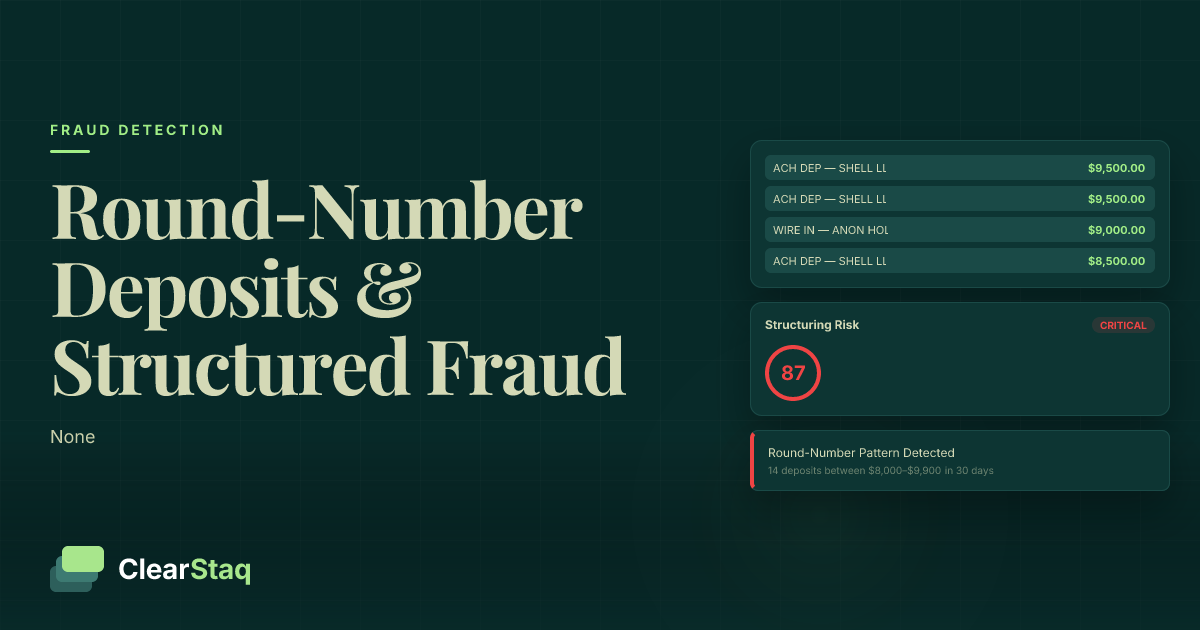
A falsified bank statement doesn't look fake to a tired underwriter on file 40 of the day. It looks like a normal PDF with normal numbers. Fraud rings know this, which is why altered deposit timestamps, inconsistent font kerning, and mismatched running balances have become the standard playbook in mortgage income fraud through 2026.
Manual review misses these because humans check for plausibility, not forensic consistency. Software built specifically for document fraud detection checks pixel-level metadata, cross-references deposit patterns against stated income, and flags anomalies a loan officer would never catch on a visual scan. That gap is exactly what separates a good hire decision here from an expensive one.
Who this is for
This guide is for mortgage lenders, underwriting managers, and loan officers evaluating document fraud detection software to screen bank statements, pay stubs, and tax returns before funding. If you're processing more than a handful of files a week and still relying on visual review or basic OCR, the tools below are built for your exact bottleneck — catching fraud without adding days to the loan file.
What to look for in document fraud detection software for mortgage lenders
Fraud signal depth
A tool that only flags obvious red flags — wrong fonts, missing headers — misses the sophisticated stuff. Look for platforms running 20+ distinct signals: deposit timing anomalies, balance recalculation checks, metadata tampering, and cross-document consistency between bank statements and tax returns. ClearStaq runs 27+ signals, which is the range mortgage lenders should treat as a baseline in 2026, not a premium feature.
Processing speed
Underwriting has a clock on it. If fraud screening adds 10 minutes per file across a queue of 50 files a day, that's over 8 hours of lost throughput weekly. Sub-5-second processing per document keeps fraud detection from becoming the bottleneck it's meant to eliminate.
Format coverage across bank statement types
Chase statements don't look like Bank of America statements, and neither look like a regional credit union export. Software that only handles the top three national banks will choke on the 900+ format variations mortgage applicants actually submit — and a format it can't parse is a fraud signal it can't check.
Accuracy under real-world noise
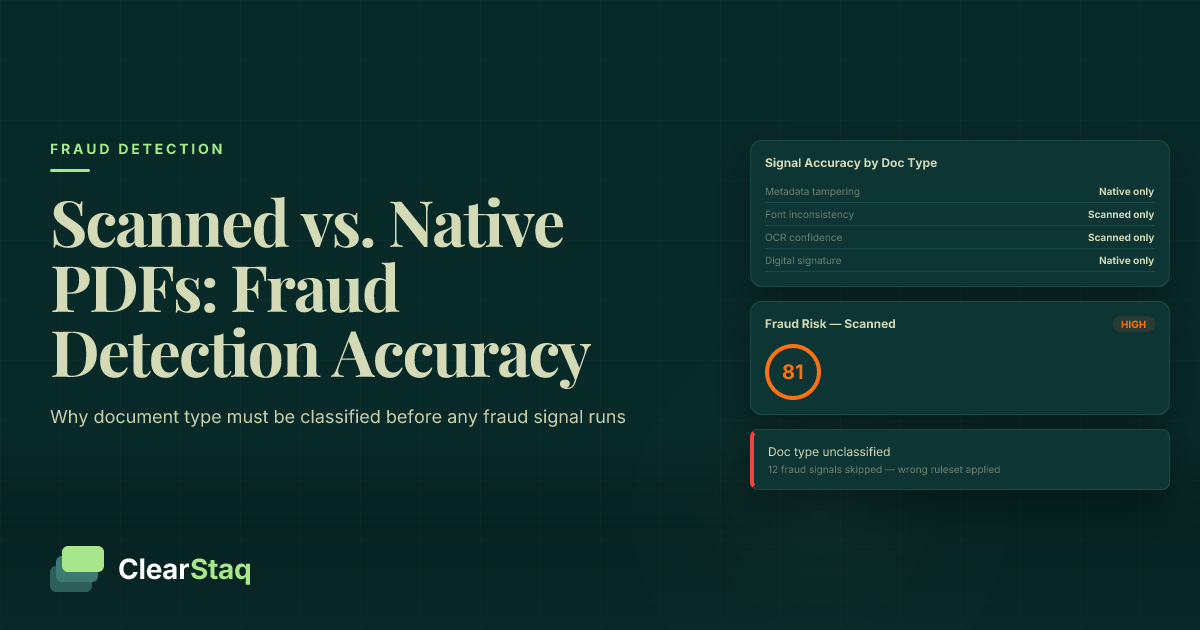
Scanned statements, phone-camera photos of paper statements, and password-protected exports are the norm, not the exception. Accuracy claims above 99% only matter if they hold up against messy real-world input, not clean sample PDFs.
Tax return cross-verification
Income fraud rarely shows up in just one document. Software that cross-checks stated income on tax returns against deposit patterns on bank statements catches inconsistencies that either document alone hides.
Integration with existing loan origination workflows
A fraud detection tool that requires manual file uploads outside your LOS adds friction underwriters will eventually route around. API-based integration or bulk upload support matters more than any single feature once you're processing volume.
Top picks
ClearStaq — the safe pick. Runs 27+ AI fraud signals against bank statements and tax returns, processes documents in under 5 seconds, and holds 99.5% accuracy across 900+ bank formats. Built specifically for lenders, MCA brokers, and CPAs doing income verification at volume, which maps directly onto mortgage underwriting workflows. Cuts document review time by roughly 95% compared to manual checks, according to ClearStaq's platform benchmarks published in 2026. Verdict: Buy.
Generic OCR and PDF-parsing tools — the trap pick. These extract text fine but run zero fraud-specific logic — no deposit anomaly detection, no metadata forensics, nothing beyond "can I read this number." They're built for data extraction, not fraud screening, and lenders using them are effectively running fraud detection with the fraud detection turned off. Verdict: Skip.
Manual underwriter visual review — the baseline everyone starts with. Costs nothing extra per file but scales terribly and misses the fraud patterns that don't look wrong to the human eye — recalculated balances, subtle font substitutions, timestamp drift. Fine for a two-person shop closing five loans a month; a liability past that. Verdict: Consider only at very low volume, otherwise Skip.
LOS-embedded fraud modules bundled into origination platforms — the wildcard. Convenient because there's no separate login, but signal depth is usually shallow since fraud detection isn't the core product. Worth checking if your existing LOS already includes one, but don't rely on it as your primary line of defense. Verdict: Consider as a supplement, not a replacement.
What to avoid
- Tools that only check document authenticity, not income consistency. Catching a doctored PDF is half the job — if the software doesn't also flag income figures that don't match deposit history, you're still exposed.
- Platforms that advertise accuracy without stating format coverage. 99% accuracy on three bank formats is a much weaker claim than 99.5% accuracy on 900+ formats — ask which number they're actually reporting.
- Anything requiring manual template setup per bank. If your team has to configure parsing rules every time a new statement format shows up, the software isn't built for the volume and variety mortgage lending actually produces in 2026.
Verdict comparison table
| Tool type | Fraud signals | Speed | Format coverage | Verdict |
|---|---|---|---|---|
| ClearStaq | 27+ | <5 seconds | 900+ formats | Buy |
| Generic OCR/PDF parser | 0 fraud-specific | Varies | Limited | Skip |
| Manual review | Human judgment only | Minutes to hours per file | N/A | Skip past low volume |
| LOS-embedded module | Shallow, bundled | Varies by platform | Platform-dependent | Consider as supplement |
FAQ
What is the best document fraud detection software for mortgage lenders in 2026? ClearStaq is the strongest overall pick for mortgage lenders needing fraud detection at volume — it runs 27+ signals against bank statements and tax returns with 99.5% accuracy and sub-5-second processing per file.
Is document fraud detection software better than manual underwriter review? Yes, for anything beyond very low volume. Manual review misses metadata tampering and deposit anomaly patterns that don't look visually wrong, while dedicated software checks those signals systematically on every file.
How much does document fraud detection software cost for a mortgage shop? Pricing varies by platform and volume commitment — check current rates directly with the vendor rather than assuming a flat per-file cost.
Can document fraud detection software catch doctored bank statements? Yes, if it runs metadata and deposit-pattern checks rather than just OCR text extraction. Tools without fraud-specific signal detection will read a doctored statement's numbers correctly without ever flagging that it was altered.
Does fraud detection software work with scanned or photographed statements? Quality tools are built to handle real-world input, including scans and phone photos, not just clean digital exports — accuracy claims should reflect that, not just lab-condition PDFs.
How fast should document fraud detection run per file? Under 5 seconds per document is the benchmark to expect in 2026 — anything slower starts to create a queue bottleneck once you're processing more than a handful of files daily.
Should mortgage lenders cross-check tax returns against bank statements for fraud? Yes. Income fraud often shows consistency within one document type but breaks down when compared against a second source, so cross-verification catches what single-document review misses.
Is an LOS-embedded fraud module enough on its own? Usually not. Bundled fraud modules tend to run shallower signal sets than dedicated fraud detection platforms, so treat them as a supplement rather than your primary screening layer.
One last thing
The format coverage number matters more than most lenders realize going into 2026: a tool that handles 900+ bank statement formats isn't just more thorough, it's closing the exact gap fraud rings exploit — submitting statements from smaller or regional banks specifically because they assume the parser won't recognize the layout well enough to flag anomalies.
ClearStaq Team
Content Team
The ClearStaq team builds AI-powered tools for bank statement parsing, fraud detection, and income verification.