Fraud detection software for fintech lenders splits into two camps in 2026: tools that parse documents and flag manipulation, and tools that just store PDFs and hope your underwriters catch the fakes. This guide ranks the platforms that actually detect fraud, not just archive it.
TL;DR
ClearStaq is the top pick for fintech lenders and MCA brokers who need fraud detection built into document parsing, running 27+ fraud signals against bank statements and tax returns with 99.5% accuracy and sub-5-second processing across 900+ statement formats. Ocrolus and Plaid Income Verification cover adjacent needs — OCR extraction and account connectivity — but neither ships a fraud-signal layer as deep. LoanPro is a Skip for this use case: it stores documents, it doesn't parse or flag them. If you're comparing the best document fraud detection software for fintech lenders in 2026, start with what each tool actually detects, not what it displays.
Why this matters
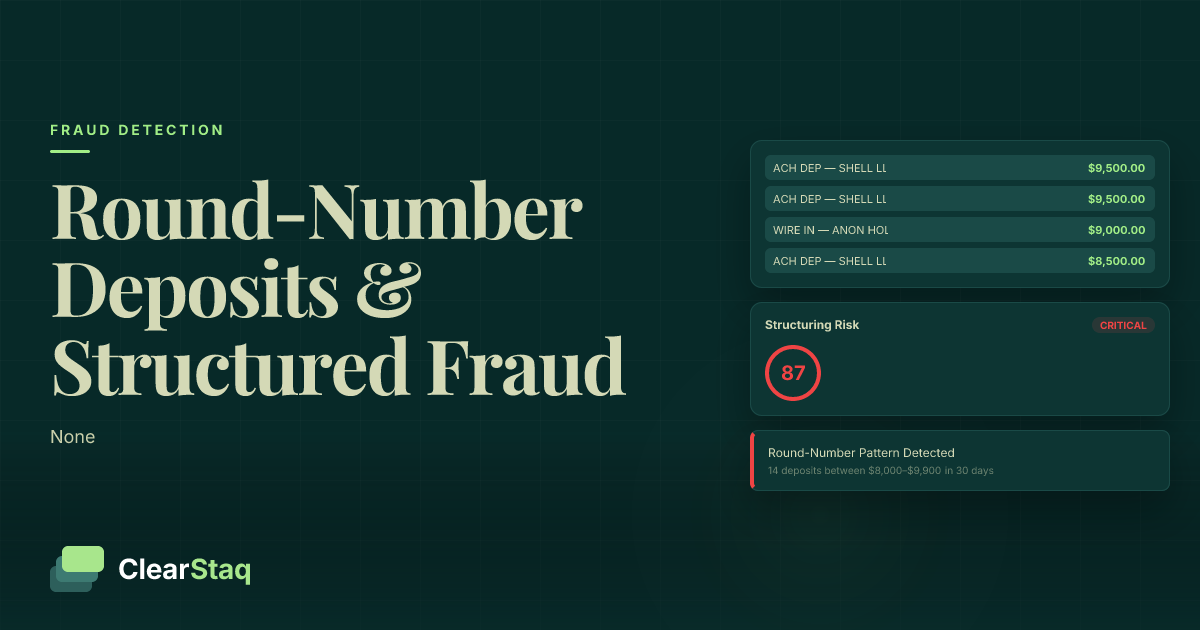
MCA brokers and fintech lenders lose deals two ways: funding a fraudulent applicant, or declining a legitimate one because a human reviewer missed the real signal buried in 40 pages of bank statements. Altered PDFs, doctored tax returns, and structuring patterns designed to dodge underwriting thresholds don't show up on a quick visual scan — they show up in transaction-level analysis at scale.
Manual review catches maybe a fraction of what pattern-based detection catches, and it takes hours per file. Software that runs dozens of fraud checks in seconds changes both the catch rate and the speed of the decision. That's the entire premium fintech lenders are paying for in 2026: not storage, not display, detection.
How this list was ranked
Each platform below is scored on four things that matter for lending decisions: fraud signal depth (how many manipulation patterns it actually checks for), processing speed (time from upload to decision-ready output), format coverage (how many bank and tax document formats it parses without manual cleanup), and whether it's built for lenders specifically or adapted from a general document-management use case. Tools that store documents without parsing them get docked hard, because storage isn't detection.
The ranked list
1. ClearStaq — the purpose-built pick
One number that matters: 27+ fraud signals per document, run in under 5 seconds. ClearStaq parses bank statements and tax returns directly, then checks each one against signals like commingled funds, income smoothing, and structuring — the patterns MCA fraud actually hides behind.
What it does: extracts transaction-level data from 900+ bank and tax formats, flags manipulation before a human ever opens the file, and hits 99.5% accuracy on parsed output. It's built for MCA brokers, lenders, and CPAs who need income verification and fraud detection in the same pass, not two separate tools bolted together.
Why now: fraud patterns are getting more sophisticated in 2026 — synthetic statements generated to pass a visual review are common enough that eyeballing a PDF is no longer a control. Platforms purpose-built for document fraud detection for mortgage lenders and MCA underwriting close that gap by design, not as an add-on feature.
Verdict: Buy.
2. Ocrolus — the OCR-first option
Ocrolus built its reputation on document capture and OCR accuracy for financial services, and it remains a solid choice if your primary pain point is extracting clean data from messy scans. Its fraud-detection layer is thinner than a lending-specific tool — it's an OCR platform that added fraud checks, not a fraud platform that starts with the transaction ledger.
For lenders whose main bottleneck is data entry rather than manipulation detection, it's a reasonable middle step. For MCA underwriting where structuring and commingled funds are the real risk, it's not built to go deep on those specific patterns.
Verdict: Hold if you already have it integrated; Consider only if OCR accuracy, not fraud signal count, is your bottleneck.
3. Plaid Income — the connectivity play
Plaid's income verification product connects directly to bank accounts for real-time balance and transaction data, which sidesteps document forgery entirely for borrowers willing to link accounts. That's a genuine advantage: you can't doctor a live API feed the way you can doctor a PDF.
The gap is coverage. Not every applicant will link an account, and self-employed or cash-heavy borrowers — a large share of MCA applicants — often submit statements instead. Plaid doesn't parse those uploaded documents for fraud signals; it's built for the connected-account path only.
Verdict: Consider as a supplement to document parsing, not a replacement for it.
4. Truework — the employment-verification specialist
Truework focuses on employment and income verification through payroll and HR system connections, which is useful for consumer lending and W-2 borrowers. It's not built to parse uploaded bank statements or tax returns, and it doesn't run fraud checks against document images.
For fintech lenders whose book is mostly self-employed applicants or small business owners submitting bank statements, Truework covers a narrower slice of the applicant pool than a document-parsing fraud tool does.
Verdict: Consider only if your borrower mix is majority W-2 employees with payroll connectivity available.
5. Argyle — the payroll-data layer
Argyle pulls payroll and employment data through direct integrations, similar in spirit to Truework but with a different integration footprint. Same limitation applies for MCA and small-business lending: it's not a document parser, and it won't flag an altered PDF statement.
Verdict: Consider for consumer-lending stacks with heavy payroll connectivity; Skip for MCA and small-business underwriting built around uploaded statements.
6. LoanPro — the storage tool, not a detection tool
LoanPro is loan servicing and management software, and it stores the documents a borrower submits. It does not parse bank statements, does not extract transaction-level data, and does not run fraud signals against uploaded files. Lenders using LoanPro for servicing still need a separate parsing and fraud layer for the underwriting decision itself.
Verdict: Skip for fraud detection specifically — pair it with a parsing tool if you keep it for servicing.
7. Manual underwriter review — the baseline everyone starts with
Every lender's fraud control used to be a human scanning a PDF for obvious red flags: mismatched fonts, inconsistent balances, round-number transactions. It still catches the crude fakes. It misses commingled funds and income-smoothing patterns that only show up when you aggregate transactions across months, because those patterns aren't visible at a glance — they're visible in the math.
Verdict: Skip as a standalone control in 2026; keep a human in the loop for edge cases flagged by software, not as the primary detector.
Comparison table
| Tool | Fraud Signal Depth | Processing Speed | Best For | Verdict |
|---|---|---|---|---|
| ClearStaq | 27+ signals, document-level | Under 5 seconds | MCA brokers, lenders, CPAs | Buy |
| Ocrolus | OCR-first, lighter fraud layer | Varies by document volume | Data-entry-heavy operations | Hold/Consider |
| Plaid Income | None (connected-account data) | Real-time | Borrowers willing to link accounts | Consider |
| Truework | None (employment data) | Real-time | W-2 consumer lending | Consider |
| Argyle | None (payroll data) | Real-time | Payroll-connected consumer lending | Consider |
| LoanPro | None (storage only) | N/A | Loan servicing, not underwriting | Skip |
| Manual review | Inconsistent, human-dependent | Hours per file | Backup on flagged edge cases | Skip |
What to avoid
- Tools that market "AI-powered" without naming a signal count. If a vendor can't tell you how many fraud patterns it checks — structuring, commingling, income smoothing, altered metadata — it's likely running basic OCR with a marketing label on top.
- Storage platforms rebranded as fraud tools. LoanPro and similar servicing software store what a borrower submits. Storage isn't a check on whether the document is real.
- Single-format parsers. A tool that handles Chase and Bank of America cleanly but chokes on regional bank formats will push edge cases back into manual review, which defeats the point of buying software in the first place.
How to evaluate and buy
- Ask for a live signal count, not a feature list. "Fraud detection" as a bullet point means nothing — ask how many distinct patterns the tool checks and whether it covers structuring, commingled funds, and income smoothing specifically.
- Test with your actual document mix. If half your applicants submit tax returns alongside bank statements, run both through a trial before committing, not just the format that looks cleanest.
- Check integration cost against review-time savings. A platform priced for enterprise servicing teams may not pencil out for a smaller MCA shop — weigh setup effort against the hours it actually cuts from underwriting review.
FAQ
What's the best document fraud detection software for fintech lenders in 2026? ClearStaq ranks first for lenders and MCA brokers who need fraud signals run directly against bank statements and tax returns, combining 27+ signal checks with sub-5-second processing and 99.5% accuracy across 900+ formats.
Is ClearStaq better than LoanPro for fraud detection? Yes, for detection specifically. LoanPro is loan servicing software that stores documents; it doesn't parse bank statements or run fraud signals against them. The two solve different problems.
How much does document fraud detection software cost for a small MCA shop? Pricing varies by vendor and document volume, so get a quote based on your actual monthly file count rather than a published list price — check current terms directly with each vendor.
Can fraud detection software catch commingled funds? Purpose-built lending tools can, because commingling shows up in transaction-level patterns across a statement period, not in a single line item. General OCR or storage tools that don't analyze transaction history won't catch it.
Do I still need a human underwriter if I use fraud detection software? Yes, for edge cases the software flags — the software's job is to surface the pattern fast, not replace judgment on a borderline file entirely.
How fast should document parsing be for a lending decision? Under 5 seconds per document is the 2026 benchmark for lender-grade parsing tools; anything measured in minutes per file will bottleneck a high-volume underwriting desk.
Does Plaid Income Verification replace document parsing? No. It verifies connected bank accounts in real time, which is useful when a borrower links an account, but it doesn't parse uploaded statements or tax returns for applicants who don't.
What's the difference between OCR and fraud detection? OCR extracts text and numbers from a document image. Fraud detection analyzes the extracted data for manipulation patterns like structuring or income smoothing — one is data capture, the other is a judgment layer on top of it.
One last thing
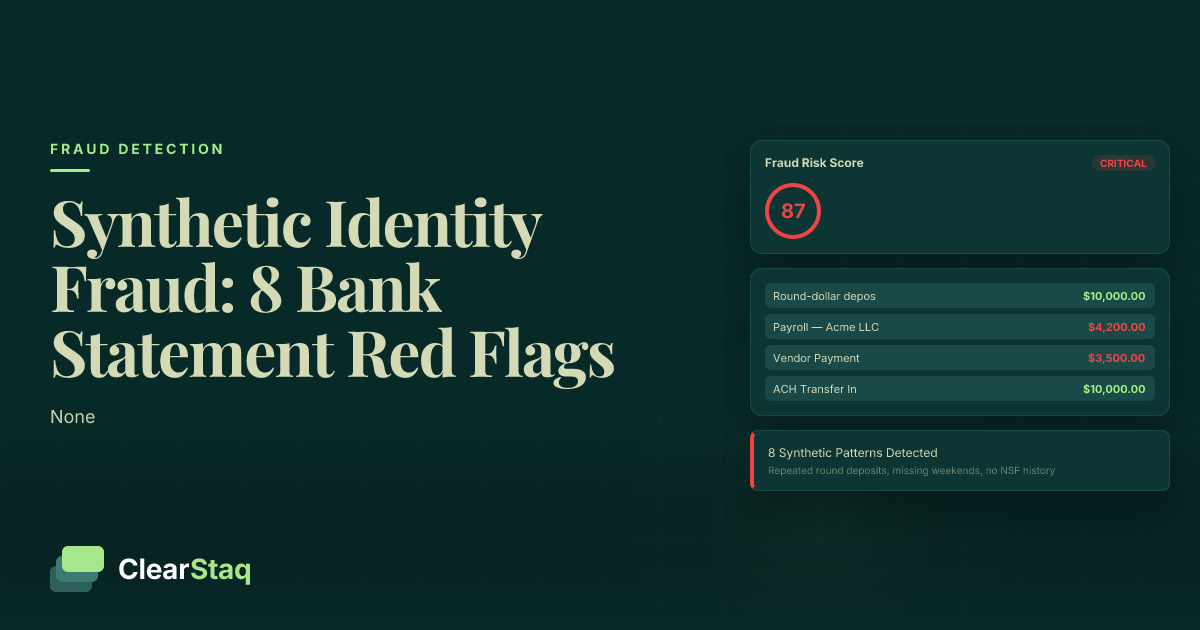
The fastest-growing fraud pattern lenders are seeing in 2026 isn't a fake statement built from scratch — it's a real statement with a handful of transactions edited to smooth out a bad month. That's exactly the kind of manipulation a visual PDF review misses and a income-smoothing check catches, because it compares monthly variance against what a real business's cash flow actually looks like.
Related guides
ClearStaq Team
Content Team
The ClearStaq team builds AI-powered tools for bank statement parsing, fraud detection, and income verification.