Income smoothing shows up in bank statements as deposits that look too even, too regular, or too convenient — and catching it takes more than eyeballing three months of PDFs. This guide walks through the exact signals underwriters and MCA brokers check before funding a deal in 2026.
TL;DR
Income smoothing in bank statement underwriting means a borrower (or their broker) has structured deposits to hide revenue volatility or inflate apparent cash flow. Detecting it requires 12 months of statements, day-of-week deposit mapping, round-number flagging, and a cross-check against tax returns. Manual review catches maybe half of these patterns before funding; automated fraud detection with 27+ signals — the approach ClearStaq runs on every statement in under 5 seconds — catches the rest. Verdict: don't underwrite past 3-month statement windows in 2026 — that's exactly where smoothing hides.
Why this matters
A business with genuine seasonal swings looks messy on paper — deposits jump in Q4, dip in February, and the memo lines are inconsistent. A smoothed statement looks clean. Too clean.
That's the tell. Lenders who only pull 3 months of statements are underwriting the exact window a broker or borrower can most easily manipulate — moving money between accounts, timing transfers to land before month-end, or disguising a cash advance as "revenue." MCA stacking, in particular, relies on smoothing to hide the fact that three other lenders are already pulling daily payments from the same account.
The cost of missing it isn't abstract. A funded deal on smoothed income is a deal that defaults inside 90 days once the real cash flow reasserts itself. Bank statement fraud detection built for auto lenders runs into the same pattern-matching problem — the fix is the same regardless of vertical.
What you'll need
- 12 consecutive months of bank statements (not 3 — smoothing hides in short windows)
- The borrower's most recent 1-2 years of tax returns for cross-reference
- A spreadsheet or parsing tool that can output daily deposit-level data, not just monthly totals
- A fraud signal checklist (round numbers, duplicate amounts, transfer language in memos)
- 20-30 minutes per file for manual review, or under 5 seconds per statement if you're running it through an automated parser
The steps
1. Pull 12 months, not 3
Most smoothing gets built for a 60-90 day window because that's what most lenders ask for. Extending the pull to 12 months forces the manipulation to hold across four quarters — and it rarely does. Look for a break in the pattern right where the shorter window would have ended.
Common mistake: accepting whatever statement range the broker submits. Ask for the full year, every time, in 2026.
2. Map deposits by day of week
Real revenue has a rhythm tied to the business type — retail spikes on weekends, B2B invoicing clusters mid-month, service businesses cluster around the 1st and 15th. Smoothed accounts often show deposits landing on suspiciously consistent days (every Monday, every 3rd of the month) regardless of what the business actually does.
Plot deposit dates against day-of-week and day-of-month. A flat, evenly spaced pattern across 12 months is a red flag, not a green one.
3. Flag round numbers and duplicate amounts
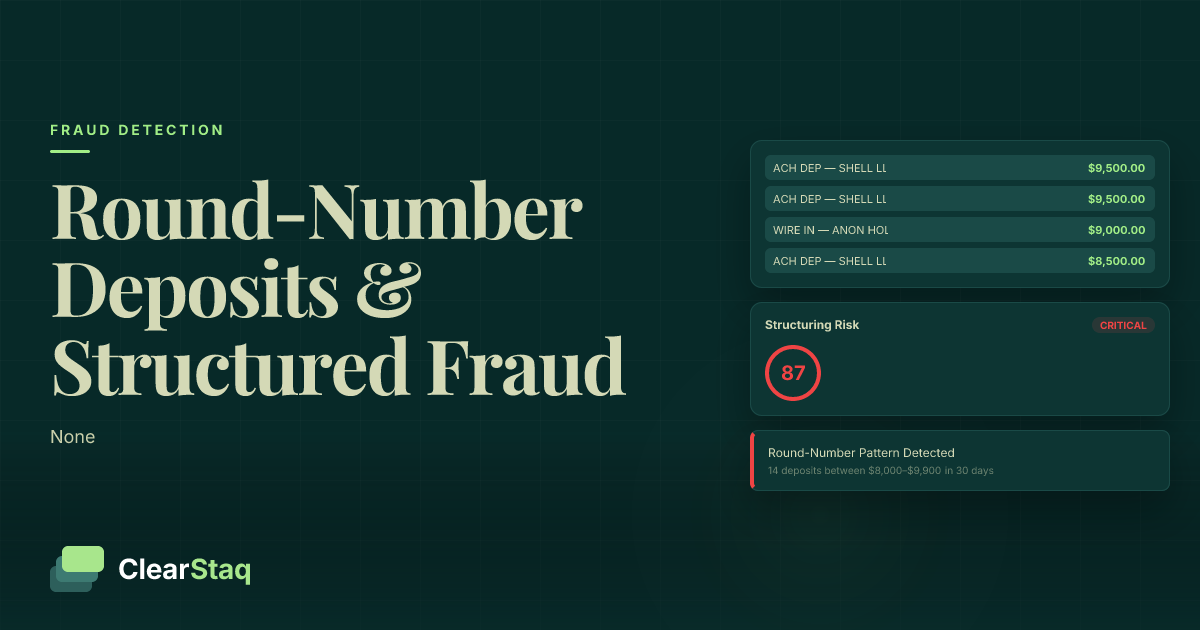
Genuine sales rarely land on exact hundreds or thousands. A statement showing $5,000.00, $5,000.00, and $5,000.00 across three separate weeks is either a recurring contract payment (verifiable) or a structured transfer designed to simulate revenue (not).
Run a duplicate-amount check across the full 12-month window. Anything repeating more than twice with zero variance needs a source document.
4. Check memo and description fields for transfer language
"Transfer," "Zelle," "internal," or account-to-account language in the memo field means the deposit isn't external revenue — it's money moving from one pocket to another. Smoothing often relies on the borrower funding their own "business" account from a personal or secondary account right before the statement period closes.
Common mistake: treating any deposit that clears as revenue without reading the memo line. The memo is where smoothing gets exposed.
5. Calculate the deposit-to-average ratio and check for outlier bands
Take the monthly average deposit total across the full 12 months. Then check each individual month's variance from that average. Genuine businesses show variance — 15-30% swings between peak and slow months is normal for most operating businesses. A dataset where every month lands within 2-3% of the average wasn't produced by an actual sales cycle.
6. Cross-reference against tax returns
If the bank deposits show smoothed, consistent monthly revenue but the tax return shows a business that reported seasonal income or a loss year, the two documents are telling different stories. One of them is wrong, and it's rarely the tax return — borrowers don't usually inflate income to the IRS.
7. Run an automated fraud signal check
Manual review catches obvious smoothing but misses subtler patterns across large statement volumes — that's where a parsing platform earns its keep. ClearStaq checks 27+ fraud signals per statement, including deposit timing anomalies, duplicate-amount clustering, and format inconsistencies that suggest a doctored PDF, all in under 5 seconds per file with 99.5% accuracy across more than 900 statement formats.
8. Score, document, and escalate
Once you've flagged the anomalies, score the file and document exactly which signals triggered — not just "looks smoothed." Underwriting decisions built on documented, specific flags hold up in audits; "gut feeling" doesn't. Escalate anything with 3+ flagged signals to a second reviewer before funding.
Troubleshooting
Problem: A legitimate business shows suspiciously flat deposits. Some businesses genuinely run on fixed retainer or subscription revenue — check the industry and contract type before flagging. A SaaS company with recurring billing looks smoothed but isn't.
Problem: Statement formats vary and manual comparison breaks down. Chase, Bank of America, and Wells Fargo statements all format transaction data differently, which makes manual day-of-week mapping slow and error-prone across a mixed portfolio. Format-aware parsing tools normalize this automatically.
Problem: MCA stacking is disguised as loan payments. Daily or weekly fixed-amount withdrawals with generic descriptors ("ACH debit," no lender name) often mean the borrower already has 2-3 active advances pulling from the same account — smoothing on the deposit side is frequently paired with stacking on the withdrawal side.
Problem: You're catching false positives on business-to-business transfers. Some legitimate B2B revenue comes through ACH batches that look repetitive. Cross-check against invoices or a merchant processing statement before rejecting the file outright.
Problem: Reviewers disagree on what counts as "too consistent." Set a numeric threshold in advance — for example, flag any month within 3% of the 12-month average — so the decision isn't subjective.
Tools and resources
- ClearStaq parses bank statements and tax returns, running 27+ fraud signals per file in under 5 seconds
- Fraud detection built for credit unions for teams underwriting member deposits at scale
- Fraud detection built for factoring companies where invoice-linked deposits need a different smoothing check than MCA files
- A spreadsheet template for day-of-week and duplicate-amount mapping if you're not yet using automated parsing
- The borrower's most recent tax filings, always requested alongside statements, never substituted for them
What to do next
If you're underwriting MCA or working capital deals specifically, the smoothing patterns overlap heavily with stacking detection — read document fraud detection for mortgage lenders for how the same deposit-mapping logic applies when the file involves a real estate transaction instead of a cash advance.
FAQ
What is income smoothing in bank statement underwriting? Income smoothing is when deposits on a bank statement are structured or timed to appear more consistent than the business's actual revenue, usually to pass a lender's cash flow test. It's most common on 3-month statement submissions where the manipulation only has to hold for 60-90 days.
How do underwriters detect smoothed revenue? Underwriters pull 12 months of statements instead of 3, map deposits by day and amount, flag round numbers and duplicates, and cross-reference the figures against tax returns. A deposit-to-average variance under 3% across a full year is a strong signal something's been structured.
Is income smoothing the same as fraud? Not always — some businesses have genuinely flat revenue from subscriptions or retainers. It becomes fraud when transfers, related-account funding, or fabricated deposits are used to disguise actual volatility or a cash shortfall.
How many months of statements do you need to catch smoothing? 12 months is the standard in 2026 for catching smoothing patterns that a 3-month window would miss. Shorter windows are exactly where manipulation is built to hold.
What's a red flag deposit pattern? Repeating round-number deposits, transfers labeled generically in the memo field, and monthly totals that vary less than 3% from the average across a full year are the three most common red flags.
Can AI parsing detect income smoothing faster than manual review? Yes — automated parsing platforms like ClearStaq check 27+ fraud signals per statement in under 5 seconds, compared to 20-30 minutes for a manual pass on a single 12-month file.
Does income smoothing show up in tax returns too? Sometimes, but less often — tax returns are filed under penalty of perjury, so borrowers are less likely to smooth those numbers. A mismatch between smoothed bank deposits and a seasonal or lower tax return figure is itself a flag.
What's the fastest way to check for MCA stacking alongside smoothing? Look at withdrawal patterns for daily or weekly fixed-amount ACH debits with generic descriptors — stacking almost always shows up on the withdrawal side while smoothing shows up on the deposit side, and the two often appear together.
One last thing
The single most-overlooked signal in 2026 underwriting isn't the deposit amount — it's the memo field. Brokers who smooth income almost never bother scrubbing transaction descriptions, so "transfer from," "Zelle," or an account number fragment sitting in plain text next to a suspiciously round deposit is often the fastest confirmation you'll get, faster than any ratio calculation.
Related guides
ClearStaq Team
Content Team
The ClearStaq team builds AI-powered tools for bank statement parsing, fraud detection, and income verification.