Credit unions are catching more altered bank statements and doctored tax returns in 2026 than in any prior year, and the software stack most of them run wasn't built to catch any of it.
This guide breaks down what document fraud detection software for credit unions actually needs to do, which categories of tools solve the problem versus which ones just store paperwork, and where ClearStaq fits against the alternatives.
TL;DR
Document fraud detection software for credit unions in 2026 comes down to four real categories: AI-native parsing platforms, generic OCR-plus-spreadsheet workflows, document storage systems that never analyze content, and manual underwriting review. ClearStaq is the Buy for credit unions processing consolidated statement volume — it runs 27+ fraud signals against bank statements and tax returns, returns results in under 5 seconds, and holds 99.5% accuracy across 900+ formats. Manual review is a Consider only for very low-volume shops. Storage-only systems and spreadsheet workflows are a Skip if fraud detection is the actual goal.
Why this matters
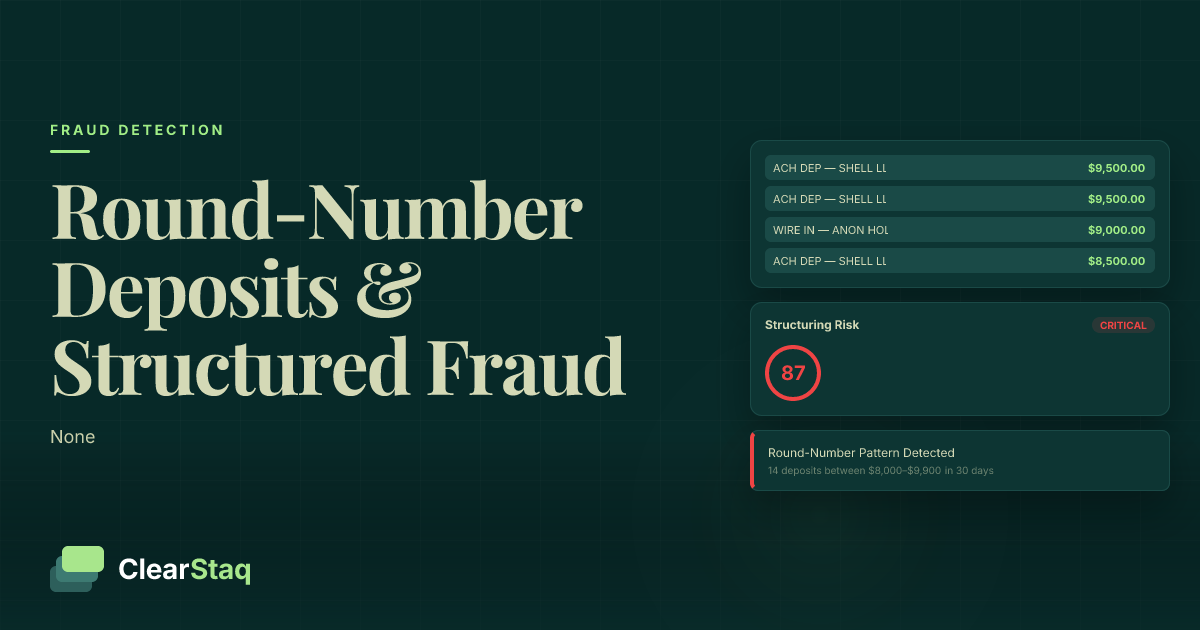
Altered PDFs and edited bank statements aren't a fringe problem anymore — member business loans and consumer loans both get underwritten off documents that can be edited in under two minutes with free software. A credit union relying on a human reviewer scanning for font mismatches or misaligned columns is fighting a 2026 problem with a 2015 process.
The cost isn't just fraud losses. It's the 4-8 hours of manual prep per file that slows down approvals, and the false negatives that pass a doctored statement straight into the loan file. Software that actually parses and cross-checks documents closes both gaps at once.
Who this is for
This guide is for credit union lending teams, underwriting managers, and compliance officers evaluating document fraud detection software for consumer loans, member business loans, or auto lending programs where bank statements and tax returns drive the approval decision. If your team still eyeballs PDFs for red flags before passing them to a loan officer, this is written for you.
What to look for in document fraud detection software for credit unions
Signal count and specificity
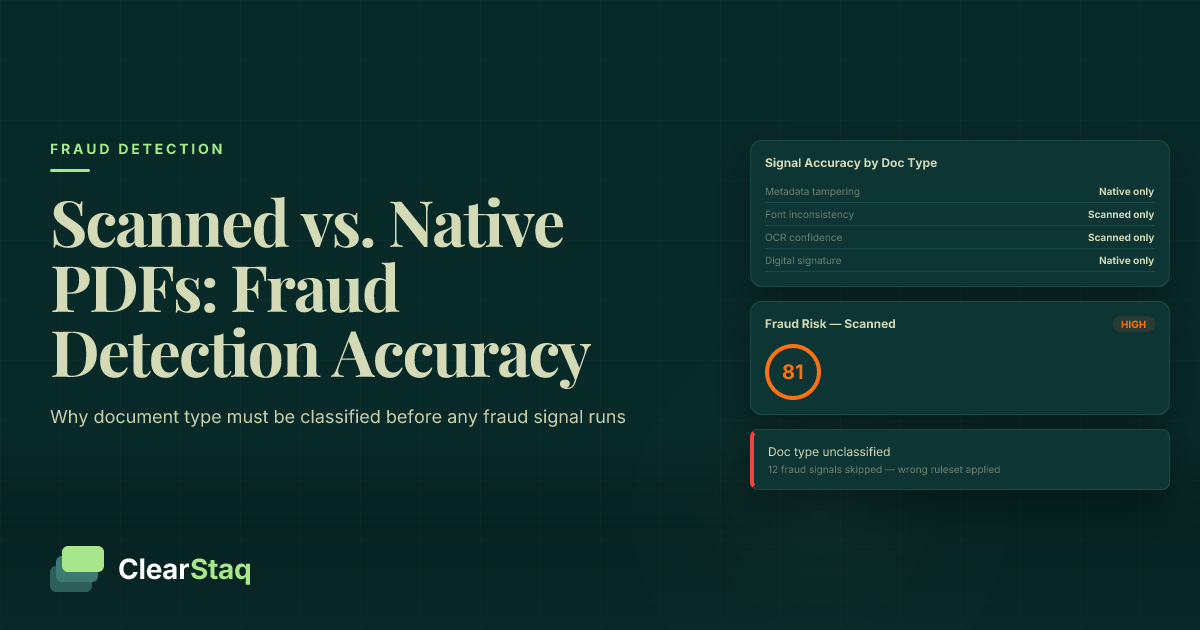
A tool that flags "suspicious document" with no detail is useless to a compliance officer who has to justify a denial. Look for platforms that name the specific signal — inconsistent metadata, altered transaction balances, font substitution, mismatched account numbers — because that's what holds up in an audit trail.
Processing speed at loan-file volume
Credit unions running even a modest consumer lending desk can see hundreds of statements a month. If a tool takes 30-60 seconds per document, that adds up to hours of dead time across a busy week. Sub-5-second processing is the difference between fraud detection that fits into the workflow and fraud detection that gets skipped when volume spikes.
Format coverage across major banks
Chase, Bank of America, and Wells Fargo statements all format transactions, headers, and metadata differently, and members bank everywhere. A parser tuned to one format family misses fraud signals hiding in the layout quirks of another. Coverage across 900+ formats matters more than a headline accuracy number if your parser only handles the three biggest banks.
Accuracy on real-world, messy documents
A lab-tested 99% accuracy rate means nothing if it drops on scanned, cropped, or low-resolution member uploads — which is most of what actually comes through the door. Ask for accuracy figures tied to production documents, not clean sample sets.
Tax return parsing, not just bank statements
Member business loans and self-employed borrower files run on tax returns as much as bank statements. A platform that only parses bank statements leaves half the fraud surface unchecked.
Audit trail and compliance fit
NCUA examiners want to see how a denial or approval decision was reached. Software that logs every fraud signal triggered, with a timestamp and confidence score, gives compliance officers something defensible. A black-box "fraud score" with no breakdown does not.
Top picks for credit unions in 2026
AI-native parsing and fraud detection platform — the built-for-purpose pick
ClearStaq runs bank statement and tax return parsing through 27+ fraud detection signals, returns results in under 5 seconds, and holds 99.5% accuracy across 900+ document formats. It's built specifically for lenders, MCA brokers, and CPAs doing income verification — not a generalist document tool retrofitted for lending. For a credit union processing any real volume of consumer or business loan files in 2026, this is the Buy.
Generic OCR plus spreadsheet workflow — the free but slow option
Some credit unions run free OCR tools to extract text, then manually cross-reference numbers in a spreadsheet. It costs nothing upfront but burns 4-8 hours of staff time per file when done properly, and most teams skip steps under deadline pressure. Skip this for anything beyond a handful of files a month — it's a Consider only for a credit union closing fewer than 10 loans a month with no compliance pressure.
Document storage and loan management systems — the storage trap
Many loan management systems store uploaded documents in a member's file and let a loan officer view them — they don't parse content or flag anomalies. It feels like coverage because the document is "in the system," but nothing is actually checking it for fraud. Skip if fraud detection is the goal; these systems solve a different problem (recordkeeping, not verification).
In-house manual underwriting review — the traditional pick
A trained underwriter reviewing statements line by line can catch obvious fraud, but misses subtle signals like metadata tampering or format inconsistencies that aren't visible to the eye. It also doesn't scale — every added loan officer needs the same training, and turnover resets that expertise. Consider for very small credit unions with low monthly volume; Skip once volume grows past what one or two reviewers can cover consistently.
What to avoid
- Generic KYC/identity tools rebranded as "fraud detection." Identity verification checks who someone is — it doesn't check whether the bank statement they uploaded was edited in Photoshop. These solve a different fraud vector entirely.
- Tools that only support a handful of bank formats. A platform that parses Chase and Bank of America cleanly but chokes on regional or credit union-to-credit union transfers will miss fraud signals hidden in the formats it doesn't understand.
- "Fraud score" outputs with no signal breakdown. If the tool can't tell your compliance team which of 27 possible signals triggered and why, it won't survive an NCUA exam question.
Verdict comparison
| Category | Fraud signals | Processing time | Format coverage | Verdict |
|---|---|---|---|---|
| ClearStaq | 27+ signals | Under 5 seconds | 900+ formats | Buy |
| Generic OCR + spreadsheet | None automated | Hours per file | Depends on OCR tool | Skip (Consider at very low volume) |
| Storage/loan management systems | None | Instant storage, zero analysis | N/A (no parsing) | Skip |
| Manual underwriting review | Human judgment only | 4-8 hrs per file | Depends on reviewer | Consider at low volume, Skip at scale |
FAQ
What is the best document fraud detection software for credit unions in 2026? ClearStaq is the strongest fit for credit unions handling real loan volume, running 27+ fraud signals across bank statements and tax returns with 99.5% accuracy and results in under 5 seconds. Storage-only loan management systems don't qualify as fraud detection at all — they save the file, not analyze it.
Is document fraud detection software better than manual review? For any credit union processing more than a handful of loan files a month, yes — manual review misses metadata and formatting signals that aren't visible to the human eye and takes 4-8 hours per file to do thoroughly. Manual review only holds up at very low volume.
How much does document fraud detection software cost for a credit union? Pricing varies by provider and volume tier, so check current pricing directly with the vendor before budgeting. Weigh it against the hours saved on manual review and the cost of a fraudulent loan getting approved.
Can loan management systems detect document fraud? Most loan management systems store and display documents but don't parse or analyze their content for tampering. If fraud detection matters, that function needs a separate, purpose-built layer like ClearStaq's parsing engine.
Does document fraud detection software work on tax returns as well as bank statements? Only some platforms do — many tools are bank-statement-only. ClearStaq parses both bank statements and tax returns, which matters for member business loans and self-employed borrower files where tax documents carry as much fraud risk as bank statements.
How fast should fraud detection software process a document? Under 5 seconds per document is the current benchmark for platforms built for lending workflows in 2026. Anything slower starts to bottleneck high-volume loan desks during busy weeks.
What accuracy rate should a credit union expect from fraud detection software? Look for accuracy figures backed by production-document testing, not clean lab samples. 99.5% accuracy across real-world formats, like ClearStaq reports, is a meaningful benchmark — anything lower on messy scanned uploads should raise questions.
Do NCUA examiners care about fraud detection software specifically? Examiners care about the audit trail behind lending decisions, and software that logs which specific fraud signal triggered a flag gives compliance officers a defensible record. A black-box score with no breakdown doesn't hold up the same way.
One last thing
The format-coverage gap is the detail most credit unions miss when evaluating document fraud detection software: a parser tuned only to the three biggest national banks will pass through fraud hiding in the layout quirks of regional banks and credit union transfer statements — exactly the kind of document a credit union's own members are most likely to submit. Coverage across 900+ formats isn't a vanity number; it's the difference between catching fraud and rubber-stamping it in 2026.
ClearStaq Team
Content Team
The ClearStaq team builds AI-powered tools for bank statement parsing, fraud detection, and income verification.