Commingled funds hide inside bank statements as round-dollar transfers, personal expense categories, and deposits that don't match any invoice or payroll record — and catching them before you fund a deal is the difference between a clean loan and a fraud writeoff in 2026.
TL;DR
Detecting commingled personal and business funds in underwriting means checking three things every time: transfer patterns between accounts, expense categorization inside the business account, and deposit-to-revenue consistency across 3-6 months of statements. Manual review catches maybe half of these cases in a 15-minute skim. ClearStaq's parsing platform runs 27+ fraud signals against the same statements in under 5 seconds and flags commingling patterns a human reviewer misses on file four of the day. Verdict: automate the first pass, reserve manual review for exceptions.
Why this matters
A business account that pays a personal Netflix subscription, a personal mortgage, or a spouse's car note isn't automatically fraud — but it is a signal that the applicant is treating business cash as personal cash, and that changes how you read every other number on the statement. Lenders who skip this check in 2026 are approving deals on inflated average daily balance figures that don't reflect real operating cash.
MCA underwriters see this constantly: an applicant deposits a personal check into the business account right before the statement period closes, propping up the balance for the exact window a lender will review. ClearStaq built its fraud detection layer specifically because this pattern repeats across thousands of files and a human reviewer, tired by file 40, starts missing it.
What you'll need
- 3-6 months of consecutive bank statements (not cherry-picked months)
- The applicant's tax returns — Schedule C, 1120S, or 1120 depending on entity type
- A payroll register or 1099 filings if the business has employees or contractors
- A transaction categorization tool or line-by-line review process
- Access to a fraud detection platform that flags transfer patterns automatically (manual review alone misses recurring low-dollar commingling)
The steps
1. Pull consecutive months, not the applicant's chosen window
Applicants sometimes submit statements from their strongest quarter. Ask for the most recent 3-6 consecutive months and compare against what was submitted. A gap or a swapped month is itself a red flag worth a follow-up call before you look at a single transaction.
Common mistake: accepting non-consecutive statements because the applicant says the missing month was slow. Slow months are exactly what you need to see.
2. Flag round-dollar transfers between accounts
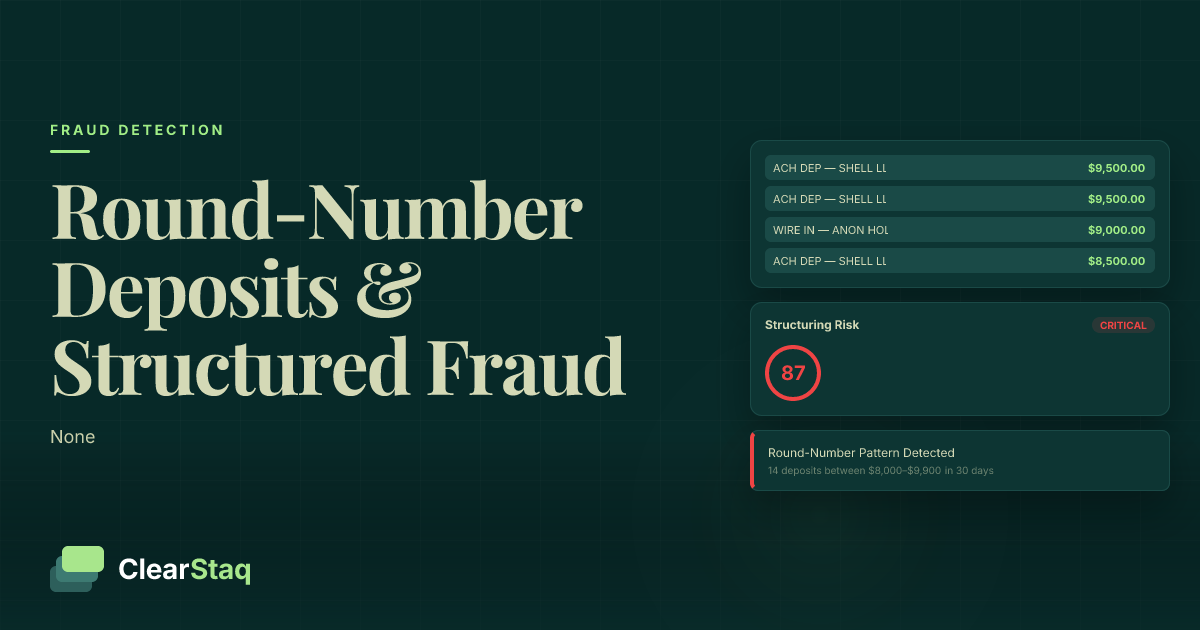
Commingling shows up as transfers in round numbers — $2,000, $5,000, $10,000 — moving from a personal account into the business account, especially in the 5-10 days before a statement cutoff. Legitimate business revenue rarely lands in perfectly round figures; personal loans between spouses or family members often do.
Cross-check the transfer date against the statement period end date. A $7,500 deposit landing three days before month-end, with no invoice or client name attached, is the single most common commingling pattern in MCA files reviewed in 2026.
3. Check for personal expense categories inside the business account
Look for recurring charges that don't belong to a business: personal insurance premiums, streaming subscriptions, retail purchases at consumer stores, or a mortgage payment routed through the business account. One or two of these might be an S-corp owner drawing a distribution informally. A dozen recurring personal line items is a business owner who doesn't separate cash at all — which means the average monthly revenue you're calculating is contaminated.
Expected outcome: a clean categorization pass should show under 5% of transaction volume tagged as personal-adjacent. Above that, escalate the file.
4. Cross-reference payroll deposits against 1099s or W-2s
If the business claims employees or contractors, payroll deposits going out should match the payroll register or filed 1099s. A mismatch — payroll going out to accounts that never show up on a 1099 — suggests either off-book payments or transfers disguised as payroll, both of which mean the business's real operating cost is different from what the statement shows.
5. Reconcile deposits against Schedule C or corporate return revenue
Total deposits across your 3-6 month window, annualize the figure, and compare it against the revenue line on the most recent tax return. A gap over 15-20% needs an explanation — seasonal timing, a new contract, or commingled personal deposits inflating the bank-side number. ClearStaq's document fraud detection tools build this reconciliation automatically by matching statement data against parsed tax return line items instead of a manual spreadsheet pull.
Common mistake: comparing gross deposits to net income instead of gross revenue. You'll manufacture a false discrepancy every time.
6. Run the file through automated fraud signal detection
Manual review catches the obvious cases — a personal Venmo transfer labeled as such. It misses the subtler patterns: transfers structured just under a reporting threshold, deposits split across two days to avoid looking like a single lump sum, or a personal account funneling money through a third intermediary account before it hits the business account. Automated detection across 27+ signals catches structuring patterns a reviewer working a 15-minute file skim will not.
7. Document the exception and escalate before funding
If commingling is confirmed, don't just adjust the revenue number down and move on. Document the specific transactions, the dollar amount involved, and whether the pattern is isolated or recurring across all 6 months. That documentation is what protects the file in an audit and what tells the next underwriter why the deal was priced or declined the way it was.
Troubleshooting
Problem: the applicant claims a large personal transfer was a shareholder loan. Ask for the loan agreement or board resolution. No documentation after a direct request means treat it as an unverified personal contribution, not business revenue.
Problem: transfers are structured just under $10,000. This is a known structuring pattern to avoid CTR reporting triggers. Flag it regardless of the applicant's explanation and escalate to compliance before proceeding.
Problem: statements show personal and business transactions in the same account because the applicant never opened a separate business account. This isn't automatically fraud, but it means you need to manually strip every personal line item before calculating average monthly revenue — a process that takes hours by hand and under 5 seconds with automated parsing.
Problem: deposit totals reconcile with tax returns, but the timing doesn't match seasonal patterns you'd expect for the industry. Request an explanation and cross-check against the prior year's statements if available. A one-time anomaly is different from a recurring mismatch.
Problem: payroll deposits go to accounts with no matching 1099 or W-2. Don't assume error. This is one of the more common indicators of off-book cash payments, and it should trigger a manual underwriter review, not an automatic decline — context matters.
Tools and resources
- Bank statement parsing software that categorizes transactions automatically instead of relying on manual line-item review
- Tax return parsing to cross-reference Schedule C, 1120, and 1120S figures against bank deposits without re-keying numbers
- Fraud signal detection covering structuring, round-dollar transfers, and account-to-account patterns across 27+ signals
- Industry-specific fraud detection breakdowns for auto lenders if your underwriting spans multiple lending verticals
- A documented escalation policy so flagged files get a consistent second review, not an ad hoc one
What to do next
Once commingling is confirmed and documented, the next step is adjusting the revenue calculation the file relies on — not just noting the exception. Recalculate average monthly revenue with the flagged transactions excluded, and re-run any debt service coverage ratio or cash flow projection that used the original, contaminated figure. Underwriters who skip this step in 2026 still end up pricing risk off numbers that were never accurate to begin with.
FAQ
What is commingling of personal and business funds? Commingling is when an applicant deposits personal money into a business account, or pays personal expenses from business funds, blurring the line between the two. It inflates or distorts the revenue and expense figures an underwriter relies on.
Is commingled funds automatically loan fraud? No. Many small business owners commingle funds out of habit, not intent to deceive. It becomes a fraud concern when the pattern is used specifically to inflate figures right before a lender review, or when transfers are structured to avoid detection.
How many months of bank statements should underwriting review? Most MCA and small business lenders review 3-6 consecutive months. Fewer than 3 months makes seasonal and one-time anomalies hard to distinguish from real patterns.
What's a red flag transfer amount? Round numbers — $2,000, $5,000, $10,000 — moving between personal and business accounts in the days before a statement cutoff are the most common pattern flagged in 2026 underwriting reviews.
Can automated software catch commingling better than manual review? Yes, on structuring and pattern-based commingling specifically. A platform running 27+ signals catches split deposits and threshold-avoidance patterns that a reviewer working a 15-minute file skim typically misses.
How much revenue discrepancy is acceptable between bank deposits and tax returns? A gap under 15-20% between annualized bank deposits and the tax return revenue line is generally explainable by timing. Anything beyond that needs documented justification before funding.
Does commingling always mean decline the loan? No. It means adjust the revenue figure to exclude the commingled transactions and reprice the deal accordingly. Outright decline is reserved for cases involving structuring or undocumented shareholder loans that can't be verified.
What documents help verify a shareholder loan claim? A signed loan agreement, board resolution, or documented repayment terms. Without one of these, treat the transfer as an unverified personal contribution rather than legitimate business capital.
One last thing
The pattern most underwriters miss isn't the obvious $10,000 transfer — it's the recurring $400-$600 personal expense drip that shows up 15-20 times across 6 months and never gets flagged because no single transaction looks suspicious on its own. Aggregated, that's $6,000-$12,000 of business cash that was never really business cash, and it's exactly the kind of pattern that automated categorization catches on the first pass instead of the fifth manual re-read.
Related guides
ClearStaq Team
Content Team
The ClearStaq team builds AI-powered tools for bank statement parsing, fraud detection, and income verification.