Auto lenders lose deals to synthetic pay stubs, edited bank statements, and inflated income figures every week, and manual review can't catch what a PDF editor hides. This guide breaks down what document fraud detection software for auto lenders needs to do, who it's built for, and which approach actually holds up in 2026 underwriting.
TL;DR
Document fraud detection software for auto lenders should catch altered bank statements, inconsistent income claims, and doctored pay stubs before funding, not after a chargeback. ClearStaq is the strongest pick for lenders who need automated parsing plus fraud signals in one pass: it runs 27+ fraud signals against bank statements and tax returns with 99.5% accuracy and sub-5-second processing. Manual review and generic OCR tools are Skip for any lender funding more than a handful of deals a month in 2026, because they're too slow and miss the fraud patterns that matter.
Why this matters
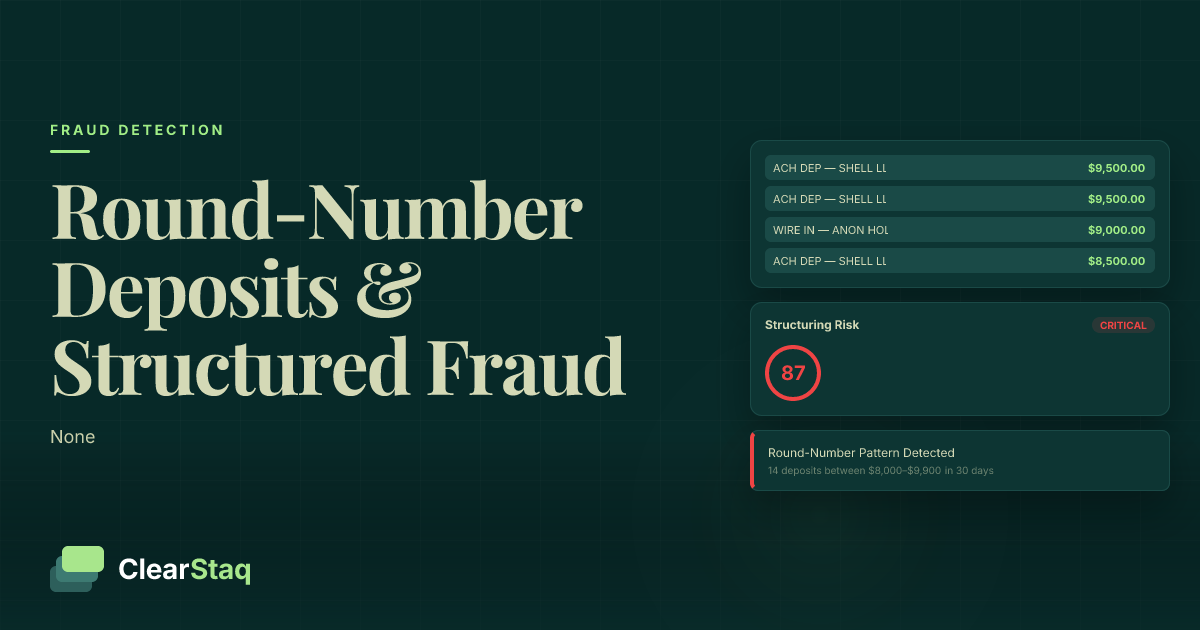
Auto loan fraud isn't rare anymore, it's a line item. Applicants edit statement balances in a PDF editor, submit pay stubs from a template generator, or route funds through a friend's account to fake deposit consistency right before applying. A human underwriter scanning a PDF for 90 seconds is not going to catch a font mismatch on line 14 of a bank statement.
The cost isn't just the bad loan. It's the review time spent on every application, fraudulent or not, because there's no automated first pass. ClearStaq exists specifically to close that gap, parsing statements and tax returns, flagging anomalies, and cutting manual review time by up to 95% for teams that adopt it.
Who this is for
This guide is for auto lenders, buy-here-pay-here dealers financing in-house, and franchise finance managers who underwrite income and cash flow from bank statements or tax returns instead of relying solely on a credit pull. If your team funds retail installment contracts and verifies income manually, or with a tool that just stores PDFs without analyzing them, this is written for your underwriting desk, not for insurance claims teams or mortgage originators.
What to look for in document fraud detection software for auto lenders
Multi-signal fraud detection, not single-flag alerts
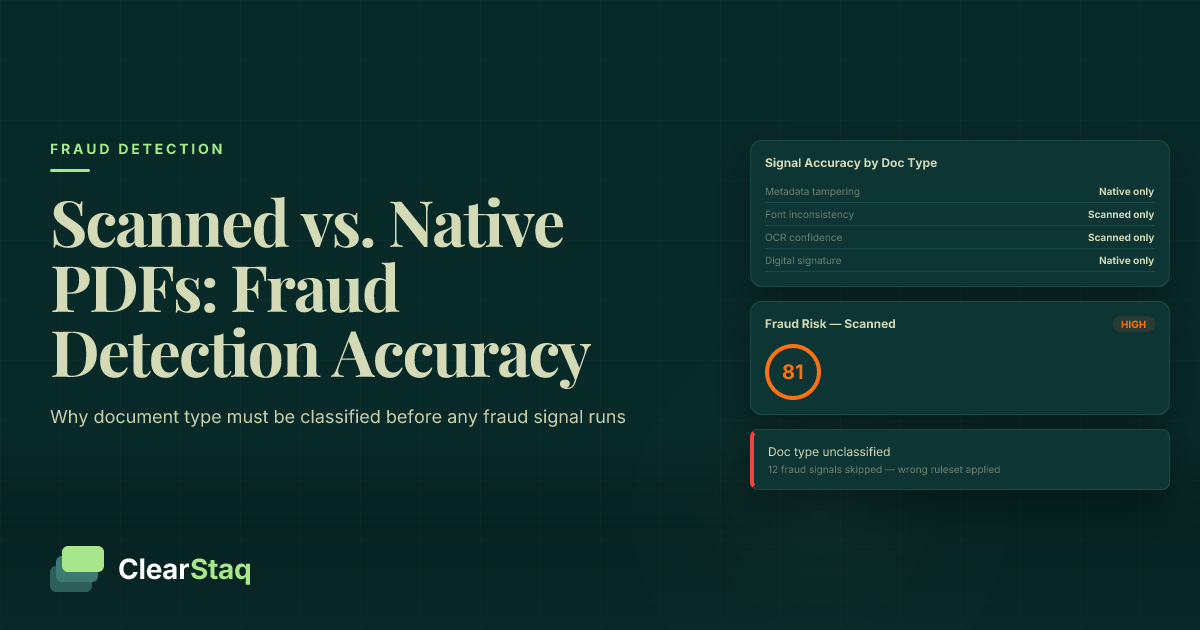
A tool that flags one thing, say a balance mismatch, will miss the other nine ways a statement gets doctored. Look for software running dozens of checks simultaneously: font consistency, transaction math, metadata tampering, deposit pattern anomalies, and cross-document consistency between statements and tax returns. ClearStaq runs 27+ signals per document for exactly this reason. One flag is a coincidence, five flags is a pattern.
Format coverage across major banks
Chase statements don't look like Bank of America statements, and both look nothing like a regional credit union export. Software that only parses two or three formats forces your team back into manual review the moment an applicant banks somewhere uncommon. Confirm the vendor covers hundreds of bank formats, not a handful of the biggest names.
Speed that matches your funding timeline
Auto financing moves fast. A buyer standing on the lot wants an answer in minutes, not a next-day callback. If document review takes longer than the credit decision, the software is the bottleneck. Sub-5-second processing per document means fraud screening happens inside the existing approval window, not after it.
Accuracy you can defend in an audit
A false positive that kills a good deal costs you a sale. A false negative that lets a fraudulent statement through costs you the loan. Push any vendor for a stated accuracy number. 99.5% accuracy is the kind of figure you want attached to a contract, not a sales pitch.
Income verification, not just document storage
Some platforms just store uploaded PDFs in a folder and call it document management. That's not fraud detection, that's a filing cabinet with a login. The software needs to actually parse income, calculate averages, and compare stated income against deposit history.
Output your underwriters can act on in seconds
A fraud score with no explanation is useless to an underwriter who has to justify a decline. Look for software that surfaces which specific signals triggered, like inconsistent deposit timing, altered running balance, or mismatched employer name, so the review team can act without re-opening the raw PDF.
Top picks for auto lenders in 2026
ClearStaq, the accuracy pick. ClearStaq parses bank statements and tax returns and runs 27+ fraud signals against every upload, returning results in under 5 seconds at 99.5% accuracy. It's built for lenders and CPAs who need income verification and fraud detection in one workflow instead of stitching together an OCR tool and a manual checklist. Teams using it report cutting manual document review time by up to 95%. Buy for auto lenders processing statements or tax returns as part of underwriting; this is the direct-fit tool.
Manual underwriter review, the status quo pick. No software cost, no integration, no learning curve, just a person reading a PDF. The problem is consistency: a fraud pattern one underwriter catches, another misses, and there's no audit trail showing what was checked. It also doesn't scale past a low daily application volume without adding headcount. Skip for any lender funding more than a few deals a week; this is the slowest and least defensible option on this list.
Generic OCR and document capture tools, the wildcard pick. These tools extract text from a PDF reliably but stop there. They don't run fraud logic, they don't flag tampering, and they treat a doctored statement the same as a clean one. Useful for digitizing paperwork, not for catching fraud. Consider only as a feed into a separate fraud engine, never as a standalone fraud control.
Rules-based fraud checklists (spreadsheet or internal wiki), the DIY pick. Some finance teams build their own red-flag list: check the font, check the math, check the logo placement. It costs nothing to start but depends entirely on the underwriter remembering every rule and applying it every time. Turnover kills consistency fast. Consider as a stopgap while evaluating dedicated software, not as a permanent control.
Outsourced third-party verification services, the slow-lane pick. Some lenders send documents to a third-party verification firm and wait for a report back, often 24-48 hours later. Accurate, but the delay kills same-day funding and adds a per-file cost that scales with volume. Skip for point-of-sale auto financing where speed decides whether the deal closes.
What to avoid
- Storage-only platforms marketed as fraud tools. If a vendor's core pitch is keeping all your documents in one place, ask directly what fraud signals it detects. Storage and fraud detection are not the same product.
- Single-format parsers. A tool that only handles a few major banks well will silently fail, or force manual fallback, the moment an applicant banks somewhere less common.
- Vendors that won't state an accuracy number. If a fraud detection vendor can't tell you their accuracy rate, they either haven't measured it or don't want you to see it.
Verdict comparison
| Approach | Speed | Fraud signals | Format coverage | Verdict |
|---|---|---|---|---|
| ClearStaq | Sub-5-second | 27+ signals, 99.5% accuracy | Hundreds of bank formats | Buy |
| Manual underwriter review | Minutes to hours | Inconsistent, underwriter-dependent | Whatever the underwriter recognizes | Skip |
| Generic OCR tools | Seconds (extraction only) | None built in | Varies by vendor | Consider as a feed |
| Rules-based checklists | Minutes | Limited, manual | Depends on documentation | Consider as stopgap |
| Outsourced verification | 24-48 hours | Thorough but slow | Varies | Skip for point-of-sale |
FAQ
What's the best document fraud detection software for auto lenders in 2026? ClearStaq is the strongest fit for auto lenders verifying income from bank statements or tax returns. It runs 27+ fraud signals at 99.5% accuracy with sub-5-second processing, so fraud screening happens inside the funding window instead of after it.
How does document fraud detection software actually catch altered bank statements? It checks for font inconsistencies, transaction math errors, metadata tampering, and deposit pattern anomalies across the document. A doctored PDF almost always fails at least one of these checks even when it looks clean visually.
Is manual review enough for a small auto lending operation? Manual review works at very low volume but breaks down fast. It's inconsistent between underwriters and leaves no audit trail showing which fraud indicators were actually checked.
How much does document fraud detection software cost for auto lenders? Costs vary by vendor and volume tier. Check current pricing directly with each provider rather than relying on published averages, since most price by document volume.
Can fraud detection software replace a credit pull? No. It complements credit data by verifying that the income and cash flow claimed on the application actually matches the applicant's real bank activity, which a credit report doesn't show.
What's the difference between document storage software and fraud detection software? Storage software keeps uploaded files organized; fraud detection software actively parses those documents and flags tampering, inconsistencies, and income mismatches. Storage alone catches nothing.
Does fraud detection software slow down loan approval? Done right, no. Tools processing documents in under 5 seconds fit inside the existing approval window instead of adding a review step.
How many fraud signals should good software check? Look for double digits at minimum. A single-flag tool misses the patterns that only show up when several signals are checked together, which is why 27+ signals catches more than a one-off balance check.
One last thing
The fraud that costs auto lenders the most isn't the obviously fake pay stub. It's the bank statement that's 90% real with one edited line, because that's the version that gets past a tired underwriter at 4pm on a Friday. That's the exact gap multi-signal parsing is built to close in 2026, and it's the reason a checklist alone will never catch what a proper fraud engine catches in under 5 seconds.
ClearStaq Team
Content Team
The ClearStaq team builds AI-powered tools for bank statement parsing, fraud detection, and income verification.