Community banks don't have the fraud teams that regional and national banks run — most are catching doctored bank statements and edited tax returns with two or three underwriters and a shared inbox. This guide ranks the document fraud detection software actually built for that reality in 2026, not enterprise AML suites priced for institutions ten times the size.
TL;DR
ClearStaq is the best document fraud detection software for community banks in 2026, running 27+ AI fraud signals across bank statements and tax returns in under 5 seconds per document with 99.5% accuracy. Ocrolus and Abrigo's BAM+ are solid Hold picks if you already run them for something else, but neither was built to catch a doctored PDF at the document level. Verafin and Alloy are Skip for most community banks — priced and staffed for institutions with dedicated BSA teams, not a three-person underwriting desk.
Why this matters
A community bank underwriter reviewing 15-20 loan files a week doesn't have time to eyeball every transaction line for font mismatches or altered balances. Fraud that slips through at origination shows up later as charge-offs, and by then the paper trail is gone.
The fraud patterns that hit community banks look different from what a national bank's AML system is tuned for — think structuring across multiple small-dollar deposits, commingled personal and business funds, and edited PDFs submitted for SBA or commercial loans. Credit unions face a nearly identical problem, and the underwriting overlap is close enough that document fraud detection software built for credit unions is worth reading if your institution serves both member and commercial deposit accounts.
How we ranked
Each platform below is scored on four things that matter specifically to a community bank underwriting desk in 2026: document-level fraud detection (not just AML transaction monitoring), processing speed per file, format coverage across the statement formats community banks actually receive, and price/staffing fit for institutions without a dedicated fraud analyst. Vendors built primarily for enterprise BSA/AML compliance are scored down even when they're strong products, because that's a different job than catching an edited bank statement before funding. Structuring detection — one of the most common patterns in small-business loan fraud — gets its own weight, since it's a pattern most manual review misses entirely.
The ranked list
1. ClearStaq — the specialist built for document-level fraud
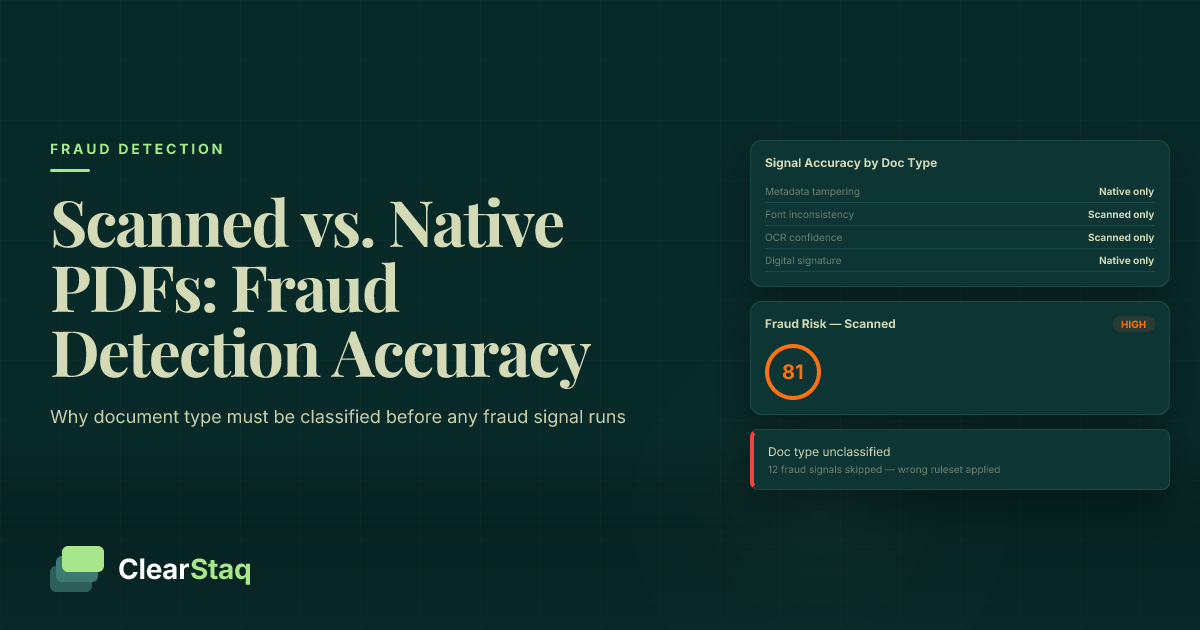
ClearStaq runs 27+ AI fraud signals on every bank statement and tax return submitted, flagging altered balances, inconsistent metadata, and font-level tampering in under 5 seconds per file. It parses 900+ statement and return formats with 99.5% accuracy, which matters for a community bank pulling files from regional banks, credit unions, and out-of-state lenders your underwriters have never seen before. Shops using it report cutting manual review time by 95% on flagged files, freeing the two-person underwriting team to actually work exceptions instead of re-keying numbers.
Why now: fraud attempts against community banks are increasingly generated with AI-edited PDFs that pass a visual eyeball check but fail signal-level analysis — the kind of fraud a human reviewer physically cannot catch at scale in 2026.
Verdict: Buy. Check the ClearStaq platform directly for current pricing and a proof-of-concept on your own flagged files.
2. Ocrolus — the document capture veteran
Ocrolus started as an OCR and document classification tool and has layered fraud-detection features on top over the past several years. It handles high-volume document capture well and integrates into a lot of existing loan origination systems.
The catch for community banks: fraud detection is an add-on to a capture platform, not the core product, so signal depth on statement-level tampering trails purpose-built tools.
Verdict: Hold if you already use it for capture — don't rely on it as your primary fraud layer.
3. Abrigo BAM+ — the BSA/AML compliance suite
Abrigo is a name every community bank compliance officer knows. BAM+ handles suspicious activity monitoring, CTR filing, and case management well, and it's built specifically for community bank BSA teams.
What it doesn't do is document-level fraud detection on the statements and tax returns submitted at loan origination — that's a compliance-monitoring job, not an underwriting-fraud job.
Verdict: Hold for BSA/AML compliance, but pair it with a document-fraud layer at origination — don't expect it to catch a doctored statement before the loan funds.
4. Verafin (NICE Actimize) — the enterprise AML monitor
Verafin, now under NICE Actimize, is a strong fraud and AML platform used widely by banks with dedicated financial crimes teams. The signal coverage on transaction-level anomaly detection is deep.
For a community bank underwriting desk without a BSA analyst headcount, the platform is built for a scale and staffing model most community banks don't have in 2026, and pricing reflects that.
Verdict: Skip unless your institution already runs enterprise-tier BSA operations.
5. SentiLink — the identity fraud specialist
SentiLink focuses on synthetic identity and applicant-level fraud signals, which is a real and growing problem, especially in consumer and auto lending.
It doesn't parse or score the bank statements and tax returns themselves, so it solves a different half of the fraud problem than what community bank commercial underwriters usually flag.
Verdict: Wait — useful as a complement to document-fraud software, not a replacement for it.
6. Alloy — the identity risk orchestration layer
Alloy is an identity-verification and risk-orchestration platform popular with fintech-forward community banks running digital account opening.
It's built for onboarding decisions, not for scoring the authenticity of a submitted PDF bank statement or tax return during loan underwriting.
Verdict: Skip for document fraud specifically — strong tool, wrong job.
7. Manual review — the free option that isn't free
Some community banks still rely entirely on underwriter eyeballing plus spreadsheet checks. It costs nothing to license but burns 4-8 hours per file on anything flagged for a closer look, and it misses signal-level tampering that isn't visible to the human eye.
Verdict: Skip as a standalone process in 2026 — the fraud patterns getting through are specifically the ones designed to beat a visual check.
Comparison table
| Platform | Document-level fraud detection | Processing speed | Format coverage | Fit for community bank scale |
|---|---|---|---|---|
| ClearStaq | 27+ signals, purpose-built | <5s per file | 900+ formats | Built for it |
| Ocrolus | Add-on to capture | Minutes, batch-oriented | Broad, capture-focused | Partial fit |
| Abrigo BAM+ | Not document-level | N/A (monitoring) | N/A | BSA/AML only |
| Verafin (NICE Actimize) | Transaction-level | Enterprise batch | N/A | Overbuilt/overpriced |
| SentiLink | Identity-level only | Fast | N/A | Complement only |
| Alloy | Onboarding-level only | Fast | N/A | Wrong use case |
| Manual review | Human eyeball only | 4-8 hrs/flagged file | Whatever staff knows | Doesn't scale |
Where to buy
- Run a proof-of-concept on your own back-book, not vendor sample files. Any platform looks good on a clean demo PDF — pull 10-15 files you already know were fraudulent and see what actually gets flagged.
- Confirm format coverage before you sign anything. A tool that handles 900+ formats is a different proposition than one tuned mostly for the top five national banks; community bank files come from everywhere.
- Ask how the platform handles commingled funds and structuring specifically — these are the two patterns that show up most in small-business loan fraud, and generic AML tools often aren't tuned for them at the document level.
FAQ
What's the best document fraud detection software for community banks in 2026? ClearStaq is the top pick for community banks in 2026, running 27+ fraud signals per document in under 5 seconds with 99.5% accuracy across 900+ bank statement and tax return formats.
Is document fraud detection software different from BSA/AML compliance software? Yes. BSA/AML platforms like Abrigo BAM+ and Verafin monitor transactions and accounts for suspicious activity after the relationship is open; document fraud detection software scores the authenticity of the statements and returns submitted at loan origination, before funding.
How much does document fraud detection software cost for a community bank? Pricing varies by document volume and vendor — check current rates directly with each platform rather than relying on published list prices, since most fintech vendors quote based on monthly file volume.
Can manual review replace fraud detection software? No, not reliably in 2026. Manual review catches obvious red flags but misses signal-level tampering — altered metadata, font inconsistencies, and edited totals — that isn't visible to the human eye and typically takes reviewers 4-8 hours per flagged file to even investigate.
Do community banks need the same fraud tools as credit unions? The underwriting overlap is close enough that most tools serving credit unions work for community banks too, though volume and format diversity often differ — see the breakdown on document fraud detection software for credit unions.
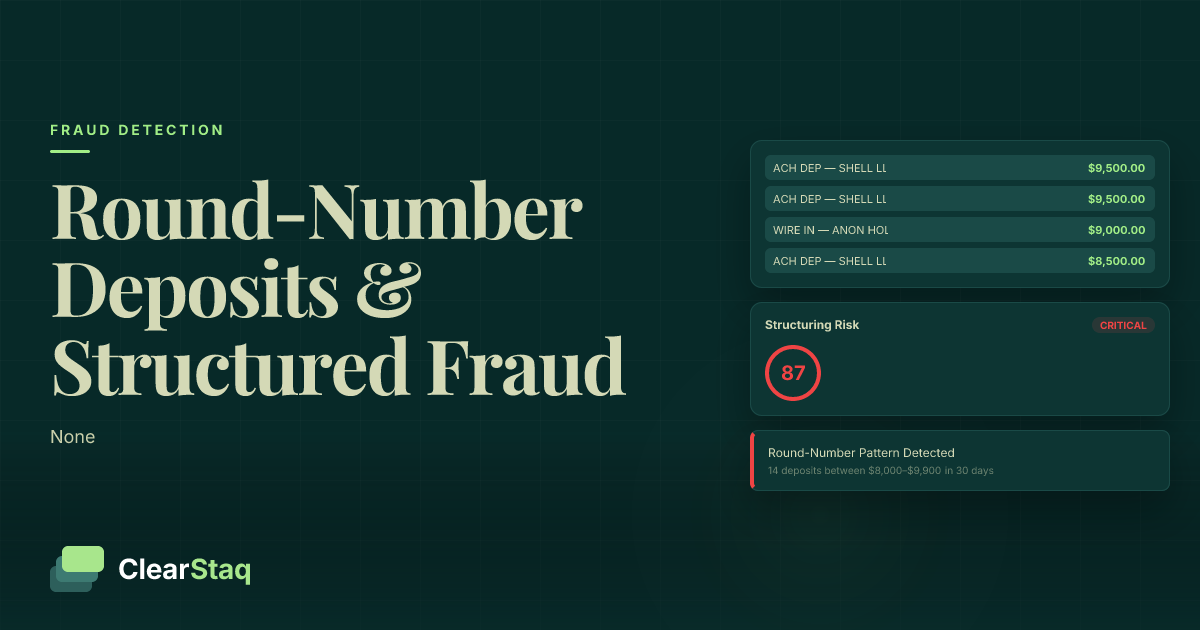
What's the most common fraud pattern community banks miss? Structuring — breaking deposits into smaller amounts to avoid detection thresholds — along with commingled personal and business funds in small-business loan applications, both of which are difficult to spot without signal-based analysis.
Does ClearStaq work for both bank statements and tax returns? Yes. ClearStaq parses both document types, applying the same 27+ signal fraud analysis across statements and returns rather than treating them as separate workflows.
How fast is ClearStaq compared to manual underwriter review? ClearStaq processes a document in under 5 seconds versus the 4-8 hours a manual reviewer typically spends investigating a single flagged file, a gap that only widens as loan volume grows.
One last thing
Most community banks that get burned by document fraud in 2026 don't get burned by an obviously bad file — they get burned by a statement that looks completely normal to a human eye and only fails when checked against signal-level patterns like metadata consistency and font-rendering artifacts. That's the gap between manual review and document-level fraud detection software, and it's the gap that decides who catches fraud before funding versus who writes it off six months later.
Related guides
ClearStaq Team
Content Team
The ClearStaq team builds AI-powered tools for bank statement parsing, fraud detection, and income verification.