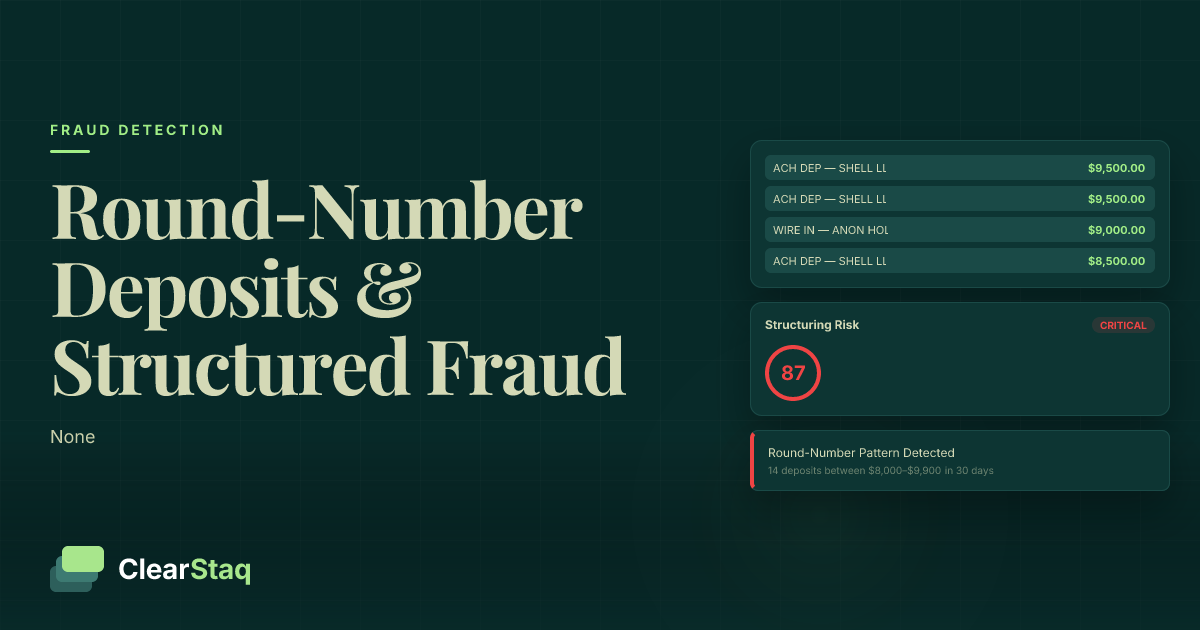
Structured transaction fraud and round-number deposits are among the hardest fraud signals to catch because they appear in otherwise clean-looking bank statements. Underwriters should watch for clusters of sub-$10,000 deposits, identical round-dollar amounts within a 30-day window, and end-of-month deposit spikes — patterns that signal either CTR-avoidance or deliberate revenue inflation.
What you'll learn
- Structured deposits produce clean-looking statements with no NSF fees or overdrafts, making pattern-level analysis across 90–365 days essential for detection
- Two distinct structuring types exist: CTR-avoidance structuring (cash deposits just under $10,000) and revenue-inflation structuring (metronomic round-number deposits to manipulate ADB calculations)
- Three or more deposits of identical amounts within any 30-day window, or deposits rounding to the nearest $1,000 in more than 60% of monthly transactions, constitute actionable fraud signals
- Round-number deposits become high-confidence fraud indicators when they co-occur with zero NSF fees, absent payroll ACH outflows, and implausibly stable month-to-month balances
- Non-bank lenders face civil forfeiture exposure if they fund businesses engaged in structuring, making documented fraud detection methodology a legal protection, not just a compliance formality
Structured transaction fraud and round-number deposits are among the hardest fraud signals to catch because they appear in otherwise clean-looking bank statements. Underwriters should watch for clusters of sub-$10,000 deposits, identical round-dollar amounts within a 30-day window, and end-of-month deposit spikes — patterns that signal either CTR-avoidance or deliberate revenue inflation.
Why "Clean-Looking" Statements Are the Most Dangerous
Fabricated bank statements with obvious errors — mismatched fonts, impossible running balances, PDF metadata from editing software — are relatively easy to catch. The sophisticated fraud is harder to see. It hides inside plausible transaction histories that pass every visual check an underwriter applies.
Structured deposits produce statements that look healthy. No NSF fees. No overdrafts. A stable, growing balance. That apparent cleanliness is precisely the problem: when business fundamentals don't match the deposit pattern, the absence of red flags becomes a red flag in itself.
Catching this requires pattern-level analysis across 90 to 365 days of transaction data — not a line-by-line scan of individual deposits. According to 2026 MCA bank statement fraud data, structured deposit manipulation is among the fastest-growing fraud typologies in alternative lending, precisely because it survives manual review so reliably.
The Problem with Manual Statement Review
When an underwriter scans a bank statement page by page, they see individual transactions. A $9,500 cash deposit on March 3rd is unremarkable. A $9,500 cash deposit on March 3rd, March 10th, March 17th, March 24th, and March 31st is a serious fraud signal — but that pattern only becomes visible when you look at all five deposits together.
Cognitive load compounds the problem. An underwriter reviewing 12 months of dense transaction data across multiple applicants in a single day won't reliably catch metronomic deposit timing or subtle amount clustering. Structured patterns are designed to be invisible at the transaction level. They only reveal themselves at the pattern level.
How Fraudsters Exploit the "Clean Statement" Perception
Structured deposits don't look like fraud because they're designed not to. A business depositing $5,000 every Monday for three months looks like a disciplined operation with steady cash flow. That perception is the goal.
Revenue-inflation structuring specifically targets the metrics underwriters use to make approval decisions: average daily balance (ADB), monthly revenue totals, and deposit frequency. The cleaner the statement looks against those metrics, the higher the advance offer — and the larger the fraud.
What Are Structured Transactions? (And Why They Show Up in Loan Applications)
Structuring is defined under 31 U.S.C. § 5324 as the deliberate practice of breaking up financial transactions into smaller amounts to avoid triggering a Currency Transaction Report (CTR). Under the Bank Secrecy Act, any cash transaction exceeding $10,000 must be reported to FinCEN. Structuring that threshold — intentionally keeping deposits below $10,000 to avoid that report — is a federal crime, regardless of whether the underlying funds are from legal sources. FinCEN's official guidance makes clear that intent, not amount, is the defining element.
For underwriters at non-bank lenders, structured deposits in a submitted bank statement carry a double warning: they may signal active money laundering or cash income concealment, and they may indicate the applicant is deliberately manipulating the financial picture presented to your underwriting team.
The $10,000 Threshold and Why It Matters to Underwriters
The CTR threshold is the organizing principle behind most cash structuring behavior. When deposits consistently land just below $10,000 — at $9,700, $9,800, $9,900 — with no business-cycle explanation for that specific range, the pattern suggests the depositor is aware of the reporting threshold and managing around it.
Non-bank lenders have no direct BSA or CTR filing obligations. But that doesn't make sub-$10,000 deposit clusters irrelevant. A business operating with CTR-avoidance behavior in its bank account is operating outside normal financial reporting norms. That's a risk indicator regardless of your regulatory status — and it's one the FFIEC BSA/AML Examination Manual treats as a core suspicious activity typology.
Smurfing in a Business Banking Context
Traditional smurfing involves multiple individuals — called "smurfs" — each making sub-threshold cash deposits across different banks or accounts to obscure the aggregate amount. In a business banking context, the same logic applies at a different scale.
Business-banking smurfing often involves related entities, family members, or shell companies spreading structured deposits across multiple accounts. Those accounts are then submitted as separate bank statements to different lenders — sometimes simultaneously. This intersects directly with MCA stacking patterns, where multiple advances are obtained concurrently by presenting different account statements to competing funders.
Two Types of Structuring Underwriters Need to Distinguish
Most AML content treats structuring as a single phenomenon. For underwriters reviewing loan applications, that's an oversimplification. There are two distinct structuring patterns that appear in submitted bank statements, and they carry different risk implications.
CTR-Avoidance Structuring: What It Looks Like
CTR-avoidance structuring is what most people think of when they hear the word "structuring." Cash deposits cluster consistently just below $10,000 with no legitimate business explanation for that specific amount range.
A concrete example: a business shows six cash deposits across a 45-day window — $9,700, $9,800, $9,500, $9,600, $9,900, and $9,750. No individual deposit triggers a CTR. But no legitimate business has a reason for its cash deposits to cluster so tightly below $10,000 without variance. Real cash-register business revenue produces irregular daily totals. This pattern doesn't.
Legal exposure for lenders is real. The DOJ's guidance on currency reporting offenses has established that third parties who knowingly benefit from structured accounts can face prosecution. ACAMS classifies this typology as one of the highest-confidence structuring indicators in AML training frameworks.
Revenue-Inflation Structuring: The ADB Manipulation Play
Revenue-inflation structuring is the fraud variant that's almost entirely absent from existing compliance literature — and the one most directly dangerous to MCA underwriters.
MCA underwriters calculate average daily balance calculations used in MCA underwriting from bank statement totals. A fraudster who deposits $5,000 every Monday for 12 consecutive weeks creates three things simultaneously: a high average daily balance, apparent revenue regularity, and zero visible red flags in isolation.
Those deposits may be owner capital recycled through the account, loan proceeds from another lender being run through to simulate revenue, or — in edited PDF cases — transactions that were never made at all. The result is an ADB that justifies a larger advance than the business's actual cash flow supports. This connects to the broader pattern of revenue smoothing and artificial cash flow patterns that sophisticated fraudsters use to engineer approval-worthy statements.
Both structuring types can appear in the same statement. When they co-occur — sub-$10,000 cash clusters alongside perfectly metronomic round-number deposits — the combination is the strongest structural fraud signal a bank statement can produce.
Round-Number Deposits: The Signal Hiding in Plain Sight
Not every round number is suspicious. But round-number deposits — exact thousands ($5,000, $10,000, $15,000), exact half-thousands ($2,500, $7,500), or repeating identical amounts — become a fraud signal when they appear with unusual frequency or regularity. You can explore the automated detection mechanics behind these patterns in our analysis of round dollar deposit patterns.
The core issue is statistical. Organic business revenue almost never produces perfectly round deposit amounts. A restaurant's daily deposit reflects card processing totals, cash drawer counts, and any commingled tips — all of which produce irregular totals with cents-level variance. A deposit of exactly $5,000.00, repeated eight weeks in a row, is mathematically inconsistent with authentic business cash flow.
Quantitative Thresholds: When Does Round Become Suspicious?
Underwriters need actionable thresholds, not vague guidance. Here are the specific criteria worth building into your review process:
| Pattern | Threshold | Signal Type |
|---|---|---|
| Identical or near-identical deposit amounts | 3+ occurrences within any 30-day window | Revenue-inflation structuring |
| Deposits rounded to nearest $1,000 | More than 60% of total deposits in a month | Statistical anomaly — warrants review |
| Cash deposits clustering within $200 of $10,000 | Any repeated occurrence | CTR-avoidance structuring |
| Deposits rounded to nearest $500 | More than 60% of total deposits in a month | Possible revenue-inflation structuring |
| End-of-month deposit concentration | More than 40% of monthly deposits in final 5 days | Balance-inflation timing signal |
These thresholds give underwriters specific criteria to apply — something entirely absent from existing compliance literature on this topic.
As the scoring visualization shows, ClearStaq doesn't flag individual round-number deposits in isolation. It evaluates deposit amount distribution, timing regularity, and round-number frequency as a combined pattern signal — producing a fraud score that reflects the cumulative risk rather than any single transaction anomaly.
End-of-Month Balance Inflation: The Timing Tell
One of the most reliable structuring tactics is timing large round-number deposits to land in the final three to five days of a statement period. This inflates both the closing balance and the ADB calculation for that month without requiring the deposit to remain in the account long-term.
A legitimate business shows deposit velocity distributed throughout the month in a pattern that matches its actual sales cycle. A retailer depositing $25,000 on the 28th of each month — with no corresponding wholesale purchase or bulk-sale event visible in the transaction record — is showing a timing pattern that has no authentic business explanation.
The Pattern Clusters: What Structuring Actually Looks Like in a Bank Statement
Definitions are useful. Concrete patterns are actionable. Here's what legitimate and structured deposit histories actually look like side by side.
Hypothetical Example: Legitimate vs. Structured Deposit Patterns
Legitimate pattern — a real restaurant: Deposits for a single week read $3,247.82 (Monday), $4,891.15 (Tuesday), $2,103.44 (Wednesday), $5,672.90 (Friday), $8,441.37 (weekend combined). The amounts are irregular, include cents-level variance, and the weekend deposit is higher than weekday deposits — consistent with a restaurant's actual traffic pattern.
Structured pattern — a fraudulent "restaurant": Deposits read $5,000.00 every Monday for eight consecutive weeks. No cents. No variance. No difference between a slow January Monday and a busy March holiday weekend. Mathematically impossible revenue consistency for any business that operates in the real world.
CTR-avoidance pattern — a business claiming cash retail sales: Four weekly deposits across a month reading $9,800, $9,500, $9,750, $9,900. All cash. No accompanying card processing deposits. No business with legitimate cash retail sales would have its cash totals cluster so consistently in a $400 range just below the reporting threshold.
Co-Occurring Fraud Signals That Amplify the Risk Score
Round-number deposits rarely appear alone in a fraudulent statement. The signals that most reliably co-occur — and that should dramatically increase your confidence in a fraud determination — are:
- Zero or near-zero NSF fees: A business with the stated revenue level has never once overdrawn, bounced a check, or experienced a timing gap between a debit and a deposit. Statistically unusual for any active business. See our analysis of NSF pattern analysis in underwriting for how this signal is quantified.
- Absent payroll ACH outflows: The business claims employees but no payroll processor ACH debits appear — no ADP, Gusto, Paychex, or manual payroll transfers on predictable pay dates.
- Duplicate or recycled transaction entries: Round-number deposits in edited statements sometimes appear as near-duplicates — same amount, one or two days apart — created when a transaction was copy-pasted during PDF manipulation. Duplicate transaction detection catches this systematically.
- Implausibly stable month-to-month totals: Every real business has variance across months. A statement showing $47,000, $47,500, $46,800, $47,200 in monthly deposits for four consecutive months is performing financial stability, not demonstrating it.
The heatmap illustrates why individual signals produce false positives while clusters produce high-confidence fraud scores. When round-number deposits, zero NSF activity, missing payroll, and stable balances all register simultaneously, the combined signal is far stronger than any single indicator alone.
Legitimate Round-Number Deposits vs. Fraudulent Ones: How to Tell the Difference
Not every round-number deposit is fraud. Building false-positive risk into your detection process creates friction with legitimate applicants and erodes underwriter confidence in the signals. The goal is accurate pattern recognition, not reflexive suspicion of any deposit ending in zeros.
Legitimate sources of round-number deposits include:
- Wire transfers — which by convention are sent in round amounts and carry sender identification in the description field
- Owner equity contributions — which should appear as ACH or wire from the owner's personal account, not as unattributed cash
- Intercompany transfers — typically from a related entity, with identifying memo fields
- Loan proceeds — SBA disbursements, bank loan draws, or MCA advances, all of which should have identifiable source descriptions
- Vendor refunds — which are typically round amounts and infrequent
Transaction Descriptions as a Verification Layer
The distinguishing factor between a legitimate round-number deposit and a suspicious one is almost always the transaction description. A $50,000 wire from "XYZ Corp — Q1 contract payment" tells an underwriter exactly what that deposit represents. A $9,800 cash deposit with the description "DEP" or "CASH" tells them nothing — and demands scrutiny.
Wire transfers carry sender identification by protocol. Cash deposits rarely have descriptive memo fields, which is precisely why round-number cash deposits are harder to verify and warrant higher scrutiny than round-number wire receipts. When descriptions are absent, generic, or identical across multiple deposits ("DEP," "CASH DEP," "DEPOSIT"), treat the pattern as suspicious until documentation explains it.
Industry Baselines and the Role of Business Type
Cash-intensive businesses — restaurants, retail stores, car washes, laundromats — legitimately deposit more frequently and in amounts that more closely approximate round numbers than B2B service businesses do. This context matters.
A car wash depositing $800 to $1,200 daily is behaving normally. A law firm depositing exactly $5,000 every Monday is not. ClearStaq's detection baselines are derived from 900+ bank formats, which allows deposit patterns to be benchmarked against industry-typical behavior rather than against a one-size-fits-all threshold.
The practical rule: round-number deposits warrant a documentation request, not an automatic decline. Flag the pattern, ask for an explanation, and let the applicant's response — or non-response — inform the decision.
How ClearStaq Detects Structured Deposit Patterns at Scale
ClearStaq's fraud detection platform approaches structured transaction fraud the way the problem actually works: at the pattern level, not the transaction level. An underwriter opening a 90-day bank statement sees pages. ClearStaq sees 27 intersecting fraud signal dimensions evaluated simultaneously across every transaction in the statement.
The 27-Signal Holistic Scoring Approach
Individual signals carry false-positive risk. A single round-number deposit proves nothing. But when 27 fraud signals ClearStaq detects in bank statements are evaluated together — deposit amount distribution, timing regularity, NSF frequency, payroll presence, balance trajectory, and PDF metadata integrity — the combined score produces confidence levels that individual signals can't approach.
Structured deposit indicators — round-number clustering, sub-$10,000 cash patterns, end-of-month concentration — are scored as one dimension of this holistic assessment. The fraud score surfaces at the API response level, before an underwriter opens the file. This enables risk-tiered review queues where high-confidence fraud signals are reviewed first and low-risk applications move through faster.
The alert feed shows what this looks like in practice: as ClearStaq parses a statement, structuring signals fire in real time — metronomic deposit timing flagged, round-number cluster identified, end-of-month concentration detected — building into an overall fraud score that tells the underwriter exactly which risk dimensions to examine first.
See ClearStaq's Fraud Detection in Action
See how ClearStaq flags structured deposit clusters, round-number patterns, and end-of-month balance inflation across a full 12-month statement — before your underwriter opens the file. Book a demo to see the fraud score in action.
Custom Thresholds for Your Underwriting Criteria
MCA lenders can configure what constitutes a round-number cluster flag for their specific applicant pool. Cash-heavy business verticals can have round-number sensitivity calibrated without disabling the signal entirely. A car wash portfolio needs different thresholds than a software-as-a-service lender's book. Custom fraud rule configuration handles this through the ML pipeline, so industry-appropriate thresholds don't produce false positives while still catching genuine structuring patterns.
API integration means fraud scores arrive with the parsed data — no separate workflow, no manual triage step before risk-tiering begins.
The Legal Exposure for Lenders Who Miss These Signals
Non-bank lenders aren't subject to BSA or SAR filing requirements. That regulatory gap can create a false sense of insulation from structuring risk. It shouldn't.
Knowingly funding a business engaged in structuring creates real legal exposure. The DOJ has prosecuted third parties who knowingly benefit from accounts used for structured deposits. And regulators increasingly expect alternative lenders to demonstrate systematic fraud detection due diligence — even where direct BSA obligations don't apply.
Civil Forfeiture and the Uncollectable Loan Risk
The most immediate financial risk isn't criminal prosecution — it's civil forfeiture. Funds deposited through a structuring scheme can be subject to government seizure. If loan proceeds are commingled with those funds, the lender's security interest may be impaired or voided entirely.
The practical scenario: an MCA advance is funded based on an inflated ADB produced by structured deposits. The structuring scheme is later identified by law enforcement. The business's accounts are frozen. The funds are seized. The advance becomes uncollectable. This risk profile is similar to those found in check kiting and float-based fraud schemes, where the underlying account activity collapses the moment external scrutiny arrives.
Due Diligence Documentation as Legal Protection
The best legal protection available to a non-bank lender isn't a compliance program — it's documentation. Automated fraud scoring creates an audit trail demonstrating that systematic detection methodology was applied to every application. A declined application with a documented fraud score, flagged signals, and recorded decision rationale is a defensible record.
Manual review with no documented methodology creates exposure in both directions: it misses fraud that gets funded, and it provides no evidence of due diligence when that funded deal goes bad. Record the signals flagged, the score, and the decision rationale for every application where structuring patterns were identified.
Building a Detection Checklist for Your Underwriting Team
Automated detection is the right long-term answer. But underwriters reviewing statements today need immediate, actionable criteria. For a deeper methodology guide, see our post on spotting structuring patterns in business bank statements. The checklist below is a manual review supplement — not a replacement for systematic pattern analysis.
The 10-Point Structured Deposit Review Checklist
- Are there three or more deposits of identical or near-identical amounts within any 30-day period?
- Do any cash deposits cluster within $500 of the $10,000 CTR threshold across multiple weeks?
- Do deposits occur at metronomic intervals — every Monday, every 1st and 15th — without a clear business-cycle explanation?
- Are deposits concentrated in the final five days of each statement month, suggesting end-of-month balance inflation?
- Do deposit amounts round to the nearest $500 or $1,000 at a rate exceeding 60% of total deposits in any month?
- Are deposit descriptions absent or generic ("CASH DEP," "DEP") without sender or source identification?
- Does the deposit pattern produce implausibly stable month-to-month revenue totals with less than 10% variance?
- Is the NSF and overdraft count suspiciously low for a business operating at the stated revenue level?
- Are payroll ACH outflows absent or inconsistent with the number of employees the business claims?
- Does the business type — cash-heavy versus B2B — provide a plausible explanation for the round-number deposit pattern?
When to Request Additional Documentation
Flagging a round-number pattern should trigger a documentation request, not an automatic decline. The pattern tells you to look closer. The documentation tells you what you're looking at.
Request the following when structuring signals are present:
- Bank statements sourced directly from the institution — not applicant-submitted PDFs, which can be edited
- Explanation letters for large round-number deposits — owner contribution letters, wire confirmations, loan disbursement notices
- Three additional months of statements if end-of-month inflation pattern is suspected — the pattern either persists or resolves with more data
- Entity documentation if multiple related accounts or intercompany transfers appear — watch for shell company red flags in bank statements that suggest a more complex structure
Frequently Asked Questions
What is considered structuring in banking?
Structuring is the practice of deliberately breaking up financial transactions into smaller amounts to avoid triggering a Currency Transaction Report (CTR), which is required for cash transactions exceeding $10,000 under the Bank Secrecy Act (31 U.S.C. § 5324). It is a federal crime regardless of whether the underlying funds come from legal sources. For underwriters, structured deposits in a submitted bank statement are a red flag for either money laundering or deliberate revenue manipulation.
What does a round-number deposit mean in fraud detection?
A round-number deposit is a deposit of an exactly round amount — such as $5,000, $10,000, or $7,500 — that appears suspiciously frequently in a bank statement. Organic business revenue almost never produces perfectly round deposit amounts because real sales include cents-level variance. When three or more round-number deposits of identical or near-identical amounts appear within a 30-day window, underwriters should treat this as a structured transaction fraud signal requiring further investigation.
What is the difference between structuring and smurfing?
Structuring refers broadly to breaking up transactions to avoid CTR reporting thresholds, and can be done by a single person or entity. Smurfing is a specific form of structuring where multiple individuals — called "smurfs" — each make sub-threshold cash deposits across different accounts or banks to further obscure the pattern. In a business banking context, smurfing often involves related entities or family members depositing structured amounts across multiple accounts that are later submitted as separate bank statements to different lenders.
How do I know if a business is structuring deposits?
Look for three or more deposits of identical or near-identical amounts within any 30-day period, deposits that consistently land just below $10,000, or deposits timed to the final days of each statement month. Additional confirming signals include metronomic deposit timing (every Monday, every 1st and 15th), absence of payroll ACH outflows, suspiciously low NSF counts, and round-number deposits with no identifying sender description. Automated bank statement analysis tools can flag these patterns across a full 12-month statement in seconds.
What are the legal risks for a lender that funds a business engaged in structuring?
Non-bank lenders don't have BSA or SAR filing obligations, but knowingly funding a business engaged in structuring can create civil forfeiture exposure — structured funds can be seized by the government, leaving the lender with an uncollectable loan and an impaired security interest. Regulatory scrutiny of alternative lenders' AML practices is increasing, and lenders without documented fraud detection methodology face greater exposure if a funded deal is later connected to financial crime. Maintaining automated fraud scoring records provides an audit trail of due diligence.
Ready to Catch Structured Deposit Fraud Before It Reaches Your Underwriters?
Manual review catches the obvious fraud. The structured transaction patterns — the ones buried in clean-looking statements — require pattern-level analysis across hundreds of transactions. ClearStaq surfaces those signals automatically, so your underwriters review risk, not rows.
Frequently Asked Questions
What is considered structuring in banking?
Structuring is the practice of deliberately breaking up financial transactions into smaller amounts to avoid triggering a Currency Transaction Report (CTR), which is required for cash transactions exceeding $10,000 under the Bank Secrecy Act (31 U.S.C. § 5324). It is a federal crime regardless of whether the underlying funds are from legal sources. For underwriters, structured deposits in a submitted bank statement are a red flag for either money laundering or deliberate revenue manipulation.
What does a round-number deposit mean in fraud detection?
A round-number deposit is a deposit of an exactly round amount — such as $5,000, $10,000, or $7,500 — that appears suspiciously frequently in a bank statement. Organic business revenue almost never produces perfectly round deposit amounts because real sales include cents-level variance. When three or more round-number deposits of identical or near-identical amounts appear within a 30-day window, underwriters should treat this as a structured transaction fraud signal requiring further investigation.
What is the difference between structuring and smurfing?
Structuring refers broadly to breaking up transactions to avoid CTR reporting thresholds, and can be done by a single person or entity. Smurfing is a specific form of structuring where multiple individuals — called 'smurfs' — each make sub-threshold cash deposits across different accounts or banks to further obscure the pattern. In a business banking context, smurfing often involves related entities or family members depositing structured amounts across multiple accounts that are later submitted as separate bank statements to different lenders.
How do I know if a business is structuring deposits?
Look for three or more deposits of identical or near-identical amounts within any 30-day period, deposits that consistently land just below $10,000, or deposits timed to the final days of each statement month. Additional confirming signals include metronomic deposit timing, absence of payroll ACH outflows, suspiciously low NSF counts, and round-number deposits with no identifying sender description. Automated bank statement analysis tools can flag these patterns across a full 12-month statement in seconds.
What are the legal risks for a lender that funds a business engaged in structuring?
Non-bank lenders don't have BSA or SAR filing obligations, but knowingly funding a business engaged in structuring can create civil forfeiture exposure — structured funds can be seized by the government, leaving the lender with an uncollectable loan and an impaired security interest. Regulatory scrutiny of alternative lenders' AML practices is increasing, and lenders without documented fraud detection methodology face greater legal exposure if a funded deal is later connected to financial crime. Maintaining automated fraud scoring records provides an audit trail of due diligence.
ClearStaq Team
Product Team
The ClearStaq team builds AI-powered tools for bank statement parsing, fraud detection, and income verification.