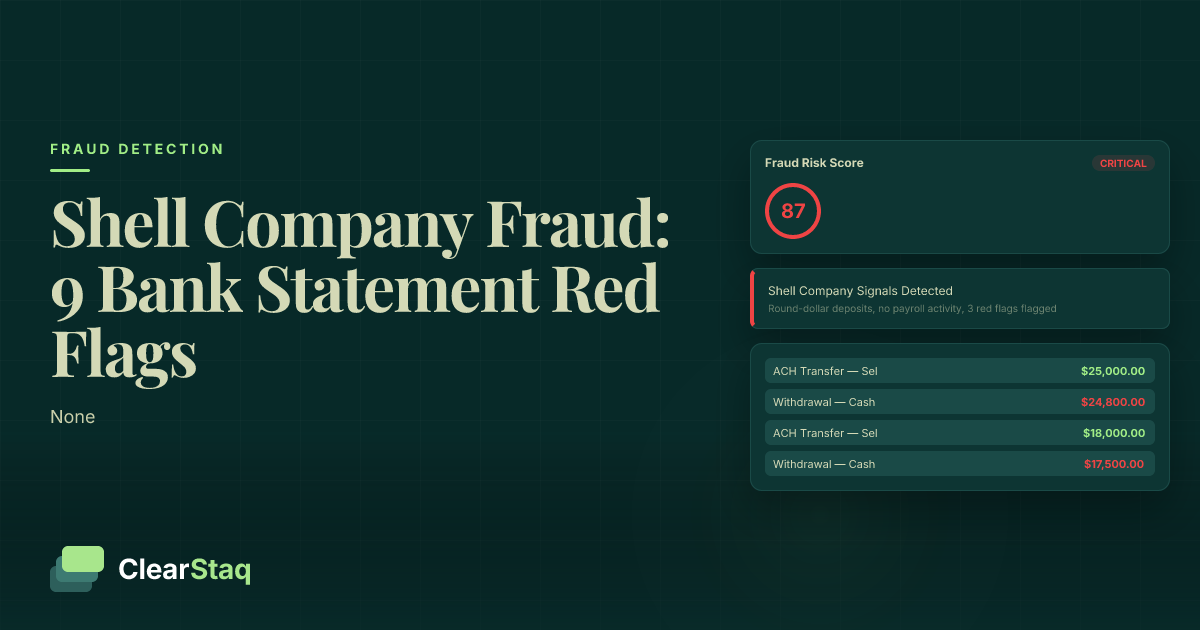
Shell company fraud in bank statements can be identified through nine key red flags: artificially smooth deposit patterns, round-dollar deposits from concentrated counterparties, circular cash flows, missing payroll or operating expenses, newly opened accounts with sudden high volume, rapid fund pass-through, geographic mismatches, and PDF metadata inconsistencies. Automated detection tools analyze these signals simultaneously — flagging shell entities in seconds rather than days.
What you'll learn
- Deposit counterparty concentration above 80% from one to three sources is the single strongest bank statement indicator of a shell entity
- The absence of payroll, rent, and operating expenses in a high-revenue account is as diagnostic as any positive fraud signal
- Round-dollar deposit patterns — exact amounts like $5,000 or $10,000 repeating across months — indicate manual, scripted transfers rather than real commerce
- PDF metadata anomalies including post-statement modification timestamps or non-bank creation software are standalone escalation triggers regardless of other flag counts
- MCA shell stacking schemes bypass UCC lien detection entirely, making cross-entity deposit source analysis the only scalable countermeasure
Shell company fraud detection in bank statements relies on nine key signals: artificially smooth deposit patterns, round-dollar inbound transfers, counterparty concentration above 80%, absent operating expenses, newly opened accounts with sudden high volume, rapid pass-through of funds, geographic mismatches, circular cash flows, and PDF metadata inconsistencies. Automated tools flag these indicators simultaneously — identifying shell entities in seconds rather than days.
What Is a Shell Company? (And Why Lenders Should Care)
A shell company is a legally registered business entity with no meaningful operations, employees, or physical presence. It exists on paper — it has an EIN, a registered address, and possibly a bank account — but it conducts no real commercial activity. According to FATF guidance on shell companies and beneficial ownership, these entities are among the most common vehicles used globally for financial fraud, money laundering, and illicit fund movement.
For lenders, the risk isn't abstract. Shell entities fabricate revenue histories, manufacture clean bank statement records, and obtain funding they never intend to repay. According to 2026 MCA bank statement fraud data, shell company-linked applications represent a growing share of fraudulent submissions — and alternative lenders are bearing a disproportionate cost.
The FDIC guidance on shell company risk frames the problem clearly: entities that exist solely as legal fictions create material risk for any institution that relies on bank statement data to underwrite credit decisions.
Legitimate Shell Companies vs. Fraudulent Shell Entities
Not every shell company is a fraud vehicle. Holding companies, real estate special purpose vehicles (SPVs), and IP-holding entities all have legitimate uses. A real estate investor using an LLC to own a single property is technically operating a shell — but the entity has documented economic purpose, traceable beneficial ownership, and a clear legal function.
The distinguishing factor is this: legitimate shells have a reason to exist beyond generating a favorable-looking bank statement. Fraudulent shell entities have three defining characteristics:
- No employees and no payroll expenses
- No recurring operating costs (rent, utilities, supplier payments)
- Inbound deposits concentrated from a very small number of related sources
When all three are present, the entity's bank account exists for one reason: to simulate business revenue for a lending application.
Why MCA Lenders Face Higher Shell Company Risk
Merchant cash advance lenders are disproportionately targeted compared to traditional banks. The reason is structural. MCA deals close in hours — not days or weeks — leaving no time for the enhanced due diligence that bank compliance teams perform over multiple business days.
Revenue-based MCA underwriting relies almost entirely on bank statement cash flow data. There's no collateral, no personal property pledge, and limited credit bureau integration. For a fraudster, a convincing set of bank statements is sufficient to obtain funding.
The absence of UCC lien enforcement infrastructure also makes fraudulent MCA applications low-risk for bad actors. If an entity defaults, recovery against a shell with no assets is effectively impossible. For more on identifying shell company bank statements during underwriting, the practical detection signals are what distinguish a fundable application from a fraudulent one.
How Fraudsters Use Shell Companies to Game MCA Funding
Shell company fraud against MCA lenders typically follows one of three patterns: manufactured revenue history, round-trip cash flow to inflate balances, and multi-entity stacking. Understanding how each scheme works at the bank statement level is the first step toward catching it.
Manufactured Revenue History: How Fake Deposit Patterns Are Built
The most common shell company fraud scheme involves creating the appearance of six months of consistent business revenue. The fraudster controls two or three related entities. One entity deposits funds into the applicant's account on a predictable schedule — every seven to ten days, in amounts between $8,000 and $12,000 — to mimic wholesale payments or service retainers.
From a surface reading, the statement looks like a functioning business receiving regular client payments. The critical tell is what's missing: there are no matching accounts payable transactions, no payroll debits, no supply purchases, and no utility payments that would naturally accompany $100,000+ in annual revenue. The money arrives and then disappears through large outbound transfers, with nothing in between that resembles real operations.
Identity layering compounds the scheme. Fraudsters use nominee directors — individuals with no real business history whose names appear on the EIN registration — and combine real EIN data with fabricated or altered bank statements. The combination creates a synthetic business identity that can pass a surface-level verification check.
Round-Trip Cash Flow and Circular Deposits Explained
Round-trip fraud involves money flowing from Entity A to Entity B to Entity C and back to Entity A. Each leg of the circuit generates a bank statement showing inbound business revenue. In isolation, each entity looks like a functioning company receiving payments from clients.
Circular flows are usually designed to avoid obvious duplication. Fraudsters use slightly different dollar amounts and timing offsets between each transfer to prevent pattern matching on exact amounts. A $10,000 transfer from A to B might return as $9,750 three weeks later — enough variation to defeat simple duplicate-detection rules.
This is exactly the type of scheme that duplicate transaction detection algorithms are built to catch — by analyzing counterparty relationships and fund flow direction rather than exact amounts and dates.
Speed exploitation is the final ingredient. Fraudsters deliberately submit applications during high-volume periods — end of month, fiscal quarter close — when underwriters are under time pressure and less likely to scrutinize individual transactions carefully.
9 Bank Statement Red Flags That Signal a Shell Company
These nine flags appear across legitimate shell company fraud cases. No single flag is definitive — the signal strength increases with each additional flag present in the same statement set.
Flags 1–4: Deposit Pattern Anomalies
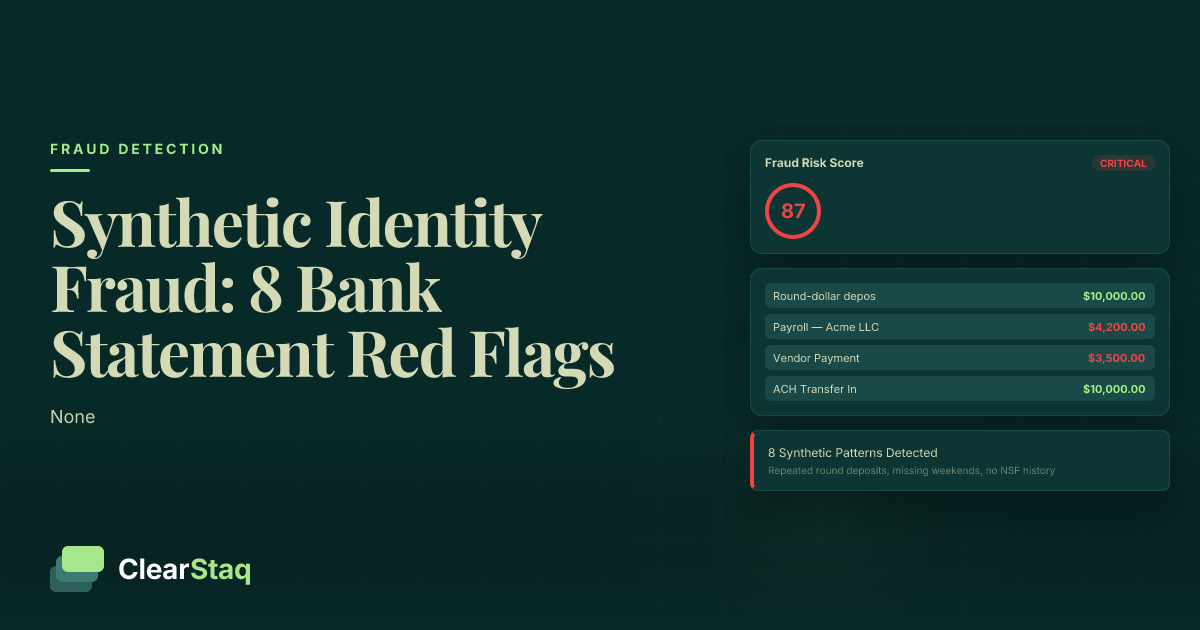
Flag 1: Deposit counterparty concentration. Legitimate small businesses have diverse customer bases. A functioning $50K/month restaurant receives deposits from card settlement processors, delivery platforms, catering clients, and cash deposit aggregators — potentially 20 or more distinct deposit sources per month. Shell companies receive 80% or more of their inbound deposits from one to three counterparties. High counterparty concentration is the single strongest bank statement indicator of a shell entity.
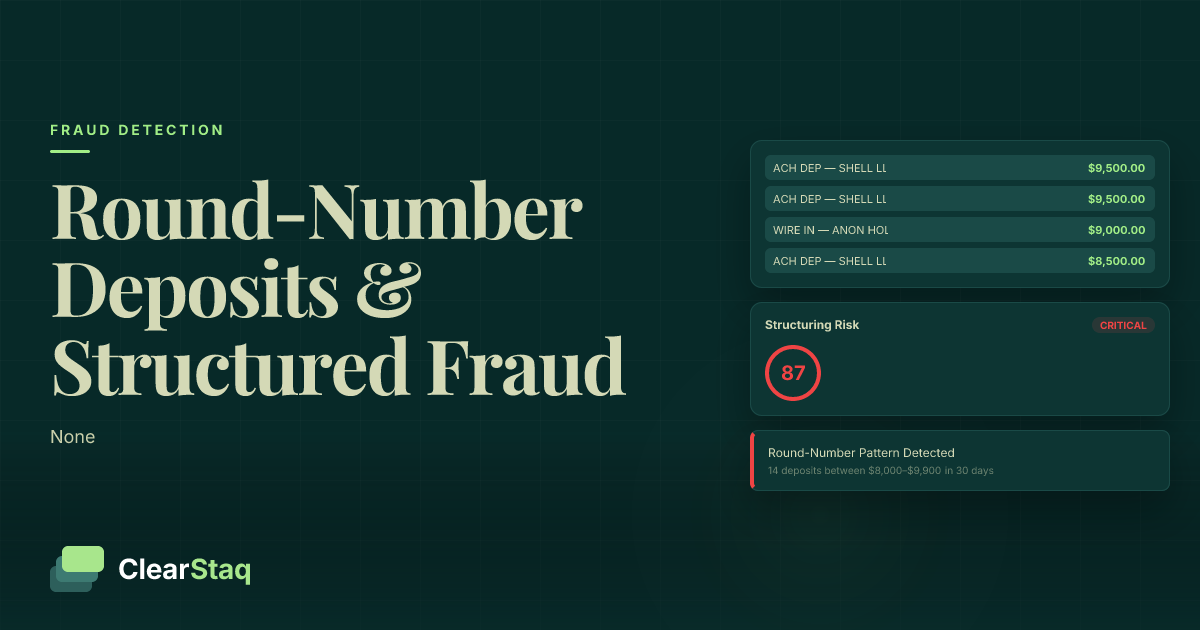
Flag 2: Round-dollar deposit patterns. Genuine B2B invoices vary by line item, tax, and negotiated terms. Real ACH payments from clients arrive as $11,247.50, $8,993.00, $14,105.75. Shell company deposits arrive as $10,000.00, $5,000.00, $15,000.00 — exact round numbers that indicate manual, scripted transfers rather than commercial invoicing. Systematic round-dollar deposit patterns across multiple months are a strong fabrication signal.
Flag 3: No payroll, no operating expenses. This is about what isn't there. A real business with $600K in annual revenue pays employees, buys supplies, covers rent, and pays utilities. The absence of payroll ACH debits, vendor payments, and recurring operating expenses is as diagnostic as the presence of any positive fraud signal. An account with consistent inbound revenue and zero outbound operating costs isn't a business — it's a pass-through.
Flag 4: Artificially smooth deposit regularity. Real SMB revenue has natural variability driven by client payment cycles, seasonal demand, and project timelines. Monthly deposit totals for a real $50K/month business typically vary 15–40% month over month. The standard deviation of monthly totals for a fabricated shell company is often near zero — deposits arrive on the same schedule, in similar amounts, month after month. Near-zero variability in monthly totals is a statistically strong fabrication signal.
Flags 5–9: Account Behavior and Document Anomalies
Flag 5: Newly opened account with immediate high-volume activity. Legitimate business growth is gradual. A new business that opens an account in January and is depositing $50,000+ per month by March has no plausible organic growth story. Accounts less than six months old with deposit volumes inconsistent with typical business ramp-up curves warrant immediate additional scrutiny.
Flag 6: No NSF fees, no overdrafts, no returned items. An active operating business — one paying employees, covering rent, and managing cash flow — will periodically experience overdrafts, returned checks, or NSF fees. A bank account with six months of spotless activity and zero exceptions is statistically inconsistent with real operations. Perfect account health is a red flag, not a green light.
Flag 7: Deposits immediately followed by large outbound transfers. In a shell company account, funds arrive and exit within 24–48 hours. There's no operational float — no period where the balance sits while the business pays bills, meets payroll, or builds a cash cushion. Consistent rapid pass-through of deposits with no operational dwell time indicates the account's only function is to show inbound volume.
Flag 8: Geographic mismatch. A construction company in Florida receiving deposits from entities based in Wyoming or Delaware — states with no meaningful construction market presence — is suspicious. Industries requiring local operations (food service, retail, field services) should show local banking activity, local counterparty names, and deposits consistent with the geographic market they claim to serve.
Flag 9: PDF metadata anomalies. Legitimate bank-issued PDF statements carry metadata reflecting the bank's internal document generation system — a consistent creator software signature, a creation timestamp near the statement close date, and no modification history. Altered statements often show Adobe Acrobat, generic PDF printer software, or modification timestamps that post-date the statement period. Thorough PDF metadata analysis can detect fabricated or altered statements before a single transaction is reviewed.
Here's how ClearStaq's fraud scoring engine aggregates all nine signals into a single composite risk score:
Rather than reviewing each flag independently, the composite score gives underwriters a single prioritized risk indicator — allowing immediate escalation of high-risk applications while lower-risk files move through standard processing.
| Red Flag | What to Look For | Signal Strength |
|---|---|---|
| Counterparty concentration | 80%+ of deposits from 1–3 sources | High |
| Round-dollar deposits | Exact amounts ($5,000, $10,000) with no variation | High |
| No operating expenses | Zero payroll, rent, utilities, or supplier payments | High |
| Artificially smooth deposits | Near-zero month-to-month variance in totals | High |
| New account + high volume | Account under 180 days old with $50K+/month | Medium-High |
| No NSFs or overdrafts | Six months of perfect account health | Medium |
| Rapid pass-through | Funds exit within 24–48 hours of receipt | High |
| Geographic mismatch | Counterparties inconsistent with stated business location | Medium |
| PDF metadata anomalies | Creation software, timestamps inconsistent with the bank | High (standalone escalation trigger) |
Deposit Pattern Analysis: What Real vs. Fabricated Revenue Looks Like
Understanding how MCA underwriters read deposit patterns starts with a concrete picture of what genuine SMB cash flow actually looks like — and how fabricated patterns differ at the transaction level.
A real $50,000/month business doesn't receive neat, even deposits. It receives card settlement batches that vary daily, ACH payments from clients that reflect actual invoice amounts, occasional check deposits, and potentially wire transfers for larger contracts. The timing is irregular. The amounts are irregular. The counterparty list is long.
A fabricated $50,000/month shell company receives four to six deposits per month from two counterparties, all ACH, all from the same routing number, in amounts like $12,000, $11,500, $13,000, $10,500 — enough variation to look organic, not enough variation to reflect real commerce.
The Counterparty Diversity Test
Counting unique deposit sources across three to six months of statements is one of the fastest shell company detection tests available. Genuine SMBs have diverse customer bases. A real $600K/year business accumulates deposits from 10 to 30+ unique counterparties over a six-month period.
Applying a Herfindahl-Hirschman Index equivalent to deposit concentration works as follows: if the top three counterparties represent 90% or more of total inbound revenue over six months, the account warrants escalation. Cross-referencing counterparty names against the applicant's described business type and geography adds another layer — a "logistics company" whose only depositing counterparties are holding companies registered in Delaware raises an immediate question about what cargo they're actually moving.
Detecting Artificially Smooth Revenue Patterns
Real businesses show monthly revenue variance of 15–40% depending on industry. A seasonal retailer might see 60% of annual revenue in Q4. A B2B services firm might have lumpy cash flow tied to project milestones. Artificially smooth revenue patterns — where monthly totals deviate less than 3–5% month over month for six straight months — are statistically inconsistent with real SMB operations.
Shell company deposits typically arrive within a two to three day window each month, on a consistent schedule. There's no seasonality. There's no lumpy month followed by a strong recovery. The revenue line is flat or gently increasing in a way that looks designed rather than organic.
The visual contrast between a genuine SMB income chart — with spikes, dips, seasonal peaks, and recovery patterns — and an artificially flat shell company deposit line makes the fabrication immediately apparent. AI-based income smoothing detection flags accounts where deposit regularity exceeds statistical norms for the applicant's stated industry.
MCA Stacking and Multi-Entity Shell Schemes
The most sophisticated shell company fraud against MCA lenders involves MCA stacking via multiple entities — using a network of related shell companies to obtain simultaneous funding from different lenders, each application appearing clean in isolation.
The scheme works like this: a single beneficial owner registers three entities — Entity A, Entity B, and Entity C. Each entity has its own EIN, bank account, and registered address. Entity A's "revenue" is actually deposits from Entity B. Entity B's "revenue" includes deposits from Entity C. Each entity's bank statement shows consistent inbound cash flow from what appears to be legitimate business counterparties. Each applies to a different MCA funder.
How to Spot Related-Entity Deposit Sources
Within a single statement, related-entity deposits leave detectable traces. Search deposit descriptions for business names that share words with the applicant entity. "ABC Holdings LLC" depositing into "ABC Services LLC" is an obvious case, but variations are common — fraudsters use maiden names, middle names, or geographic suffixes to obscure the connection.
Routing number analysis is particularly effective. Flag routing numbers that appear in both inbound deposits and outbound transfers — money arriving from and departing to accounts at the same bank, potentially the same account cluster, indicates circular fund movement rather than genuine commercial revenue.
Address pattern matching catches a different layer: shell entities frequently share registered agents in Delaware or Wyoming. A depositing counterparty registered at the same registered agent address as the applicant entity is a strong related-entity indicator.
Why Stacking via Shell Entities Is Harder to Catch Than Traditional Stacking
Traditional MCA stacking leaves UCC lien traces. A lender searching UCC filings can identify prior positions and decline to fund an already-leveraged merchant. Shell entity stacking bypasses this entirely — each entity has no prior financing history, no UCC liens, and no adverse credit signals. Each appears clean individually.
The fraud only becomes visible when entities are analyzed together — when deposit sources across applications are cross-referenced and the circular fund flow becomes apparent. Automated cross-referencing of deposit source patterns across a lender's entire portfolio is the only scalable solution to this specific threat.
By the time a single lender's manual review catches a stacking scheme, the other lenders in the network have already funded. Speed of detection is everything — and manual processes simply can't match the pace at which these schemes operate.
How to Verify Business Legitimacy During Underwriting
Bank statement analysis is the starting point, not the entire picture. A solid KYB verification workflow layers external data sources on top of bank statement signals to build a complete picture of whether a business actually operates.
Using the Corporate Transparency Act as a Due Diligence Resource
As of 2024, most US entities are required to report beneficial ownership information to FinCEN under the Corporate Transparency Act. This creates a new verification layer for lenders. FinCEN Beneficial Ownership Information Reporting data allows lenders to request that applicants provide their BOI filing confirmation as part of the underwriting package.
A mismatch between the stated ownership on the application and the beneficial ownership registered with FinCEN is a strong shell company indicator. A business that hasn't filed its required BOI report at all is either non-compliant — or doesn't actually exist in the way the applicant claims.
Lenders aren't required to access FinCEN's database directly (access is currently restricted to authorized government users), but requiring applicants to provide their filing confirmation number and cross-referencing stated ownership claims is a practical, low-cost verification step.
Cross-Referencing Bank Statement Data Against KYB Records
Three specific cross-references catch shell company fraud at the document verification stage:
- Entity formation date vs. earliest bank statement transaction date. Shell companies are often recently formed relative to their claimed revenue history. An entity incorporated six months ago with bank statements showing twelve months of transactions has an obvious problem.
- Registered agent address vs. deposit branch locations. Shell companies frequently use registered agent services in Delaware or Wyoming with no local banking activity. A "New York restaurant" whose only branch deposits come from a state other than New York isn't operating a restaurant anywhere near New York.
- Business type claimed vs. transaction categories present. A logistics company should have fuel purchases, toll payments, and vehicle-related transactions. A restaurant should have card terminal settlements and food supplier ACH debits. When a business's stated industry produces no recognizable transaction footprint, the business description is likely fabricated.
Google Street View and business directory cross-referencing takes five minutes and catches obvious shells — registered addresses that are UPS store mailboxes, vacant lots, or residential addresses inconsistent with the described business type.
How ClearStaq Automates Shell Company Detection
The 27 fraud signals ClearStaq applies to every bank statement include a dedicated cluster designed specifically for shell company detection: deposit regularity anomaly scoring, counterparty concentration analysis, round-dollar frequency measurement, and pass-through velocity calculation. These signals run automatically on every submitted statement — no separate fraud review step required.
ClearStaq's approach is bank statement-native. Parsing and fraud scoring happen in a single API call. Underwriters receive parsed transaction data and a complete fraud signal breakdown in the same response — no waiting for a separate document review queue.
The Shell Company Signal Stack: What ClearStaq Checks
Five signals form the core of ClearStaq's shell company detection layer:
- Counterparty diversity score: ratio of unique deposit sources to total deposits across the statement period
- Round-dollar deposit frequency: percentage of inbound transactions that are exact round numbers, compared to baseline for the applicant's industry
- Pass-through velocity: median time between deposit receipt and corresponding outbound transfer — sub-48-hour consistent velocity is a strong shell indicator
- Account age vs. volume ratio: flags accounts less than 180 days old with deposit volumes inconsistent with typical business ramp-up curves for the stated industry
- PDF integrity score: PDF metadata analysis checks creation software signatures, modification timestamps, and document author fields against known bank statement generation patterns for 900+ supported bank formats
ClearStaq's 900+ bank format support matters specifically for shell company detection. Fraudsters frequently use obscure regional banks or newly chartered accounts that other parsing tools can't read. Supporting these edge-case formats means shell company statements from less common banks receive the same fraud scrutiny as statements from major national institutions.
API Integration for MCA Underwriting Workflows
A single POST request returns parsed transactions, a composite fraud score, and a full signal breakdown. Webhook delivery supports real-time fraud alerts when shell company signals exceed a configurable threshold — allowing automated holds on high-risk applications before they reach a human underwriter's queue.
Signal weights are configurable, allowing lenders to tune detection sensitivity for their specific risk tolerance and portfolio mix. Batch processing supports high-volume MCA operations where hundreds of applications may be submitted on the same day.
ClearStaq's fraud detection platform is purpose-built for the speed requirements of MCA underwriting — fraud signals are returned in the same API response as parsed data, making same-day funding decisions compatible with meaningful fraud detection for the first time.
See Shell Company Red Flags Caught Before You Fund
See how ClearStaq's 27 fraud signals flag shell company red flags before you fund. Book a demo and run a live bank statement through the detection engine.
What to Do When You Suspect a Shell Company Application
Suspecting a shell company application requires a structured response. Your MCA underwriting checklist should include a defined escalation path for fraud flags — improvised responses lead to inconsistent documentation and potential regulatory exposure.
Escalation Thresholds: When to Decline vs. When to Investigate Further
A tiered escalation framework prevents both over-reaction to minor anomalies and under-reaction to serious fraud signals:
- 1–2 red flags: Heightened scrutiny. Request supplemental documentation — 12 months of statements (not just three), business license, and lease agreement. Continue processing while documentation is pending.
- 3–4 red flags: Escalate to senior underwriter or fraud team. Pause application. Do not fund while investigation is pending — document the hold reason in your loan origination system.
- 5+ red flags: Decline and document. Consider SAR filing if the evidence supports structuring or fraud. DOJ enforcement actions against shell company fraud make clear that lenders who fund and ignore obvious red flags face reputational and regulatory consequences.
- Any PDF metadata anomaly combined with round-dollar deposits: Automatic escalation regardless of total flag count. PDF manipulation plus deposit pattern anomalies together constitute strong evidence of document fraud, not coincidence.
When fraud is confirmed, file a Suspicious Activity Report (SAR) if your institution is a covered entity under BSA/FinCEN rules. SAR filing is both a regulatory obligation and a contribution to industry-wide fraud intelligence.
Building a Shell Company Red Flag Register
Every confirmed shell company application is intelligence. Maintain an internal registry of flagged counterparty names, routing numbers, and registered agent addresses. Cross-reference new applications against this registry as a first-pass filter — shell company networks often hit multiple lenders simultaneously, and an entity that appears as a deposit source in a declined application may appear as the applicant in a future submission.
Share intelligence with industry fraud consortia where your participation agreements allow. Shell company schemes are rarely isolated to a single target. The counterparty names and routing numbers in one fraudulent application may be the primary entities in the next.
The seven-step response framework in full:
- Do not fund while investigation is pending — document the hold in your LOS
- Request 12 months of statements, business license, lease agreement, and tax returns
- Cross-reference Corporate Transparency Act BOI filing and Secretary of State records
- Call the business phone number and verify physical address independently
- Check UCC filing history under all related entity names identified
- File a SAR if fraud is confirmed and your institution is a covered BSA entity
- Add counterparty names and routing numbers to your internal blocklist
Frequently Asked Questions
How do you identify a shell company in bank statements?
Shell companies typically show artificially smooth deposit patterns, high counterparty concentration (80%+ of deposits from one to three sources), round-dollar inbound transfers, and a complete absence of operating expenses like payroll, rent, or supplier payments. PDF metadata inconsistencies — such as modification timestamps after the statement date, or creation software inconsistent with the issuing bank — are also a strong indicator that the document was generated or altered rather than issued by the bank.
What are the red flags of a shell company bank account?
Key red flags include deposits from a very small number of related entities, no NSF fees or overdrafts across months of activity, rapid pass-through of funds with no operational float, accounts under six months old with high-volume deposits, and identical or near-identical deposit amounts repeating on a fixed schedule. These patterns indicate an account used to simulate business revenue rather than conduct real operations.
How do shell companies commit fraud in MCA lending?
Fraudsters register shell entities, manufacture a revenue history by circulating funds between related accounts, and submit bank statements showing consistent deposits to MCA lenders. Because MCA underwriting relies heavily on bank statement cash flow rather than collateral or credit scores, a convincing fabricated statement history can be enough to obtain funding — often from multiple lenders simultaneously using different shell entities in a stacking scheme.
What is the difference between a shell company and a legitimate holding company?
A legitimate holding company owns assets, subsidiaries, or intellectual property and has documented economic purpose, traceable beneficial ownership, and often real employees or service agreements. A fraudulent shell company has no meaningful operations, no employees, no business activity beyond bank transfers, and is typically created solely to obtain financing or obscure fund flows. The distinction matters because not all shells are illegal — context, documentation, and beneficial ownership transparency determine legitimacy.
Can automated tools detect shell company bank statement fraud?
Yes. AI-powered bank statement analysis tools like ClearStaq apply multiple fraud signals simultaneously — including deposit regularity analysis, counterparty concentration scoring, round-dollar frequency detection, and PDF metadata verification — to flag shell company indicators in seconds. This is critical for MCA lenders operating on same-day underwriting timelines where manual enhanced due diligence is impractical and where speed of detection directly determines loss exposure.
Stop Shell Company Fraud Before You Fund
Shell company fraud costs MCA lenders millions every year — and most of it is detectable in the bank statement before funding. ClearStaq's automated detection catches the patterns that manual review misses, in the time your deals actually require. Book a demo today.
Frequently Asked Questions
How do you identify a shell company in bank statements?
Shell companies typically show artificially smooth deposit patterns, high counterparty concentration (80%+ of deposits from one to three sources), round-dollar inbound transfers, and a complete absence of operating expenses like payroll, rent, or supplier payments. PDF metadata inconsistencies — such as modification timestamps after the statement date, or creation software inconsistent with the issuing bank — are also a strong indicator that the document was generated or altered rather than issued by the bank.
What are the red flags of a shell company bank account?
Key red flags include deposits from a very small number of related entities, no NSF fees or overdrafts across months of activity, rapid pass-through of funds with no operational float, accounts under six months old with high-volume deposits, and identical or near-identical deposit amounts repeating on a fixed schedule. These patterns indicate an account used to simulate business revenue rather than conduct real operations.
How do shell companies commit fraud in MCA lending?
Fraudsters register shell entities, manufacture a revenue history by circulating funds between related accounts, and submit bank statements showing consistent deposits to MCA lenders. Because MCA underwriting relies heavily on bank statement cash flow rather than collateral or credit scores, a convincing fabricated statement history can be enough to obtain funding — often from multiple lenders simultaneously using different shell entities in a stacking scheme.
What is the difference between a shell company and a legitimate holding company?
A legitimate holding company owns assets, subsidiaries, or intellectual property and has documented economic purpose, traceable beneficial ownership, and often real employees or service agreements. A fraudulent shell company has no meaningful operations, no employees, no business activity beyond bank transfers, and is typically created solely to obtain financing or obscure fund flows. The distinction matters because not all shells are illegal — context and documentation determine legitimacy.
Can automated tools detect shell company bank statement fraud?
Yes. AI-powered bank statement analysis tools like ClearStaq apply multiple fraud signals simultaneously — including deposit regularity analysis, counterparty concentration scoring, round-dollar frequency detection, and PDF metadata verification — to flag shell company indicators in seconds. This is critical for MCA lenders operating on same-day underwriting timelines where manual enhanced due diligence is impractical.
ClearStaq Team
Product Team
The ClearStaq team builds AI-powered tools for bank statement parsing, fraud detection, and income verification.