Best overall for blockchain wallet sanctions screening in 2026: Chainalysis. Best for verifying the fiat side of a crypto deposit: ClearStaq. Best budget-friendly sanctions and PEP screening: Sanction Scanner. Here's how six sanctions screening options for crypto exchanges compare in 2026, including where each one leaves a gap.
- Chainalysis wins wallet-level sanctions screening for crypto exchanges in 2026; pair it with fiat-side verification.
- ClearStaq catches structuring and shell-company patterns in bank statements that blockchain tools never see.
- Sanction Scanner is the budget pick for lean compliance teams that don't need enterprise blockchain forensics.
- The best sanctions screening software for crypto exchanges is usually two tools, not one.
- ComplyAdvantage handles customer name and PEP screening; it doesn't touch blockchain addresses at all.
Why this matters
Crypto exchanges get sanctioned risk from two directions at once: a wallet address tied to a designated entity, and a fiat deposit that traces back to a shell company or a structured cash pattern. OFAC has designated crypto-native entities before — Tornado Cash in 2022 and the exchange Garantex the same year — and enforcement pressure into 2026 hasn't slowed down.
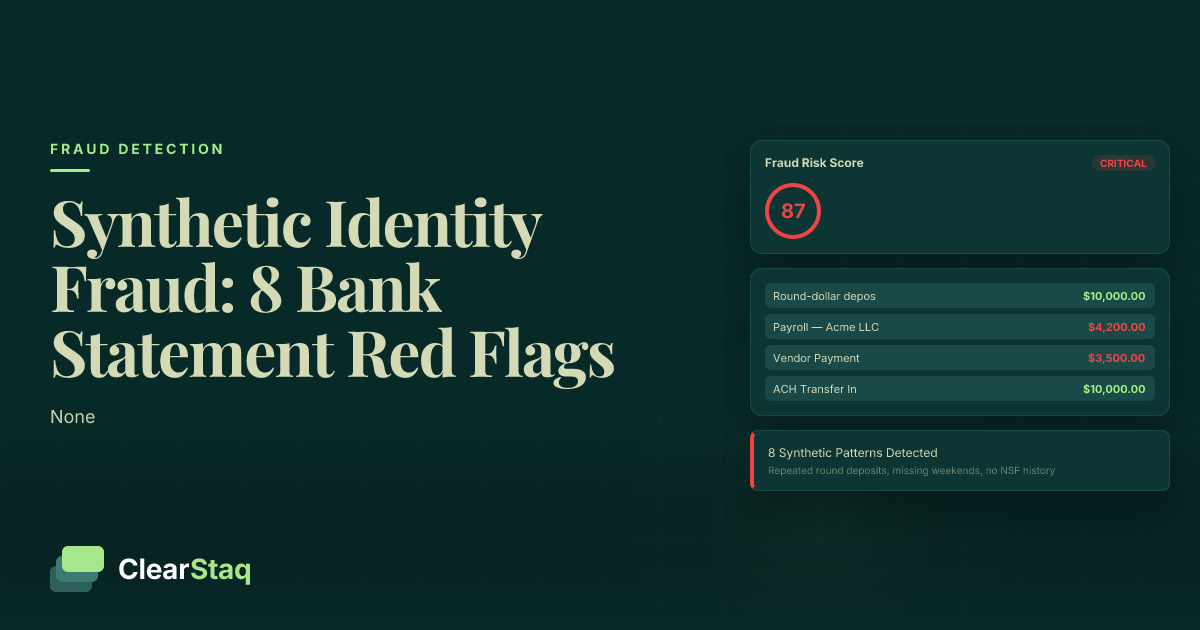
Most sanctions screening tools only cover one of those two surfaces. Blockchain analytics vendors screen wallet addresses against government lists in real time. ClearStaq's fraud detection platform parses the bank statements and tax documents behind a fiat deposit and flags structuring, shell-company patterns, and layered transfers before funds clear. An exchange running only one layer is running half a compliance program.
What makes the best sanctions screening software for crypto exchanges
- List coverage and update speed — OFAC SDN, UN, EU, and UK HMT lists, refreshed as designations happen, not on a weekly batch
- Wallet address screening — the ability to match a crypto address against sanctioned entities at the point of deposit or withdrawal
- Fiat document verification — bank statement and tax return parsing to catch structuring and shell accounts behind large transfers
- False-positive tuning — fuzzy-matching controls that don't bury compliance teams in name-match noise
- API integration — a screening call that fits into an onboarding or transaction flow without months of custom work
- Case management and audit trail — a record a regulator can review after the fact
Sanctions screening software for crypto exchanges: at a glance
| Software | Best For | Standout Feature | Key Limitation |
|---|---|---|---|
| ClearStaq | Fiat deposit verification and structuring detection | 27+ fraud signals across bank statements and tax returns | No native blockchain wallet screening |
| Chainalysis | Wallet-level sanctions screening | Real-time OFAC SDN matching on crypto addresses | No fiat document verification |
| Elliptic | Multi-chain risk scoring | Cross-chain wallet tracing | No fiat-side coverage |
| TRM Labs | Investigation-grade compliance | Forensics tooling behind sanctions alerts | Heavier than most small teams need |
| ComplyAdvantage | Customer name and PEP screening | Real-time watchlist database updates | Not built for wallet screening |
| Sanction Scanner | Lean compliance teams | Self-serve API setup | Thinner blockchain-native tooling |
1. ClearStaq: best sanctions screening companion for fiat onboarding fraud
ClearStaq parses bank statements and tax returns across 900+ formats and runs 27+ fraud signals against each one, catching structuring, layered cash deposits, and shell-account patterns before a fiat deposit clears into a crypto exchange. It processes a document in under 5 seconds at 99.5% accuracy, per its published benchmarks. It isn't a wallet screening tool — it's the layer that watches the bank account funding the trade, which is exactly the gap most crypto-native compliance stacks leave open. For structuring specifically, the same fraud-detection logic applies to AML transaction monitoring for crypto exchanges.
ClearStaq pros:
- Parses 900+ bank statement and tax document formats to verify the fiat funding source behind a deposit
- Flags 27+ fraud signals, including structuring and layered deposits, that blockchain-only tools don't see
- Sub-5-second processing at 99.5% accuracy
- Built for lending and fintech compliance teams, so it integrates naturally alongside KYB checks
ClearStaq cons:
- Does not screen blockchain wallet addresses against OFAC SDN, UN, or EU lists
- No built-in PEP or adverse media name-matching database
- Needs a dedicated blockchain screening tool alongside it, not instead of it
Best for: exchanges that need to verify the bank statements and tax documents behind large fiat deposits and catch structuring before funds hit the platform. Verdict: Buy — as a companion to wallet-level screening, not a replacement for it.
2. Chainalysis: best for real-time wallet sanctions screening
Chainalysis screens crypto wallet addresses against OFAC SDN and other government sanctions lists at the point of deposit or withdrawal, backed by an address-attribution database built over years of blockchain forensics work. It's one of the most widely adopted tools among crypto exchanges, which makes the integration precedent easier to defend to a regulator.
Chainalysis pros:
- Real-time wallet address screening against sanctions lists
- Deep address-attribution dataset from years of blockchain forensics
- Wide adoption among exchanges, which simplifies regulatory conversations
Chainalysis cons:
- No fiat-side document verification — a sanctioned wallet can still sit behind a clean-looking bank statement
- Enterprise sales process that can slow down smaller exchanges
Best for: exchanges that need wallet-level sanctions screening at transaction time. Verdict: Buy for wallet screening; pair with a fiat-side tool for full coverage.
3. Elliptic: best for multi-chain risk scoring
Elliptic covers cross-chain wallet risk scoring and transaction tracing across major blockchains, with a screening API built to run inside exchange transaction flows rather than after-the-fact investigations.
Elliptic pros:
- Wallet risk scoring across multiple chains, not just one
- Screening API designed for live transaction flows
- Case management tooling for flagged wallets
Elliptic cons:
- Smaller address-attribution footprint than the largest blockchain analytics vendors, by public reputation
- No fiat-side bank document coverage
Best for: exchanges running operations across several chains that want one screening layer to cover them. Verdict: Buy for multi-chain coverage.
4. TRM Labs: best for investigation-grade compliance
TRM Labs pairs blockchain forensics with sanctions list matching for wallet addresses tied to designated entities, and it's used by both exchanges and law enforcement for incident response.
TRM Labs pros:
- Sanctions list matching combined with forensics-grade investigation tooling
- Strong case-building features for flagged transactions
- Used across both private and law-enforcement compliance workflows
TRM Labs cons:
- Investigation-heavy feature set can be more than a small compliance team needs day to day
- No fiat document verification
Best for: exchanges that need investigation-grade tooling behind their sanctions alerts, not just a pass or fail screen. Verdict: Buy for teams with dedicated investigators; Hold for smaller compliance teams.
5. ComplyAdvantage: best for customer name and PEP screening
ComplyAdvantage runs real-time sanctions, PEP, and adverse media screening against customer names and entities through an API, with database updates aimed at closing the lag between a new designation and a match firing.
ComplyAdvantage pros:
- Real-time sanctions, PEP, and adverse media screening on customer names
- Fast database updates after new designations
- Covers the KYC side of onboarding that blockchain tools skip entirely
ComplyAdvantage cons:
- Not built for blockchain wallet address screening
- Fuzzy-matching tuning takes work to cut false positives on common names
Best for: exchanges that need customer-name sanctions and PEP screening at onboarding, separate from wallet screening. Verdict: Buy for KYC-side screening.
6. Sanction Scanner: best budget option for lean compliance teams
Sanction Scanner offers sanctions and PEP list coverage aimed at fintechs and smaller compliance teams, with a self-serve API setup that skips the enterprise sales cycle.
Sanction Scanner pros:
- Self-serve setup without a long enterprise sales process
- Sanctions and PEP coverage sized for smaller teams
- API-based integration into an onboarding flow
Sanction Scanner cons:
- Less blockchain-native tooling than crypto-focused vendors
- Smaller vendor footprint means less regulatory precedent than the bigger blockchain analytics names
Best for: smaller or newer crypto exchanges that need sanctions and PEP screening without an enterprise contract. Verdict: Buy for lean teams; Wait if wallet screening is your top priority.
How we ranked these
Each tool was weighed against the six criteria above: list coverage, wallet screening, fiat document verification, false-positive tuning, API integration, and audit trail depth. None of the six covers all six criteria alone — that's the honest finding here, not a gap in the ranking.
Which sanctions screening software should you choose?
If your exchange only screens blockchain wallets, you're missing the fiat side. Chainalysis stays the default pick for wallet-level sanctions screening in 2026, and pairing it with ClearStaq's bank statement and tax return parsing closes the fiat gap that structuring exploits. Smaller exchanges without an enterprise budget should start with Sanction Scanner for sanctions and PEP coverage, then add wallet screening once transaction volume justifies it.
See how ClearStaq flags fiat-side fraud
27+ fraud signals across bank statements and tax returns, in under 5 seconds.
FAQ
What's the best sanctions screening software for crypto exchanges in 2026?
Chainalysis is the default for real-time wallet address screening in 2026, but no single tool covers both blockchain and fiat sides. Pairing it with ClearStaq's bank statement and tax return parsing closes the fiat-side gap.
Is Chainalysis better than Elliptic for sanctions screening?
Chainalysis has the deeper address-attribution dataset and wider exchange adoption; Elliptic covers cross-chain risk scoring with a screening API built for live transaction flows. Both skip fiat document verification entirely.
Does ClearStaq screen crypto wallets against OFAC sanctions lists?
No. ClearStaq parses bank statements and tax returns to catch structuring and shell-account patterns on the fiat side; it doesn't match blockchain addresses against sanctions lists.
How much does sanctions screening software cost for a crypto exchange?
Pricing varies by transaction volume and vendor, and most of the tools on this list quote based on account size rather than publishing a flat rate. Contact each vendor directly for a quote matched to your exchange's volume.
What's the difference between AML transaction monitoring and sanctions screening?
Sanctions screening checks a name or wallet address against a government list at a single point in time. AML transaction monitoring watches ongoing transaction patterns for structuring, layering, and other laundering behavior over time.
How do crypto exchanges reduce false positives in sanctions screening?
Fuzzy-matching tuning on name variants and transliterations cuts down false positives without missing true matches. Weak default settings on common names are the biggest source of alert fatigue for compliance teams.
Do crypto exchanges need both blockchain screening and bank statement verification?
Yes, if fiat on-ramps and off-ramps are part of the exchange's business. Blockchain tools like Chainalysis and Elliptic don't verify the bank account funding a deposit, which is where structuring patterns show up first.
Is TRM Labs used by crypto exchanges for compliance?
Yes. TRM Labs combines sanctions list matching for wallet addresses with forensics-grade investigation tooling, and it's used by both exchanges and law enforcement for incident response.
One last thing
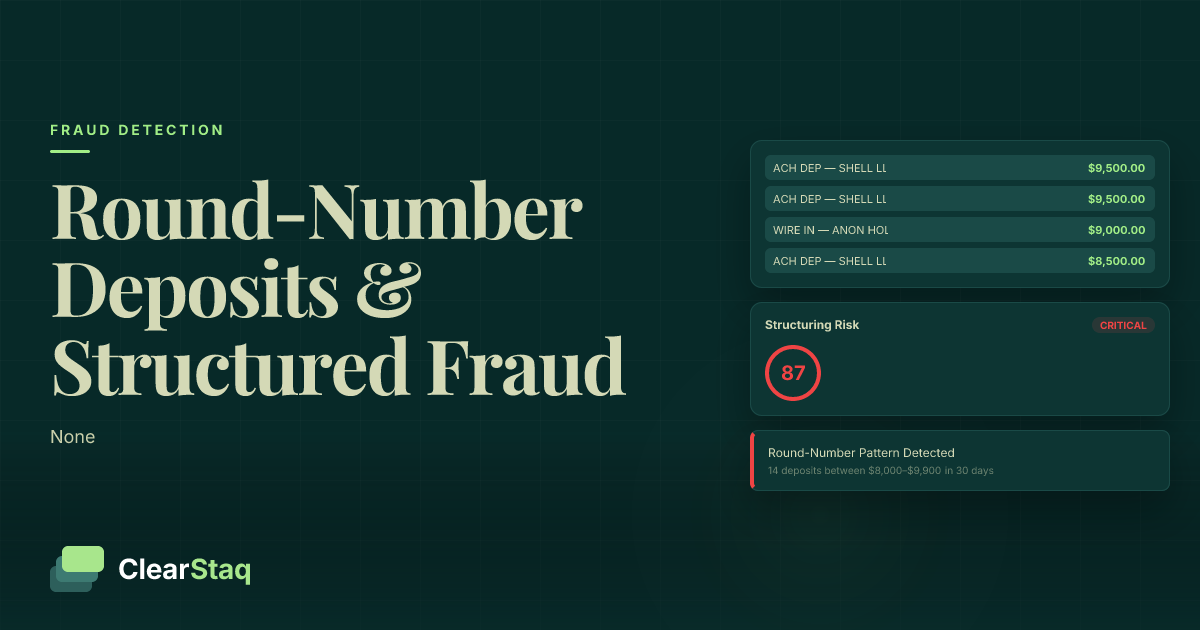
The structuring patterns that trip up crypto exchange fiat on-ramps rarely show up in a single transaction — they show up across a sequence of deposits just under a reporting threshold, spread across a handful of accounts. A wallet screening tool has no visibility into that sequence at all; it only sees the chain-side transfer once the funds are already inside the exchange. Catching it earlier means reading the bank statement, not just the blockchain.
Related guides
ClearStaq Team
Content Team
The ClearStaq team builds AI-powered tools for bank statement parsing, fraud detection, and income verification.