Crypto exchange AML transaction monitoring software tracks fiat and on-chain transaction flows to flag structuring, layering, and sanctioned counterparties before a suspicious activity report deadline slips. Exchanges face a split problem: wallet-level blockchain analytics catch on-chain layering, but the fiat ramps — ACH deposits, wire withdrawals, bank-linked funding — need a separate monitoring layer built for bank statement data.
- Crypto exchanges need two monitoring layers in 2026: on-chain wallet analytics and fiat-rail bank statement monitoring — no single tool covers both.
- ClearStaq parses bank statements tied to exchange deposits/withdrawals and screens counterparties against sanctions and PEP lists with 27+ fraud signals.
- The Travel Rule applies at $3,000 per transfer; Currency Transaction Reports apply at $10,000 — most retail crypto transfers sit inside that gap.
- MSB-registered exchanges must file SARs on suspicious activity at $2,000, not the $5,000 bank threshold.
- Blockchain analytics tools (Chainalysis, Elliptic) handle wallet clustering but do not see bank-side deposits — pair them with fiat monitoring, don't replace it.
Why AML transaction monitoring matters for crypto exchanges
Most crypto exchanges register as money service businesses under the Bank Secrecy Act, which means SAR obligations kick in at $2,000 of suspicious activity — not the $5,000 threshold banks use. Miss that and the exchange, not just the transaction, is the exposure.
The fiat side is where a lot of exchanges under-invest. On-chain monitoring gets the budget because it's the visible crypto-native problem. But the deposit that funds a wallet, or the withdrawal that cashes it out, moves through a bank account — and that's exactly the data ClearStaq parses: bank statements, ACH batches, wire descriptions, tied back to the account holder behind the transaction.
Heading into 2026, regulators are pushing harder on the funding side of exchanges specifically because on-chain tooling has gotten good — criminals have shifted the weak point to fiat onramps.
Map your fiat and on-chain transaction flows
Start with a diagram, not a tool purchase. You can't monitor what you haven't mapped.
- List every funding rail: ACH, wire, card rails, stablecoin on-ramps, third-party payment processors
- Identify where each rail hands off to on-chain custody
- Flag which rails currently have zero automated monitoring
- Note transaction volume per rail over the last 90 days
- Mark which rails touch correspondent banks (higher AML scrutiny)
Set risk-based thresholds and rules
A flat $10,000 rule catches almost nothing in 2026 — launderers structure below CTR thresholds routinely.
- Build velocity rules (X deposits in 24 hours from new accounts)
- Flag round-dollar transactions clustered near $2,000-$9,999
- Weight rules by account age — new accounts get tighter thresholds
- Set geography-based multipliers for high-risk jurisdictions
- Document the rationale for every threshold for your examiner file
Screen counterparties against sanctions and PEP lists
Every new account and every counterparty on a wire needs a real-time screen against OFAC, PEP, and adverse media lists — not a monthly batch job.
- Screen at onboarding and again on every material transaction
- Re-screen the full customer base when list updates publish
- Log every match and every dismissed false positive with a reason code
- Escalate true positives to a named compliance officer within a set SLA
- Keep screening logs for the exam window your regulator requires
Sanctions screening software built for money service businesses runs this exact workflow against bank-linked account data, and PEP screening for fintech onboarding covers the politically-exposed-person side most exchanges skip until an examiner asks for it.
Monitor bank-linked deposits and withdrawals for fraud patterns
This is the step most exchanges outsource to spreadsheets, which is also where most SAR-worthy activity gets missed.
- Parse incoming bank statements for third-party funding (funds from an account that doesn't match the customer name)
- Flag rapid deposit-then-withdrawal cycles inside a single day
- Cross-check deposit source against the customer's stated occupation/income profile
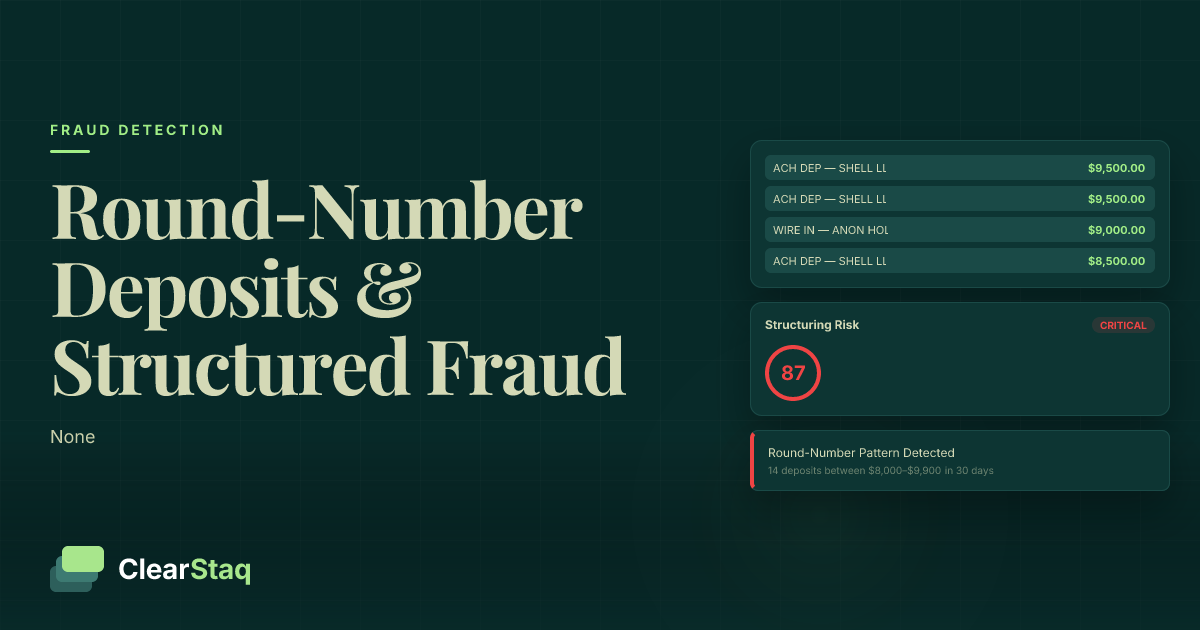
- Detect structuring patterns just under CTR and SAR thresholds
- Watch for check-kiting behavior across linked accounts
ClearStaq processes bank statements in under 5 seconds against 27+ fraud signals and flags structuring, third-party funding, and account layering automatically — the manual version of this step is a compliance analyst opening PDFs one at a time.
Automate suspicious activity report workflows
SAR filing deadlines are 30 days from detection, extendable to 60 in some cases — automation buys back the days manual review burns.
- Auto-populate SAR narrative fields from flagged transaction data
- Route flagged cases to a queue with a filing-deadline countdown
- Attach supporting bank statement evidence directly to the case file
- Track filing history per customer for pattern-of-conduct language
“If your fiat rails don't get the same monitoring rigor as your on-chain wallets, criminals will find the gap.”
Test and tune your monitoring rules
A rule set from 2024 is stale in 2026 — laundering patterns shift as exchanges close the last gap.
- Backtest new rules against 12 months of historical flagged/cleared cases
- Track false-positive rate per rule and retire rules above your tolerance
- Re-tune velocity thresholds quarterly against current volume
- Document every rule change with date and rationale
Audit and document your program
Examiners want a paper trail, not a promise that monitoring happened.
- Keep a written AML program covering fiat and on-chain monitoring separately
- Log every alert, disposition, and analyst decision with timestamps
- Retain SAR filings and supporting evidence per your jurisdiction's retention rule
- Run an annual independent test of the monitoring program
Automate fiat-side AML monitoring
Parse bank statements tied to exchange deposits and withdrawals in under 5 seconds.
Comparison: monitoring options for crypto exchanges
| Option | Best for | Key limitation |
|---|---|---|
| Blockchain analytics (e.g., Chainalysis, Elliptic) | Wallet clustering and on-chain transaction graph risk scoring | Doesn't see bank-side deposits or withdrawals at all |
| Legacy bank AML rule engines | Large exchanges with dedicated compliance ops running high volume | Built for retail banking; high false-positive rates on crypto-linked accounts |
| ClearStaq | Screening and parsing bank statements behind fiat deposits/withdrawals | Doesn't monitor on-chain wallet activity; pair with a blockchain analytics tool |
| Manual review / spreadsheets | Very low transaction count, early-stage exchanges | Doesn't scale past a few hundred transactions a month; SAR deadlines slip |
Verdict: no single tool covers a crypto exchange's full AML surface in 2026 — the fiat rails and the on-chain rails need separate, purpose-built monitoring, and ClearStaq covers the fiat side specifically.
Common mistakes crypto exchanges make
- Treating on-chain monitoring as the whole program. Blockchain analytics tools never see the bank account that funded the wallet in the first place.
- Screening once at onboarding and never again. Sanctions and PEP lists update constantly; a clean screen in January doesn't hold in 2026.
- Setting flat thresholds instead of risk-based ones. A $9,500 deposit from a 3-day-old account should trigger review even though it's under the $10,000 CTR line.
- Storing bank statement evidence as unstructured PDFs. When a SAR filing deadline hits, an analyst re-reading PDFs by hand costs days the 30-day clock doesn't give back.
- Skipping documentation on dismissed alerts. Examiners ask why a flag was cleared, not just whether it was flagged.
FAQ
What is AML transaction monitoring software for crypto exchanges?
It's software that screens exchange transactions — fiat deposits, withdrawals, and often on-chain transfers — against sanctions lists, structuring patterns, and velocity rules to flag suspicious activity for SAR filing. Most exchanges need separate tools for the fiat side and the on-chain side.
Is on-chain monitoring enough for AML compliance at a crypto exchange?
No. On-chain analytics tools like Chainalysis and Elliptic track wallet clustering but never see the bank account that funded the deposit or received the withdrawal. Regulators expect monitoring on both sides of the transaction.
What's the SAR threshold for crypto exchanges registered as MSBs?
Money service businesses file SARs on suspicious activity at $2,000, lower than the $5,000 threshold banks use. Most crypto exchanges register as MSBs and fall under the lower threshold.
What's the Travel Rule threshold for crypto transfers?
The Funds Transfer Rule (31 CFR 1010.410(e)), commonly called the Travel Rule, applies to transmittals of $3,000 or more and requires originator and beneficiary information to travel with the transaction.
Do crypto exchanges need to register as money service businesses?
Exchanges that transmit or exchange convertible virtual currency for customers generally qualify as money transmitters under FinCEN guidance and must register as an MSB, triggering AML program and SAR obligations.
How is ClearStaq different from blockchain analytics tools like Chainalysis?
ClearStaq parses bank statements and screens counterparties tied to fiat deposits and withdrawals; it does not track on-chain wallet activity. Exchanges typically run ClearStaq alongside a blockchain analytics tool, not instead of one.
Can bank statement parsing catch money laundering that blockchain monitoring misses?
Yes. Structuring, third-party funding, and check-kiting patterns show up in bank statement data before a wallet ever touches the blockchain, which is exactly the layer on-chain tools can't see.
How much does AML transaction monitoring software cost for a crypto exchange?
Cost varies by transaction volume and monitoring scope across vendors; get a quote based on your exchange's actual deposit/withdrawal volume rather than a published rate card.
One last thing
Most retail crypto transfers land between $3,000 and $10,000 — above the Travel Rule threshold, below the CTR line. That's the gap regulators are watching hardest heading into 2026, and it's also the gap a lot of exchanges leave to a rule engine built for retail banking instead of one tuned to how crypto funding actually moves.
Related guides
ClearStaq Team
Content Team
The ClearStaq team builds AI-powered tools for bank statement parsing, fraud detection, and income verification.