Money service businesses face BSA exams, FinCEN registration renewals, and state-level MSB licensing reviews that legacy AML tools were never built to survive — this guide breaks down what actually matters when you're picking aml transaction monitoring software for money service businesses in 2026.
- AI-native platforms with structuring detection win aml transaction monitoring software for money service businesses in 2026 — verdict: Buy.
- Rule-based legacy engines still clear FinCEN exams but need constant manual tuning around the $10,000 CTR threshold — verdict: Consider.
- Spreadsheet-based manual review breaks down past a few hundred monthly transactions — verdict: Skip.
- Managed AML-as-a-service outsourcing fits MSBs without an in-house BSA officer — verdict: Consider.
Who this is for
This guide is for check cashers, currency exchangers, money transmitters, remittance companies, and prepaid access providers registered as MSBs under FinCEN's 31 CFR 1022. If you're filing CTRs on cash transactions over $10,000, watching for structuring under that line, or building SAR narratives by hand every month, the tooling decision below directly affects your next exam cycle. A fraud detection platform built for lending doesn't automatically cover MSB-specific patterns like sequential money order purchases or third-party remittance layering — you need software that was built with those patterns in mind.
Why this matters
State MSB examiners and FinCEN both expect a documented, defensible transaction monitoring program — not a spreadsheet with manual flags. Examiners in 2026 are asking for audit trails that show when an alert fired, why, and what the analyst did with it within a fixed number of days. Miss that documentation and you're looking at a consent order, not just a deficiency letter.
The gap between tools that check a compliance box and tools that actually catch structuring is wide. A system tuned for retail banks assumes account relationships and payroll deposits — an MSB's transaction volume looks nothing like that, with cash-heavy, high-velocity, often anonymous or semi-anonymous flows.
What to look for in AML transaction monitoring software for MSBs
Structuring detection tuned to MSB thresholds
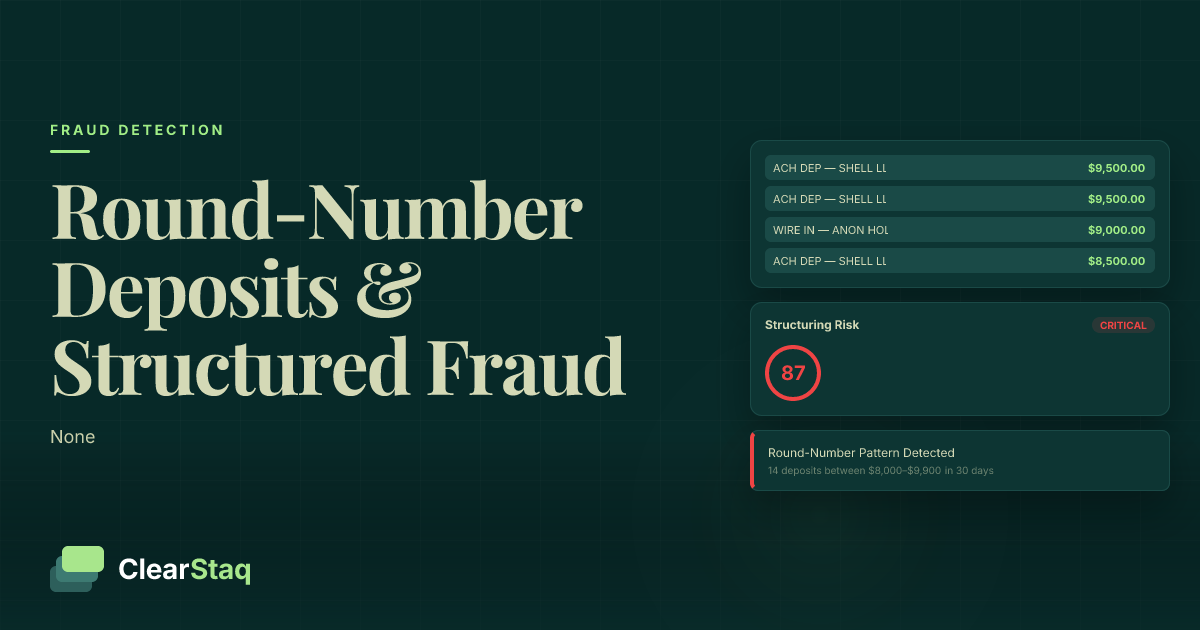
MSBs live and die by the $10,000 CTR threshold and the $3,000 recordkeeping trigger on money orders and traveler's checks. Software needs to flag patterns just under those lines — multiple $9,000-$9,800 transactions across a day or a week — not just single large transactions. Generic bank AML tools often miss this because they're tuned for account-based deposit patterns, not counter transactions. See how structuring patterns actually show up in business bank statements before you evaluate a vendor's claims.
SAR and CTR filing workflow integration
Alerts that don't connect to a filing workflow just create backlog. The software should generate a SAR narrative draft, pre-fill CTR fields from the transaction data, and track filing deadlines automatically. Manual re-entry into FinCEN's BSA E-Filing system is where most MSB compliance teams lose hours every week.
Cross-border and multi-currency wire monitoring
If you handle remittances, monitoring needs to track sender-receiver pairs across corridors, flag unusual destination-country concentration, and catch the same beneficiary receiving from multiple unrelated senders. A tool built only for domestic ACH won't catch this.
Sanctions and PEP screening built in, not bolted on
OFAC screening at onboarding isn't enough — transactions need re-screening against updated sanctions lists in real time, since lists change and existing customers don't get rescreened automatically in most legacy systems. Look for a platform that screens every transaction, not just every new customer.
Alert tuning and false positive control
A system that fires 200 alerts a day for a mid-size MSB isn't monitoring, it's noise. Ask any vendor for their expected alert-to-disposition ratio and how thresholds get adjusted as your volume changes month to month.
Examiner-ready audit trail
Every alert, disposition, and analyst note needs a timestamp and a reason code that survives an exam without reconstruction. If the software can't export a full case history in a few clicks, it will cost you hours during your next review.
“If your transaction monitoring can't tell a $9,800 cash deposit apart from a $9,500 one filed twenty minutes later, you're not monitoring, you're logging.”
Top picks by approach
AI-native fraud and AML detection platforms — the accuracy pick
These systems score transactions against dozens of behavioral signals instead of static thresholds. Platforms built this way typically run detection in under five seconds per transaction and hold accuracy rates above 99% on document and pattern checks, which matters when you're processing hundreds of daily cash transactions across multiple branches. The tradeoff is a steeper setup than a rules spreadsheet, but the false-positive reduction pays that back within a quarter. See how this plays out for aml transaction monitoring software built for online lenders — the underlying detection logic transfers directly to MSB cash-flow monitoring. Verdict: Buy.
Rule-based legacy transaction monitoring engines — the compliance-checkbox pick
Static threshold engines have been the industry default for over a decade and most examiners recognize them on sight. They work for basic CTR/structuring alerts but require manual rule updates every time your product mix or volume shifts, and false positive rates climb fast as transaction count grows. Fine for a single-location check casher processing under a few hundred transactions a month; painful past that. Verdict: Consider.
Managed AML-as-a-service / outsourced BSA officer support — the hands-off pick
Some MSBs, especially smaller remittance operators, don't have the headcount for a full-time BSA officer. Outsourced monitoring-plus-review services fill that gap, combining software with a human review layer. It costs more per transaction than running software in-house, but it removes the staffing risk entirely. Building the underlying program still matters even if you outsource execution — building an AML transaction monitoring program for lenders walks through the same governance structure examiners expect from MSBs. Verdict: Consider.
Spreadsheet-based manual review — the free pick that isn't free
Tracking transactions in Excel with manual threshold checks costs nothing upfront and everything in labor hours and exam risk. Past a few hundred monthly transactions, human reviewers start missing structuring patterns that span multiple days or multiple tellers. Examiners in 2026 increasingly treat spreadsheet-only monitoring as a documented deficiency on its own, independent of what it actually catches. Verdict: Skip.
See fraud signals your monitoring tool might miss
27+ signals, sub-5-second processing, built for lenders and financial services teams.
What to avoid
- Bank-only AML tools re-labeled for MSBs. Software built for deposit-account monitoring doesn't reliably catch counter-transaction structuring or money-order layering — ask any vendor for MSB-specific case studies, not generic banking ones.
- Screening tools with no re-screening cadence. A one-time OFAC check at onboarding misses list updates. Sanctions lists change regularly, and existing customers need rescreening on a set schedule, not just at signup.
- Free or bundled tools without SAR narrative generation. If the tool flags a transaction but leaves you writing the SAR narrative from scratch every time, you haven't automated anything — you've just added another dashboard to check.
Verdict comparison
| Approach | Structuring detection | SAR/CTR workflow | Setup effort | Verdict |
|---|---|---|---|---|
| AI-native platform | Strong, behavioral | Built-in draft generation | Moderate | Buy |
| Rule-based legacy engine | Basic, threshold-only | Manual entry | Low | Consider |
| Managed AML-as-a-service | Strong (human + software) | Handled by provider | Low (outsourced) | Consider |
| Spreadsheet manual review | Weak past low volume | Fully manual | None | Skip |
FAQ
What is the best AML transaction monitoring software for money service businesses in 2026?
AI-native platforms that score transactions against behavioral signals rather than static thresholds perform best for MSBs in 2026, because they catch structuring patterns that span multiple transactions or days. Rule-based engines still pass exams but generate more false positives as volume grows.
How much does AML transaction monitoring software cost for an MSB?
Pricing varies by transaction volume and whether SAR/CTR filing automation is included, so check current vendor pricing directly rather than relying on published list prices. Outsourced managed AML services typically run higher per-transaction than self-serve software.
Do MSBs legally need transaction monitoring software?
MSBs registered under FinCEN's 31 CFR 1022 must maintain a documented AML compliance program under the Bank Secrecy Act, which in practice requires some form of transaction monitoring. Spreadsheet-based manual tracking is increasingly flagged as a deficiency during exams.
What is the CTR threshold MSBs need to monitor for?
Currency Transaction Reports are required for cash transactions over $10,000 in a single business day. Structuring detection needs to catch transactions kept just under that line across multiple visits or tellers, not just single large deposits.
Is rule-based AML software still viable for MSBs in 2026?
Rule-based engines still work for low-volume MSBs processing a few hundred transactions a month, but false positive rates climb fast past that point. Growing MSBs typically move to AI-native or hybrid platforms within a year or two of scaling.
Can AML software generate SAR narratives automatically?
Platforms with built-in filing workflows can pre-fill CTR fields and draft SAR narrative language from the underlying transaction data, cutting manual entry time significantly. Tools without this feature still require analysts to write filings from scratch.
How often should sanctions screening run for an MSB?
Sanctions and PEP lists update regularly, so transactions need re-screening on an ongoing basis, not just at customer onboarding. A one-time check at signup misses list changes that happen months or years later.
What's the difference between rule-based and AI-native AML monitoring?
Rule-based systems flag transactions against fixed thresholds set by an administrator, while AI-native systems score transactions against multiple behavioral signals simultaneously. The AI-native approach generally produces fewer false positives at scale but requires more setup time.
One last thing
The single biggest exam finding for MSBs isn't a missed structuring case — it's an undocumented alert disposition. Examiners in 2026 will pull a random sample of alerts and ask why each one was closed the way it was; if the answer isn't in the system, it doesn't count as reviewed, even if an analyst genuinely looked at it. Whatever software you pick, confirm it timestamps and stores the disposition reasoning automatically, because that single feature has closed more exam gaps than any detection algorithm.
Related guides
ClearStaq Team
Content Team
The ClearStaq team builds AI-powered tools for bank statement parsing, fraud detection, and income verification.