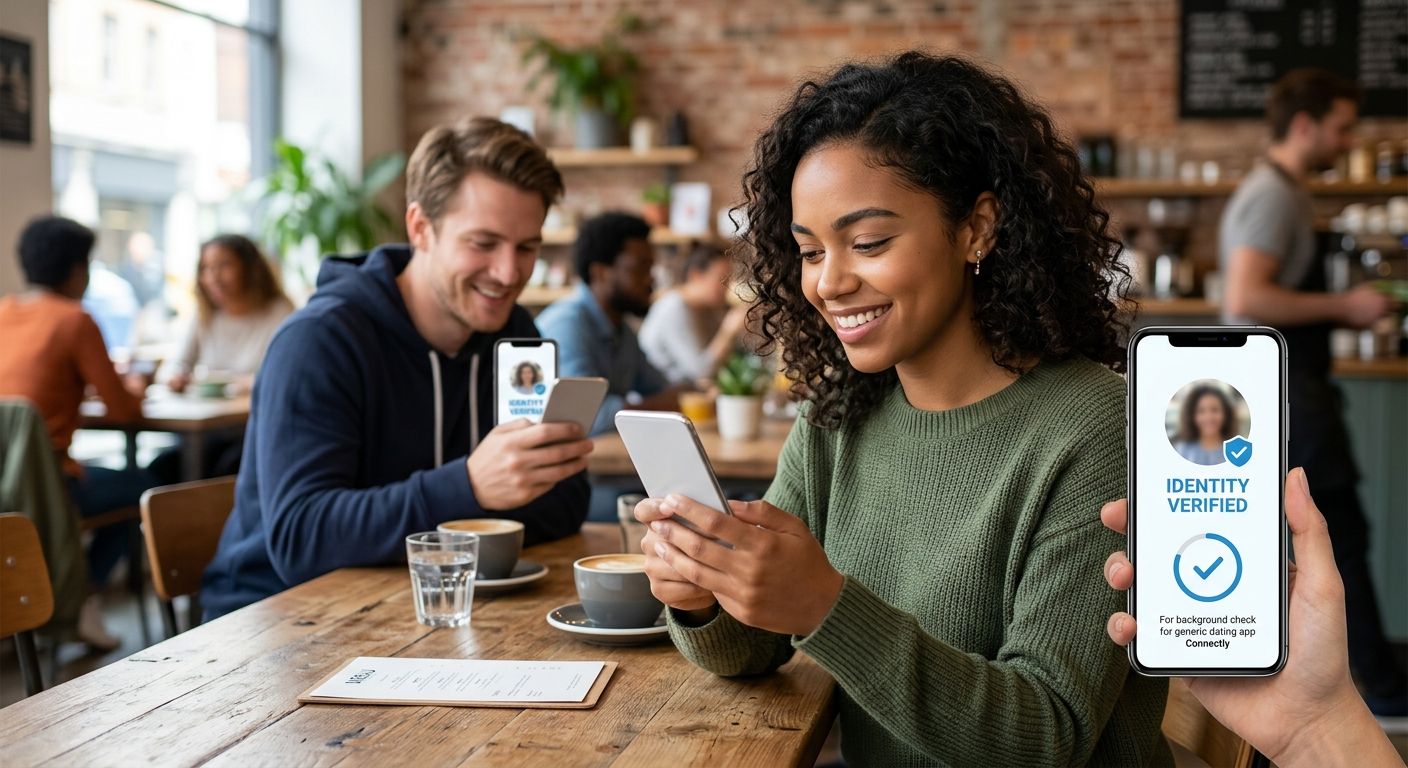
Identity verification software for dating apps confirms a profile belongs to a real, of-age person who matches the government ID on file — combining age checks, liveness detection, and document matching before and after account activation. Dating apps need this running continuously, not just at signup, because catfishing and romance scams usually surface weeks or months into a match, long after onboarding is finished.
- Identity verification software for dating apps blends age checks, liveness detection, and ID matching to block catfish accounts, bots, and underage sign-ups.
- Persona, Veriff, Jumio, and Yoti lead the category in 2026 — pick based on onboarding friction tolerance and verification volume, not price alone.
- Selfie-only liveness checks miss most catfishing; pairing liveness with a government-ID cross-check is the stronger combination.
- Re-verifying after user reports catches more fraud than one-time signup checks, since most romance scams develop weeks after a match starts.
Why identity verification matters for dating apps
Dating apps carry more identity risk per user than almost any other consumer app category — a fake profile doesn't just mean a bad review, it means a scam victim. The FTC's Consumer Sentinel data put reported romance scam losses at $1.3 billion in 2022, spread across more than 70,000 reports — more dollar loss than any other fraud category tracked that year. Catfishing and romance scams both start the same way: a profile that isn't who it claims to be.
Standard KYC checks built for lending or gig platforms don't map cleanly onto dating apps. A lender verifies identity once, at loan approval. A dating app needs identity confidence to hold up through months of messaging, video calls, and eventually a real-world meeting — which is why techniques like liveness detection technology, built originally for high-stakes financial onboarding, are showing up in dating app trust-and-safety stacks in 2026.
App-store policy adds another layer of pressure. Apple's and Google's review guidelines require dating and social apps to ship abuse-reporting tools and age-appropriate content controls before approval, and a growing list of US states now expect age assurance for platforms enabling adult matching features. Skipping identity verification isn't just a trust problem — it's a distribution risk.
Building identity verification into your dating app in 2026
Verify age before account activation
- Cross-check the birthdate a user enters against a government-issued ID rather than trusting self-attestation
- Require date-of-birth re-entry at a separate onboarding step and flag mismatches automatically
- Lock date-of-birth edits once an account passes verification
- Use document-based age estimation in regions where a full ID upload isn't legally required
- Log every age check so you have evidence ready for app-store compliance reviews
Add liveness detection to catch bots and stolen photos
- Require a short live-selfie video, not a static upload, at signup
- Screen for screen-replay, printed-photo, and deepfake identity document detection artifacts before approving a profile photo
- Re-run liveness checks whenever a user swaps their primary photo
- Flag any account where the liveness selfie doesn't match the uploaded ID photo
- Compare metadata across image uploads to catch recycled or stock photography
Cross-check the selfie against the government ID
- Match facial geometry from the live selfie to the photo printed on the submitted ID
- Reject documents with inconsistent fonts, spacing, or missing security features
- Route low-confidence matches to manual review instead of auto-approving
- Store match-confidence scores so trust and safety can audit a disputed match later
Screen for repeat offenders and ban-evasion accounts
- Fingerprint devices, not just accounts, so banned users can't simply re-register
- Cross-reference new signups against a shared blocklist of previously banned document numbers
- Watch for the same face appearing across multiple "different" profiles
- Flag payment methods already tied to an account banned for scam behavior
Monitor behavior after onboarding, not just at signup
- Track message velocity and off-platform redirect attempts — a classic romance-scam pattern
- Trigger a re-verification when a user requests money or gift cards through in-app chat
- Re-check identity when report volume on a profile crosses a threshold
- Watch for profile edits that contradict the verified ID: name, age, or location changes
Build a tiered verification flow so you don't kill signups
- Ask for the minimum at signup: age check plus a liveness selfie
- Reserve full document verification for higher-risk actions: video calls, meetups, in-app payments
- Give verified users a visible badge to reward the extra step instead of forcing it on everyone
- A/B test where verification sits in the flow — drop-off is usually a UX problem, not a legal one
Document every verification decision for trust and safety review
- Keep an audit trail of which signal triggered a manual review
- Record why an account was approved, rejected, or flagged
- Make the log visible to support agents handling user reports, not just engineering
Identity verification options for dating apps in 2026
Most dating apps are choosing from the same short list of vendors, and the mechanics behind their checks — document parsing, biometric verification software, liveness scoring — are the same building blocks ClearStaq documents for financial-services identity verification. The difference is tuning: a dating app optimizes for signup conversion first and fraud second; a lender does the reverse.
| Option | Best for | Key limitation |
|---|---|---|
| Persona | Apps that want a fully custom verification flow built around their own risk rules | Needs in-house engineering time to configure and maintain |
| Veriff | High-volume apps that need fast liveness and document checks at signup | Re-verification at scale adds up as check volume grows |
| Jumio | Apps operating across many countries with different ID formats | Broader document coverage adds friction to a mobile-first signup |
| Yoti | Apps that want age estimation without collecting a full ID scan | Estimation-only mode is less precise than a document-based check |
| Manual review | Early-stage apps with low signup volume | Doesn't scale past a few hundred signups a day and produces inconsistent judgment |
Veriff and Persona cover most dating apps at scale; Yoti fits apps prioritizing minimal data collection over precision; manual review only holds up below a few hundred signups a day.
“A liveness check that never gets cross-referenced against a government ID is a photo filter, not a verification.”
Common mistakes dating apps make with identity verification
- Verifying once at signup and never again, even after a profile gets reported multiple times
- Trusting selfie-only liveness without a document match, which lets catfish accounts using stolen photos straight through
- Treating age as a self-reported field instead of a checked one, which creates app-store compliance risk
- Running full document verification on every signup instead of tiering by risk, which tanks conversion
- Keeping verification logs inside engineering instead of sharing them with the team that handles user reports
See how identity-fraud signals get built
ClearStaq breaks down the liveness, document, and biometric signals used to catch fraud.
FAQ
What is identity verification software for dating apps?
Identity verification software for dating apps checks that a profile belongs to a real, of-age person by combining age checks, liveness detection, and government-ID matching. It runs at signup and again when risk signals — reports, money requests, photo swaps — appear later.
Is age verification legally required for dating apps in the US?
There's no single federal law mandating age verification for every dating app, but app-store policies and a growing number of state age-assurance laws effectively require it for platforms enabling adult matching features. Self-reported birthdates alone don't satisfy either standard in 2026.
How does liveness detection stop catfishing?
Liveness detection requires a live selfie video instead of a static photo, catching printed photos, screen replays, and some deepfakes at the point of upload. It stops catfishing only when the live selfie is also matched against a submitted government ID.
Should dating apps verify identity once or repeatedly?
Repeatedly. Most romance scams don't surface at signup — they develop over weeks or months of chat before a money request appears, so re-verification triggered by reports or in-app payment requests catches more fraud than a one-time check.
What's the difference between age estimation and age verification?
Age estimation infers age from a selfie or behavioral signals without collecting an ID. Age verification checks the stated birthdate against a government-issued document. Estimation is lower-friction; verification is more precise and holds up better under compliance review.
Can deepfake photos pass liveness checks?
Static or older liveness checks can be fooled by high-quality deepfakes, which is why active liveness prompts — blinks, head turns — paired with document cross-matching matter more than a single selfie snapshot in 2026.
What happens when a user fails identity verification?
A failed check should route to manual review before an outright ban, since document quality and lighting cause a share of false rejections. Repeat failures, mismatched documents, or blocklist hits are the cases that should result in an automatic block.
One last thing
Most romance scams don't fail at the door — they fail months in, after weeks of chat built enough trust for a money request. That's the argument for spending less engineering time perfecting signup verification and more time building the re-verification trigger that fires the moment a user asks for gift cards or a wire transfer inside your chat. The signup check stops bots. The re-check stops the scam.
Related guides
ClearStaq Team
Content Team
The ClearStaq team builds AI-powered tools for bank statement parsing, fraud detection, and income verification.