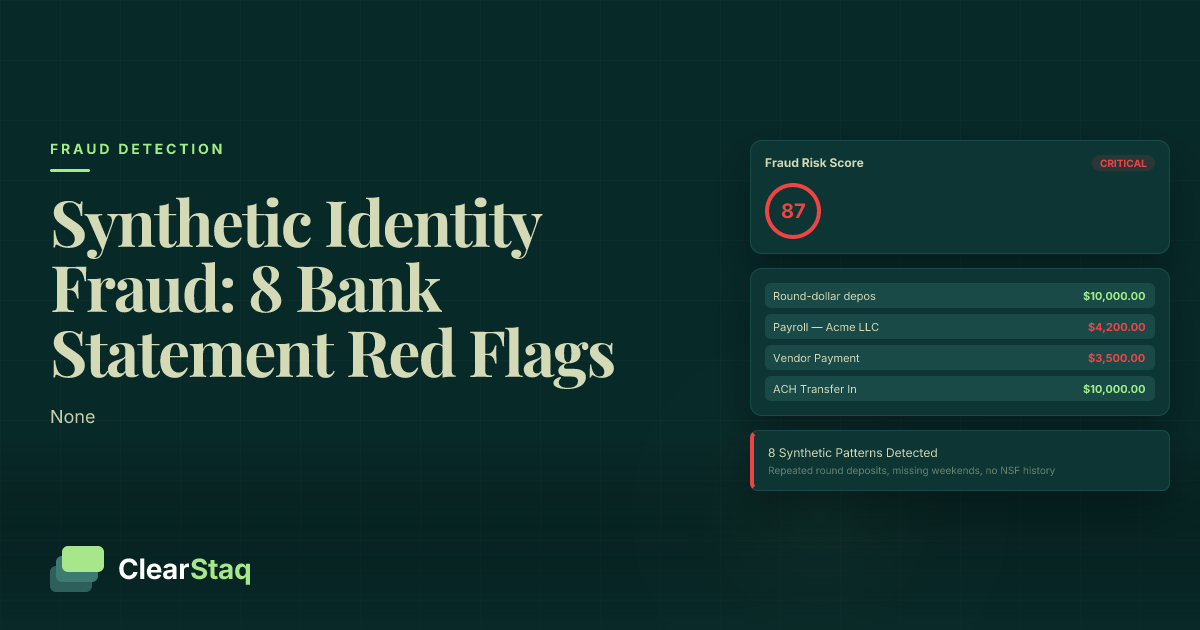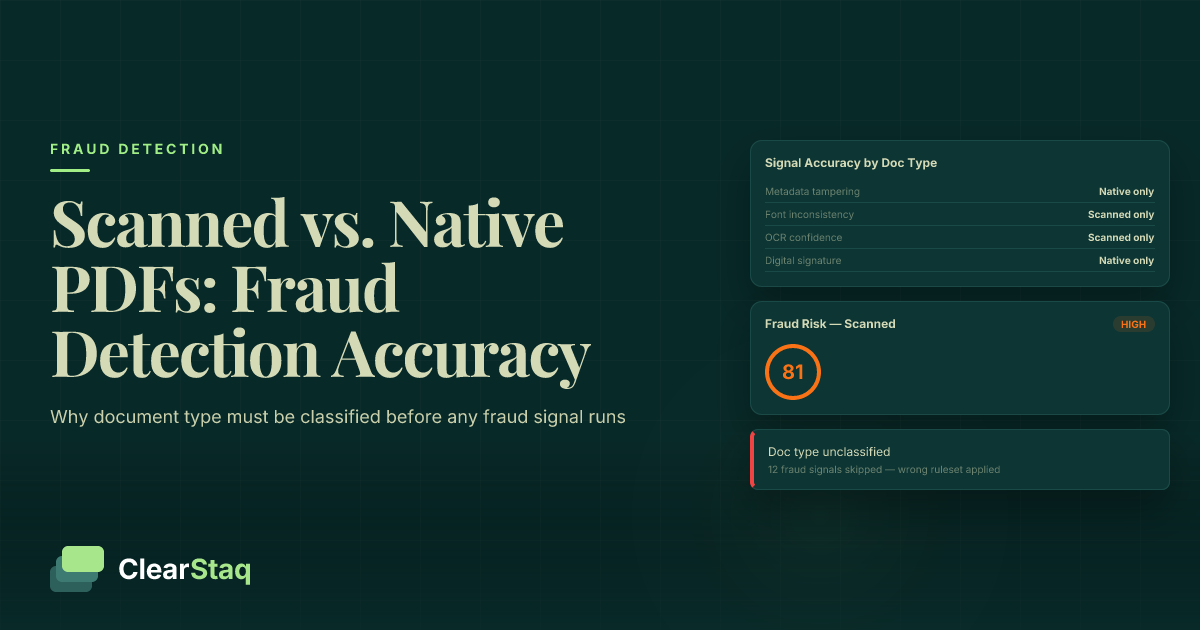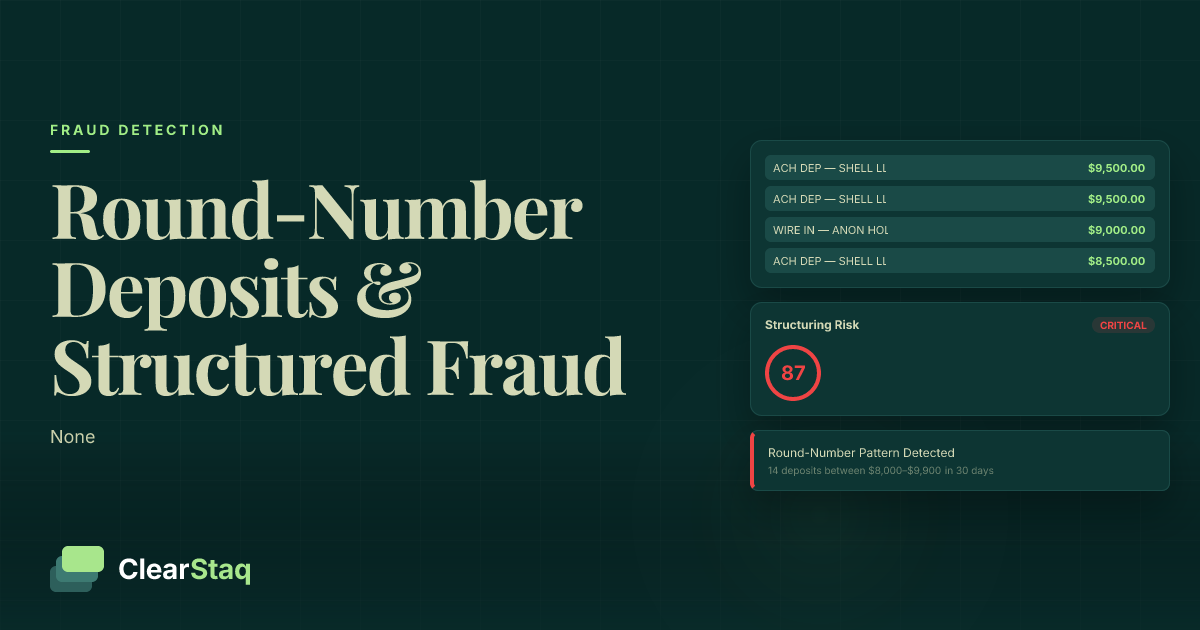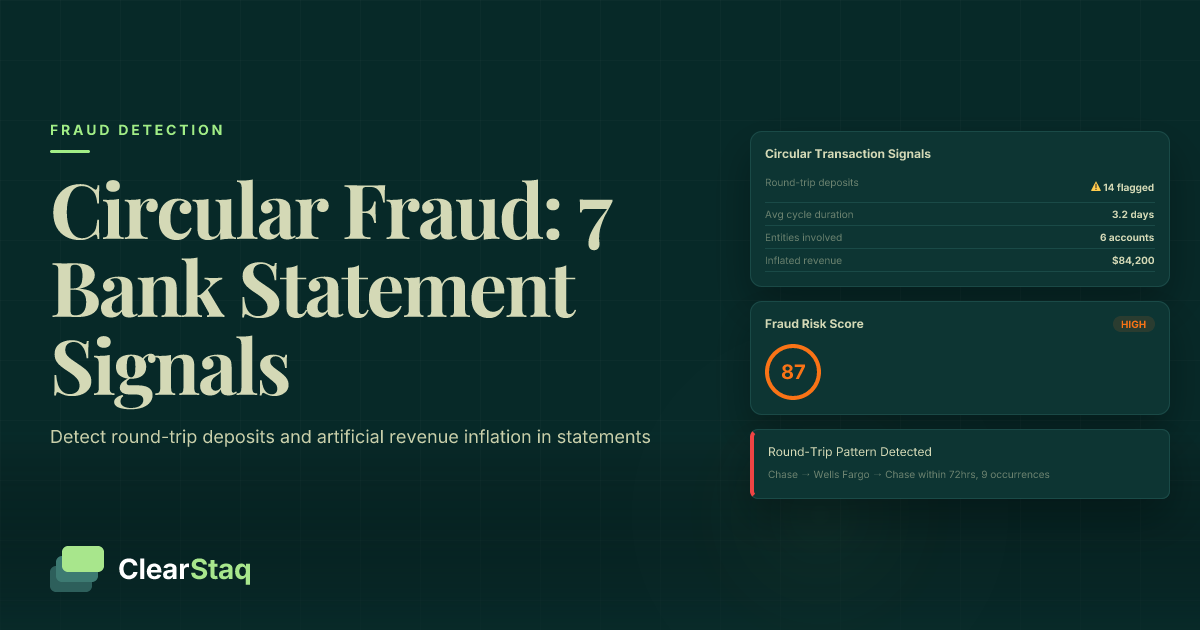
Circular transactions in bank statements are detected by identifying counterparty repetition, deposit-to-withdrawal timing clusters, round-trip amount patterns, and abnormal deposit concentration from a small number of senders. Automated tools analyze these signals simultaneously across multiple accounts, stripping circular inflows to reveal true net cash position and expose artificial revenue inflation before funding decisions are made.
What you'll learn
- Circular transactions cycle the same funds between related accounts to inflate gross deposit figures without generating real economic activity
- Seven signals — including counterparty repetition, timing clusters, and amount tolerance clustering — reliably identify circular fund flows on bank statements
- The net cash position formula (gross deposits minus identified circular inflows) exposes the true operating revenue a funding decision should be based on
- Triangular and multi-node circular schemes are undetectable through single-statement manual review and require automated cross-statement counterparty network analysis
- Circular transaction fraud and loan stacking almost always co-occur — circular flows inflate the deposit figures that qualify a borrower for multiple concurrent advances
Circular transactions in bank statements are detected by identifying counterparty repetition, deposit-to-withdrawal timing clusters, round-trip amount patterns, and abnormal deposit concentration from a small number of senders. Automated tools analyze these signals simultaneously across multiple accounts, stripping circular inflows to reveal true net cash position and expose artificial revenue inflation before funding decisions are made.
What Are Circular Transactions in Bank Statements?
A circular transaction is a fund flow where money departs an account and returns to the same account — directly or through one or more intermediary entities — within a defined timeframe, without generating any real economic activity. The funds complete a loop. Nothing of value is produced. Only the gross deposit figure on the bank statement grows.
The FATF round-trip transaction typology defines these flows as transactions where funds are transferred between entities with the same beneficial owner, designed to create the appearance of legitimate business activity. In lending fraud, the goal is simpler: make a business look more profitable than it is.
Bank statements are the primary detection layer for this fraud type because every transaction is timestamped, assigned a counterparty name, and recorded in sequential order. That structure is the fraudster's constraint — and the investigator's advantage. For context on how prevalent this has become, the trends in bank statement fraud in MCA lending show circular schemes among the fastest-growing fraud types in small business lending applications.
Circular Transactions vs. Legitimate Intercompany Transfers
Not every transfer between related entities is fraud. Legitimate intercompany transfers have a documented business purpose, occur between entities with distinct economic functions, and are conducted at arm's length. They don't inflate gross deposits because the inflow to one entity is a true expense for another.
Fraudulent circular flows fail this test. The same beneficial owner controls both sides of the transaction. There's no economic substance — no goods delivered, no services rendered, no arm's-length pricing. And crucially, the inflow returns to its origin within days, meaning it never increases net liquidity.
The key diagnostic question for any underwriter: does this inflow increase the business's net cash position, or does an equivalent outflow follow within a short window? If the answer is the latter, the deposit shouldn't count toward qualifying revenue. This distinction matters not just for AML teams, but for every funding decision your underwriting desk makes.
Why Circular Transaction Fraud Is Surging in Alternative Lending
MCA and short-term business lending approval processes rely heavily on two metrics: average daily balance and gross monthly deposits. Both are calculated directly from bank statements. Both are easily inflated by cycling the same funds through multiple accounts.
The barrier to entry is low. A fraudster needs a business checking account, a personal account or related LLC, and basic banking access. No sophisticated technology is required. The 90-day statement window most lenders request provides plenty of time to run multiple cycles and inflate the deposit figure significantly.
Speed compounds the problem. MCA approvals are often completed within 24-72 hours — far too fast for manual review to catch timing-based loops. This is mechanically distinct from check kiting schemes, which exploit float between banks rather than cycling real funds between accounts. Circular transaction fraud moves actual money in deliberate loops. Kiting exploits clearing delays. Both inflate apparent balances, but they require different detection approaches.
Why Fraudsters Use Circular Transactions: The Revenue Inflation Game
The core mechanic is straightforward. Cycling $50,000 between two related accounts three times within a 90-day statement window creates $150,000 in apparent gross deposits. The business never had $150,000. It had $50,000 that moved in circles. But the bank statement shows three separate deposit events, each looking like revenue.
MCA underwriters typically approve funding based on gross monthly deposits — often multiplying that figure by a factor to determine advance size. This makes gross deposits the primary attack surface. An applicant who qualifies for a $30,000 advance based on real deposits can qualify for a $90,000 advance after three cycles of the same funds.
Circular flows also enable duplicate transaction detection failures by creating multiple unique-looking deposit entries rather than exact duplicates. Each transaction has a slightly different amount, a different date, and sometimes a different memo. Traditional duplicate-flagging rules won't catch them. And for fraudsters who want to appear consistently profitable month over month, circular cycling manufactures artificial cash flow patterns that eliminate the revenue volatility a real small business would show.
How Gross Deposit Inflation Works: A Numeric Example
Consider this concrete scenario. Business A transfers $30,000 to Business B — a related LLC controlled by the same owner. Four days later, Business B transfers $29,500 back to Business A. The memo on each transfer reads "business expense" or "consulting fee."
Net economic gain: $0. Apparent deposits on Business A's statement: $59,500. If this cycle runs weekly for 12 weeks, the 3-month gross deposit total reaches approximately $354,000 — funded by a single $30,000 pool of capital.
The amount tolerance trick makes this harder to catch. The return transfer is $29,500, not $30,000. Next week it's $31,200 out and $30,800 back. The amounts differ by 1-3%, which defeats exact-match detection rules. No two transactions look identical, but the pattern is statistically visible when you examine counterparty pairs across the full statement period.
The Net Cash Position Reality
The antidote to gross deposit inflation is the net cash position methodology: Total Gross Deposits minus Identified Circular Inflows equals True Net Liquidity.
A concrete example: an applicant shows $180,000 in gross deposits over three months. Investigation identifies $130,000 of those deposits as circular inflows from two related counterparties. Adjusted net cash position: $50,000. That's the number a funding decision should be based on — not $180,000.
Starting balance versus ending balance comparison doesn't catch this. If an applicant begins January with $8,000 and ends March with $9,200, the small balance increase looks plausible. But if $130,000 cycled through during that period, the gross deposit figure is wildly misleading. The ending balance comparison only confirms that the funds returned — which is exactly what circular transactions are designed to ensure.
The Three Circular Transaction Schemes You'll Actually See
In MCA and alternative lending underwriting, circular transaction fraud appears in three primary configurations. Each has a distinct footprint on a bank statement and a different level of detection difficulty. Understanding the typology before opening a statement helps you know what to look for — and where manual review reaches its limits.
Scheme 1: The Direct Loop (Two-Party Cycle)
The simplest scheme. The applicant's business account sends funds to a second account — typically a personal account, a spouse's account, or a related LLC — and receives equivalent funds back within 1-7 days. On the bank statement, the same counterparty name appears in both the credit (inflow) column and the debit (outflow) column, often multiple times within the same month.
This is the easiest scheme to detect. Counterparty repetition in both columns is the primary signal. Scroll down any statement with a direct loop long enough and you'll see the same name sending money in and receiving money out in a rolling pattern.
Common obfuscation tactics: using a spouse's maiden name, a related entity with a slightly different name ("Smith Consulting" vs. "Smith Business Consulting"), or routing through a fintech wallet like Venmo or Cash App where the counterparty name is less standardized. Different banks are also used to separate the legs of the loop.
Scheme 2: The Triangular Scheme (Three-Party Loop)
The triangular scheme adds one node to the loop: funds travel A → B → C → A, with each leg disguised as a separate, legitimate business payment. From the perspective of Account A's statement alone, the outflow goes to Entity B and the inflow comes from Entity C. No single counterparty appears as both a sender and recipient.
This is why triangular schemes are significantly harder to catch with single-statement review. The loop is only visible when all three accounts' statements are reviewed together, and most underwriters receive only the applicant's primary statement. Shell entities are frequently used as Node B or Node C — entities with no real business activity that exist solely as pass-through vehicles. Review our guide to shell company red flags to understand how to identify these intermediaries when business entity information is available.
The detection signal, when you have access to multiple statements, is timing: all three legs of the loop complete within a 3-14 day window, and amounts are consistent within the 1-3% tolerance range across all three transfers.
Scheme 3: Multi-Node Networks (Four or More Parties)
The most sophisticated configuration. Funds cycle through 4-6 entities before returning to the origin account. Each individual leg looks like a routine business payment. The loop is only detectable through graph or network analysis that maps relationships across all parties simultaneously.
Timing obfuscation is deliberate: individual legs are spaced days or even weeks apart to avoid triggering velocity rules. Amount obfuscation compounds the difficulty — each transfer in the chain is slightly different ($50,000 → $49,200 → $48,850 → $50,100), so no two legs are identical. Reconstructing the loop from a single statement is practically impossible. Catching this scheme requires automated counterparty network analysis across all submitted statements.
Understanding what these schemes look like on paper requires clean, structured transaction data as the foundation. Here's how ClearStaq's parsing engine structures raw bank statement data to make scheme detection possible:
7 Signals That Indicate Circular Fund Flows in a Bank Statement
These seven signals are ordered from easiest to spot to most subtle. Each is described as it appears on a physical bank statement, alongside the legitimate activity it could be confused with. Start with Signal 1 and work down — the more signals you find in combination, the stronger the case for circular transaction fraud.
Signals 1–3: The Counterparty and Timing Cluster
Signal 1 — Counterparty Repetition: The same entity name appears in both the debit (outflow) and credit (inflow) columns of the statement. Flag any counterparty that appears 3 or more times across both columns within the statement period. On a PDF statement, this requires scanning the description or payee field for both incoming and outgoing rows — something that's tedious manually but immediately visible when transactions are sorted by counterparty. Legitimate explanation to rule out: a major customer who also happens to be a vendor, or an entity that provides both payment and invoicing services.
Signal 2 — Deposit-to-Withdrawal Timing Clusters: A large deposit is followed by a near-identical outflow within 1-5 business days. For each recurring counterparty, calculate the average lag between their inflows and the subsequent outflows. A consistent lag of 1-5 days across multiple cycles is a strong indicator of deliberate fund cycling. Legitimate explanation to rule out: a business that receives client payments and promptly pays subcontractors — common in construction and staffing. The distinguishing factor is whether the outflow goes to the same counterparty that sent the inflow.
Signal 3 — Deposit Concentration: 60% or more of gross deposits originate from 1-3 counterparties. On the statement, this is visible by sorting credits by sender and calculating each sender's share of total inflows. No obvious business explanation exists for this concentration — the senders aren't major known customers, payroll processors, or marketplace platforms. Legitimate explanation to rule out: a business with a single major client that provides most of its revenue. Distinguishing factor: does the concentrated sender also receive significant outflows?
Signals 4–5: Amount Patterns and Balance Behavior
Signal 4 — Amount Tolerance Clustering: Inflows and outflows to the same counterparty differ by only 0.5-3%. A $30,000 transfer out is followed by a $29,700 transfer in. Next cycle: $31,500 out, $30,850 in. The amounts are different enough to defeat exact-match detection but close enough to reveal the loop statistically when viewed across the full statement period. This is the signal that most manual reviewers miss — the human eye doesn't naturally perform percentage-difference calculations across dozens of transactions. Automated detection tools apply amount tolerance windows systematically to every counterparty pair.
Signal 5 — Round-Number Deposits with Rapid Egress: Large, round-number deposits ($10,000, $25,000, $50,000) that are followed within 2-5 days by outflows of similar magnitude. Round-number amounts are a co-occurring signal — real business revenue rarely arrives in perfectly round figures. For more on this pattern, see our coverage of round-number deposits and structured transactions as standalone fraud signals. When round-number amounts combine with rapid egress to a recurring counterparty, the circular transaction probability increases substantially.
Signals 6–7: Net Position and Statement-Level Anomalies
Signal 6 — Flat or Declining Net Cash Position Despite High Gross Deposits: Gross deposits are high, but the ending balance is consistently close to the starting balance each month. Calculate this ratio: (Ending Balance − Beginning Balance) ÷ Gross Deposits. A ratio below 5-10% means the business is not retaining any of its stated revenue — a strong signal that deposits are returning to their source. Legitimate explanation to rule out: a business with very high operating expenses. Distinguishing factor: do the outflows go to the same parties that sent the inflows?
Signal 7 — Memo Field Anomalies: Large transfers in and out carry vague, generic, or identical memo descriptions: "transfer," "business expense," "loan repayment," "payment." Contrast this with legitimate business payments, which typically reference invoice numbers, order IDs, project codes, or specific service descriptions. When a $40,000 deposit memo reads "payment" and the corresponding $39,200 outflow three days later reads "business expense," that vagueness is itself a signal. Circular transaction participants rarely create detailed memos because documentation creates a paper trail that undermines the scheme's purpose.
Here's how ClearStaq's fraud scoring engine evaluates all seven of these signals simultaneously and combines them into a single composite circular transaction risk score:
How to Manually Trace a Circular Transaction: A Step-by-Step Method
No competitor provides an underwriting-specific manual detection walkthrough. This three-step method is adapted for MCA underwriters and fraud investigators working with PDF bank statements. It works reliably for direct loops. For triangular and multi-node schemes, this method identifies warning signs but automated cross-statement analysis is required for confirmation.
Step 1: Build a Counterparty Frequency Map
Extract all unique counterparty names from both the debit and credit columns across the full statement period. If you're working with a PDF, copy the transaction data into a spreadsheet. Use COUNTIF to count how many times each counterparty name appears in the credit column and how many times it appears in the debit column separately.
Flag any counterparty that appears in both columns. Then rank all flagged counterparties by total dollar volume — the sum of all inflows plus all outflows associated with that counterparty. Focus your investigation on the top 5 counterparties by combined volume. Use SUMIF to calculate the total inflow value and total outflow value for each flagged counterparty — you'll need these for Step 2.
Step 2: Trace Return Flows and Calculate Lag Time
For each flagged counterparty, sort transactions by date and identify each outflow-to-inflow pair. Calculate the lag in business days between the outflow and the subsequent return inflow from that counterparty.
Apply this risk rating to each pair:
| Lag Time | Risk Level | Action |
|---|---|---|
| 0–7 days | High | Escalate for investigation |
| 8–30 days | Medium | Request documentation of business purpose |
| 31+ days | Low/Context required | Review with other signals present |
Next, calculate the net position per counterparty: total inflows from that counterparty minus total outflows to that counterparty. A net position close to zero means funds are returning at close to the same rate they're being sent. Then calculate the return rate: total inflows ÷ total outflows × 100. A return rate above 80% is a strong circular transaction signal. If $50,000 goes out and $47,000 comes back, the return rate is 94% — flag it.
Step 3: Calculate Adjusted Net Cash Position
Sum all circular inflows from counterparties where both conditions are met: return rate above 80% AND average lag under 14 days. These are your high-confidence circular inflows.
Apply this formula: Adjusted Net Cash = Gross Deposits − Identified Circular Inflows
Recalculate the applicant's average monthly revenue using the adjusted figure. Per FDIC guidance on identifying fictitious transactions, this adjusted figure represents the business's true operating cash flow for underwriting purposes.
Decision rule: If adjusted net cash is more than 25% below gross deposits, escalate. Request 6 additional months of statements and business tax returns. If the tax returns don't support the gross deposit figure, decline. If adjusted net cash is more than 50% below gross deposits and counterparty return rates are consistently above 80%, consider whether SAR filing obligations apply under your BSA program.
Circular Transactions and Loan Stacking: The Double Threat
Circular transaction fraud and loan stacking are rarely separate schemes. In the majority of cases encountered in MCA underwriting, they operate together — circular transactions create the inflated deposit figures that enable a borrower to qualify for multiple concurrent advances across different lenders simultaneously.
The risk compounds in both directions. Circular fraud overstates the borrower's revenue base. Stacking overstates their debt capacity. Together, they produce a borrower who is simultaneously misrepresenting their income and carrying far more debt service than any legitimate cash flow could support.
How Circular Revenue Creates the Stacking Window
Stacking requires a borrower to appear creditworthy to multiple lenders at the same time. Circular transactions manufacture the gross deposit figures that satisfy each lender's underwriting criteria independently.
The typical timeline works like this: the borrower obtains Advance 1 from Lender A. They use those proceeds to fund circular loops between their business account and a related account, generating inflated gross deposits over the following 30-60 days. They then apply to Lender B with a fresh 3-month statement showing the inflated figures — qualifying for Advance 2. The same proceeds fund another round of loops for Lender C's application.
The signal overlap is significant. Stacking applicants show the same counterparty repetition and deposit concentration signals as pure circular fraud cases. The circular scheme is often how you discover the stacking — and the stacking is often how the borrower funds the next cycle of loops.
Detecting When Outflows Are Hidden Debt Service
A related pattern: circular inflows are timed specifically to offset MCA repayment outflows, keeping the ending balance stable enough to avoid triggering underwriter concern. The gross deposit figure is inflated by cycling; the ending balance looks healthy because the cycling covers the daily ACH debits draining the account for repayment.
Look for daily or weekly fixed ACH debits in consistent amounts — these are characteristic of MCA factor-rate repayment schedules, where a fixed daily or weekly percentage of gross deposits is debited automatically. When those debits are offset by circular inflows arriving in a predictable rhythm, the balance stability is manufactured. For a full treatment of identifying concurrent advance obligations, see how to detect MCA stacking from bank statements, which covers the ACH debit signature patterns used to identify hidden debt service obligations.
Manual Detection vs. Automated Detection: What Each Catches
Most MCA underwriters currently operate with manual review as their primary fraud detection method. That's a reasonable starting point for direct loops — but it has real, documented limitations for triangular and multi-node schemes. This comparison is honest about what each method delivers.
What Manual Review Can Catch
Manual review is effective for direct loops with obvious counterparty repetition — the same name appearing in both debit and credit columns of the same statement. An experienced underwriter who calculates net position per counterparty will also catch gross deposit inflation when the cycling is concentrated in a small number of counterparty relationships.
Timing clusters are visible on a date-sorted statement. Memo field vagueness is visible to any reader paying attention. These signals don't require software to spot.
The limitations are significant, however:
- Manual review covers only a single statement at a time — triangular schemes require cross-statement analysis that takes hours to do manually
- A thorough manual review of one 3-month statement takes 30-60 minutes — at any volume, this creates a bottleneck
- Amount tolerance obfuscation (1-3% variation) is invisible to the human eye across dozens of transactions
- Multi-node network schemes require graph analysis that cannot be done manually in any reasonable timeframe
- Counterparty name variations (spelling differences, abbreviations, entity suffix differences) defeat name-matching without normalization logic
What Automated Detection Adds
Automated detection closes the gaps that matter most for triangular and multi-node schemes. The capability difference is not marginal — it's the difference between detecting 30% of circular fraud and detecting 90%+.
Key automated capabilities:
- Cross-statement counterparty analysis: detects triangular schemes where no single statement shows the complete loop — the loop is reconstructed across all uploaded statements
- Amount tolerance window scanning: systematically flags counterparty pairs where inflows and outflows differ by less than 3% — statistically visible at scale, invisible to the human eye
- Net cash position calculation: completed in seconds, not 30-60 minutes per statement
- Real-time flagging: circular signals are identified during upload, enabling same-session decision-making
- Counterparty name normalization: handles spelling variations and entity suffix differences that defeat manual name matching
ClearStaq's 27 fraud signals framework includes all seven counterparty-level signals described in this article, plus additional document-level and behavioral signals — evaluated simultaneously across every uploaded statement in a single application package.
How ClearStaq Detects Circular Transactions at Scale
ClearStaq's circular transaction detection is built around the capability that matters most: cross-statement counterparty network analysis. Every detection method described in this article runs automatically, in seconds, across all statements uploaded for a single applicant — regardless of which banks issued them.
Multi-Statement Counterparty Network Analysis
ClearStaq cross-references transactions across all uploaded statements from a single applicant simultaneously. When a counterparty appears as a debit destination in Statement A and a credit source in Statement B for the same applicant, ClearStaq flags the bidirectional relationship — the triangular loop signature that is impossible to detect through single-statement manual review.
This works even when statements come from different financial institutions. ClearStaq's 900+ bank format support means that a circular scheme running between a Chase business account, a Bank of America personal account, and a Wells Fargo LLC account is detectable when all three statements are uploaded together. The counterparty network graph is built automatically — no spreadsheet work, no manual cross-referencing.
For multi-node networks involving 4-6 entities, ClearStaq's graph analysis maps bidirectional relationships across all identified counterparties and calculates the probability of a closed loop based on timing, amount tolerance, and return rate — surfacing schemes that are literally undetectable through manual review alone. This connects directly to ClearStaq's fraud detection platform capabilities for alternative lenders.
Automated Net Cash Position Calculation and Real-Time Alerts
ClearStaq's API calculates adjusted net cash position automatically — stripping identified circular inflows and returning a fraud-adjusted revenue figure alongside gross deposits in every statement analysis response. Underwriters see both numbers immediately: the gross deposit total the applicant would prefer you use, and the adjusted net cash position that reflects actual business liquidity.
Real-time fraud alerts via webhook fire when circular transaction signals exceed configured thresholds — enabling same-upload-session flagging rather than end-of-day batch review. An application that would have been approved at 2pm can be flagged for review before the underwriter closes the file.
Lenders with specific portfolio risk profiles can configure custom fraud rules within ClearStaq's ML pipeline. A lender that has historically seen triangular schemes in their construction or staffing portfolio can set tighter amount tolerance windows for those industry segments. The detection logic adapts to the specific fraud patterns your portfolio has encountered.
See ClearStaq's Circular Transaction Detection in Action
See how ClearStaq's counterparty network analysis flags circular fund flows across multiple bank statements in a single upload. Book a demo to walk through a live circular transaction case.
Your Circular Transaction Investigation Checklist
Use this checklist on every application where bank statement fraud is a concern. It covers both manual review steps and automated tool outputs. The escalation criteria at the end define when additional documentation is warranted versus when a SAR filing obligation may apply under your BSA program.
Pre-Review Setup (5 Minutes)
Before beginning any circular transaction analysis, establish the integrity of the statements themselves. Begin with statement authenticity checks — verify PDF metadata, confirm font consistency across all pages, and spot-check the running balance math at several points in the statement. Circular transaction analysis built on a fabricated statement is wasted effort; document tampering and circular fraud often co-occur.
- Confirm the statement period covers the full requested window (typically 3-6 months). Note any gaps in dates.
- List all unique bank accounts and financial institutions submitted. Note whether multiple accounts from different banks are present — this increases triangular scheme risk substantially.
- Identify the applicant's industry. Flag applications from construction, staffing, trucking, and retail — high transaction volume in these industries makes circular loops easier to conceal.
- Record the starting and ending balance for each monthly statement period. You'll use these for the net position calculation in Step 6.
Detection Steps and Escalation Criteria
- Build counterparty frequency map: Extract all counterparty names from both debit and credit columns. Flag any counterparty appearing in both columns. Rank by combined dollar volume.
- Calculate net position per flagged counterparty: Total inflows minus total outflows. Flag any counterparty where the net position is within 20% of zero (funds returning at approximately the same rate they're sent).
- Calculate return rate: Total inflows ÷ Total outflows × 100 for each flagged counterparty. Flag return rates above 80%.
- Measure lag time: For each flagged counterparty, calculate the average number of business days between outflows and corresponding return inflows. Flag average lags under 14 days.
- Calculate adjusted net cash position: Subtract all high-confidence circular inflows (return rate >80%, lag <14 days) from gross deposits. Flag if circular inflows exceed 20% of gross deposits.
- Check memo fields: Review memo descriptions on all transfers exceeding $5,000. Flag vague or generic memos ("transfer," "payment," "expense") on transactions to or from flagged counterparties.
- Check for fixed ACH debits: Look for daily or weekly ACH debits in consistent amounts — a signature of MCA repayment obligations that may indicate stacking.
Escalation criteria:
| Condition | Action |
|---|---|
| Adjusted net cash is 25-50% below gross deposits | Request 6 additional months of statements + business tax returns |
| Adjusted net cash is >50% below gross deposits | Decline; document findings in underwriting file |
| Return rate >80% + lag <14 days + tax returns don't support deposits | Decline; consult BSA officer regarding SAR obligation |
| Circular flows exceed $5,000 + reasonable basis to suspect intentional fraud | Consult BSA officer; SAR filing may be required under FinCEN BSA guidance |
| Evidence of stacking (fixed ACH debits + circular inflows offsetting them) | Decline; flag applicant in internal fraud database |
Frequently Asked Questions
What are circular transactions in banking?
Circular transactions are fund flows where money departs an account and returns to the same account — directly or through intermediary entities — without generating real economic activity. In lending fraud, they are used to artificially inflate gross deposit figures on bank statements submitted with loan applications, making a business appear to generate significantly more revenue than it actually does.
How do you detect round-trip transactions in bank statements?
Detect round-trip transactions by mapping counterparties that appear in both the debit and credit columns, calculating the net position per counterparty (inflows minus outflows), and measuring the lag time between outflows and return inflows. A counterparty with a return rate above 80% and an average lag under 14 days is a strong indicator of a circular transaction scheme. Automated tools apply these calculations across all transactions simultaneously, catching amount-tolerance obfuscation that manual review misses.
How do fraudsters use circular transactions to inflate revenue for loan applications?
Fraudsters cycle funds between two or more related accounts repeatedly within the 90-day statement window submitted to lenders. Each pass of the same dollars creates a new deposit entry, inflating gross deposit totals without increasing actual liquidity. A single $30,000 pool of capital cycled weekly for 12 weeks can appear as over $350,000 in gross deposits on the resulting bank statements.
What is loan stacking and how does it relate to circular transactions?
Loan stacking occurs when a borrower obtains multiple concurrent advances from different lenders simultaneously. Circular transactions enable stacking by inflating deposit figures to meet each lender's underwriting criteria independently. The proceeds of early advances are typically used to fund the circular loops that qualify the borrower for subsequent advances — creating a compounding fraud where the borrower is simultaneously over-leveraged and misrepresenting their revenue base.
Can AI automatically detect circular transactions in bank statements?
Yes. AI-powered platforms like ClearStaq analyze counterparty network relationships, amount tolerance clustering, deposit timing patterns, and net cash position across multiple uploaded statements simultaneously. This enables detection of triangular and multi-node circular schemes that are impossible to identify through manual single-statement review. Automated detection also catches the 1-3% amount variation that fraudsters use to defeat exact-match rules — a signal that's statistically visible to algorithms but invisible to the human eye at transaction volume.
Stop Funding Circular Revenue. Start Seeing True Net Cash.
Circular transaction fraud is designed to survive manual review. ClearStaq's multi-signal detection engine catches direct loops, triangular schemes, and multi-node networks — and delivers an adjusted net cash position before you make a funding decision. Book a demo to see it in action.
Frequently Asked Questions
What are circular transactions in banking?
Circular transactions are fund flows where money departs an account and returns to the same account — directly or through intermediary entities — without generating real economic activity. In lending fraud, they are used to artificially inflate gross deposit figures on bank statements submitted with loan applications, making a business appear to generate significantly more revenue than it actually does.
How do you detect round-trip transactions in bank statements?
Detect round-trip transactions by mapping counterparties that appear in both debit and credit columns, calculating the net position per counterparty (inflows minus outflows), and measuring the lag time between outflows and return inflows. A counterparty with a return rate above 80% and an average lag under 14 days is a strong indicator of a circular transaction scheme. Automated tools apply these calculations across all transactions simultaneously, catching amount-tolerance obfuscation that manual review misses.
How do fraudsters use circular transactions to inflate revenue for loan applications?
Fraudsters cycle funds between two or more related accounts repeatedly within the 90-day statement window submitted to lenders. Each pass of the same dollars creates a new deposit entry, inflating gross deposit totals without increasing actual liquidity. A single $30,000 pool of capital cycled weekly for 12 weeks can appear as over $350,000 in gross deposits on the resulting bank statements.
What is loan stacking and how does it relate to circular transactions?
Loan stacking occurs when a borrower obtains multiple concurrent advances from different lenders simultaneously. Circular transactions enable stacking by inflating deposit figures to meet each lender's underwriting criteria independently. The proceeds of early advances are typically used to fund the circular loops that qualify the borrower for subsequent advances — creating a compounding fraud where the borrower is simultaneously over-leveraged and misrepresenting their revenue base.
Can AI automatically detect circular transactions in bank statements?
Yes. AI-powered platforms like ClearStaq analyze counterparty network relationships, amount tolerance clustering, deposit timing patterns, and net cash position across multiple uploaded statements simultaneously. This enables detection of triangular and multi-node circular schemes that are impossible to identify through manual single-statement review. Automated detection also catches the 1-3% amount variation that fraudsters use to defeat exact-match rules — a signal that's statistically visible to algorithms but invisible to the human eye at transaction volume.
ClearStaq Team
Product Team
The ClearStaq team builds AI-powered tools for bank statement parsing, fraud detection, and income verification.