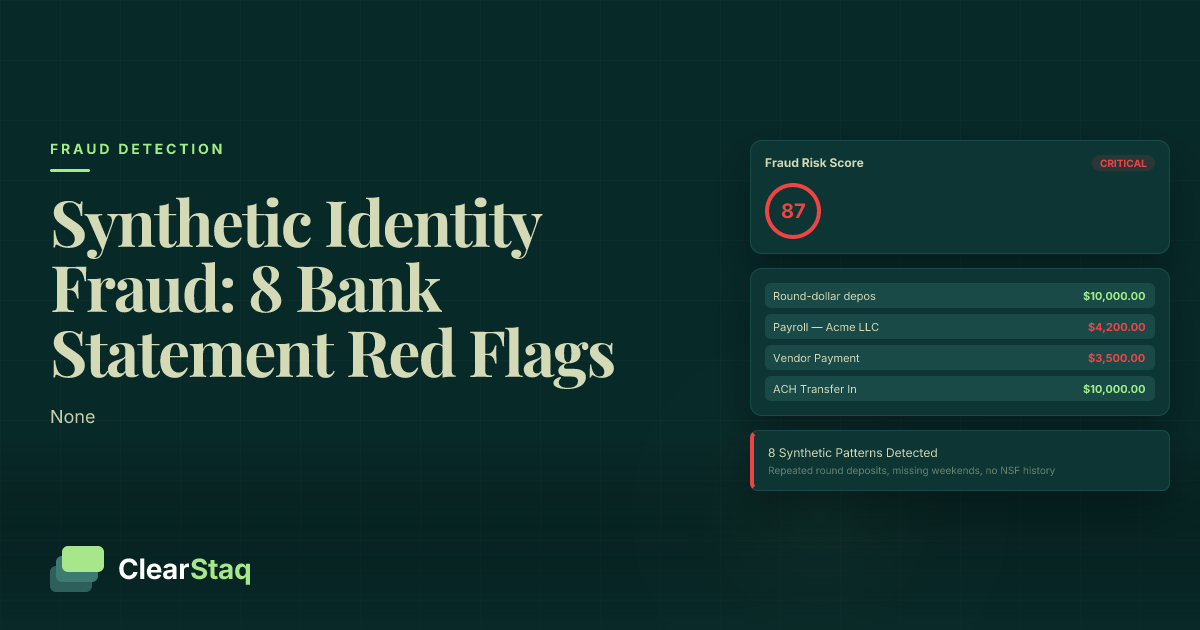
Synthetic identity fraud in small business lending occurs when fraudsters combine fabricated or stolen credentials with manufactured financial histories to impersonate legitimate businesses. Bank statements are the primary vehicle for this deception. Key patterns that reveal synthetic business identities include unnaturally smooth revenue curves, round-number deposits, absent NSF fees, industry-transaction mismatches, and deposit velocity spikes immediately before application submission.
What you'll learn
- Synthetic identity fraud constructs an entirely artificial borrower — no real victim exists to report it, making application-stage detection the only effective defense
- Eight specific bank statement patterns distinguish fabricated small business financial histories from legitimate ones, and they cluster in synthetic fraud cases
- The absence of NSF fees, overdrafts, and near-zero balance days is one of the most reliable synthetic fraud indicators and is missed by nearly all manual reviewers
- MCA and alternative lenders are disproportionately exposed because bank statements are the primary underwriting surface and origination timelines compress manual review windows
- A four-layer defense combining document integrity checks, transaction pattern analysis, KYB cross-referencing, and automated score-triggered human escalation makes synthetic fraud nearly impossible to fund undetected
Synthetic identity fraud in small business lending occurs when fraudsters combine fabricated or stolen credentials with manufactured financial histories to impersonate legitimate businesses. Bank statements are the primary vehicle for this deception. Key patterns that give synthetic business identities away include unnaturally smooth revenue curves, round-number deposits, absent NSF fees, industry-transaction mismatches, and deposit velocity spikes immediately before application submission.
What Is Synthetic Identity Fraud — And Why Small Business Lending Is the New Target
Most lenders think of fraud as someone stealing a real person's identity. Synthetic identity fraud is different — and far more dangerous. Instead of stealing an existing identity, fraudsters construct one from scratch: fabricated EINs, invented business names, manufactured financial histories, and sometimes real SSNs lifted from individuals who won't notice the abuse for months or years.
The result is a borrower who doesn't exist but looks entirely plausible on paper. There's no victim to file a police report. No credit bureau flag triggers. The synthetic identity simply accumulates credibility until the moment it cashes out and disappears. For a broader overview of how this threat plays out across lending products, see our guide to synthetic identity fraud in bank statements.
Small business lending has become the primary hunting ground. The Federal Reserve's white paper on synthetic identity fraud estimates it is the fastest-growing financial crime in the United States, generating billions in annual losses across lending products — with commercial lending increasingly in the crosshairs as consumer-side detection has matured.
Synthetic Identity Fraud vs. Traditional Identity Theft: The Key Distinction
Traditional identity theft involves a real person whose credentials are stolen and misused. That person eventually discovers the fraud — a collections call, a credit bureau alert, a tax discrepancy — and the trail leads back to a real human being.
Synthetic fraud creates no such trail. The identity is assembled from components: a fabricated EIN, a real SSN belonging to a child or recent immigrant with no credit footprint, an invented business name, a purchased virtual mailbox address. No single real person was harmed in a way they'd recognize, so no one reports it.
This is what makes synthetic business fraud a newer and less understood threat than its consumer counterpart. Consumer synthetic fraud has been studied for over a decade. Business synthetic fraud — particularly the small business variant — is still maturing as a detection discipline. The fraud community figured this out before the lending community did.
Why MCA and Alternative Small Business Lenders Are Especially Exposed
Merchant cash advance and alternative small business lenders rely on bank statements as the primary verification layer. There are no W-2s to cross-reference. No employer on record. Credit bureau pulls are thin by default for young businesses. The bank statement is the underwriting foundation — and it's exactly what fraudsters fabricate.
MCA origination timelines compound the problem. Decisions are made in hours, not days. That compressed window eliminates most manual verification options. A sophisticated fabricated bank statement submitted at 9 a.m. may result in a funded advance by 3 p.m. the same day.
The SBA Office of Inspector General has documented synthetic identity fraud as a significant driver of losses in small business lending programs, including pandemic-era relief programs where the volume and speed of origination created ideal conditions for synthetic borrower exploitation. Higher loan amounts — often $50,000 to $500,000 per event — mean each successful fraud incident is materially more damaging than a fraudulent consumer credit card account.
How Fraudsters Build a Fake Small Business From Scratch
Synthetic business fraud doesn't happen overnight. The most sophisticated operations invest 6 to 24 months constructing an identity that can withstand underwriting scrutiny. By the time an application arrives at your desk, the fabricated business has a plausible paper trail across multiple systems. Understanding the construction playbook is essential to recognizing what you're actually looking at when you review those bank statements.
Step 1: Fabricating or Hijacking an EIN
An Employer Identification Number is the business equivalent of a Social Security Number — and it's surprisingly easy to obtain with minimal verification. The IRS issues EINs online with no document submission requirement, making them a significant vulnerability in the business identity ecosystem.
Fraudsters use two methods. The first is applying for a new EIN using a synthetic SSN or a real SSN belonging to someone unlikely to notice. The second is identifying dormant legitimate businesses — companies that stopped operating but never formally dissolved — and hijacking their existing EINs. The dormant business approach is particularly insidious because the EIN already has age and history.
The EIN issuance date is an underwriting signal that far too few lenders check. If a business claims three years of operating history but the EIN was issued 14 months ago, that's a hard inconsistency. Verify EIN issuance dates against stated time-in-business on every application. The IRS TIN matching service makes this check free and takes seconds.
Step 2: Establishing a Business Address and Digital Footprint
A plausible business address is the next construction layer. Virtual mailbox services, UPS Store boxes, and registered agent services all provide mailable addresses that pass a surface-level check. These addresses are legitimate businesses themselves — which is exactly what makes them useful to fraudsters.
The digital footprint follows: a minimal website, a Google Business profile with a few reviews, a LinkedIn company page, perhaps a Facebook presence. None of these take more than an afternoon to create. The goal isn't to withstand deep investigation. It's to survive a 5-minute Google search by a busy underwriter reviewing 30 applications that day.
Address red flags worth checking: the same address appearing for hundreds of other registered businesses (a sign of a virtual mailbox service or mass-registered agent), and addresses that don't match the claimed industry type — a residential address for a claimed manufacturing company, or a commercial office park address for a claimed landscaping business.
Step 3: Manufacturing a Credit History via Tradeline Piggybacking
Credit depth is the next fabrication target. Fraudsters use the same authorized user tradeline schemes that have plagued consumer credit repair for years, adapted for the business context. The synthetic business is added as an authorized user on established business credit cards with long, clean payment histories. Positive payment history flows into the synthetic business's credit profile.
Vendor tradeline services — essentially credit repair schemes for businesses — sell "payment history" by adding the synthetic entity to established vendor relationships. These produce a manufactured business credit profile that looks like a real business with real vendor relationships. It's thin — lacking the depth that comes from years of genuine business activity — but in small business lending, thin credit files are normalized. A two-year-old LLC with a modest Dun & Bradstreet profile raises no flags on its own.
Step 4: Creating Supporting Financial Documents
Bank statements are fabricated last, after the identity scaffolding is in place. The fraudster now knows the business type, operating location, and revenue level the identity needs to support. Fabrication tools range from PDF editing software to commercially available bank statement templates to, in more sophisticated operations, compromised access to real bank account portals from which authentic-looking statements are exported and modified.
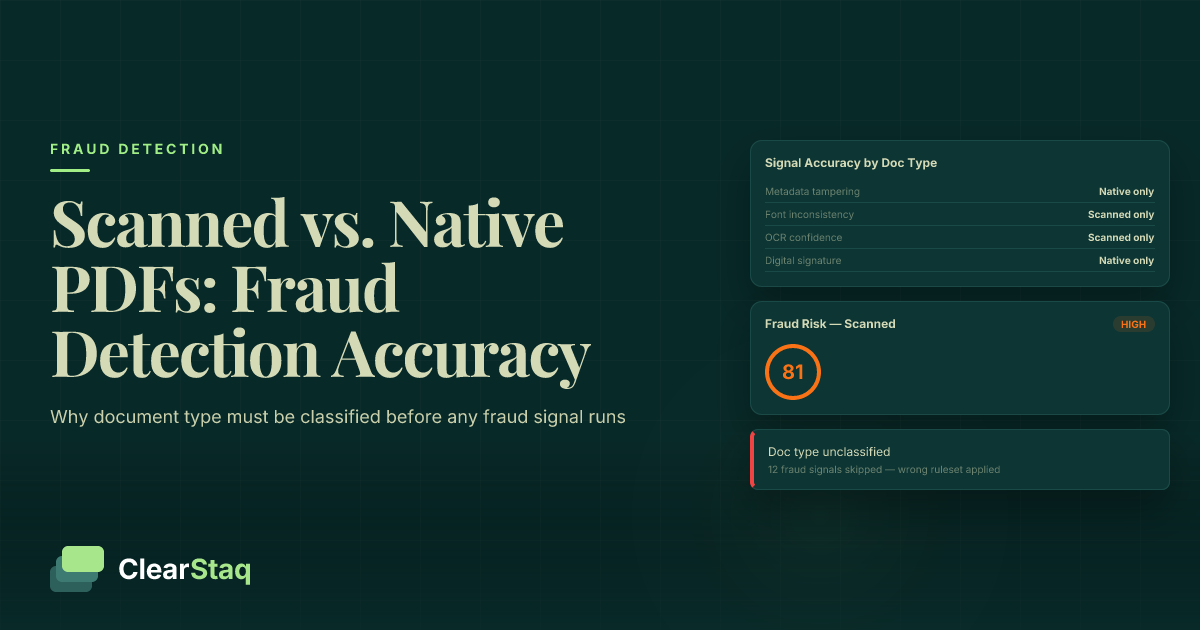
The fabrication must be internally consistent: the business type must match the revenue level, the transaction counterparties must be plausible for the industry, and the statement formatting must match the claimed issuing bank. This is where the 8 detection patterns emerge. Fabrication is a creative act under constraint — and it leaves systematic traces that automated analysis can catch. PDF metadata analysis is one of the most powerful forensic tools for detecting document-level manipulation, and understanding scanned vs. native PDF bank statements reveals which document format choices fraudsters make — and what each format exposes.
The 8 Bank Statement Patterns That Give Synthetic Identities Away
Every competitor in this space covers how synthetic identities are built. None of them tell you what fabricated small business bank statements actually look like to a trained underwriter. These 8 patterns are the specific signals that distinguish a manufactured financial history from a legitimate one — and they cluster. Multiple signals appearing together is exponentially more diagnostic than any single indicator in isolation.
1. Unnaturally Smooth Revenue Curves with No Volatility
Real small businesses have messy revenue. A landscaping company earns almost nothing in January and February. A retail shop has a holiday spike and a post-January slump. An HVAC contractor has strong summers and winters, slow shoulder seasons. Even businesses without obvious seasonality experience irregular months: a big client pays late, a project falls through, an unexpectedly large contract closes.
Fabricated statements show suspiciously consistent month-over-month deposit totals. A claimed $80,000/month business deposits $78,400 in Month 1, $81,200 in Month 2, $79,800 in Month 3. The variance is less than 3%. In the real world, this consistency almost never happens. Fraudsters smooth the revenue because they're trying to demonstrate financial stability — and in doing so, they eliminate the very chaos that marks legitimate cash flow.
Look at artificially smooth cash flow patterns as a core fraud signal: legitimate cash flow chaos is nearly impossible to fake convincingly at scale, which makes this one of the most reliable indicators in the synthetic fraud detection toolkit.
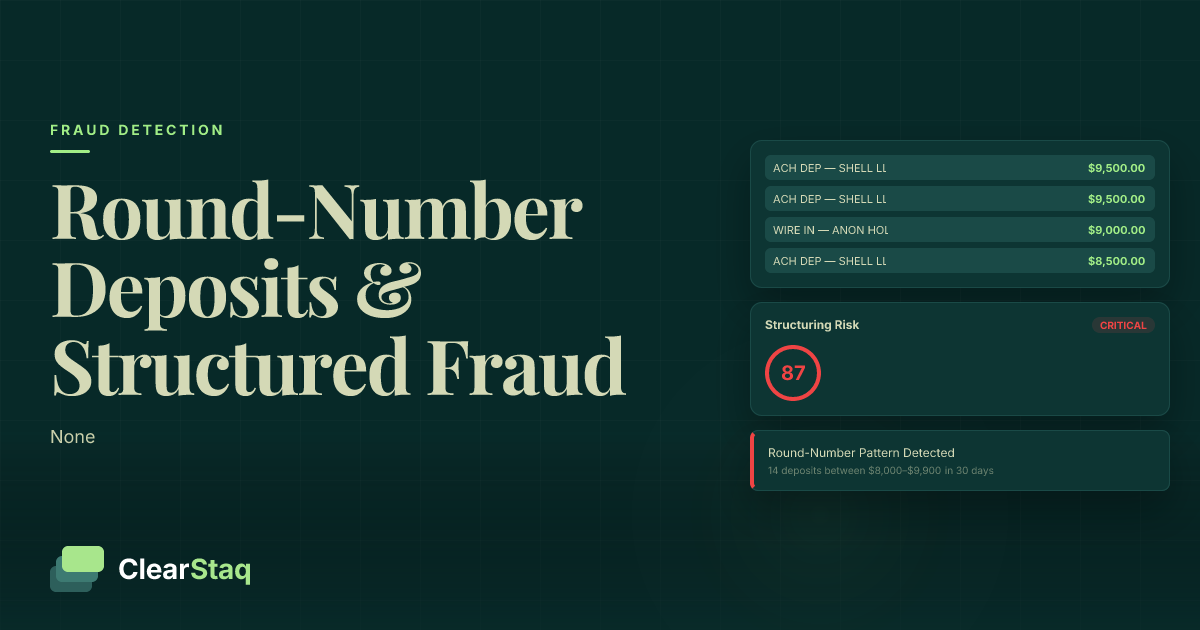
2. Round-Number Deposits at Regular Intervals
Real business revenue arrives in odd amounts. An invoice for $4,287.50. A client check for $11,932.18. A wire for $23,750.00 after a 5% discount applied at settlement. Real money has friction — taxes withheld, fees deducted, discounts negotiated, partial payments made.
Fabricated deposits cluster around round numbers: $5,000.00, $10,000.00, $25,000.00. They often arrive at suspiciously regular intervals — every Monday, or every two weeks, in amounts that feel like a salary schedule rather than business revenue. This is a direct artifact of human invention: people don't think in $4,287.50 increments when making up numbers. They think in thousands.
The pattern is amplified in synthetic fraud relative to other fraud types because the fabricator is inventing transactions entirely from scratch. For a deeper look at how round-number deposits and structured transactions signal fraud, including how this overlaps with structuring behavior, the pattern taxonomy is well-documented. Also watch for duplicate transaction detection — fraudsters sometimes recycle transaction amounts across statement months, a shortcut that creates detectable repetition.
3. Missing NSF Fees, Overdrafts, and Negative Balance Days
This is the most underappreciated signal in synthetic fraud detection — and it's completely absent from competitor content. Call it the "missing normal chaos" indicator.
Real small businesses, even financially healthy ones, experience friction. An ACH payment posts before a client wire arrives. A quarterly tax payment creates a brief dip. A payroll run hits on a day when receivables are slower than expected. The result: occasional NSF fees, overdraft charges, brief negative balance periods, or balance dips to near zero before a deposit arrives. These aren't signs of financial distress. They're signs of a real operating business.
Fabricated statements are constructed to look financially healthy. The fraudster omits these friction events entirely. An extended 6-month statement with zero NSF activity, zero overdraft charges, and no negative balance days is statistically anomalous for any active small business. When you see a statement this clean, ask yourself: does this look like a real business, or does it look like what someone thinks a healthy business should look like?
4. Absence of Vendor, Payroll, and Supplier Payments Consistent with Business Type
Every real business has operating costs that leave traces in its bank statement. These traces are industry-specific and surprisingly predictable. A claimed HVAC contractor will have payments to Ferguson Enterprises, Johnstone Supply, Home Depot, or regional HVAC distributors. A restaurant will have food distributor payments, POS system fees, linen service charges, and grease trap maintenance costs. A trucking company will have fuel card transactions, truck stop payments, and DOT registration fees.
Synthetic statements often contain generic ACH credits and debits — payroll processor withdrawals, insurance payments, a few vendor names — but they lack the industry-specific counterparties that real businesses of that type necessarily accumulate. The fabricator doesn't know the operational cost structure of an HVAC business well enough to fake it convincingly.
The diagnostic question for underwriters: "Where are the operating expenses this business type would necessarily incur?" If you can't find them, that absence is a fraud signal. A construction company with no materials purchases. A staffing agency with no payroll funding transfers. A medical practice with no billing service or supply vendor. Each absence tells a story.
5. Deposit Velocity That Spikes Just Before Application Submission
Fraudsters often "warm up" a bank account in the 30 to 60 days before submitting a loan application. They run circular transfers or temporarily inflate deposit volumes to make the most recent activity look strong. The goal is to hit the revenue threshold required for the loan amount they're targeting.
This creates a deposit velocity spike in the final month of the statement period that's inconsistent with prior months. Month 1: $42,000 in deposits. Month 2: $38,000. Month 3: $44,000. Month 4: $39,000. Month 5: $41,000. Month 6: $87,000. That final-month spike demands an explanation. Is there a legitimate contract or seasonal event that explains it? Or did deposits roughly double in the month before application with no clear business reason?
This pattern is especially common in MCA fraud because the standard lookback period is 3 to 6 months. Fraudsters calibrate the spike to fall within that window. Always examine the trend line of monthly deposits from first month to last — organic business growth is gradual, not sudden.
6. Circular Transfers Between Related Accounts
The self-funding pattern works like this: money deposited into Account A is transferred to Account B, then transferred back to Account A, creating the appearance of revenue where none exists. Running this loop creates deposit volume without representing any real economic activity.
Red flags include same-day or next-day transfers to accounts with similar beneficiary names, recurring transfer amounts that match across accounts, and transfers that return to the originating account within a short window. Synthetic business fraud often uses two to three related accounts in this loop, which means reviewing a single account in isolation misses the pattern entirely.
This is one reason why cross-account analysis matters. For a deeper treatment of how circular transfer patterns in business banking are used to manufacture apparent revenue, the mechanics overlap closely with check kiting schemes — same principle, adapted for ACH-era banking.
7. Transaction Counterparties That Don't Match the Stated Industry
Beyond the absence of expected vendors, the presence of unexpected counterparties is equally suspicious. A claimed trucking company with no fuel card transactions, no truck stop charges, no DOT or IFTA-related payments, but regular transfers to what appear to be personal accounts. A claimed retail business with no POS system fees, no Shopify or Square charges, no inventory supplier payments, but a clean set of round-number deposits twice a month.
Industry-calibrated counterparty analysis requires knowing what a real business in each industry's bank statement actually looks like. This is where automated detection significantly outperforms manual review. A human underwriter may not know that a legitimate commercial cleaning company should have janitorial supply purchases, commercial liability insurance payments, and vehicle fuel costs. An automated system trained on real industry data does.
The counterparty mismatch signal works in both directions: what's missing that should be there, and what's present that doesn't belong.
8. PDF Metadata and Document Formatting Anomalies
Legitimate bank statements are generated by bank core banking systems — software that produces consistent, institution-specific output with specific fonts, layouts, page dimensions, and metadata signatures. Fabricated statements are produced with PDF editing tools, often Adobe Acrobat, Microsoft Word, or specialized document manipulation software.
The metadata tells the story. A bank statement whose PDF creation software is listed as "Adobe Acrobat 23.0" rather than the bank's core system was not generated by the bank. A modification timestamp showing the document was edited after its stated generation date is a hard fraud signal. Font substitutions — where the fabricator used a similar but not identical typeface to the bank's standard — appear as rendering artifacts in forensic analysis. Page dimension anomalies and invisible layer artifacts from PDF editing software are invisible to the human eye but detectable by automated document analysis.
ClearStaq's library of 900+ bank format signatures allows every submitted statement to be compared against the authentic formatting template for the claimed issuing institution. A format mismatch generates a document integrity flag independent of transaction pattern analysis — catching fabrications that might have realistic-looking transaction data but fail at the document level.
Manual review catches fraud signals one at a time, sequentially, and only if the reviewer knows what to look for. ClearStaq's fraud scoring engine analyzes all 8 patterns simultaneously across the full statement period, producing a composite synthetic identity risk score in seconds — before underwriting review begins.
Why Synthetic Business Fraud Is Harder to Catch Than Consumer Synthetic Fraud
Consumer synthetic fraud has been studied for over a decade. Detection infrastructure has matured around credit bureau signals: thin files, authorized user tradeline anomalies, SSN velocity patterns, address inconsistencies. The credit bureau ecosystem creates cross-reference points that fraudsters must navigate carefully.
Business synthetic fraud attacks a fundamentally different surface: document-based underwriting. And the detection infrastructure for that surface is far less mature. Small business lending relies on bank statement review rather than bureau pulls as the primary verification layer — which is exactly the surface fraudsters fabricate.
Business identities also have fewer cross-reference points than consumer identities. There's no SSA earnings record to check. No employer W-2 history. No consumer credit footprint that must remain internally consistent across bureaus. A synthetic business can exist with far fewer verifiable data points than a synthetic consumer identity requires. It's worth noting how synthetic business identities often overlap with shell company red flags in bank statements — many of the same structural signals appear in both contexts.
The Thin-File Normalization Problem
New small businesses legitimately have thin credit files. An LLC formed 18 months ago with limited credit history is completely normal — it's not a red flag, it's expected. Lenders who penalize thin-file businesses lose real customers. Fraudsters exploit this normalization precisely: a synthetic business with 18 months of aged EIN history looks exactly like a real young business with limited credit depth.
The solution isn't to penalize thin-file applicants. It's to look harder at bank statement quality signals when credit depth is limited. The 8 patterns described above become more diagnostic when credit bureau depth is unavailable — not less. The bank statement is where synthetic fraud reveals itself when other verification channels are thin.
Why Manual Review Misses What Automated Systems Catch
A human underwriter reviewing one month of bank statements in isolation will miss the revenue smoothing trend — because the trend only appears across multiple months. Manual review is sequential: it catches individual anomalies but not cross-signal pattern clusters. And fabricated statements are specifically designed to pass a human 5-minute scan. Round-number deposits look clean, not suspicious, at a glance. A healthy-looking statement with no overdrafts reads as a positive indicator.
Automated systems apply all 8 signals simultaneously across the full statement period. They don't get fatigued reviewing application 47 of the day. They don't miss the pattern because the statement looks "fine" on the surface. The analytical depth that catches synthetic fraud requires simultaneous multi-signal analysis — and that's only reliable at scale when it's automated.
The Bust-Out Cycle: How Small Business Synthetic Fraud Actually Plays Out
Understanding the complete fraud lifecycle matters for underwriting policy. The timeline determines what lookback period is most diagnostic, which fabrication artifacts appear at each stage, and why prevention at application is the only cost-effective defense. Competitors cover the bust-out cycle for consumer lending. Here's how it actually plays out in small business lending.
Phase 1: Identity Construction (6–24 Months)
The EIN is obtained, the business registered, the address established, and the digital footprint built. Tradelines are piggybacked or vendor credit established to create a credit profile. A bank account is opened and slowly "aged" with small, real transactions — genuine purchases, modest deposits, occasional transfers — that create authentic-looking historical activity.
The aging period is the most important investment a sophisticated fraudster makes. A 24-month aged account produces a bank statement history so long that smoothing artifacts are harder to detect across the full period. A 6-month aged account leaves obvious smoothing patterns and insufficient transaction density. Sophisticated operations invest 12 to 24 months specifically because they know longer lookback periods are more scrutinized.
Phase 2: The Loan Application Window
Applications are submitted to multiple lenders simultaneously. MCA loan stacking patterns co-occur with synthetic identity fraud during this window — the fraudster is trying to maximize total exposure across lenders before any single lender's decision triggers a credit inquiry or cross-lender data sharing.
Bank statements covering the 3 to 6 month lookback period are the primary fabricated documents. Supporting documents — tax returns, business licenses, voided checks — are also fabricated or purchased. The deposit velocity spike is typically visible in the final 30 to 60 days of the statement period, as the fraudster inflates the account to hit the revenue threshold required for the targeted loan amount.
MCA and alternative lenders are prioritized because turnaround is measured in hours. A decision in 24 hours leaves no time for extended KYB verification. The faster the lender, the more attractive the target.
Phase 3: Rapid Drawdown and Disappearance
Funds are drawn as quickly as possible after disbursement — often within 24 to 72 hours of funding. The business address becomes unreachable. The phone is disconnected. The website goes dark. The Google Business profile disappears. The first default notice has no valid recipient.
The synthetic identity leaves no real person to pursue legally. Recovery rates on synthetic identity fraud losses are extremely low — there is no asset to seize, no individual to locate, no real business to wind down. This is why prevention at the application stage is the only effective defense. Post-origination monitoring, while valuable for other fraud types, can only confirm what happened after the loss has already occurred.
Beyond the Bank Statement: KYB Signals That Confirm a Synthetic Business
Bank statement patterns are the primary detection surface, but KYB cross-referencing closes the loop. Each KYB signal functions as a corroborating check — most powerful when it confirms what the bank statement patterns already suggest. For a comprehensive treatment of the full application-stage detection workflow, see our guide to detecting synthetic identity fraud in loan applications.
Business Registration Age vs. Claimed Operating History
The Secretary of State business registration date is publicly accessible in every state and takes less than a minute to check. A business claiming three years of operation but registered 14 months ago has an inconsistency that requires explanation. Cross-reference with the EIN issuance date for a second data point — if both are more recent than the claimed founding date, the probability of a synthetic identity increases sharply.
This check costs nothing and eliminates a meaningful percentage of synthetic applications immediately. It should be a mandatory step in every small business underwriting workflow, not an occasional due diligence measure.
Registered Agent and Address Red Flags
Virtual mailbox services and commercial registered agents are not inherently suspicious — many legitimate small businesses use them. But they warrant additional scrutiny. Check whether the listed address serves hundreds of other businesses. Check whether the registered agent is a commercial service rather than an individual officer of the company. Check whether the business address matches the claimed industry type — a manufacturing company shouldn't operate out of a shared office suite, and a landscaping company shouldn't list a downtown high-rise as its primary address.
Google Street View verification of the business address takes 30 seconds and occasionally reveals that the "business location" is a vacant lot, a residence, or a mailbox service front.
EIN Issuance Date Mismatches
The IRS TIN matching service allows lenders to verify that an EIN is associated with the business name presented on the application — and it's free. An EIN associated with a different business name than the applicant's claimed name is an immediate flag. An EIN issued less than 6 months before the application date on a statement showing 12 months of history is a fabrication indicator.
Also watch for multiple EINs associated with the same address or the same beneficial owner appearing across multiple business registrations. Ring fraud operations often register several synthetic businesses using shared infrastructure — the same address, the same registered agent, the same phone number — applying to multiple lenders in rotation.
Beneficial Ownership Inconsistencies
FinCEN beneficial ownership requirements create a cross-reference opportunity that many lenders underutilize. The owner's personal credit profile should be broadly consistent with the claimed business success. A business owner claiming $1.5 million in annual revenue who has a near-empty personal credit file and no verifiable address history raises questions worth answering before funding.
The most diagnostic signal is the same beneficial owner appearing across multiple short-lived business entities. Each entity has its own EIN, its own bank account, its own registration — but they share an owner who has a pattern of forming businesses that default early. That pattern, visible in business credit bureau data and public registration records, is a ring fraud indicator that synthetic identity fraud detection should be calibrated to catch.
See ClearStaq's Synthetic Fraud Detection in Action
ClearStaq analyzes 27 fraud signals simultaneously — including all 8 bank statement patterns described above — across 900+ bank formats, with PDF metadata validation built in. Upload a bank statement and receive a composite synthetic identity risk score in seconds, before underwriting review begins. Start your free trial — no credit card required.
How Automated Detection Catches What Manual Review Misses
The scale problem in MCA and alternative lending is real. An underwriting team reviewing 50 applications per day cannot manually apply 8 bank statement signals across 3 to 6 months of statements per application, cross-reference KYB data, check PDF metadata, and identify circular transfer patterns — all before a same-day funding decision. The math doesn't work. Automation isn't a luxury in this context; it's the only operationally viable approach to synthetic identity fraud detection at scale.
27-Signal Analysis vs. Manual Checklist Review
Manual review is sequential. One signal at a time, often across a single month of statements, by a reviewer who may be looking at the 30th application of the day. Automated analysis runs all 27 fraud detection signals simultaneously across the complete statement period — not just the 8 patterns detailed in this guide, but an additional 19 signals covering behavioral, structural, and counterparty dimensions.
Pattern clustering — three or more signals co-occurring — is exponentially more diagnostic than any individual signal. A statement with smooth revenue is worth investigating. A statement with smooth revenue, round-number deposits, no NSF fees, and a deposit velocity spike in the final month is a near-certain synthetic identity. That cluster is only visible when all signals are analyzed together.
PDF Metadata and Document Integrity Scoring
ClearStaq analyzes the PDF creation software, modification timestamps, and font consistency against known bank output signatures. When a statement claims to be from a regional community bank but was generated by Adobe Acrobat and modified three days after its stated date, the document integrity score reflects that discrepancy — independently of whatever the transaction data shows.
This matters because sophisticated fabrications may have plausible-looking transaction data but fail at the document level. The two-layer analysis — document integrity plus transaction pattern — produces a composite synthetic identity risk score that is more robust than either check alone.
Cash Flow Pattern Recognition Across 900+ Bank Formats
Revenue smoothing detection, round-number deposit analysis, and circular transfer identification all require parsing full transaction-level data — not summary totals, not balance snapshots, but every individual line item across the complete statement period. That parsing must be accurate to be useful.
ClearStaq's support for 900+ bank formats ensures accurate extraction even for regional and community bank statements — which fraudsters sometimes prefer specifically because they expect lower scrutiny on less-recognized institution formats. Extended lookback analysis across 6 months of statements dramatically improves smoothing detection relative to a 3-month review. NSF absence detection requires a complete transaction-level view that's simply not available from PDF summaries or manually keyed data.
Real-Time Fraud Scoring via API
A fraud score that arrives after the underwriting decision is an audit tool, not a prevention tool. ClearStaq delivers the fraud score via API before underwriting review begins — integrated into the application intake workflow so that high-risk applications are flagged before a human reviewer opens the file.
Lenders can configure score thresholds that automatically route applications to enhanced due diligence queues, request additional documentation, or decline at intake. API integration into existing loan origination systems means no workflow disruption — the fraud signal arrives where the underwriter already works, not in a separate system they have to remember to check.
Building a Synthetic Identity Fraud Defense for Small Business Lending
Synthesizing everything above into an operational framework requires thinking in layers. No single check catches all synthetic identities. But a layered defense — where each layer filters the applications that slip through the previous one — makes it nearly impossible for a synthetic business to reach funding without triggering an escalation flag somewhere in the process.
The Layered Defense Framework
The four-layer model for small business synthetic identity fraud defense:
- Layer 1: Document Integrity Check. PDF metadata validation and format verification against the claimed issuing institution. This layer eliminates obvious fabrications — statements generated by the wrong software, modified after generation, or formatted inconsistently with the bank's known output — before any transaction analysis begins.
- Layer 2: Transaction Pattern Analysis. All 8 bank statement signals analyzed simultaneously across the full statement period. Revenue smoothing, round-number deposit clustering, NSF absence, industry-transaction mismatch, deposit velocity spikes, and circular transfer patterns. Applications flagged here proceed to cross-referencing before any favorable underwriting action.
- Layer 3: KYB Cross-Reference. EIN issuance date verification, Secretary of State registration age check, address validation, and beneficial ownership cross-reference. This layer either confirms or contradicts what the bank statement patterns suggest. A flagged statement combined with a mismatched EIN issuance date is a high-confidence synthetic identity indicator.
- Layer 4: Human Review Escalation. Triggered by composite score threshold — not by default for every application. The escalation queue contains only the applications that failed multiple automated checks. Experienced underwriters review these with the automated findings already surfaced, making the human review faster and more targeted than a cold manual review.
Genuinely synthetic applications rarely pass all four layers. The construction investment required to defeat simultaneous document integrity, transaction pattern, KYB, and human scrutiny is prohibitive enough that most fraudsters move to softer targets.
Underwriting Policy Recommendations
Specific policy changes that materially improve synthetic identity fraud detection in small business lending:
| Policy Area | Current Common Practice | Recommended Practice | Why It Matters |
|---|---|---|---|
| Statement lookback period | 3 months | 6 months minimum for loans above threshold | Revenue smoothing patterns are far more visible across 6 months than 3 |
| Document format requirement | PDF or scanned copy accepted | Native PDF required; scans flagged for metadata review | Metadata analysis is only fully effective on native PDFs |
| EIN verification | EIN present on application | IRS TIN matching on every application | Free check that eliminates a major fraud vector |
| Business registration check | Ad hoc or not performed | Secretary of State check mandatory | Catches operating history misrepresentation immediately |
| Fraud score threshold | No automated scoring | Automated score with defined escalation threshold | Removes volume bottleneck from human review queue |
| Declined application logging | Reason code only | Fraud signals documented for model feedback | Detection models improve with documented fraud signal data |
For a complete operational checklist aligned to these recommendations, see our MCA underwriting checklist — a step-by-step guide to implementing this framework within an alternative lending workflow.
Frequently Asked Questions
What is synthetic identity fraud in lending?
Synthetic identity fraud in lending occurs when a fraudster constructs an artificial borrower identity using fabricated or blended credentials — often a real SSN combined with an invented name, EIN, and manufactured financial history — to qualify for a loan that will never be repaid. Unlike traditional identity theft, there is no real victim to report the fraud, making detection at the application stage the only effective defense.
How is synthetic identity fraud different from traditional identity theft?
Traditional identity theft involves stealing and misusing a real person's existing credentials. That person eventually discovers the fraud and reports it. Synthetic identity fraud creates a new identity that doesn't correspond to any real person, so there's no victim to file a report and no credit bureau flag to trigger. This makes synthetic fraud systematically harder to detect and dramatically lowers recovery rates after a loss occurs.
What bank statement patterns indicate a synthetic business identity?
The most reliable indicators include unnaturally smooth month-over-month revenue with less than 5% variance, round-number deposits at regular intervals, complete absence of NSF fees or overdraft charges, missing vendor payments consistent with the claimed business type, and a deposit velocity spike in the final 30 to 60 days before application. Multiple signals appearing together substantially increases the probability of a synthetic identity.
Can AI detect synthetic identity fraud in bank statements?
Yes. AI-powered bank statement analysis can simultaneously apply dozens of fraud signals — including revenue smoothing detection, round-number deposit clustering, circular transfer identification, and NSF absence analysis — across extended statement periods in seconds. Automated systems also analyze PDF metadata and document formatting to catch fabrications that have plausible transaction data but fail at the document level. The simultaneous multi-signal approach catches pattern clusters that sequential manual review misses.
What role does KYB play in preventing synthetic identity fraud in small business lending?
KYB cross-referencing corroborates what bank statement analysis suggests. The most diagnostic KYB checks are EIN issuance date verification (via free IRS TIN matching), Secretary of State registration age compared to claimed operating history, and beneficial ownership cross-reference for patterns of multiple short-lived entities under the same owner. KYB alone won't catch sophisticated synthetic identities, but combined with bank statement pattern analysis, it creates a layered defense that's very difficult for fabricated applications to pass.
How much does synthetic identity fraud cost the small business lending industry?
The Federal Reserve has identified synthetic identity fraud as the fastest-growing financial crime in the United States. While precise small business lending figures are difficult to isolate from aggregate fraud losses, the SBA OIG documented hundreds of millions in losses attributable to synthetic and fabricated identity fraud in small business lending programs — with alternative lenders and MCA providers bearing disproportionate exposure due to lighter verification standards and faster origination timelines.
Ready to Automate Synthetic Identity Fraud Detection?
Manual review can't keep pace with sophisticated synthetic business fraud at MCA and alternative lending volumes. ClearStaq's 27-signal analysis engine evaluates bank statements for all the patterns described in this guide — simultaneously, in seconds, via API — before your underwriting team opens a single file. Start your free trial today and see exactly what your current review process is missing.
Frequently Asked Questions
What is synthetic identity fraud in lending?
Synthetic identity fraud in lending occurs when a fraudster constructs an artificial borrower identity using fabricated or blended credentials — often a real SSN combined with an invented name, EIN, and manufactured financial history — to qualify for a loan that will never be repaid. Unlike traditional identity theft, there is no real victim to report the fraud, making detection at the application stage the only effective defense.
How is synthetic identity fraud different from traditional identity theft?
Traditional identity theft involves stealing and misusing a real person's existing credentials — that person eventually discovers the fraud and reports it. Synthetic identity fraud creates a new identity that doesn't correspond to any real person, so there's no victim to file a report and no credit bureau flag to trigger, making it systematically harder to detect and dramatically lowering recovery rates after a loss occurs.
What bank statement patterns indicate a synthetic business identity?
The most reliable indicators include unnaturally smooth month-over-month revenue with less than 5% variance, round-number deposits at regular intervals, complete absence of NSF fees or overdraft charges, missing vendor payments consistent with the claimed business type, and a deposit velocity spike in the final 30 to 60 days before application. Multiple signals appearing together substantially increases the probability of a synthetic identity.
Can AI detect synthetic identity fraud in bank statements?
Yes. AI-powered bank statement analysis can simultaneously apply dozens of fraud signals — including revenue smoothing detection, round-number deposit clustering, circular transfer identification, and NSF absence analysis — across extended statement periods in seconds. Automated systems also analyze PDF metadata and document formatting to catch fabrications that have plausible transaction data but fail at the document level.
What role does KYB play in preventing synthetic identity fraud in small business lending?
KYB cross-referencing corroborates what bank statement analysis suggests. The most diagnostic KYB checks are EIN issuance date verification via free IRS TIN matching, Secretary of State registration age compared to claimed operating history, and beneficial ownership cross-reference for patterns of multiple short-lived entities under the same owner. Combined with bank statement pattern analysis, KYB creates a layered defense that fabricated applications rarely pass.
How much does synthetic identity fraud cost the small business lending industry?
The Federal Reserve has identified synthetic identity fraud as the fastest-growing financial crime in the United States. The SBA OIG documented hundreds of millions in losses attributable to synthetic and fabricated identity fraud in small business lending programs, with alternative lenders and MCA providers bearing disproportionate exposure due to lighter verification standards and faster origination timelines.
ClearStaq Team
Product Team
The ClearStaq team builds AI-powered tools for bank statement parsing, fraud detection, and income verification.