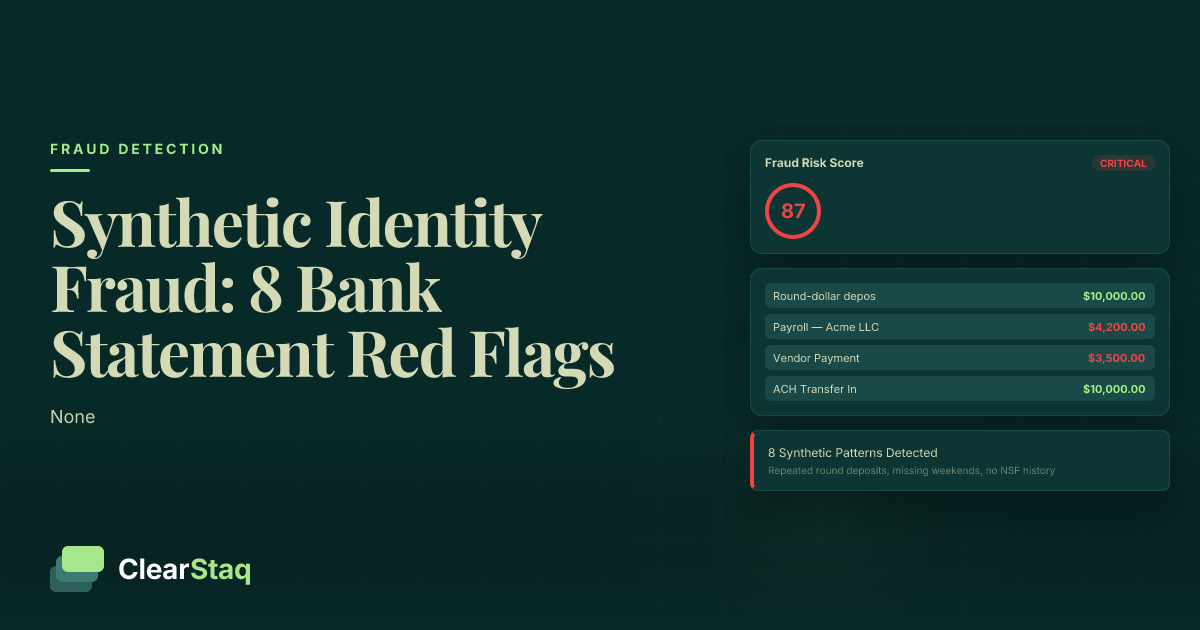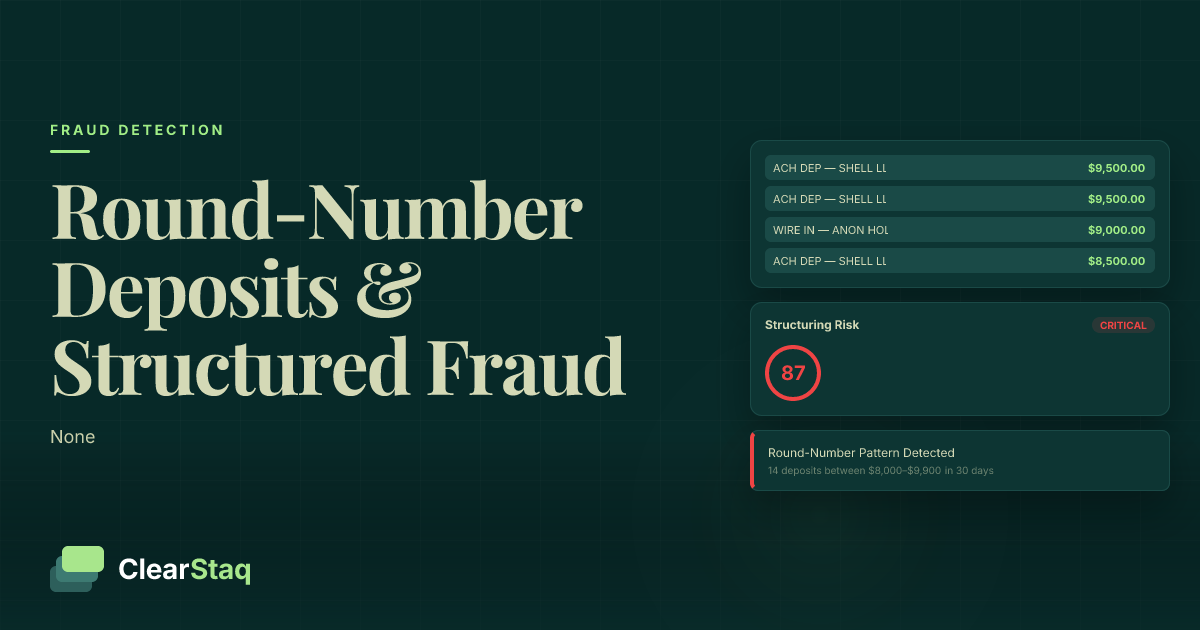
Synthetic identity fraud slips through standard KYC checks because the identity is a blend — a real Social Security number attached to a fabricated name, birth date, and address history. Here's how to catch it in loan applications before it reaches funding, using the same signals underwriting teams and fraud analysts rely on in 2026.
- Cross-check SSN issuance year against stated birth year first — the single fastest tell for synthetic identity fraud in loan applications.
- Thin credit files paired with rapid tradeline aging (0 to 700+ score in under 18 months) signal piggybacking, not a real borrower.
- Bank statement account-open dates that dont match stated employment or residency history are a red flag automated parsing catches in seconds.
- ClearStaq flags synthetic identity patterns across 27+ signals with 99.5% parsing accuracy, replacing manual cross-referencing.
Why this matters
Synthetic identity fraud doesn't behave like stolen identity fraud. There's no real victim calling to dispute a charge, no credit freeze triggered, no fraud alert on file — because the identity was built from scratch, usually around a real but unused Social Security number. The Federal Reserve has flagged it as the fastest-growing form of identity fraud in lending for several years running, and it's the reason application volume keeps climbing while chargeback data stays quiet.
Lenders that only check credit score and income miss it entirely. The applicant looks clean on paper because the file was built to look clean. Catching synthetic identity fraud in loan applications requires checking things a credit score doesn't show: how old the identity actually is, how the tradelines got there, and whether the bank account history matches the story on the application. Synthetic identity fraud detection for online lenders breaks down how digital-first lenders adapted their intake flow once manual review couldn't keep pace with application volume.
What you'll need
- A credit report showing tradeline age, not just score
- SSN issuance year data (available through most bureau add-ons)
- Bank statements covering at least 6-12 months of account history
- Address history from the application plus a National Change of Address check
- 10-15 minutes per file for manual review, or under 5 seconds per document with automated parsing
- A document fraud detection tool that flags tampering at the pixel and metadata level
The steps
1. Check SSN issuance year against stated birth year
This catches the most common synthetic identity pattern: an SSN issued in a year that doesn't line up with the applicant's claimed age. SSA issuance data is publicly referenced by most credit bureaus. If the SSN was issued when the applicant would have been 40 years old, or issued in a state the applicant never lived in, that's a signal worth escalating — not proof, but a reason to dig further. Common mistake: dismissing this because the SSN validates on a basic format check. Format validation only confirms the number is structurally real, not that it belongs to the applicant.
2. Measure credit file thickness against tradeline age
A real credit history builds slowly — first card, then an auto loan, then a mortgage, over years. Synthetic identities often show the opposite: a thin file that suddenly gains three to five tradelines within 12-18 months, usually through authorized-user piggybacking on someone else's account. Flag any file where tradeline count triples within 18 months without a corresponding life event (marriage, cosigned loan) explaining it. Common mistake: treating young credit file and synthetic identity as the same thing — real young borrowers exist too, especially first-time applicants in their early 20s.
3. Match bank account open dates to the application story
If the applicant claims five years at their current employer but the primary checking account opened eight months ago, the story doesn't hold. Bank statement parsing pulls account-open date, average balance trend, and deposit source automatically instead of requiring an underwriter to scroll through PDF pages. How to detect fake bank statements in loan applications covers the tampering patterns that show up alongside synthetic identity cases — the two often travel together. Common mistake: accepting a bank statement PDF at face value because the logo and formatting look right; formatting is the easiest thing to fake.
4. Scan for address instability across documents
Synthetic identities frequently cycle through addresses because the fraud ring needs a mailing point for credit-building activity, not a real residence. Cross-reference the address on the application, the credit report, and the bank statement. Two or three address changes within 24 months, especially across state lines with no employment change to explain it, is worth flagging. Common mistake: ignoring PO boxes or mail-forwarding addresses as just a preference — legitimate applicants use them too, but they warrant one extra verification step.
5. Look for authorized-user tradeline piggybacking
Fraud rings buy authorized-user slots on aged, well-managed credit cards to inflate a synthetic file's credit age overnight. A file that jumps from no history to a 10-year-old tradeline in a single reporting cycle is the clearest version of this pattern. Pull the tradeline detail and check whether the applicant is listed as primary or authorized user — most bureau reports show this distinction directly. Common mistake: treating tradeline age alone as proof of a real credit history without checking primary-vs-authorized status.
6. Run automated document fraud detection across every uploaded file
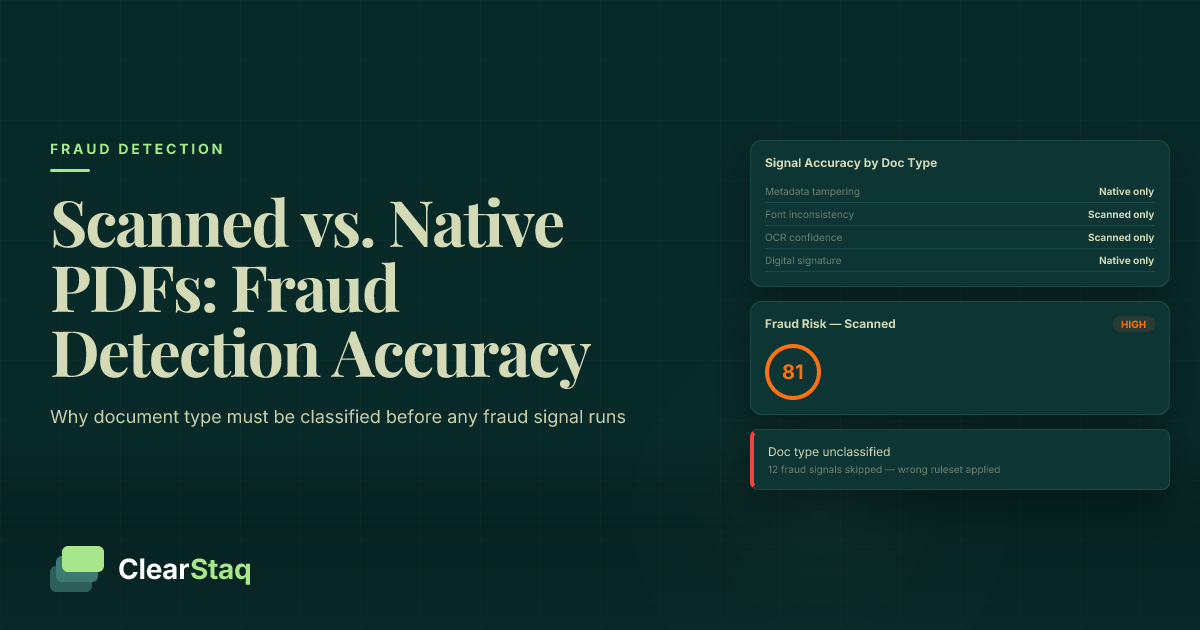
Manual review catches maybe half of doctored documents because tampering at the metadata or pixel level isn't visible to the eye. Automated detection scans bank statements, pay stubs, and tax returns for signs of editing software fingerprints, inconsistent fonts, and math that doesn't reconcile line to line. Document fraud detection software for fintech lenders walks through what a 27-signal scan actually checks for, beyond a visual glance. Common mistake: relying on a single reviewer's eye for tampering — even trained underwriters miss digitally altered PDFs at a meaningful rate.
7. Check application velocity tied to shared identity elements
Synthetic identities rarely apply once. The same SSN, phone number, or device fingerprint often shows up across multiple lenders or multiple applications within a short window. If your intake system flags shared elements across five or more applications in 30 days, that's a fraud ring pattern, not coincidence. Common mistake: only checking velocity within your own portfolio — cross-lender data feeds catch far more.
8. Escalate borderline files to manual review with a documented reason
Not every flag means fraud. Escalation should require the underwriter to name which signal triggered it — thin file, address mismatch, velocity — so the decision is auditable later. In 2026, regulators expect a documented reason for any adverse action tied to fraud suspicion, not a blanket denial. Common mistake: denying the loan without recording which signal drove the decision, which creates compliance exposure down the line.
Troubleshooting
- Legitimate young borrower flagged as synthetic: Check for a cosigner or recent life event (first job, first apartment) that explains a thin file without piggybacking.
- Recent immigrant with short U.S. credit history: SSN issuance for recent immigrants often postdates their actual birth year by design — this is normal, not synthetic, and should be excluded from the SSN-year check.
- Address mismatch from a recent move: Confirm with a utility bill or lease dated within 60 days before treating the mismatch as fraud.
- Doctored statement that passes visual review: Run it through automated document fraud detection rather than a second manual glance — tampering at the metadata level won't show up to the eye twice.
- High application velocity from a real cosigned loan: Check whether the shared identity elements (SSN, address) are tied to a documented cosigner relationship before flagging as fraud ring activity.
Tools and resources
- ClearStaq for automated bank statement parsing, income verification, and 27+ signal fraud detection
- Credit bureau reports with tradeline age and SSN issuance data
- Synthetic identity fraud detection for fintech onboarding for how onboarding flows adapt the checks above for digital-first applications
- USPS National Change of Address database for address history verification
What to do next
Once the file passes these checks, the next risk is commingled or manipulated cash flow inside the bank statements themselves. How to detect commingled funds in business underwriting covers the follow-up review most underwriting teams run right after identity clears.
FAQ
What is synthetic identity fraud in loan applications?
Synthetic identity fraud combines a real Social Security number with a fabricated name, birth date, or address to build a credit profile that doesnt belong to any real person. Its harder to detect than stolen identity fraud because theres no victim reporting it.
How is synthetic identity fraud different from stolen identity fraud?
Stolen identity fraud uses a real persons complete identity, so the victim eventually disputes charges or freezes credit. Synthetic identity fraud builds a new identity around a real SSN, so no victim exists to raise an alarm.
Can bank statement parsing detect synthetic identities?
Yes — bank statement parsing flags mismatches between account-open dates and the applicants stated employment or residency history, which is one of the strongest synthetic identity signals. ClearStaq processes these checks in under 5 seconds per document.
Whats the fastest way to verify SSN issuance for a loan applicant?
Most credit bureau add-ons include SSN issuance year and state, which you compare against the applicants stated birth year and residency. A mismatch doesnt confirm fraud on its own but warrants further review.
Do thin credit files always mean fraud?
No — thin files are normal for young borrowers, first-time applicants, and recent immigrants. The fraud signal is a thin file that suddenly gains multiple tradelines within 12-18 months, not thinness alone.
What documents does a synthetic identity fraud check require?
A full check needs a credit report with tradeline age, 6-12 months of bank statements, and address history from the application and a change-of-address database. Pay stubs and tax returns add a second layer if income verification is also in scope.
How accurate is automated document fraud detection in 2026?
ClearStaqs parsing engine runs at 99.5% accuracy across 900+ bank statement formats as of 2026, catching tampering that manual review typically misses. Accuracy varies by vendor, so ask for a benchmark before switching tools.
Is manual underwriting enough to catch synthetic identity fraud?
Manual review alone catches roughly half of doctored documents because tampering at the metadata level isnt visible to the eye. Pairing manual judgment with automated document fraud detection closes that gap.
One last thing
The detail most underwriting teams miss: synthetic identity rings often target SSNs belonging to children or deceased individuals specifically because those numbers go unused for years, giving the fabricated identity time to age a credit file undisturbed. Cross-referencing SSN issuance data against a death index isn't standard in most loan origination systems in 2026 — it should be, and it's one of the cheapest checks to add.
Related guides
ClearStaq Team
Content Team
The ClearStaq team builds AI-powered tools for bank statement parsing, fraud detection, and income verification.