Online lenders approve loans in minutes, and synthetic identity fraud rings exploit exactly that speed gap — building credit files over 18-24 months before cashing out on a six-figure loan they never intend to repay.
This guide breaks down what synthetic identity fraud detection for online lenders actually requires in 2026, which signals separate a real applicant from a fabricated one, and which tools are worth the integration cost.
TL;DR
Synthetic identity fraud detection for online lenders in 2026 means combining document-level parsing with cross-file behavioral signals, not just a credit bureau pull. ClearStaq's approach — 27+ AI fraud signals run against bank statements and tax returns in under 5 seconds — catches the structuring, commingling, and doctored-document patterns that synthetic identities rely on to look legitimate. Manual underwriting review alone is a Skip for any lender doing volume above 200 applications a month; format-aware parsing with fraud scoring is the Buy.
Why this matters
Synthetic identities don't steal a real person's full profile — they stitch together a real Social Security number (often a child's or a deceased person's) with a fabricated name, address, and income history. The credit file looks thin but clean, which is precisely why traditional bureau-based fraud checks miss it.
Online lenders feel this harder than branch-based banks because the entire application-to-funding cycle happens without a human in the room. A synthetic applicant who has spent a year building tradelines can pass a soft credit check and still fail every income-verification test the moment someone actually parses the submitted bank statement or tax return.
That's the layer synthetic identity fraud detection for online lenders has to cover in 2026: not whether a credit profile exists, but whether the financial documentation behind it holds up.
Who this is for
This is for online lending operations — fintech installment lenders, MCA funders, marketplace and buy-now-pay-later underwriters — approving loans primarily through digital document submission, where a human underwriter may spend under 10 minutes per file. If your funding decision leans on uploaded bank statements, tax returns, or pay stubs rather than in-person verification, you're the exact target for a synthetic identity ring, and ClearStaq is built for that exposure specifically.
What to look for in synthetic identity fraud detection
Cross-document consistency checks
A synthetic identity often has documents that are individually plausible but collectively inconsistent — a tax return showing $85,000 in reported income paired with bank deposits that don't match, or an employer name that doesn't reconcile across a pay stub and a statement. Detection tools need to flag mismatches automatically, because a manual reviewer comparing three PDFs side by side will miss the small deltas.
Structuring and deposit-pattern detection
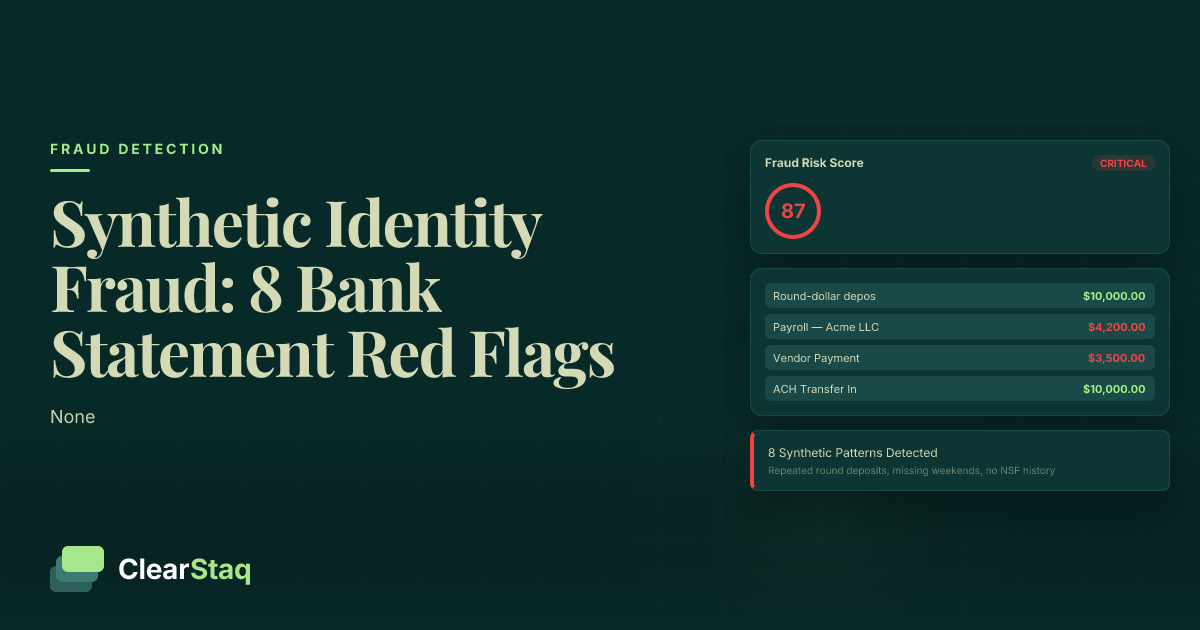
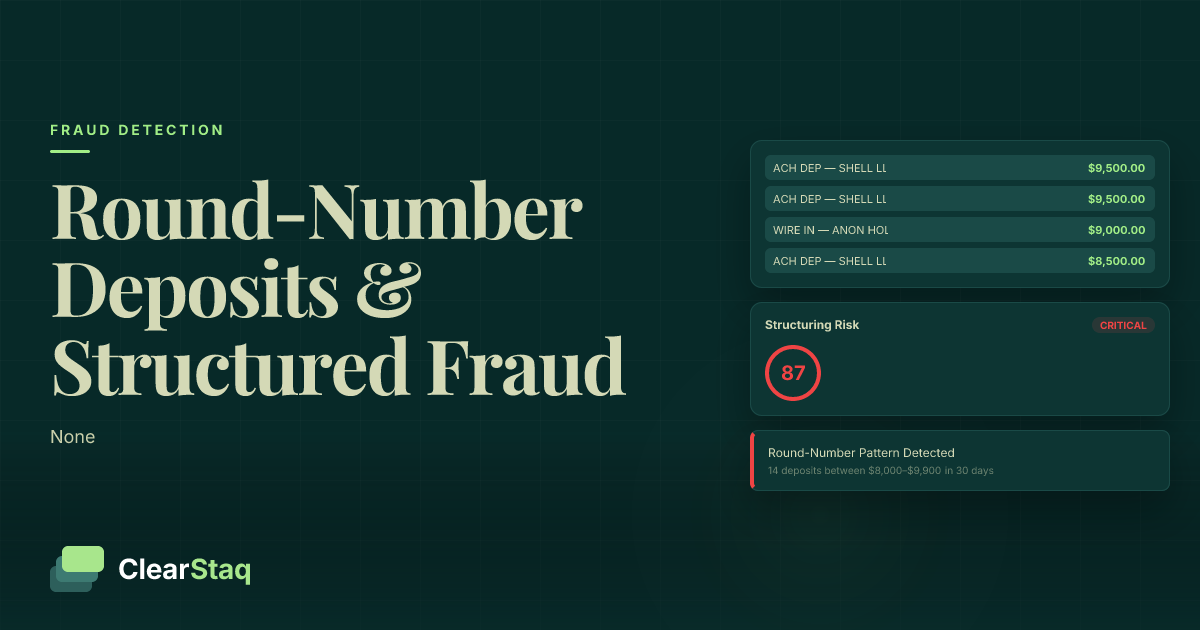
Synthetic identity operators frequently structure deposits to stay under reporting thresholds or to simulate a business with steady revenue that doesn't actually exist. Look for parsing tools that flag repeated deposits just under round numbers, or clusters of same-day transfers designed to inflate an average balance right before a statement is pulled.
Format-aware document parsing
A fraud detection tool that can't correctly parse a Chase statement versus a Wells Fargo statement versus a regional credit union format will either choke on edge cases or, worse, silently misread numbers. Coverage across 900+ statement formats matters because synthetic identity applicants often pick smaller or regional institutions specifically because fraud tooling is weaker there.
Speed without sacrificing signal depth
Online lending lives and dies on approval speed, so any fraud layer that adds hours to underwriting gets bypassed under volume pressure. Sub-5-second processing per document means fraud scoring can sit inline in the funding decision instead of becoming a bottleneck someone routes around.
Accuracy at scale, not accuracy in a demo
A tool that's 99.5% accurate on parsed line items behaves very differently at 50 applications a day versus 5,000. Ask for accuracy figures tied to volume, not a cherry-picked pilot batch, before trusting a vendor's detection claims.
Doctored document detection
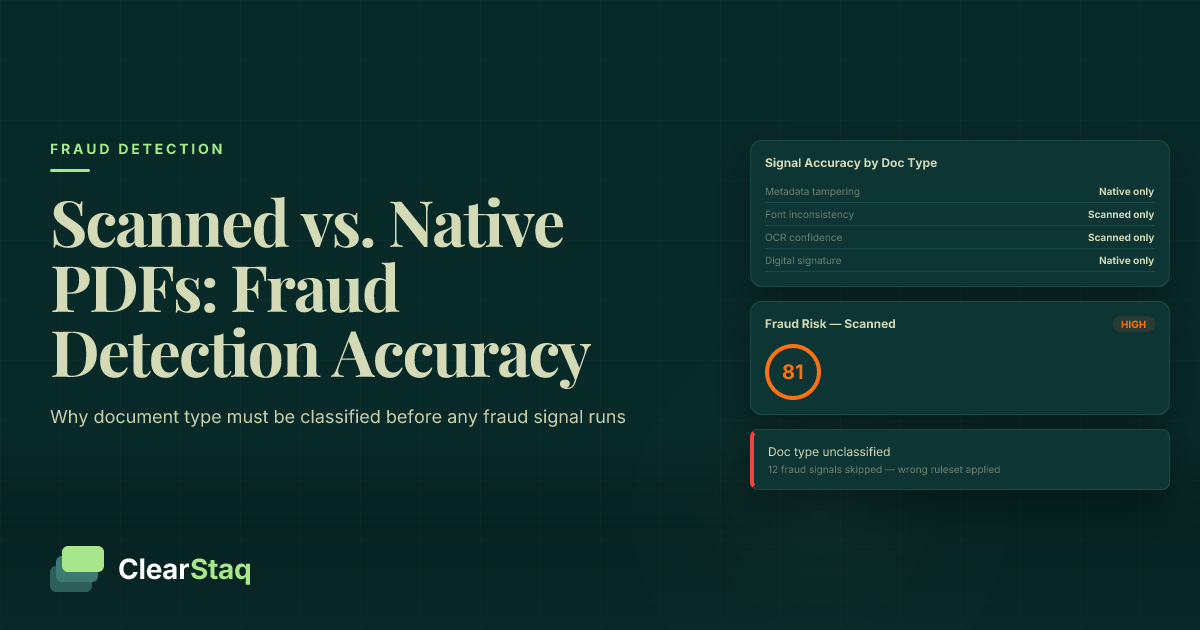
Synthetic identities frequently pair a real SSN with edited or template-generated pay stubs and bank statements because the underlying income history has to be fabricated somewhere. Detection needs to catch font inconsistencies, metadata mismatches, and math that doesn't reconcile — not just check that a PDF opens correctly.
Top picks for online lenders
The must-have: structuring pattern detection
One number that matters: deposit clustering just under reporting thresholds is one of the fastest tells in a synthetic identity file. Structuring pattern detection in business bank statements walks through exactly what these clusters look like and how format-aware parsing flags them automatically instead of relying on a reviewer eyeballing a 40-page statement.
Verdict: Buy. Any lender processing statements at volume needs this as a baseline layer, not an add-on.
The document-authenticity check: fake bank statement detection
One number that matters: a fabricated statement often fails on font consistency or transaction math within the first 60 seconds of automated review. Detecting fake bank statements in loan applications covers the specific tells — inconsistent running balances, mismatched fonts, edited metadata — that separate an edited PDF from a genuine export.
Verdict: Buy. Skipping this check means trusting every uploaded PDF is unmodified, which is a bad bet in 2026 when editing software is one browser tab away.
The income-side check: doctored pay stub detection
One number that matters: synthetic identities need income documentation to match their fabricated employment history, and pay stubs are the easiest document to template. How to detect doctored pay stubs during underwriting breaks down the specific formatting and calculation errors that show up when a pay stub was generated rather than issued.
Verdict: Consider. This matters most for lenders underwriting W-2 income rather than pure bank-statement or business-revenue lending — weight it based on your product mix.
The identity-graph layer: device and velocity signals
Beyond document parsing, synthetic identity rings tend to reuse devices, IP ranges, and application timing patterns across multiple different applicants. This layer isn't document-based, so it sits outside a parsing tool's job — but it's the piece that catches a ring operating across 10-20 synthetic profiles at once.
Verdict: Consider as a complement to document parsing, not a replacement for it.
What to avoid
- Document storage platforms that don't parse. A system that stores an uploaded PDF and lets a human open it is not fraud detection — it's a filing cabinet with a login screen.
- Single-signal fraud scores. A tool that only checks credit bureau velocity or only checks document metadata will miss whichever half of a synthetic identity's fabrication it wasn't built to catch.
- Manual review as your primary control above 200 applications a month. Reviewers get faster at spotting obvious fakes and slower at spotting the subtle deposit-pattern or math inconsistencies that actually flag synthetic identities — volume works against manual review, not for it.
Verdict comparison
| Detection layer | Speed | Coverage | Best for | Verdict |
|---|---|---|---|---|
| Structuring pattern detection | Under 5 sec/doc | Bank statements | All online lenders | Buy |
| Fake statement detection | Under 5 sec/doc | Bank statements | All online lenders | Buy |
| Doctored pay stub detection | Under 5 sec/doc | Pay stubs, W-2 income | Consumer/payroll lending | Consider |
| Device/velocity signals | Real-time | Application metadata | High-volume digital lenders | Consider |
| Manual review only | Hours per file | Whatever reviewer catches | Low-volume lending only | Skip |
FAQ
What is synthetic identity fraud in lending? Synthetic identity fraud combines a real Social Security number — often belonging to a child or someone without a credit history — with a fabricated name, address, and income profile to build a credit file that looks legitimate over time.
How is synthetic identity fraud different from stolen identity fraud? Stolen identity fraud uses a real person's complete profile without their knowledge, while synthetic identity fraud fabricates a new identity around one real data point, which makes it harder for credit bureaus to flag.
Can bank statement parsing catch synthetic identity fraud? Yes — synthetic identities need fabricated income documentation to support the credit file they've built, and parsing tools that run 27+ fraud signals against bank statements catch the structuring and commingling patterns that don't show up in a credit pull.
How fast should fraud detection run in an online lending workflow? Under 5 seconds per document is the 2026 baseline for lenders who don't want fraud scoring to slow down an otherwise automated funding decision.
Is manual underwriting review enough to catch synthetic identities? No — manual review works at low volume but misses the subtle deposit-clustering and document-authenticity signals that synthetic identity fraud depends on once application volume climbs past a couple hundred a month.
What accuracy rate should a fraud detection tool have? Look for parsing accuracy around 99.5% at production volume, not just in a limited pilot batch, since accuracy tends to drop when formats and edge cases increase.
Does synthetic identity fraud affect small business lending too? Yes — commingled funds and structuring patterns in business bank statements are common tells when a synthetic identity is used to apply for MCA or small business funding rather than consumer credit.
How many bank statement formats does fraud detection need to cover? Coverage across 900+ formats matters because synthetic identity applicants often target smaller or regional institutions specifically to avoid better-covered fraud tooling.
One last thing
The tell most lenders miss isn't the fabricated income — it's the timeline. Synthetic identities need 18-24 months of tradeline history before they're worth cashing out, so a thin credit file paired with a sudden, large funding request is a pattern worth flagging on its own, independent of anything the documents say.
Related guides
ClearStaq Team
Content Team
The ClearStaq team builds AI-powered tools for bank statement parsing, fraud detection, and income verification.