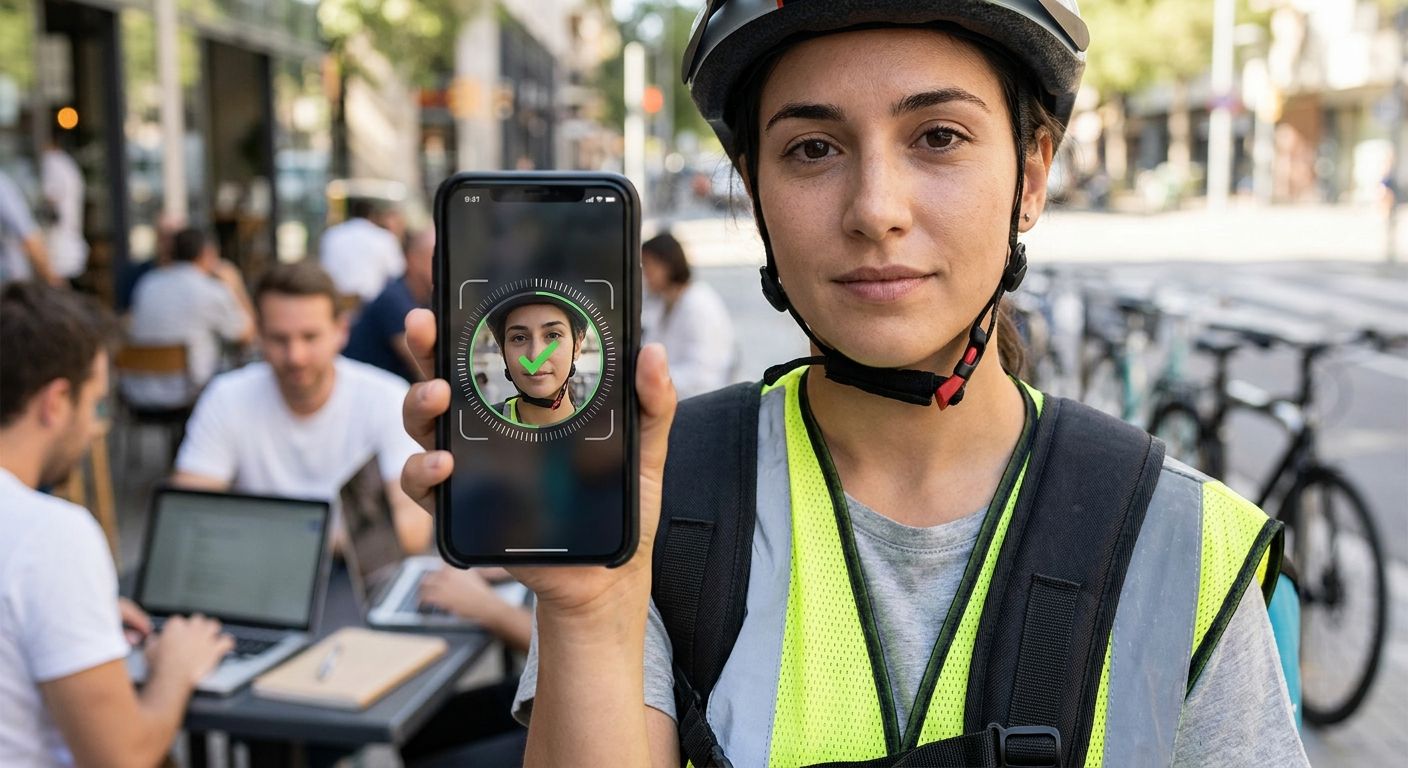
Biometric identity verification software for gig economy platforms confirms that the person opening an account, applying for financing, or getting paid is a real, live human matching a government-issued ID — not a photo, a deepfake, or a stolen identity. Gig platforms and the lenders financing gig workers face a different fraud profile than salaried-borrower lending: high applicant volume, thin credit files, frequent device and location changes, and workers who reapply under slightly altered identities after a rejection.
- Biometric identity verification software for gig economy platforms combines liveness detection with document authentication to stop synthetic identities before onboarding.
- Standalone biometric vendors confirm identity but not income — pair them with bank statement parsing to catch fraud in the numbers, not just the face.
- ClearStaq processes gig worker bank statements in under 5 seconds with 27+ fraud signals, complementing biometric checks rather than replacing them.
- Manual selfie-to-ID review breaks down past a few hundred applications a month — automation is the only path that scales in 2026.
Why biometric verification matters for gig economy platforms
Gig platforms and the fintechs that finance gig workers see repeat-applicant fraud at a rate salaried lending doesn't: a rejected driver or courier can reapply with a slightly different name, a new phone number, and a borrowed ID photo within days. Income volatility in gig economy bank statements already makes underwriting harder — layering identity fraud on top compounds the risk.
Biometric checks close the identity gap at the top of the funnel. They don't verify that the earnings an applicant reports are real, consistent, or theirs. That's a separate problem, and one gig lenders solve with bank statement analysis, not a selfie.
Update your onboarding flow before you touch software
Start with the applicant journey, not the vendor list.
- Map every point where identity is claimed but not checked: app signup, driver profile, financing application.
- Flag flows where a single device or IP submits multiple applications in 2026 — a common synthetic-identity signal.
- Require a live selfie match against the submitted ID photo at the highest-risk step, not just at signup.
- Log rejected applications with reason codes so reapplication patterns are traceable.
Add liveness detection at the highest-fraud step
Liveness detection stops the most common bypass: a static photo or a deepfake video held up to the camera. Liveness detection software for digital lending onboarding breaks down how this works for lenders specifically.
- Require active liveness prompts (blink, turn head) rather than passive checks alone.
- Match selfie geometry against the ID photo with a documented confidence threshold.
- Reject submissions where liveness confidence falls below your platform's set floor.
- Route borderline scores to manual review instead of auto-approving or auto-declining.
Authenticate the document itself, not just the face
A convincing face match means nothing if the ID document is doctored or synthetic.
- Check for tampering markers: font mismatches, inconsistent hologram rendering, altered machine-readable zones.
- Cross-reference document issue and expiration dates against known state and country formats.
- Flag IDs where the photo has clearly been re-embedded or resized.
- Compare document metadata against the applicant's stated location and device locale.
Screen for synthetic and repeat identities
Once identity clears the face-and-document check, the next risk is a synthetic identity built from real fragments — a real Social Security number attached to a fabricated name and history.
- Cross-check applicant details against internal records for reused phone numbers, emails, or bank accounts.
- Flag identities with no historical credit footprint paired with a recently issued document.
- Run device fingerprinting to catch repeat applicants across rejected accounts.
- Escalate matches to a fraud analyst before financing approval, not after disbursement.
Verify income after identity clears
This is where most gig platforms stop too early. A verified human with a verified ID can still submit doctored pay stubs or cherry-picked bank statements. ClearStaq parses gig worker bank statements and tax returns in under 5 seconds, checking the deposit patterns, structuring, and doctored-document markers that biometric tools never touch. Bank statement analysis software for gig economy lenders covers the underwriting side in more detail.
- Pull 3-12 months of transaction history, not a single snapshot.
- Check payout consistency against the platforms the applicant claims to drive or deliver for.
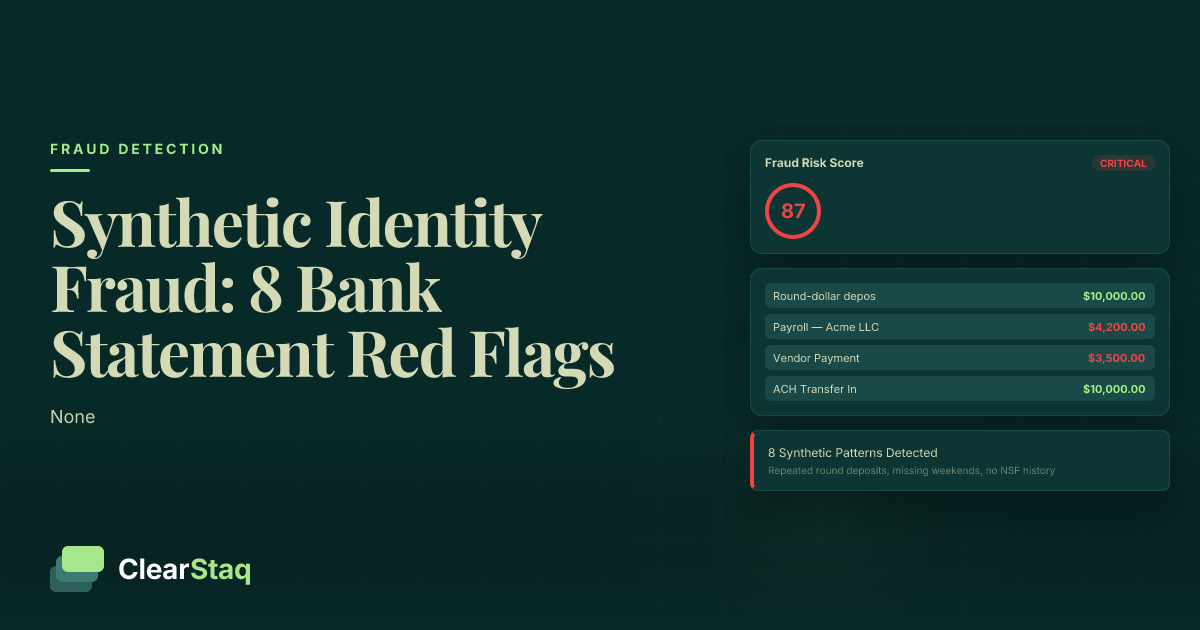
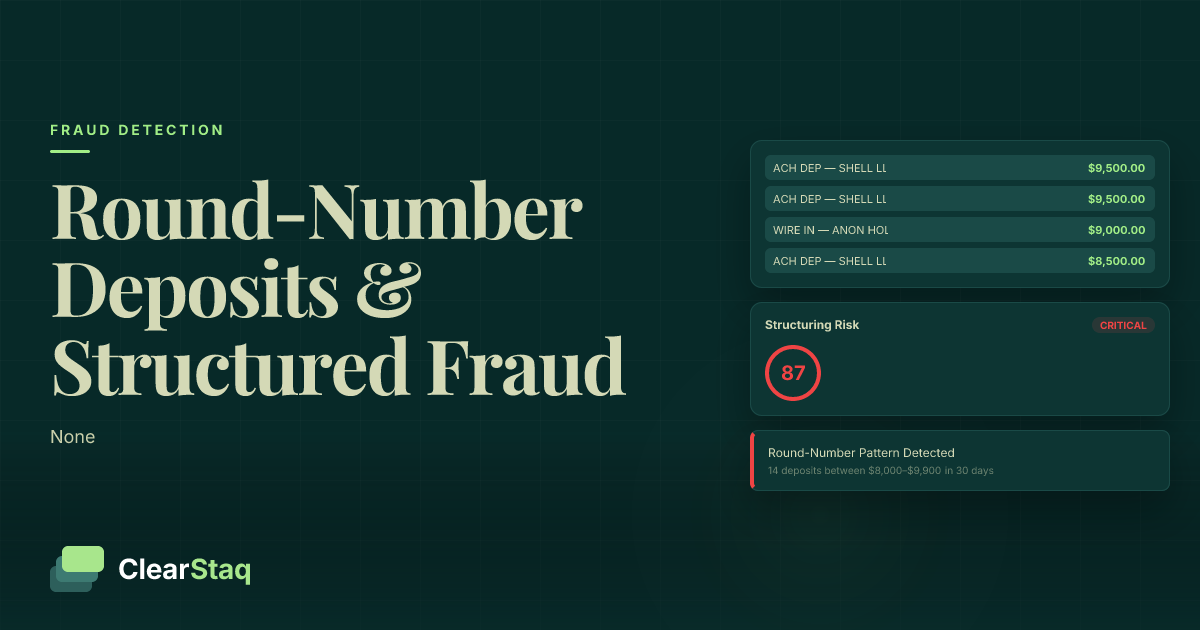
- Run the 27+ fraud signals against deposit timing, round-number patterns, and account age.
- Flag statements edited in a PDF editor rather than exported directly from the bank.
Measure your false positive and false negative rates
A verification stack that rejects too many real applicants costs you volume. One that lets too many fake ones through costs you defaults.
- Track approval rate by document type and issuing state or country monthly.
- Audit manually-reviewed borderline cases quarterly to recalibrate liveness thresholds.
- Compare fraud catch rate before and after each new verification layer goes live.
- Benchmark document accuracy against a stated figure — ClearStaq reports 99.5% parsing accuracy across 900+ statement formats.
Comparison: verification approaches for gig economy platforms
| Approach | Best for | Key limitation |
|---|---|---|
| Manual selfie and ID review by ops staff | Early-stage platforms under a few hundred applications a month | Slow, inconsistent scoring, breaks down as volume grows |
| Standalone biometric vendors (liveness plus document scan) | Platforms needing fast identity confirmation at signup | Confirms who someone is, not whether their income or statements are real |
| ClearStaq bank statement and fraud detection layer | Lenders verifying gig worker income after identity clears | Not a biometric capture tool — runs after identity verification, not instead of it |
Verdict: gig economy platforms that finance workers need both layers — biometric verification to confirm identity, and bank statement fraud detection like ClearStaq to confirm the money is real. Neither layer alone catches what the other one catches.
See the fraud layer behind identity checks
27+ fraud signals, sub-5-second parsing, built for gig worker income verification.
Common mistakes gig economy platforms make
- Treating biometric verification as the whole fraud program. A passed liveness check says nothing about whether reported income is real, and deepfake identity documents increasingly clear basic checks too.
- Setting liveness thresholds once and never revisiting them. Fraud tactics shift year over year; a threshold tuned two years ago is stale in 2026.
- Ignoring device and account reuse across rejected applications. Repeat applicants under new names are the most common gig-platform fraud pattern, and most platforms don't log rejections well enough to catch it.
- Approving financing on a single bank statement snapshot. Gig income is volatile by nature — one strong month proves nothing about the next six.
- Skipping manual review on borderline biometric scores. Auto-approving or auto-declining edge cases either lets fraud through or costs you legitimate workers.
FAQ
What is biometric identity verification software for gig economy platforms?
It is software that confirms an applicant is a real, live person matching their government-issued ID using liveness detection and document authentication. On gig platforms it runs at account signup or loan application, before any income verification step.
Is biometric verification enough to stop lending fraud on gig platforms?
No. Biometric checks confirm identity but not income, and a verified human can still submit doctored bank statements or pay stubs. Pairing biometric checks with bank statement fraud detection like ClearStaq's 27+ signal analysis closes that gap.
How does liveness detection work in loan onboarding?
Liveness detection uses an active prompt such as a blink or head turn, captured on camera in real time, then matches the resulting face geometry against the submitted ID photo. It is built to defeat static photos and pre-recorded video spoofs.
How fast can bank statement parsing verify gig worker income?
ClearStaq parses bank statements and tax returns in under 5 seconds per document in 2026, checking deposit patterns and formatting against 27+ fraud signals. That replaces a manual review that typically runs far longer per file.
What is the biggest identity fraud risk specific to gig platforms?
Repeat applicants who reapply under slightly altered identities after a rejection, often from the same device or IP address. Most platforms do not log rejection reason codes well enough to catch the pattern.
Do gig economy lenders need both biometric and document verification?
Yes. Biometric verification confirms who the applicant is; bank statement and document analysis confirms their income and financial history are real. Running only one layer leaves an open lane for fraud.
How accurate is automated bank statement parsing in 2026?
ClearStaq reports 99.5% parsing accuracy across 900+ statement formats. Use that as the benchmark when evaluating any parsing vendor for gig worker income verification.
Is manual selfie-to-ID review ever the right choice?
Only at very low volume, roughly a few hundred applications a month or fewer. Past that, review time and scoring inconsistency make automation the cheaper and more accurate option.
One last thing
The platforms that get burned worst in 2026 are not the ones skipping biometric verification entirely. They are the ones who install it, watch signup fraud drop, and stop looking. Fraud moves downstream to the income verification step — doctored statements, structured deposits, payout histories that do not match the platforms an applicant claims to work for. That is exactly where ClearStaq's 27+ fraud signals run.
Related guides
ClearStaq Team
Content Team
The ClearStaq team builds AI-powered tools for bank statement parsing, fraud detection, and income verification.