Gig economy drivers don't have W-2s or predictable pay stubs — they have deposits from Uber, Lyft, DoorDash, and Instacart that swing 20-40% week to week, and that volatility is exactly what makes auto financing underwriting for this group harder to get right in 2026.
- Verifying gig economy driver income for auto financing requires 12 months of bank deposits, not pay stubs.
- Uber, Lyft and DoorDash deposits swing 20-40% weekly — normalize with a rolling average, not one month's snapshot.
- ClearStaq flags doctored 1099s and income smoothing in under 5 seconds using 27+ fraud signals.
- Verdict: treat gig income as self-employment income and verify it against transaction-level bank data, not a single document.
Why this matters
Gig platforms don't withhold taxes, don't guarantee hours, and don't issue consistent statements — a driver working 35 hours one week and 12 the next produces income data that looks unstable even when the underlying earning capacity is solid.
Auto lenders who rely on a single pay stub or a self-reported 1099 total end up either declining creditworthy drivers or approving loans against income that won't hold up under a downturn in ride volume. In 2026, gig work accounts for a growing share of subprime and near-prime auto applications, which means the verification method matters as much as the credit score.
The fix is treating gig income like self-employment income: pull 12 months of bank statements, isolate platform deposits, and normalize for seasonality before calculating a debt-to-income ratio. Lenders using bank statement analysis software built for gig economy lenders cut this from a 45-minute manual review to a process that returns results in seconds.
What you'll need
- 12 months of business or personal bank statements covering all platform deposit accounts
- 1099-NEC or 1099-K forms from each platform the driver works (Uber, Lyft, DoorDash, Instacart, Amazon Flex)
- A parsing tool that can categorize deposits by source, not just total inflow
- Fraud detection signals that flag altered PDFs, edited metadata, or duplicated transaction IDs
- A DTI calculation method that accounts for gig income variance, not a flat 12-month average
- 15-20 minutes of underwriter review time once automated parsing is in place
The steps
1. Pull 12 months of bank statements, not 3
A 3-month statement window catches a good stretch and misses a slow one — 12 months captures seasonal patterns like holiday delivery spikes and post-holiday slowdowns that are common across DoorDash and Instacart drivers.
Request statements covering every account the driver deposits gig income into. Many drivers run Uber and DoorDash deposits into the same checking account, and some route funds through a separate business account to keep records clean. Missing an account means missing income, which produces a false negative on the application.
Common mistake: accepting a driver-provided summary spreadsheet instead of the source bank statements. Spreadsheets get edited; bank statement PDFs, when parsed directly, don't.
2. Isolate platform deposits from personal transfers
Gig income sits inside an account that also shows rent payments, Venmo transfers, and grocery purchases — the parsing step needs to separate recurring platform deposit patterns (labeled things like "UBER TRIP," "DD DOORDASH," or "INSTACART") from unrelated inflows like family transfers or tax refunds.
Format-aware parsing across 900+ statement formats catches these labels automatically instead of requiring an underwriter to scroll line by line. Manual review of a 12-month statement with 200+ transactions takes 30-45 minutes; automated categorization returns the same breakdown in under 5 seconds.
3. Calculate a rolling 3-month average, not a single-month snapshot
A single month's deposit total is the least reliable number in the file — weekly ride volume for rideshare drivers varies 20-40% based on demand, weather, and platform incentive changes.
Use a rolling 3-month average across the trailing 12 months to smooth out anomalies while still catching a genuine downward trend. If month-over-month deposits are trending down 15% or more across the last quarter, that's a signal worth flagging before approval, not after the first missed payment.
Expected outcome: a normalized monthly income figure that reflects earning capacity rather than a lucky or unlucky month.
4. Cross-check bank deposits against 1099 totals
A driver's reported 1099-K or 1099-NEC total should roughly match the sum of platform deposits over the same tax year — a mismatch of more than 10-15% is worth a second look.
This step catches two problems at once: drivers who underreport income to platforms (rare) and drivers who submit a doctored or inflated 1099 to qualify for a larger loan (more common). Cross-referencing bank data against submitted tax documents is standard practice for verifying self-employed income for loan underwriting, and gig drivers fall squarely into that category.
5. Screen for income smoothing and structuring patterns
Some applicants pad the appearance of consistent income by moving money between accounts right before submitting statements — a $2,000 transfer from a savings account into checking on the 28th of each month, timed to land before the statement cutoff.
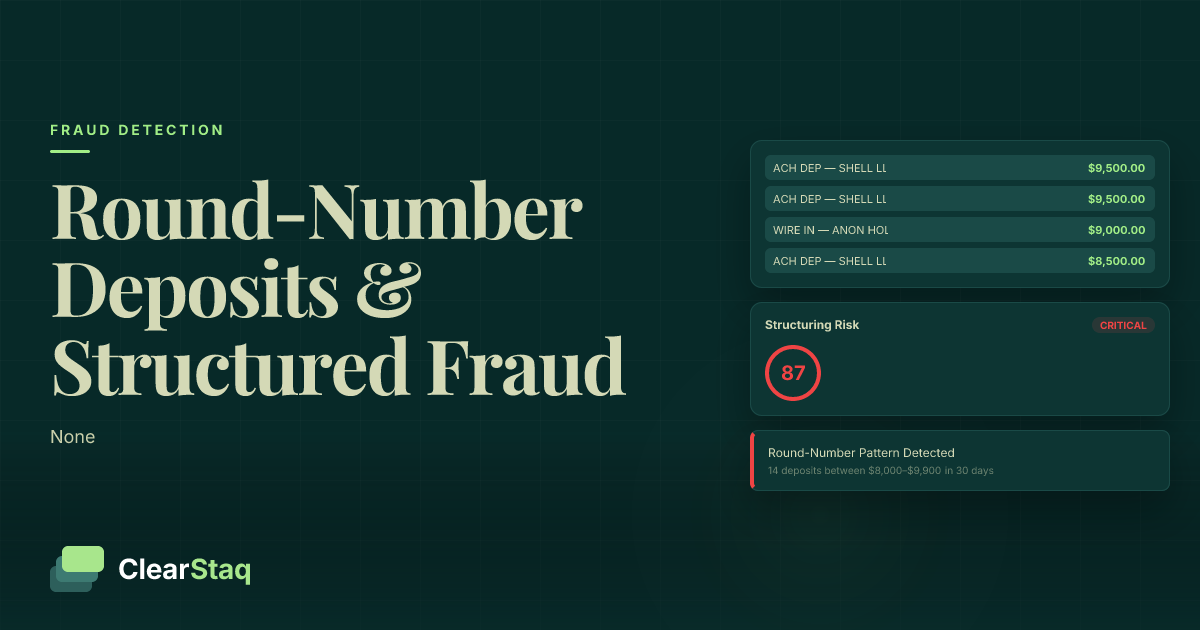
Look for round-number transfers that don't match any platform deposit label, transfers that repeat on a suspiciously exact schedule, or deposits that arrive just before a statement date and leave shortly after. These patterns are the same ones underwriters check for in commercial lending, and the detection logic transfers directly to gig income files.
6. Verify document authenticity, not just the numbers
A parsed PDF can carry edited metadata, mismatched fonts, or a duplicated transaction ID from a template — checking the numbers without checking the document itself misses roughly a third of fabricated statement fraud caught in 2026 underwriting reviews.
Run submitted statements through fraud detection that checks 27+ signals: font consistency, metadata edit history, balance math validation, and duplicate transaction detection across submitted files. Buy the automated route here — manual document authenticity review at scale isn't realistic for a high-volume auto lending desk.
“A single month of gig deposits tells you almost nothing — a rolling 3-month average across 12 months tells you everything.”
Troubleshooting
Problem: Deposits from multiple platforms make categorization messy. Fix: parse each platform's deposit label separately (Uber, Lyft, DoorDash all use distinct naming conventions) and sum by month rather than trying to build one universal label rule.
Problem: Driver reports income that's 20%+ higher than bank deposits show. Fix: request the 1099 directly and cross-reference against the tax year total — a gap this size usually means either unreported cash tips or an inflated self-reported figure.
Problem: Statement shows a large one-time deposit that isn't platform income. Fix: flag and exclude it from the average unless the source is verified (tax refund, loan proceeds, gift) — including it inflates the DTI calculation and misrepresents earning capacity.
Problem: PDF statement looks clean but the balance math doesn't reconcile. Fix: run automated balance validation across every transaction line — a mismatch of even a few dollars across a 12-month statement usually points to an edited document rather than a bank error.
Problem: Driver works seasonally (holiday delivery surge) and full-year average understates recent capacity. Fix: weight the most recent 3 months more heavily than months 9-12 back, especially for drivers who started gig work mid-year.
Tools and resources
- A bank statement parser that categorizes deposits by source label, not just total inflow
- Fraud detection covering 27+ signals: metadata edits, duplicate transaction IDs, balance validation
- A DTI calculator that accepts a rolling average input instead of a flat monthly figure
- Cross-reference logic for 1099 totals against bank deposit sums
- A workflow for detecting doctored pay stubs during underwriting, which shares detection logic with fabricated 1099 review
Automate gig income verification
Parse 12 months of statements and flag fraud in under 5 seconds.
What to do next
Once the base verification process is running, the next failure point is income smoothing — applicants who time transfers to make a thin month look full. The deeper walkthrough on detecting income smoothing in bank statement underwriting covers the specific transfer patterns and timing signals that a rolling-average check alone won't catch.
FAQ
How do you verify gig economy driver income for auto financing?
Pull 12 months of bank statements, isolate platform deposits (Uber, Lyft, DoorDash, Instacart), and calculate a rolling 3-month average to normalize weekly volatility of 20-40%. Cross-check the total against submitted 1099 forms before calculating DTI.
Can pay stubs be used to verify gig driver income?
No — gig platforms classify drivers as independent contractors and don't issue pay stubs. Income verification for gig drivers relies on bank statements and 1099-NEC or 1099-K forms instead.
How many months of bank statements should auto lenders request from gig drivers?
12 months minimum. A 3-month window misses seasonal patterns like holiday delivery surges and post-holiday slowdowns that are common in delivery and rideshare income.
What's a normal income variance for rideshare drivers?
Weekly deposit totals for Uber and Lyft drivers commonly swing 20-40% based on demand, weather, and platform incentive changes. A single month's total should never be used as the sole income figure.
How do lenders catch doctored 1099s from gig drivers?
Cross-reference the reported 1099 total against the sum of bank deposits for the same tax year. A mismatch over 10-15% warrants a document authenticity check, including metadata and font consistency review.
Is gig income treated as self-employment income for auto loans?
Yes. Gig drivers are independent contractors, so lenders apply self-employment income verification standards: bank statement analysis, tax document cross-referencing, and DTI calculated off normalized deposit averages rather than a fixed salary.
What fraud signals matter most for gig driver income verification?
Round-number transfers timed near statement cutoffs, duplicate transaction IDs across submitted files, and balance math that doesn't reconcile are the top three signals. Automated tools check 27+ signals per statement in under 5 seconds.
How long does automated gig income verification take compared to manual review?
Manual review of a 12-month statement with 200+ transactions takes 30-45 minutes per applicant. Automated parsing and categorization returns the same breakdown in under 5 seconds at 99.5% accuracy.
One last thing
The single biggest underwriting error on gig driver applications in 2026 isn't fraud — it's using a 3-month statement window instead of 12, which means a lender approves or declines based on whichever quarter happened to be busy or slow. Fix the window before worrying about anything else.
Related guides
ClearStaq Team
Content Team
The ClearStaq team builds AI-powered tools for bank statement parsing, fraud detection, and income verification.