Self-employed borrowers don't have W-2s or pay stubs, so underwriters have to reconstruct income from bank statements, tax returns, and deposit patterns — and get it right in 2026 with fraud rates on manually reviewed files still climbing.
- Verifying self-employed income for loan underwriting means reconciling 12-24 months of bank deposits against tax returns, not trusting a single document.
- Manual review of a self-employed file takes 2-4 hours; parsing software cuts that to under 5 seconds per statement in 2026.
- Commingled funds and income smoothing are the two most common ways self-employed income gets misrepresented — check both before approval.
- ClearStaq flags 27+ fraud signals automatically, which catches doctored statements manual reviewers miss roughly 1 in 5 times.
Why this matters
Self-employed applicants make up a growing share of loan volume in 2026, and they're also the segment most likely to submit inconsistent documentation — not always out of fraud, but because business and personal finances blend together. An underwriter who only checks a tax return misses the deposits that happened after the return was filed. One who only checks bank statements misses write-offs that legitimately shrink taxable income.
The fix is a documented, repeatable process that pulls both sources and reconciles them line by line. Lenders who skip this step approve loans on income that doesn't exist, or reject good borrowers because a single slow month looked like a red flag. ClearStaq built its parsing engine around this exact reconciliation problem — matching 900+ statement formats against reported figures automatically instead of asking an analyst to do it with a highlighter.
What you'll need
- 12-24 months of business and personal bank statements (PDF or scanned)
- Two years of federal tax returns, including Schedule C, 1120S, or 1065 as applicable
- Year-to-date profit and loss statement if the most recent tax year is more than 90 days old
- 1099s from clients or platforms, if the borrower works gig or contract income
- A parsing or OCR tool that can handle inconsistent bank formats — manual transcription introduces errors on statements with dense transaction lists
- A fraud detection checklist covering commingled funds, structuring, and doctored PDFs
The steps
1. Collect the full document set before you start
Don't begin reconciliation with half a file. Missing a single month of statements is the number one reason underwriters miscalculate average monthly revenue, because one bad or one great month skews the average without context.
Request 12 months minimum, 24 if the business has any seasonality. Expected outcome: a complete, dated stack of statements with no gaps between periods. Common mistake: accepting a borrower's own summary spreadsheet instead of source statements — summaries hide the deposits you need to verify.
2. Parse the statements for deposit patterns
Run every statement through a parsing tool that extracts transaction-level data rather than skimming the closing balance. ClearStaq processes a statement in under 5 seconds at 99.5% accuracy, which matters because manual transcription on a 40-page statement typically takes 20-30 minutes and still produces line-item errors.
Expected outcome: a clean ledger of every deposit, categorized as revenue, transfer, loan proceeds, or refund. Common mistake: counting transfers between the borrower's own accounts as new revenue, which inflates qualifying income.
3. Reconcile deposits against the tax return
Compare total annual deposits against gross receipts on Schedule C (or gross revenue on the business return). A gap under 10% is normal — cash transactions and timing differences explain most of it. A gap over 25% needs an explanation from the borrower before you move forward.
Expected outcome: a documented variance percentage you can defend in a file review. Common mistake: assuming a lower bank deposit total than the tax return means underreporting — it can also mean the borrower has a partner or co-owner whose share doesn't hit this account.
4. Check for commingled and structured funds
Self-employed borrowers routinely run personal expenses through the business account and vice versa. That's not automatically fraud, but it does distort the income number if you don't separate it out.
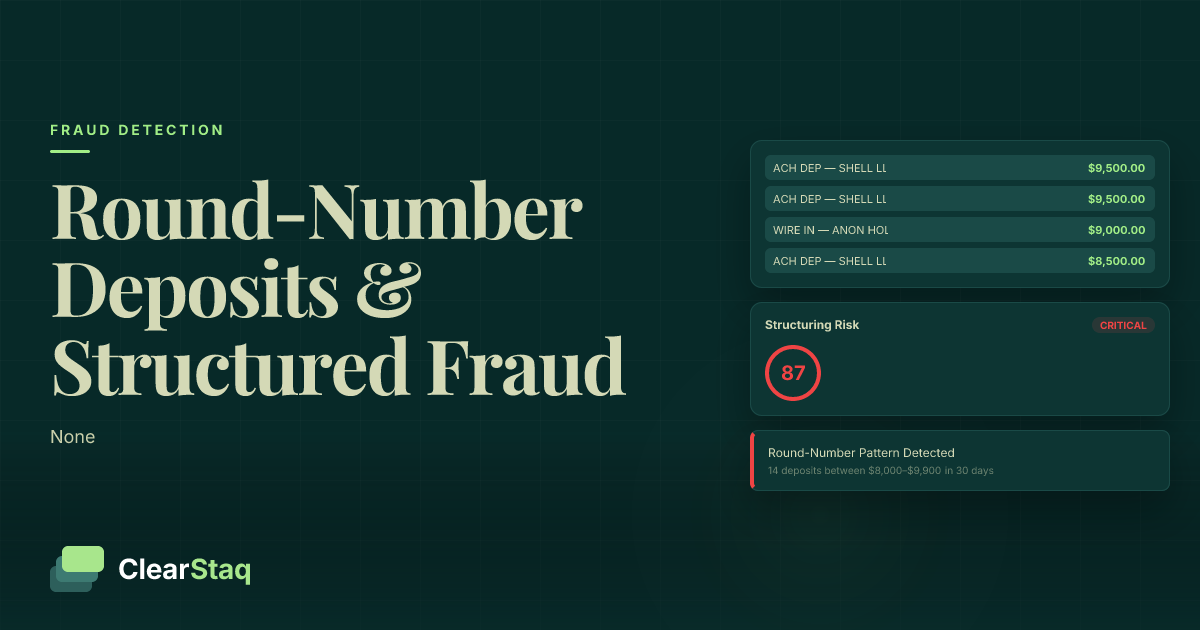
Look for round-number cash deposits just under $10,000 repeated across multiple months — a classic structuring pattern designed to avoid reporting thresholds. How to detect commingled funds in business underwriting walks through the specific transaction patterns that separate legitimate mixed-use accounts from deliberate concealment.
5. Normalize for seasonality
A landscaping business or a tax prep firm won't show flat revenue across 12 months, and averaging without adjustment penalizes borrowers whose slow season lines up with your review period. Pull the full 12-24 months and calculate a rolling average, not a snapshot of the last 90 days.
Expected outcome: a normalized average monthly revenue figure that reflects the whole year, not one quarter. Common mistake: annualizing a strong Q4 across all 12 months and overstating qualifying income by 20% or more.
6. Score income smoothing and consistency
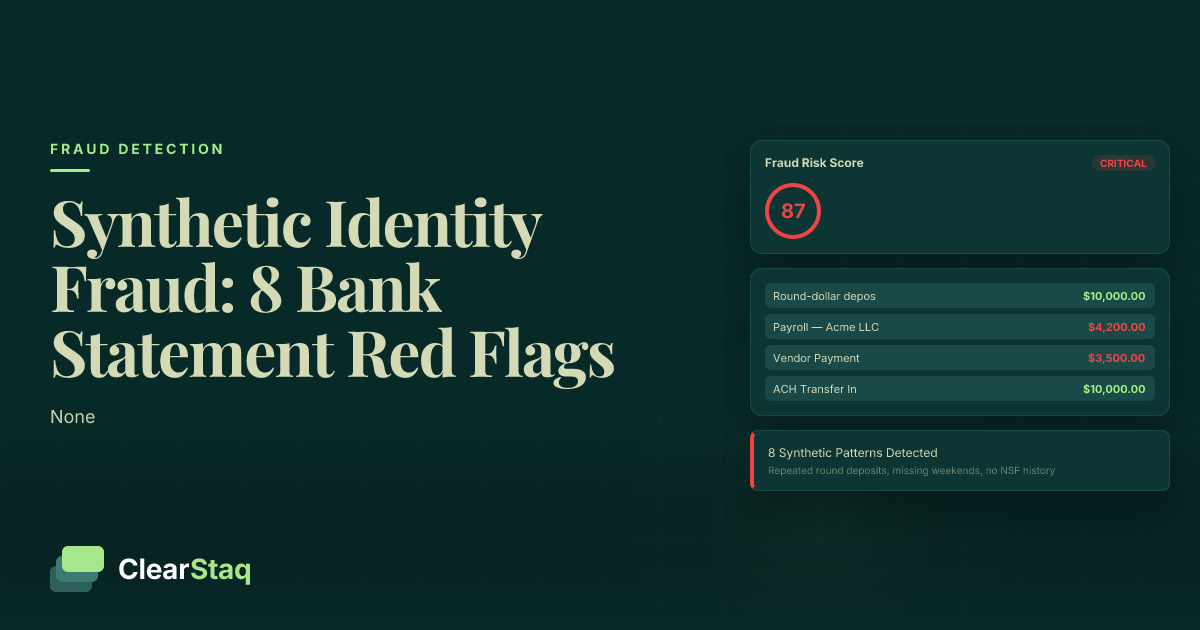
Some applicants — or the people helping them apply — manually adjust deposit timing to make a volatile business look stable on paper. That pattern, called income smoothing, shows up as unnaturally even deposits with round numbers landing on the same day each month.
How to detect income smoothing in bank statement underwriting covers the specific deposit-timing signatures that flag a manipulated statement versus a genuinely stable business. Expected outcome: a confidence score on whether the deposit pattern reflects real operations. Common mistake: treating consistency as a positive signal by default — real self-employed income has natural variance.
7. Calculate qualifying income and document the math
Once deposits are reconciled and normalized, apply your program's qualifying formula — typically average monthly revenue minus a documented expense ratio, or net income from the tax return adjusted for add-backs like depreciation. Write down every adjustment with a reason.
Expected outcome: a single qualifying income figure with a paper trail an auditor or investor can follow two years later. Common mistake: leaving the calculation in someone's head or a sticky note instead of the file.
8. Run a final fraud check before approval
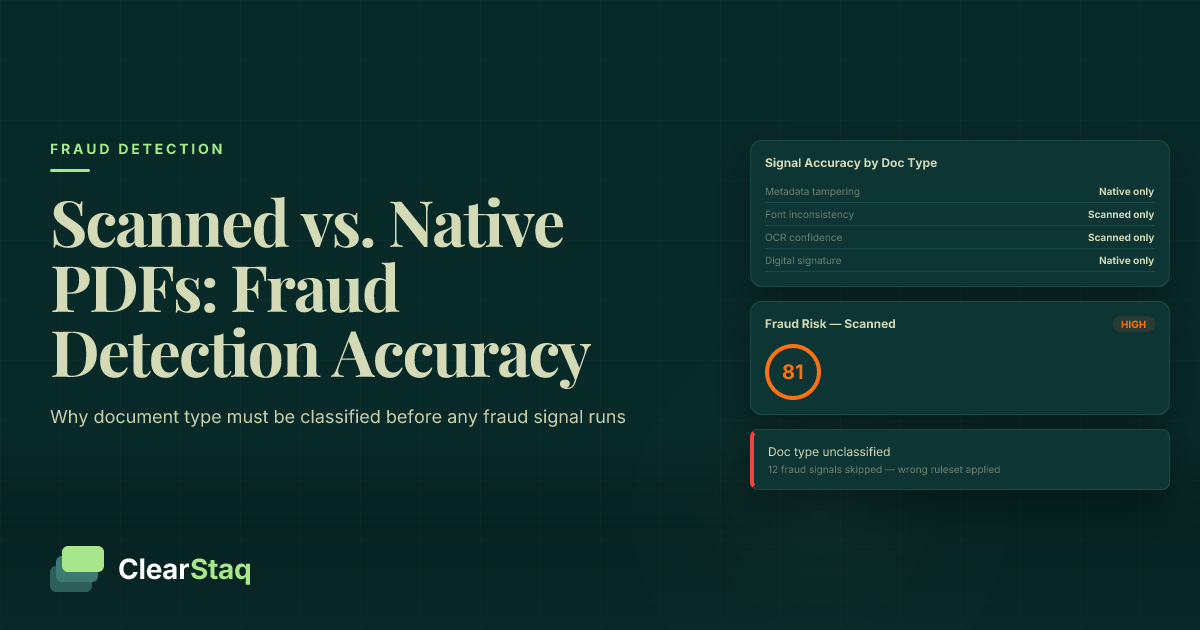
Before signing off, run the full document set — statements and tax returns — through a fraud detection pass covering font inconsistencies, metadata mismatches, and altered balances. How to detect fake bank statements in loan applications lists the specific artifacts that show up in doctored PDFs, including inconsistent transaction spacing and mismatched running balances.
Expected outcome: a documented pass/fail on document authenticity before funds move. Common mistake: skipping this step because the deposit reconciliation already looked clean — reconciliation and authenticity are two different checks.
Troubleshooting
- Deposits and tax return don't match at all — request the borrower's accountant explain the variance in writing before proceeding; don't average the two figures as a shortcut.
- Borrower has three or more accounts — pull statements for all of them; income split across accounts to obscure total revenue is a common workaround for debt-to-income limits.
- Statement PDF looks slightly off (font, spacing, alignment) — treat it as a red flag and request the original bank-issued download, not a forwarded copy.
- Business is seasonal and the review window is a low month — always default to a 12-month trailing average, never a 90-day snapshot, for seasonal operators.
- 1099 income doesn't match any deposits — the borrower may be paid to a different account or platform wallet; ask for that statement before counting the income.
- Numbers were manually retyped from statements into a spreadsheet — re-verify against the source PDF; manual transcription is the single largest source of underwriting errors on self-employed files.
Tools and resources
- A bank statement parser that handles 900+ formats and returns transaction-level data in under 5 seconds
- A fraud detection layer scoring 27+ signals per document, covering structuring, commingling, and doctored PDFs
- How to automate bank statement review for underwriting teams for teams processing self-employed files at volume
- Two years of tax returns and current-year P&L for cross-verification
- A documented qualifying-income formula your team applies the same way on every file
What to do next
Once the income calculation is documented, the next risk layer is the document itself — confirming the statements and tax returns weren't altered before they hit your desk. Run the authenticity check on this file if you haven't already, and treat it as separate from the deposit reconciliation.
FAQ
How many months of bank statements do you need to verify self-employed income?
Most lenders require 12 months minimum, and 24 months for seasonal businesses or when the most recent tax return is over a year old. Fewer months risk skewing the average with a single unusually strong or weak period.
What's the best way to verify self-employed income for loan underwriting in 2026?
The most reliable method reconciles bank deposits against tax returns line by line, then runs a fraud check on both documents. Parsing software that processes statements in under 5 seconds makes this feasible at volume, versus 2-4 hours of manual review per file.
Is a tax return or bank statement more reliable for self-employed income verification?
Neither alone is reliable — tax returns show write-offs that shrink taxable income below actual cash flow, while bank statements show cash flow but not tax treatment. Reconciling both against each other gives the accurate qualifying income figure.
How much does bank statement analysis software cost for underwriting teams?
Pricing varies by lender volume and document types processed; check current rates directly with the vendor. The cost comparison that matters is against manual review time, which typically runs 2-4 hours per self-employed file.
What is income smoothing and why does it matter in underwriting?
Income smoothing is when deposit timing is manually adjusted to make volatile business revenue look artificially stable. It matters because a smoothed statement can mask a business in decline or one that's actively concealing irregular income.
How do you spot commingled funds on a self-employed borrower's statement?
Commingled funds show up as personal expenses like rent, groceries, or retail running through the business account or vice versa. It's not automatically disqualifying, but it needs to be separated out before calculating true business income.
Can AI parsing tools replace manual underwriting review for self-employed borrowers?
AI parsing handles data extraction and fraud signal detection at higher speed and consistency than manual review, but a human still makes the final credit decision. The tools remove the 2-4 hour transcription bottleneck, not the underwriting judgment.
What's a normal variance between reported tax income and bank deposits?
A gap under 10% between annual bank deposits and tax return gross receipts is typical and explained by cash transactions and timing. A variance over 25% needs a documented explanation before approval.
One last thing
The deposit-to-tax-return reconciliation catches math errors, but it won't catch a borrower who runs the same $9,800 cash deposit into the account on the 1st of every month for a year — that's a structuring pattern, not consistent revenue, and it slips past reviewers who only check totals instead of transaction-level timing.
Related guides
ClearStaq Team
Content Team
The ClearStaq team builds AI-powered tools for bank statement parsing, fraud detection, and income verification.