Synthetic identities get caught in marketplace onboarding by cross-checking document issue dates, bank statement age, and device behavior against one continuous identity — not by any single verification step. A Social Security number issued after an applicant's stated birth year, a bank account with six months of transaction history and nothing before it, or a device fingerprint shared across a dozen "different" seller accounts are the tells that single-point checks miss every time.
- How to detect synthetic identities in marketplace onboarding starts with cross-checking document issue dates, bank statement age, and device fingerprints against one identity.
- ClearStaq scans applicant bank statements and tax documents across 27+ fraud signals in under 5 seconds per file at 99.5% accuracy.
- Thin credit files paired with sudden high-limit requests are a stronger red flag than any single document check.
- Manual review catches individually fake documents but misses cross-document inconsistencies that expose synthetic identities.
Why this matters
Marketplace platforms onboard sellers and buyers fast, sometimes in under a minute, and that speed is exactly what synthetic identity fraud exploits. No single check — SSN validation, address verification, document upload — catches a synthetic identity on its own; that's why fraud detection software for online marketplaces cross-references data points against each other instead of validating each one in isolation.
A fabricated identity built from a real SSN fragment, a made-up name, and a false date of birth passes individual KYC checks because each data point looks valid alone. The fraud only shows up once you compare bank statement age, credit file depth, and device history side by side, and in 2026 marketplace fraud rings run this pattern at volume, not as one-off attempts.
How to detect synthetic identities in marketplace onboarding
Catching a synthetic identity during onboarding takes six checks run together, not run one after another and dropped once the first one clears:
- Validate SSN issuance against stated age. Social Security issuance ranges tie SSNs to birth years; an applicant claiming to be 45 years old with an SSN issued after 2015 fails instantly.
- Check credit file depth. A thin file — under 12 months of tradelines — combined with a request for a high credit limit is a classic synthetic pattern lenders and marketplaces both see.
- Cross-reference bank statement history length against the credit file. Real applicants usually have banking history that predates their credit file; synthetic identities frequently show the opposite, with a newer bank account than credit file.
- Run device and IP fingerprinting across the applicant pool. The same device applying under five "different" identities in a week is a fraud ring, not five separate customers.
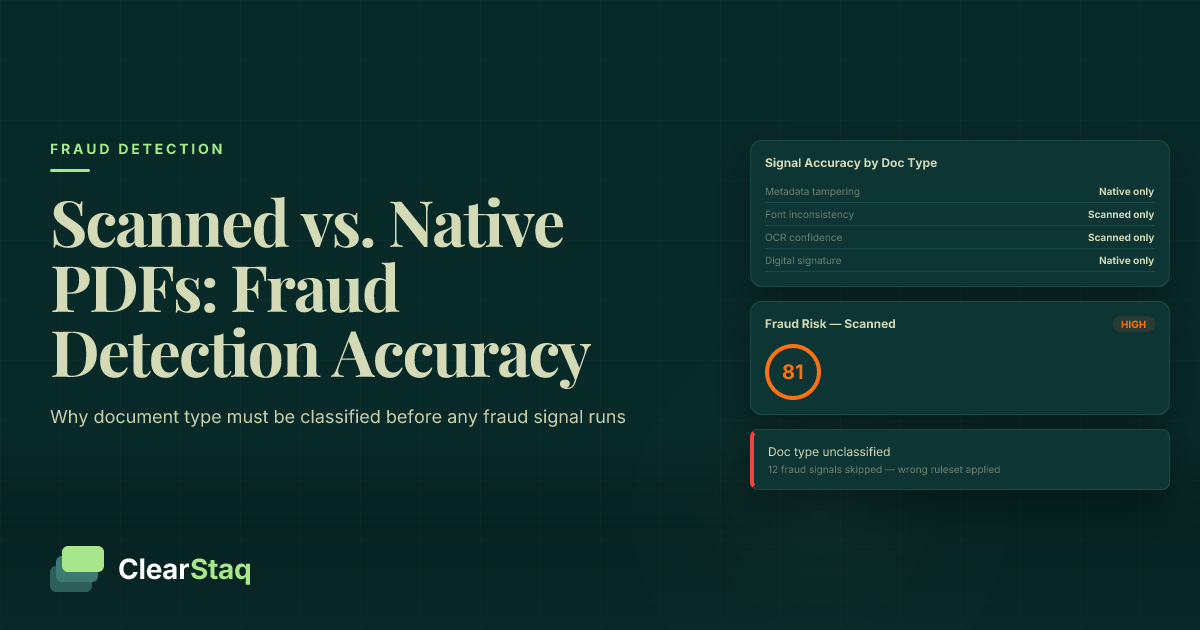
- Flag document metadata mismatches. Fonts, edit timestamps, and compression artifacts on uploaded IDs and pay stubs reveal template-based fabrication that a visual glance misses.
- Score reused identity fragments against prior denied applications. Synthetic identity rings recycle the same SSN or address across multiple attempts until one application clears.
Identity verification software for two-sided marketplaces runs these checks against both sides of a transaction — buyer and seller — since marketplace fraud frequently uses synthetic identities on the seller side to collect payouts and disappear before a chargeback lands.
Document and bank statement parsing catches 27+ fraud signals
ClearStaq parses uploaded bank statements and tax returns and checks them against 27+ fraud signals in under 5 seconds per document, at 99.5% accuracy. That includes signature mismatches, altered transaction totals, and formatting inconsistent with the claimed bank's actual statement layout — the parser recognizes 900+ statement formats, so a fabricated PDF built to look like a Chase or Wells Fargo statement gets flagged the moment its structure doesn't match the real template.
For marketplace onboarding specifically, synthetic identity fraud detection tools that only check the identity document miss the second half of the pattern: the financial history behind it. A synthetic identity with a convincing driver's license but three months of manufactured bank statements still fails cross-checks once ClearStaq's fraud detection engine compares statement formatting against known real-bank templates.
| Signal Category | What It Flags | Data Source |
|---|---|---|
| SSN issuance mismatch | Applicant age doesn't match SSN issuance range | Government issuance ranges |
| Credit file depth | Thin file paired with a sudden high-limit request | Credit bureau file age |
| Bank statement age | Statement history younger than the credit file | Parsed bank statement data |
| Document metadata | Font, timestamp, or compression mismatches | Uploaded ID and pay stub metadata |
| Device fingerprint | Same device across multiple "different" applicants | Session and device logs |
| Fragment reuse | Same SSN or address across prior denied applications | Historical application data |
Bank statement age is the strongest single tell
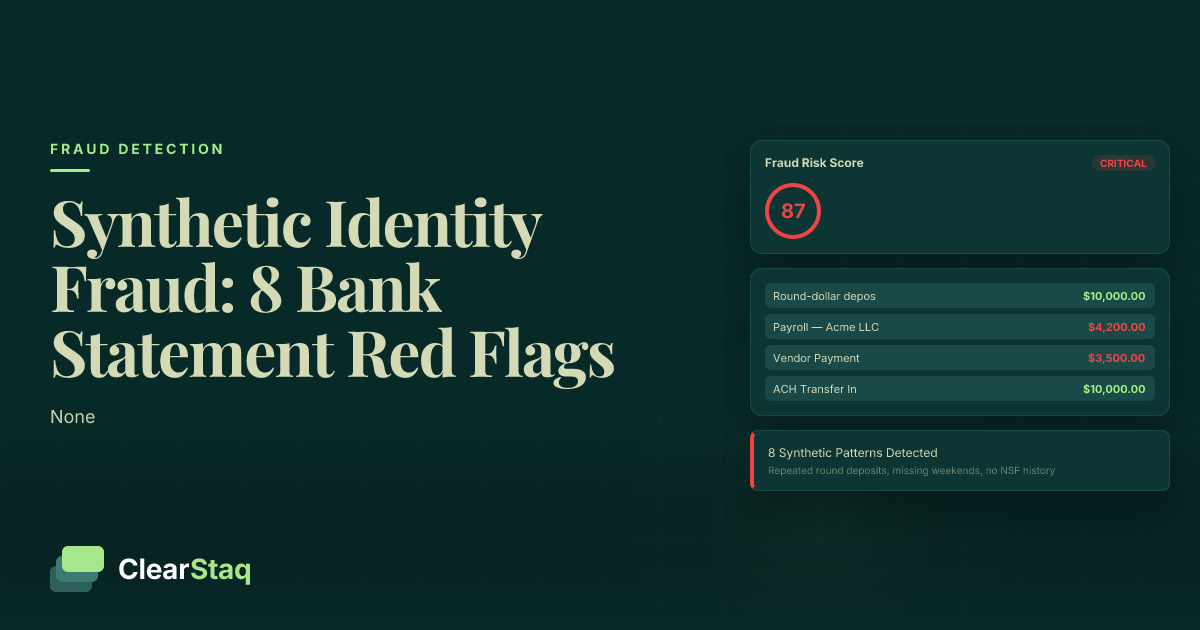
Real bank accounts accumulate irregular deposits, occasional overdraft fees, and seasonal spending patterns over years. Synthetic identities rarely carry more than a few months of manufactured history, because building older fake statements is harder to fabricate convincingly and riskier to maintain across dozens of applications.
A marketplace applicant with a 3-month-old bank account and a credit file that's just as new should route to manual review automatically in 2026, even when every individual document passes a first look.
Why synthetic identities are hard to catch
Synthetic identity fraud beats standard KYC because of how it's built, not because individual checks are weak:
- Real SSN fragments defeat single-field validation. Fraud rings use valid, unused SSNs paired with fabricated names, so the SSN itself checks out on its own.
- Each data point passes in isolation. Address, phone number, and employer can all be individually plausible even when the combination has never existed as a real person.
- Fraud rings build credit slowly. A synthetic identity might hold a small credit line for 12-18 months, paying on time, before a bust-out that maxes every available line at once.
- Marketplace onboarding speed works against manual review. Platforms built for sub-minute signups don't have a review step where a human compares document age against credit file age.
- Device and IP infrastructure gets shared across dozens of profiles. Fraud rings run identity mills, not one-off attempts, so the same device reapplies under new "identities" repeatedly.
- Static document checks stop at authenticity, not consistency. A real, valid-looking ID does not confirm the financial history behind the applicant is real.
Screen every applicant before onboarding
Cross-check documents, bank history, and device signals in one pass.
Is synthetic identity fraud different from stolen identity fraud?
Yes — stolen identity fraud uses a real person's complete information without their knowledge, while synthetic identity fraud combines a real SSN fragment with fabricated personal details to create a person who has never existed. Stolen identity fraud gets caught faster because the real person eventually disputes the account; synthetic identities can operate for months because there's no victim to complain.
Does device fingerprinting alone stop synthetic identity fraud?
No — device fingerprinting flags shared infrastructure across applications but misses synthetic identities built on separate devices with no prior fraud history. It works best paired with document and bank statement cross-checks, not as a standalone control on a marketplace onboarding flow.
Can synthetic identities pass account takeover checks too?
Yes — once a synthetic identity holds a working account, that account can later get hijacked through account takeover fraud in marketplace payments, layering a second fraud type on top of the first. Platforms that only screen at onboarding miss this second wave entirely.
FAQ
What's the fastest way to detect synthetic identities in marketplace onboarding?
Cross-checking document issue dates, bank statement age, and device fingerprints against one identity is the fastest method. ClearStaq runs this check across 27+ fraud signals in under 5 seconds per application in 2026.
Is SSN validation enough to catch synthetic identity fraud?
No, SSN validation alone is not enough because synthetic identities often use real, valid SSN fragments paired with fabricated names. It has to be combined with bank statement and credit file cross-checks to catch the mismatch.
How long do synthetic identities operate before getting caught?
Synthetic identities often operate for 12-18 months, building a thin credit file with on-time payments before a bust-out where every available credit line gets maxed at once.
Can manual review catch synthetic identity fraud?
Manual review catches individually fake documents but misses cross-document inconsistencies, like a bank statement that's newer than the credit file behind it. Automated cross-checks catch this pattern in seconds instead of hours.
Does a real driver's license mean an identity is real?
No, a real-looking driver's license only confirms document authenticity, not that the financial history behind the applicant is real. Synthetic identities frequently pair authentic-looking IDs with fabricated bank statements.
What's the difference between synthetic identity fraud and stolen identity fraud?
Synthetic identity fraud fabricates a person using a real SSN fragment and invented details, while stolen identity fraud uses a real person's complete information without consent.
Should marketplaces screen sellers and buyers differently for synthetic identities?
Yes, marketplace sellers carry more synthetic identity risk because payout accounts get built specifically to collect funds and disappear. Seller onboarding should carry document and bank statement cross-checks at minimum, even when buyer onboarding stays lighter.
One last thing
The single biggest tell in 2026 marketplace fraud isn't a bad document — it's a bank statement that's younger than the credit file sitting next to it. Fraud teams that only check document authenticity miss this pairing every time, because both pieces look legitimate individually. Run bank statement age against credit file age on every application in ClearStaq or any comparable fraud detection workflow, even on the ones that clear identity verification cleanly.
Related guides
ClearStaq Team
Content Team
The ClearStaq team builds AI-powered tools for bank statement parsing, fraud detection, and income verification.