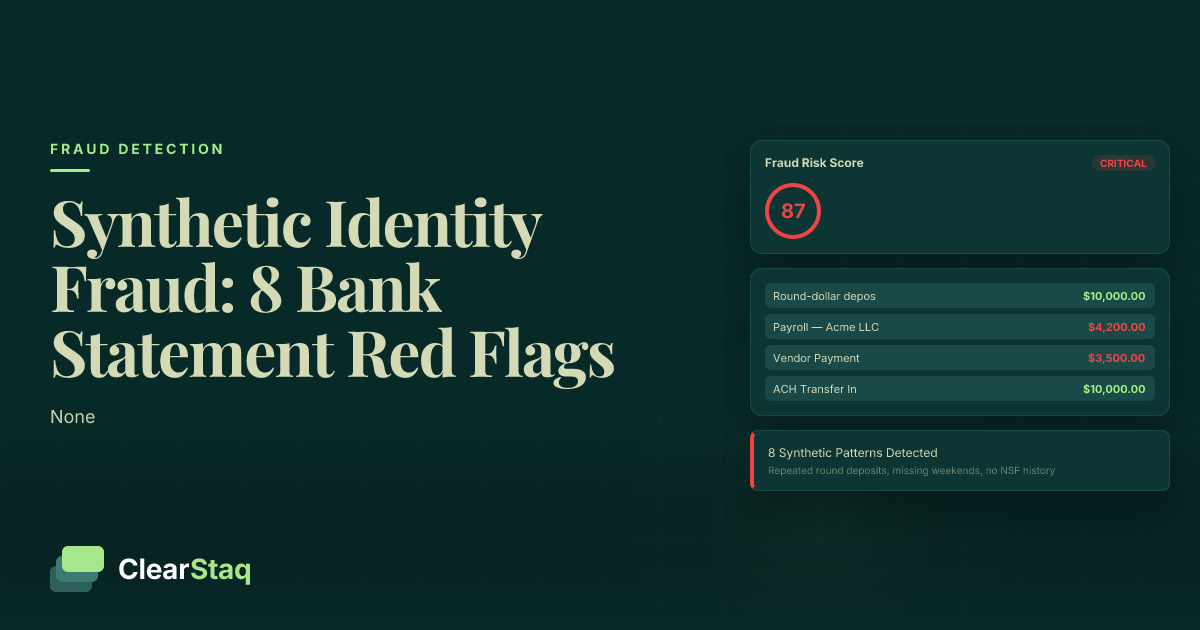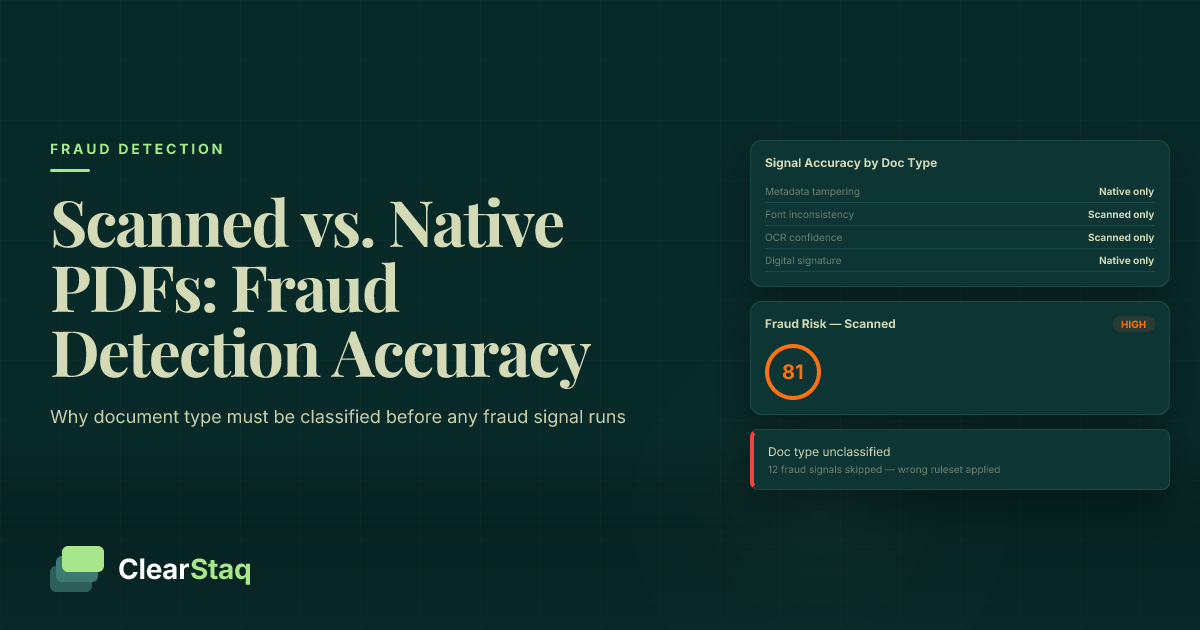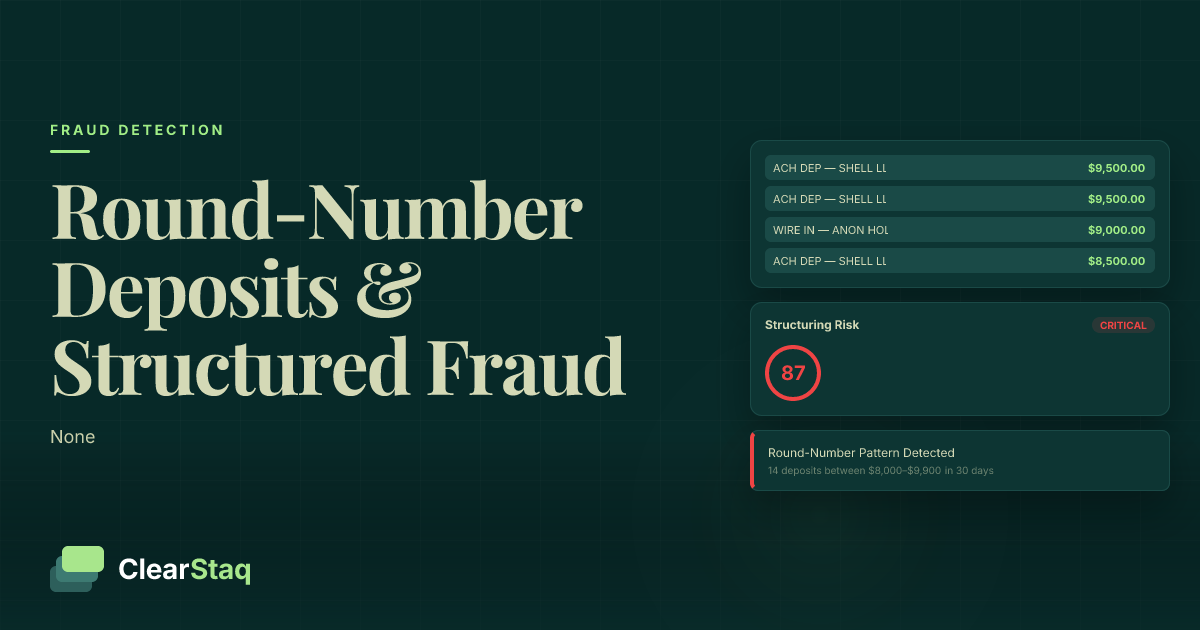
Synthetic identity fraud costs lenders more than any other identity fraud type because the identity doesn't belong to anyone — it's stitched together from a real Social Security number, a fabricated name, and a manufactured credit history. This guide ranks the tool categories lenders actually deploy against it in 2026, tells you which one catches fabricated income documents versus fabricated identities, and where ClearStaq fits in that stack.
- ClearStaq wins for document-side synthetic identity fraud detection — 27+ AI signals, 99.5% accuracy, under 5 seconds per file. Buy.
- Credit bureau synthetic ID scores catch thin-file mismatches but miss doctored bank statements entirely. Hold as a supplement.
- Manual underwriting review remains the slowest and least consistent option for spotting synthetic identity fraud detection gaps in 2026. Skip as a standalone process.
- Standalone KYC identity verification APIs confirm the person exists but rarely parse the financial documents fraud rings fabricate.
Why This Matters
Synthetic identities pass most front-end identity verification checks because the SSN is real and the credit file, once built, looks legitimate on paper. The fraud shows up downstream — in synthetic identity fraud detection for online lenders, the pattern that surfaces first is almost always a bank statement or income document that doesn't match the applicant's stated employment or deposit history.
Most identity verification vendors stop at confirming the SSN, name, and address resolve to a real record. They don't parse the bank statement, the tax return, or the pay stub sitting in the loan file — which is exactly where synthetic identity rings get sloppy in 2026. A tool that only checks identity attributes and never touches the financial documents leaves half the fraud surface uncovered.
How We Ranked
Each category below is scored against three things lenders actually need in 2026: does it detect document-level fabrication (not just identity-attribute mismatches), how fast does it return a decision, and does it produce an audit trail an underwriter can act on without a second review cycle. Categories that only verify identity existence — without touching the financial documents backing the loan file — rank lower regardless of how well-known the vendor is. Categories are ranked by how much of the synthetic identity fraud surface they actually cover, not by market share.
The Ranked List
1. AI Document Fraud Parsers — The Specialist
ClearStaq runs 27+ AI fraud signals against every bank statement and tax return in a loan file, returning a result in under 5 seconds at 99.5% parsing accuracy across 900+ bank formats. This is the category built specifically to catch the part of synthetic identity fraud that identity-verification tools miss: the fabricated or altered financial document sitting behind the application.
For a lender underwriting against income and deposit history, this closes the gap that credit bureau checks and KYC APIs leave open. Buy — for any lender that touches bank statements or tax returns as part of underwriting, this is table stakes in 2026, not a nice-to-have.
2. Credit Bureau Synthetic ID Scores — The Baseline
Credit bureau synthetic identity scores flag thin-file anomalies — a credit history that's too clean, too new, or built in a pattern common to fraud rings. They're useful as a first-pass filter and cheap to add to an existing pull.
The limitation: these scores say nothing about the bank statement or tax return in the file. A synthetic identity with a manufactured credit history can still submit a doctored bank statement, and the bureau score won't catch it. Hold — keep it as a screening layer, not a standalone decision engine.
3. Device and Behavioral Biometrics — The Onboarding Layer
These tools watch how an applicant fills out a form — typing cadence, mouse movement, device fingerprint reuse across applications. They're strong at catching bot-driven application fraud and repeat synthetic identities hitting the same lender from the same device.
They don't touch documents at all, so a human-operated synthetic identity submitting a clean application on a fresh device passes through untouched. Hold — pair with a document-level check, never run it alone for underwriting decisions.
4. Standalone KYC Identity Verification APIs — The Front Door
These confirm the SSN, name, date of birth, and address resolve to a real, matching record — the front-door check most lenders already run before underwriting starts. It's necessary, but it's a pass/fail on identity existence, not on the financial documents behind the loan.
See synthetic identity fraud detection for fintech onboarding for how onboarding-stage checks and underwriting-stage document checks need to run as separate layers, not one tool covering both. Hold — necessary at onboarding, insufficient at underwriting.
5. Manual Underwriting Document Review — The Legacy Default
Human review of bank statements and tax returns still catches obvious fabrication — mismatched fonts, inconsistent balances, transaction dates that don't add up. It doesn't scale, and reviewer fatigue means the 40th file of the day gets less scrutiny than the first.
See how to detect fake bank statements in loan applications for the specific patterns manual reviewers miss most often — subtotal mismatches and altered running balances near the bottom of a page. Skip as a standalone process in 2026; use it only as a spot-check layer behind automated parsing.
6. Generic OCR and Document Digitization Tools — Not Built for This
Generic OCR tools extract text from a PDF — they don't flag altered balances, inconsistent transaction math, or format inconsistencies that indicate a doctored statement. They were built for digitization, not fraud detection, and treating OCR output as a fraud signal is a mistake lenders still make in 2026.
Skip for fraud detection specifically — use a purpose-built parser if the goal is catching synthetic identity or document fraud, not just converting a PDF to text.
“If a tool can't tell you which of the 27 signals triggered, it's not detection — it's a black box.”
Comparison Table
| Category | Catches Document Fraud | Speed | Best For | 2026 Verdict |
|---|---|---|---|---|
| ClearStaq (AI document parser) | Yes — 27+ signals | <5 seconds | Bank statement & tax return fraud | Buy |
| Credit bureau synthetic ID score | No | Instant (batch) | Thin-file screening | Hold |
| Device/behavioral biometrics | No | Real-time | Bot & repeat-device detection | Hold |
| Standalone KYC identity API | No | Seconds | Identity existence check | Hold |
| Manual document review | Partial, inconsistent | Hours per file | Spot-check backstop | Skip (standalone) |
| Generic OCR tools | No | Seconds | Text extraction only | Skip |
Where to Source These Tools
- Demo against your own loan files, not a vendor sample set. Synthetic identity patterns vary by product line — a tool tuned on mortgage files won't necessarily catch the patterns showing up in MCA or auto lending.
- Ask for the signal count and what each signal actually checks. A vendor claiming fraud detection without naming specific signals — altered balances, font inconsistencies, transaction math errors — is selling a black box.
- Confirm processing time under real file volume, not a single test document. A tool that returns results in under 5 seconds on one file can slow down significantly at batch scale; ask for the number under production load.
FAQ
What's the best synthetic identity fraud detection tool for lenders in 2026?
For document-level synthetic identity fraud — fabricated or altered bank statements and tax returns — ClearStaq leads with 27+ AI fraud signals and 99.5% parsing accuracy in under 5 seconds per file. For identity-attribute checks alone, a standalone KYC API still has a role, but it won't catch a doctored bank statement.
Is credit bureau synthetic ID scoring enough on its own?
No. Bureau scores flag thin-file and credit-history anomalies but never touch the bank statements or tax returns in the loan file, which is where fabrication most often shows up in 2026 underwriting.
How much does synthetic identity fraud cost lenders?
Costs vary widely by portfolio and product line, and no single industry-wide figure applies across lender types. The bigger cost driver in 2026 is review time — manual document review can take hours per file versus seconds for an automated parser.
Can manual underwriting review catch synthetic identity fraud?
Manual review catches some obvious fabrication — mismatched fonts, inconsistent balances — but doesn't scale and reviewer fatigue lowers detection rates on high-volume days. It works best as a backstop behind automated document parsing, not as the primary check.
Do KYC identity verification APIs detect fabricated bank statements?
No. KYC APIs confirm that an SSN, name, and address resolve to a matching real-world record — they don't parse or analyze the financial documents submitted with the loan application.
How fast should a fraud detection tool process a bank statement?
Under 5 seconds per file is the 2026 benchmark for AI-based document parsers like ClearStaq. Manual review, by comparison, runs hours per file at typical underwriting volume.
What's the difference between identity fraud and synthetic identity fraud?
Identity fraud uses a real person's stolen information; synthetic identity fraud combines a real SSN with a fabricated name and manufactured credit history that belongs to no actual person. Document-level checks catch the financial fabrication that typically accompanies synthetic applications.
Does device biometrics replace document fraud detection?
No. Device and behavioral biometrics catch bot-driven and repeat-device application patterns but never analyze the bank statement or tax return itself, leaving document-level fabrication undetected.
One Last Thing
The fastest-growing synthetic identity pattern in 2026 lending isn't a fake SSN — it's a real SSN paired with a bank statement doctored just enough to smooth over a thin or inconsistent deposit history. Tools that only check identity attributes will pass that file every time; only a parser that runs fraud signals against the document itself catches it.
Related Guides
ClearStaq Team
Content Team
The ClearStaq team builds AI-powered tools for bank statement parsing, fraud detection, and income verification.