Buy now pay later checkout can't wait for a fraud analyst — synthetic identity fraud detection for buy now pay later platforms has to run in the same window as the approval decision, or the sale is gone.
TL;DR: Synthetic identity fraud detection for buy now pay later works only when it goes past SSN and device checks into the bank statement itself — deposit patterns, structuring, and doctored income docs are where synthetic profiles fall apart. ClearStaq parses statements across 900+ formats in under 5 seconds and flags across 27+ signals, which is the layer most BNPL stacks skip. Buy: bank-statement-level verification. Skip: relying on SSN/KYC checks alone — synthetic identities are built to pass those. 2026 approval volumes make manual review queues too slow to hold the line.
Why this matters
Synthetic identities don't fail a credit bureau pull — they're built from real SSNs (often a child's or an unused one), fabricated names, and manufactured credit history designed to clear exactly those checks. BNPL platforms approve in seconds at checkout, which is precisely the window synthetic fraud rings exploit: no time for a human underwriter, no friction to trip up a bot ring running hundreds of applications a day.
The fraud doesn't show up in the identity layer. It shows up in the bank statement — deposits that don't match the stated employer, structuring just under reporting thresholds, or income smoothed to look consistent when the real pattern is erratic. Catching synthetic identity fraud for buy now pay later in 2026 means adding a document-level check that most checkout financing stacks never built.
Who this is for
This guide is for risk and fraud teams at buy now pay later platforms, checkout financing providers, and the underwriting leads deciding what sits between application and approval. If your platform is still leaning on SSN validation, device fingerprinting, and a credit bureau ping — and losses are climbing anyway — the gap is almost always at the document layer.
What to look for in synthetic identity fraud detection for BNPL
Sub-5-second decisioning
BNPL approval happens at checkout, not in a queue. Any fraud layer that adds more than a few seconds gets bypassed by product teams chasing conversion, which means the check either runs invisibly fast or it doesn't run at all.
Bank statement cross-verification
SSN and device checks confirm an identity exists — they don't confirm the income behind it is real. Cross-referencing stated income against actual deposit history in the applicant's bank statements catches synthetic profiles that pass every identity check but show no matching cash flow.
Signal depth beyond pass/fail
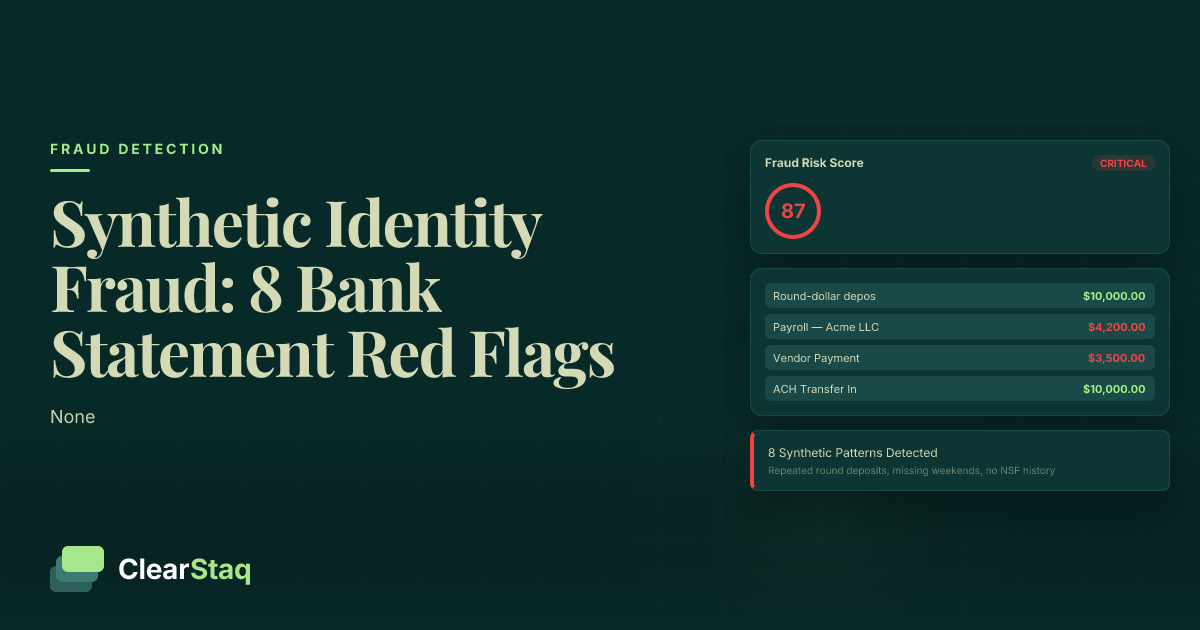
A single fraud score tells you nothing about why an application is risky. Detection built on 27+ discrete signals — deposit timing, structuring patterns, income smoothing, round-number deposits — gives your team a reason code, not just a red flag.
Format coverage across banks and neobanks
Synthetic identity applications skew toward newer neobanks and smaller regional institutions where verification is thinner. A parser that only handles Chase, Bank of America, and Wells Fargo formats misses exactly where synthetic fraud concentrates; coverage across 900+ statement formats closes that gap.
False positive control
BNPL runs on volume — a fraud layer with a high false-positive rate blocks real customers and kills approval rates. Accuracy figures matter here: 99.5% accuracy on document parsing means fewer good applicants get bounced for a formatting quirk instead of an actual fraud signal.
Audit trail for compliance
When a synthetic identity slips through and a chargeback or regulator asks why, you need a documented signal trail, not a black-box score. Explainable flags tied to specific statement lines hold up better than an opaque risk number.
Top picks for BNPL fraud teams
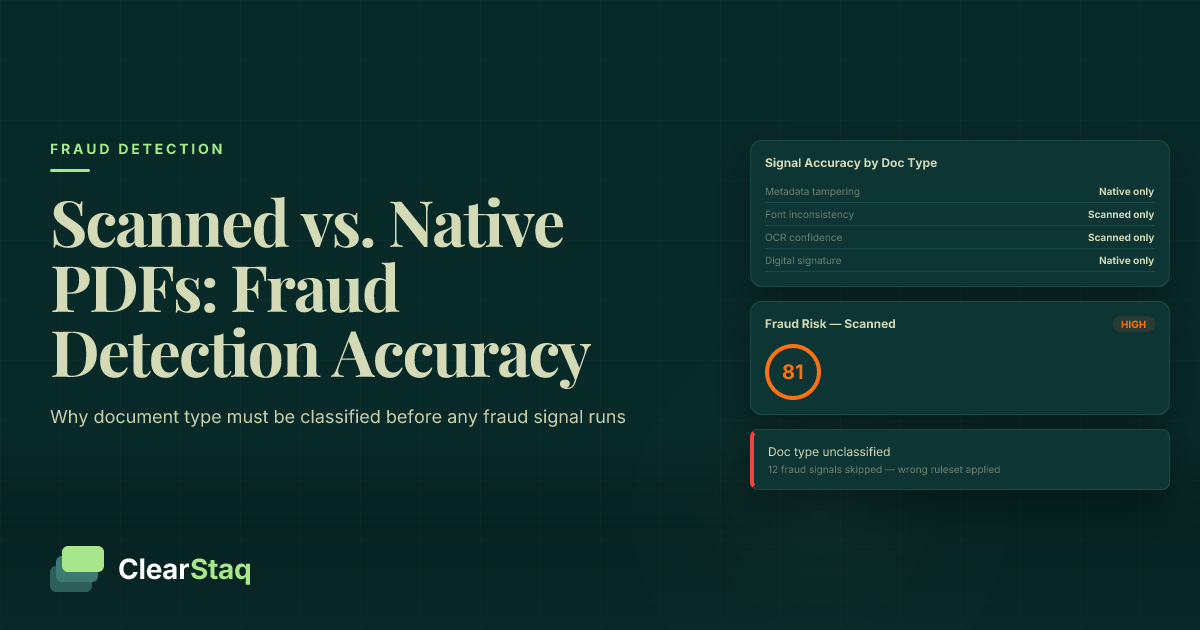
The baseline check — fake bank statement detection. Synthetic identity applications frequently pair a real (stolen or fabricated) SSN with an edited or template-generated bank statement to fake income. Detecting fake bank statements in loan applications covers the metadata and formatting tells that separate a real statement from a doctored one — this is the layer that catches what SSN checks structurally cannot. Buy.
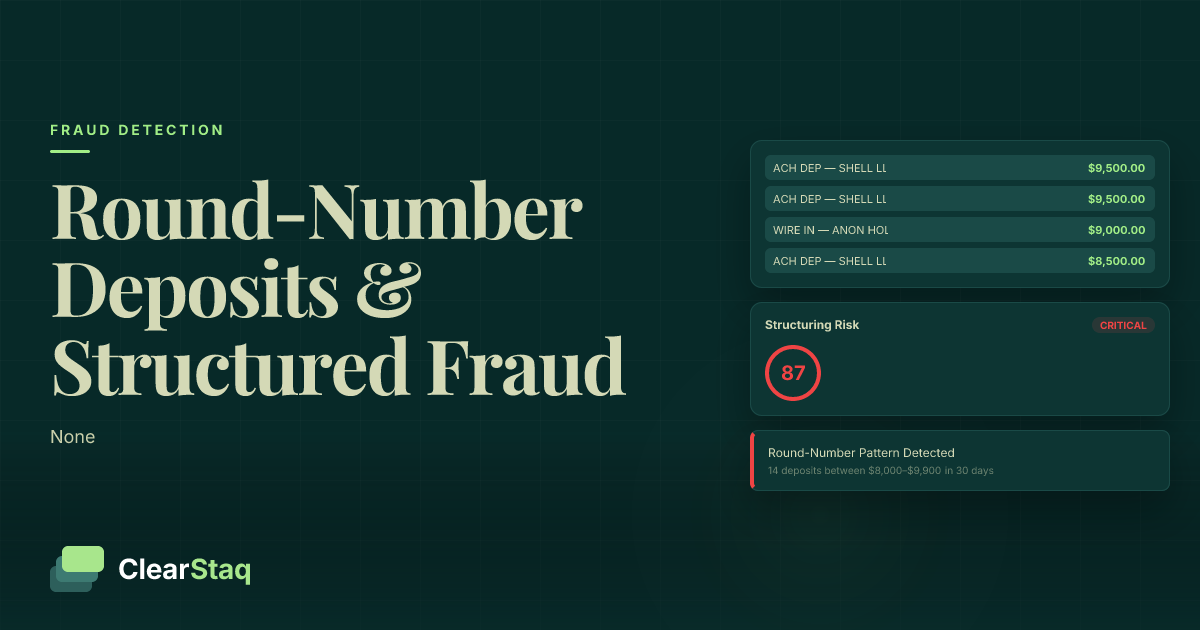
The velocity flag — structuring pattern detection. Synthetic profiles built to look creditworthy often show deposits broken into amounts just under reporting or review thresholds, a pattern real income rarely produces. Spotting structuring patterns in business bank statements breaks down the deposit timing and amount clustering that flags this behavior automatically. Buy.
The income proof gap — doctored pay stub detection. Some BNPL underwriting flows still accept pay stubs as a secondary income proof alongside bank statements, and stub fabrication is cheap and common in synthetic fraud kits. Detecting doctored pay stubs during underwriting walks through the font, math, and formatting inconsistencies that flag a fabricated stub in seconds. Consider — prioritize this if pay stubs are part of your income verification flow at all; skip the manual review of every stub if you're not using stubs in the decision.
What to avoid
- SSN/KYC validation as the sole gate. Synthetic identities are engineered specifically to clear this check — it confirms a number exists, not that the person behind it is real.
- Device fingerprinting alone. It catches repeat bot rings reusing hardware, but a fraud operation rotating devices and IPs sails through with a clean synthetic profile underneath.
- Manual underwriter review as the fraud backstop. It works, eventually, but a 1-3 day review queue defeats the point of buy now pay later — by the time the flag comes back, the checkout is long closed or the goods are already shipped.
Verdict comparison
| Detection layer | What it catches | Speed | Verdict |
|---|---|---|---|
| SSN/KYC check | Stolen or invalid identity numbers | Under 1 second | Baseline — not sufficient alone |
| Device fingerprinting | Repeat bot rings, device reuse | Under 1 second | Useful, not sufficient |
| Bank statement parsing (27+ signals) | Synthetic income, structuring, deposit mismatches | Under 5 seconds | Buy |
| Doctored pay stub detection | Fabricated income documents | Under 5 seconds | Consider if stubs are in your flow |
| Manual underwriter review | Everything, eventually | 1-3 days | Skip for checkout-speed BNPL |
FAQ
What's the best way to catch synthetic identity fraud in BNPL applications? Bank statement cross-verification against stated income is the most reliable layer, because synthetic identities are built to pass SSN and device checks but rarely have deposit history that matches a real income story.
Is synthetic identity fraud detection different for BNPL than for traditional lending? Yes — the decision window is seconds, not days, so any detection layer has to run in real time at checkout rather than in a back-office underwriting queue.
How much does document-level fraud detection cost compared to losses from synthetic fraud? Costs vary by platform and volume; check current pricing directly, but the comparison that matters is processing speed and accuracy against chargeback and default rates you're already tracking.
Can SSN validation alone stop synthetic identity fraud? No — synthetic identities are specifically constructed to clear SSN and credit bureau checks, which is why the fraud shows up downstream in the bank statement or pay stub instead.
Does bank statement parsing slow down BNPL approval? Not if the parser processes in seconds — sub-5-second parsing keeps the check inside the existing approval window instead of adding a queue.
What signals matter most for BNPL synthetic identity detection in 2026? Deposit timing and structuring, income smoothing, and stated-versus-actual income mismatches are the highest-value signals, since they're the patterns synthetic profiles struggle to fake convincingly.
How many bank formats does fraud detection software need to cover? Coverage across 900+ formats matters because synthetic applications skew toward smaller banks and neobanks where thinner verification makes fraud easier to slip through.
Is manual review still necessary if automated detection is in place? A thin manual review layer for edge cases still has a place, but it should sit behind automated flags, not in front of every application — a 1-3 day queue on every applicant defeats the point of BNPL.
One last thing
Most BNPL fraud postmortems in 2026 trace back to the same gap: the identity check passed, the device check passed, and nobody looked at whether the deposits in the bank statement actually matched the stated income. That's the one layer synthetic fraud can't fake convincingly — deposit history takes real cash flow to fabricate, not just a template.
Related guides
ClearStaq Team
Content Team
The ClearStaq team builds AI-powered tools for bank statement parsing, fraud detection, and income verification.