Fraud detection software for online marketplaces flags fake payout histories, synthetic seller identities, and doctored bank statements before a marketplace lender extends working capital — the goal is catching fraud at intake, not after the advance is already funded. Marketplace lending runs on payout data instead of paystubs, which means the fraud vectors look different from consumer lending: sellers can inflate GMV with self-purchases, layer chargebacks to mask a cash crunch, or submit statements from an account that isn't actually theirs.
- Fraud detection software for online marketplaces needs payout-specific signals, not generic consumer-lending fraud rules.
- ClearStaq processes bank statements in under 5 seconds with 99.5% accuracy across 900+ formats and flags 27+ fraud signals per document.
- Chargeback spikes and self-funded GMV are the two fraud patterns generic tools miss most often in marketplace underwriting.
- Manual review of seller statements takes hours per file — parsing software cuts that to minutes without skipping fraud checks.
Why fraud detection matters for online marketplaces
Marketplace sellers don't hand underwriters a W-2 and a pay stub. They hand over payout deposits from Amazon, Shopify, Etsy, or a gig platform, and those deposits are easy to fabricate or misrepresent because the underwriter rarely has a direct API connection to the marketplace itself. A doctored PDF statement can pass a visual glance in seconds.
The fraud patterns specific to this segment include synthetic seller identities built around a shell LLC with no real sales history, self-funded GMV where a seller buys their own inventory to inflate revenue before applying, and chargeback-driven cash shortfalls that get hidden by timing an application around a temporary deposit spike. None of these show up in a standard credit pull. They show up in the transaction-level detail of the bank statement, which is why verifying marketplace payouts for working capital loans has become its own underwriting discipline rather than a subset of general income verification.
Speed matters as much as accuracy here. Marketplace lenders compete on same-day funding, and a fraud review that takes a human underwriter 3-4 hours per file kills that promise. Software that parses a statement and runs fraud checks in under 5 seconds keeps the funding-speed pitch intact without skipping the review.
Verify payout deposits against claimed GMV
Start by pulling every payout deposit line from the seller's bank statement and comparing the total against the GMV figure claimed on the application. A mismatch of more than 10-15% over a 3-month window is the first flag, not proof of fraud, but a reason to dig further.
- Cross-check deposit frequency against the marketplace's known payout cadence (weekly for most Amazon sellers, bi-weekly or monthly for others)
- Flag deposits from a payment processor that doesn't match the platform the seller claims to sell on
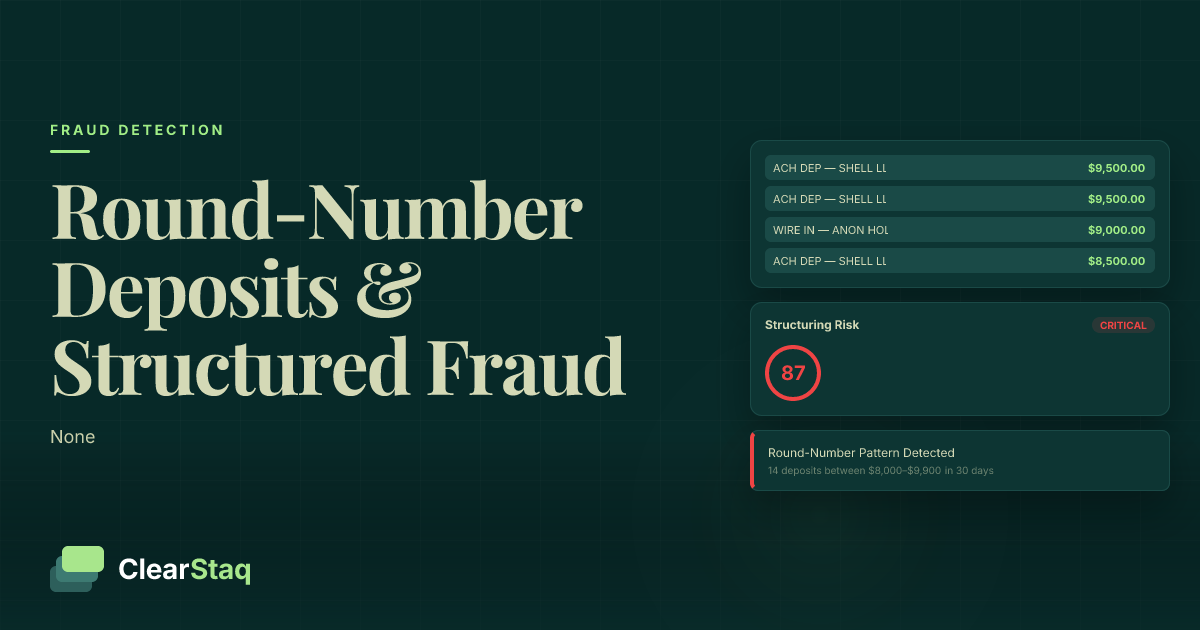
- Look for round-number deposits that don't match typical payout math (payouts are rarely clean round figures after fees)
- Compare deposit growth trend against any invoice or sales report submitted separately
Screen for chargeback and refund clustering
Chargebacks hit the seller's payout account as debits, and a cluster of them in the 30-60 days before an application is one of the strongest early-warning signals of a cash-flow problem the seller is trying to outrun. Manual reviewers often miss this because chargebacks look like routine deductions unless you're specifically counting them.
- Count debit transactions tagged as chargebacks, refunds, or reversals over a rolling 60-day window
- Flag any month where chargeback debits exceed 5% of that month's gross payout volume
- Check whether chargeback volume spikes right before the application date (timing is the tell)
- Compare chargeback rate against the platform's typical range for that seller category
Software built for this reads the full transaction ledger and tags every chargeback-coded line automatically. Chargeback fraud detection built for payment processors uses the same underlying signal — debit clustering tied to processor codes — applied one layer up, at the lender evaluating the seller rather than the processor evaluating the transaction.
Detect self-funded GMV inflation
A seller trying to qualify for a bigger advance sometimes buys their own inventory through a second account to inflate sales volume right before applying. This shows up as a spike in both revenue and cost-of-goods-sold in the same window, with no matching increase in shipping or fulfillment activity.
- Compare revenue growth against any available shipping, fulfillment, or logistics cost line items
- Flag GMV spikes concentrated in the 30 days immediately before application
- Check for reciprocal transfers between the seller's business account and a personal or secondary account
- Look for round-trip transactions — money out, then money back in within days, at similar amounts
Confirm the bank account actually belongs to the seller
Account takeover and identity mismatch are common enough in marketplace lending that name-matching on the statement header is a mandatory step, not a nice-to-have. A statement showing a different legal entity or a personal name where a business name is expected is a hard stop until resolved.
- Match the account holder name on the statement against the business name and EIN on the application
- Verify the routing and account number format matches the claimed bank
- Flag any statement where the account was opened less than 90 days before the application
- Cross-reference the address on the statement against the business address on file
This is where identity checks and document parsing overlap. Teams running synthetic identity fraud detection for online lenders apply the same principle — a mismatched or too-new identity profile is treated as a fraud signal, not a data-entry error.
Normalize seasonal payout patterns before scoring
Marketplace sellers, especially in categories like home goods or apparel, see 2-3x payout swings between peak season and off-season. Scoring against a single month's revenue instead of a trailing 12-month average produces both false declines and, worse, false approvals timed around an artificial peak.
- Pull at least 6-12 months of payout history when available, not just the most recent statement
- Calculate a trailing average monthly revenue figure instead of scoring off the latest month alone
- Flag applications submitted right after an unusually high single-month payout
- Weight recent months less heavily during known low-season periods for that seller's product category
Automate document parsing before applying fraud rules
Fraud rules are only as good as the data feeding them, and manual transcription of bank statements introduces errors that mask real fraud signals or create false ones. Parsing needs to run first, cleanly, before any rule engine touches the data.
- Use format-aware parsing that handles the seller's actual bank format, not a generic template
- Extract transaction-level detail, not just summary balances, since fraud signals live in the line items
- Run parsing and fraud scoring in the same pass so nothing gets lost in a handoff between tools
- Log every extracted field so a human reviewer can audit the source line if a flag gets disputed
ClearStaq handles this step directly: statements parse in under 5 seconds at 99.5% accuracy across 900+ bank formats, with 27+ fraud signals scored on the same pass. That means the GMV mismatch, chargeback clustering, and self-funded revenue checks above run automatically instead of requiring a separate manual pass per file.
See fraud signals on your next file
Run a marketplace seller's bank statement through ClearStaq and see the flags in under 5 seconds.
Comparing your options for marketplace fraud detection in 2026
| Option | Best for | Starting price | Key limitation |
|---|---|---|---|
| Manual underwriter review | Very low application volume, high-touch relationship lending | Not software-based (labor cost only) | Hours per file, misses transaction-level chargeback patterns |
| Generic document OCR tools | Teams that only need text extraction, no fraud scoring | Varies by vendor | No built-in fraud signal detection, requires a separate rules engine |
| ClearStaq | MCA brokers, marketplace lenders, and CPAs needing parsing plus fraud scoring in one pass | Contact for pricing | Built for bank statements and tax returns, not a full KYC/AML suite on its own |
ClearStaq wins for marketplace lenders who need payout-pattern fraud checks and statement parsing in a single under-5-second pass, not a bolt-on rules engine.
Common mistakes marketplaces make with fraud detection
- Scoring off the most recent month only — a single strong payout month hides a seasonal dip or a self-funded spike that a 6-12 month view would catch.
- Treating chargebacks as noise — reviewers who don't isolate chargeback-coded debits miss the clearest early signal of seller cash trouble.
- Skipping name and account matching — approving based on the application form without checking that the statement header matches the claimed business identity.
- Running fraud rules on manually transcribed data — transcription errors from PDF-to-spreadsheet copying create false flags and mask real ones.
- No audit trail on flagged transactions — a fraud flag a reviewer can't trace back to the exact line item on the statement gets overridden without real justification.
FAQ
What is fraud detection software for online marketplaces?
It's software that parses seller bank statements and payout histories to flag fraud patterns specific to marketplace lending — GMV inflation, chargeback clustering, and identity mismatches — before a lender funds an advance. ClearStaq runs this scoring in under 5 seconds with 99.5% accuracy.
How is marketplace fraud different from consumer loan fraud?
Marketplace fraud centers on payout data instead of pay stubs, so the signals are different: self-funded GMV spikes, chargeback timing, and mismatched processor accounts rather than fake W-2s.
Can chargeback patterns predict marketplace seller fraud?
Yes. A cluster of chargeback debits in the 30-60 days before an application, especially exceeding 5% of that month's payout volume, is one of the strongest early indicators of a cash-flow problem the seller is trying to hide.
How much manual review time does automated fraud detection save?
Manual statement review for fraud checks commonly takes hours per file when done by hand; parsing and scoring software that runs the checks in the same pass as document extraction cuts that to minutes, since the transaction-level flags surface automatically instead of requiring line-by-line reading.
Does fraud detection software replace a human underwriter?
No — it surfaces the flags (GMV mismatch, chargeback clustering, identity mismatch) so a human underwriter decides faster, with an audit trail back to the source transaction, rather than reading every line manually.
What bank statement formats does fraud detection software need to support?
It needs to handle the actual formats sellers submit, not one template. ClearStaq supports 900+ bank statement formats so parsing doesn't fail on a less common bank.
Is 12 months of bank statement history necessary for marketplace underwriting?
It's strongly recommended for any seller in a seasonal category. A single recent month can hide a peak-season spike or an off-season dip that skews the fraud score and the revenue estimate.
How many fraud signals should marketplace lending software check?
ClearStaq scores 27+ fraud signals per document, covering document tampering, transaction-pattern anomalies like chargeback clustering, and identity mismatches in a single parsing pass.
One last thing
The chargeback-clustering check is the single highest-signal, lowest-effort flag on this whole list — it needs no external data source beyond the statement already in hand, and a 5% monthly threshold catches a real cash-flow problem well before it shows up in a declined application or a missed payment.
Related guides
ClearStaq Team
Content Team
The ClearStaq team builds AI-powered tools for bank statement parsing, fraud detection, and income verification.