Working capital lenders approve deals in days, not weeks — which means a structured deposit pattern or a doctored bank statement has almost no friction to slip through in 2026. Fraud detection software for working capital lenders exists to close that gap before funding, not after a default.
- ClearStaq's fraud detection software for working capital lenders flags structuring, stacking, and doctored statements across 27+ signals — Buy for MCA and short-term lenders.
- Skip single-signal tools that only check PDF metadata; structuring and commingled funds pass through untouched.
- 900+ statement formats parse at 99.5% accuracy in under 5 seconds, versus 30+ minutes of manual review per file.
- Income smoothing and stacking detection matter more for working capital deals than for term loans — prioritize that capability first.
Why this matters
Working capital and MCA deals move on bank statements, not credit files. That makes bank statements the single point of failure — a borrower who stacks three advances in the same month, structures deposits under $10,000 to dodge reporting thresholds, or runs personal and business funds through one account can look fully qualified on a surface read.
Manual underwriting catches maybe one or two of these patterns per file, and only if the underwriter knows to look. Fraud detection software for working capital lenders is built to check all of them, every time, without adding hours to the funding timeline in 2026.
Who this is for
This guide is for MCA brokers, working capital lenders, and alternative small business lenders underwriting revenue-based deals from 3-12 months of bank statements. If your deals close in days and your risk sits in deposit patterns rather than FICO scores, the criteria below apply directly to you — not to mortgage or auto underwriting, where the fraud vectors are different.
What to look for in fraud detection software for working capital lenders
Multi-signal detection, not a single check
A tool that only flags one thing — say, altered PDF metadata — misses structuring, stacking, and income smoothing entirely. Look for platforms running 20-plus signals per statement, because MCA fraud rarely shows up as a single anomaly.
Format coverage across every bank a borrower uses
Working capital borrowers bank everywhere from Chase to small regional credit unions, and each format lays out transactions differently. Software that only parses the top five banks cleanly forces manual review on the rest, which is exactly where fraud hides.
Speed that matches deal velocity
Working capital deals often fund same-day or next-day. If a parsing and fraud check takes 20 minutes per file, it becomes the bottleneck instead of the safeguard — sub-5-second processing keeps the review inside the existing funding window in 2026.
Structuring and stacking detection built for short-term deals
Structuring — breaking deposits into sub-$10,000 amounts across accounts — and stacking — layering multiple advances against the same receivables — are the two patterns that hit working capital lenders hardest. General-purpose fraud tools built for mortgage or auto lending often don't check for either.
Income verification that catches smoothing, not just totals
A borrower can average $40,000 a month in revenue while three of those months were propped up by loan deposits disguised as sales. Software needs to isolate real operating deposits from inflows that look like revenue but aren't.
Top picks for working capital lenders
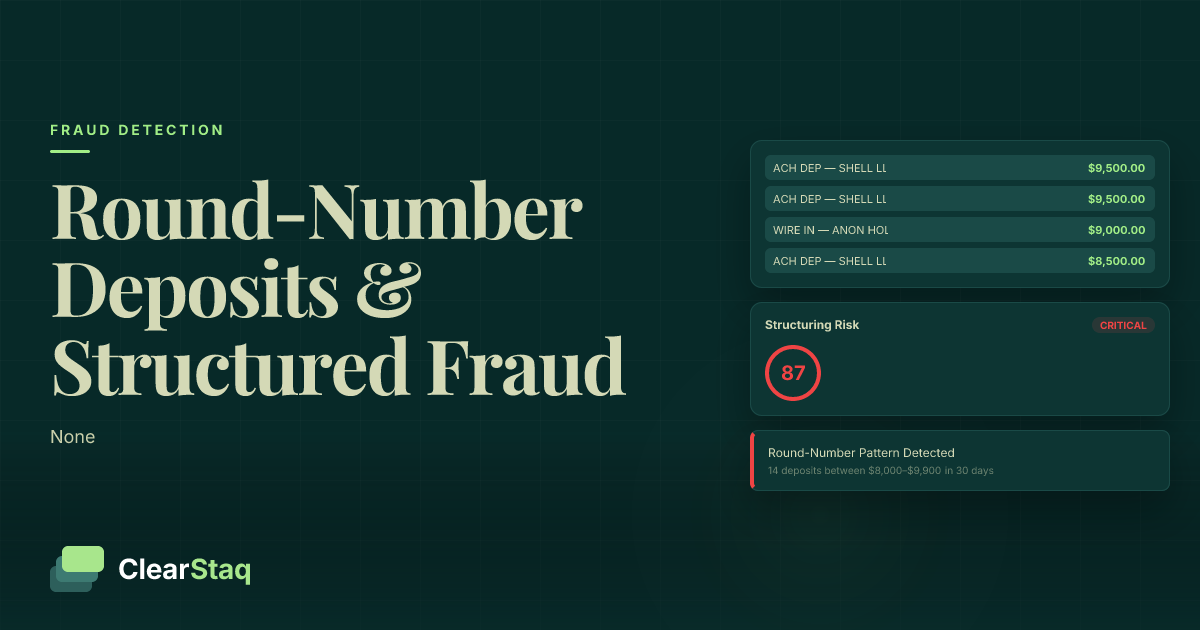
Structuring pattern detection — the one deals get killed on
Structuring shows up as deposits split into amounts under the $10,000 currency transaction reporting threshold, spread across multiple accounts in the same week. Structuring pattern detection built into the fraud check catches the pattern automatically instead of relying on an underwriter to notice six near-identical deposits. Verdict: Buy — this is the single highest-value check for MCA-style deals.
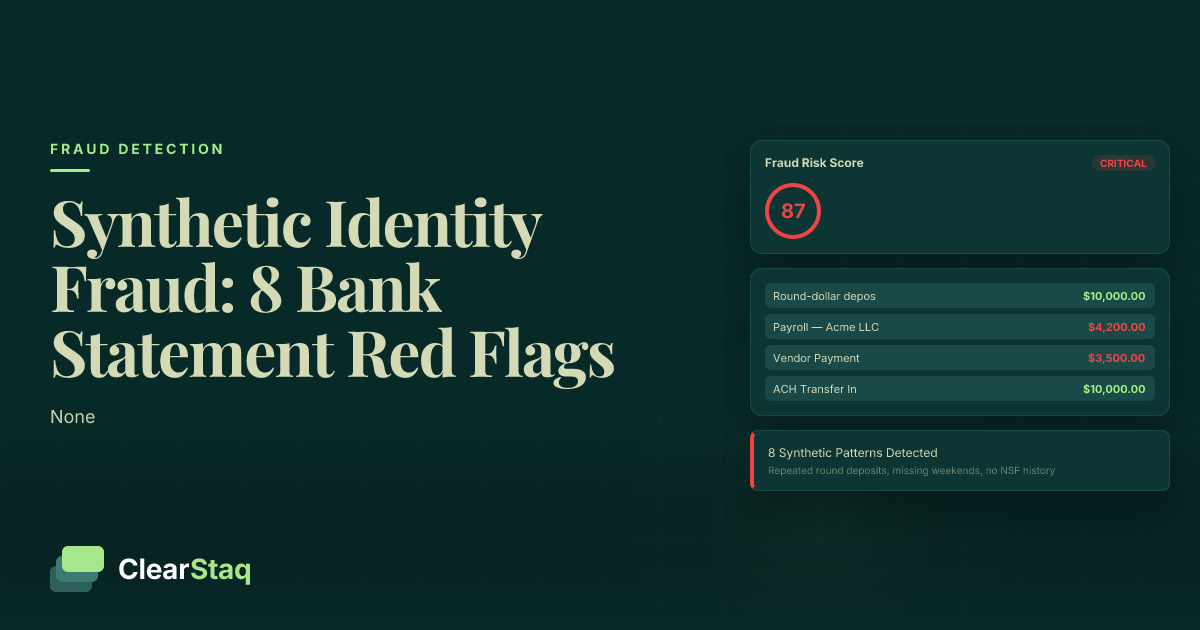
Synthetic identity fraud detection — the safe pick for online originations
Synthetic identities pair a real Social Security number with a fabricated name and business history, and they show zero verifiable transaction activity before the account opens. Synthetic identity fraud detection cross-references account age against deposit history to flag exactly that gap. Verdict: Buy — non-negotiable for any lender originating online.
Fake bank statement detection — the baseline, non-negotiable check
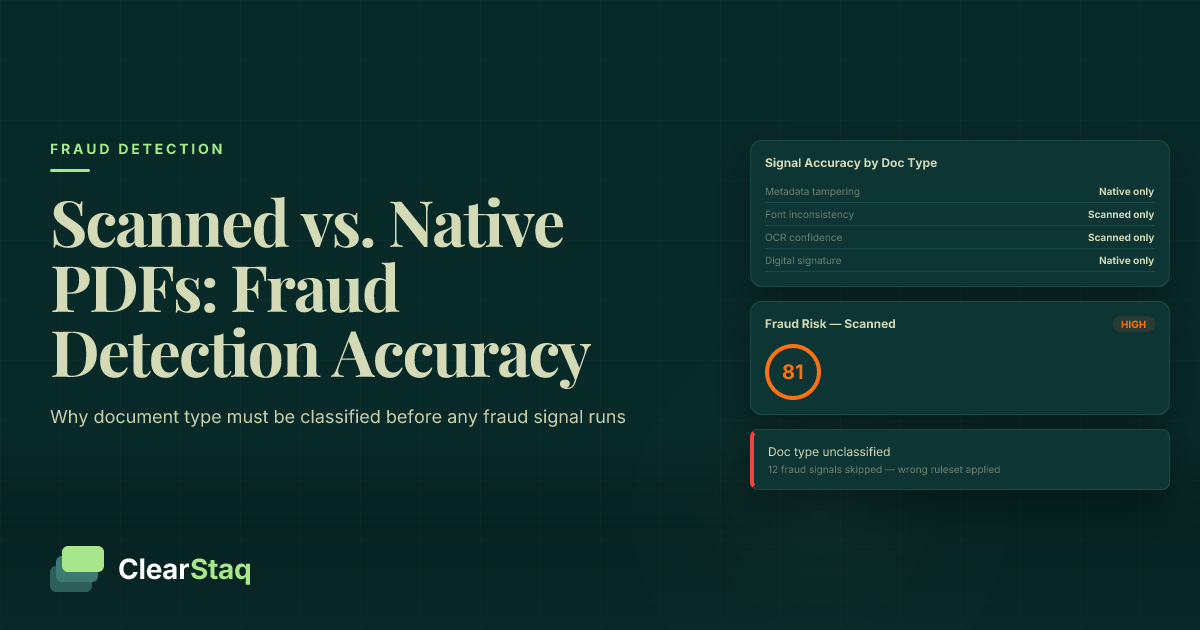
Altered running balances, inconsistent transaction IDs, and mismatched fonts are still the most common forgery in 2026 because they're the easiest to fake with basic PDF editors. Fake bank statement detection checks document forensics against the numbers, not just the layout. Verdict: Buy — treat this as table stakes, not a feature add-on.
Doctored pay stub detection — the overlooked one for owner-operator deals
Owner-operators sometimes submit personal pay stubs alongside business statements to pad perceived income, and inflated net pay lines rarely reconcile against actual deposits. This check matters less for pure business-revenue underwriting and more when personal income backstops the deal. Verdict: Consider — worth having if any of your deals blend personal and business income.
Commingled funds detection — the wildcard for stacking cases
Personal and business deposits mixed in the same account mask true operating cash flow and make revenue look larger than it is. Lenders who skip this check tend to over-approve borrowers who are already carrying stacked advances. Verdict: Buy — pair it with structuring detection for full coverage on stacking cases.
What to avoid
- Metadata-only checks. Tools that flag a modified PDF but don't cross-reference transaction math will miss a statement that's internally consistent but entirely fabricated.
- "AI-assisted" tools that still require line-by-line manual review. If your team is still opening every statement to eyeball deposits, the software isn't doing the fraud work — it's doing the filing.
- Single-bureau identity checks with no transaction cross-reference. A clean credit pull says nothing about whether the deposits behind it are real.
Verdict comparison
| Capability | Signal Type | What It Catches | Verdict |
|---|---|---|---|
| Structuring detection | Transaction pattern | Sub-$10k deposits across accounts | Buy |
| Synthetic identity detection | Identity + transaction | No history before account open | Buy |
| Fake bank statement detection | Document forensics | Altered balances, mismatched fonts | Buy |
| Doctored pay stub detection | Document + reconciliation | Net pay vs. actual deposits | Consider |
| Commingled funds detection | Cash flow segmentation | Personal vs. business deposits | Buy |
“A borrower who structures six deposits under $10,000 across three accounts in one month isn't being careful — they're avoiding a report.”
FAQ
What is fraud detection software for working capital lenders?
It's software that parses bank statements and flags fraud patterns specific to short-term business lending, like structuring, advance stacking, and doctored documents. ClearStaq runs 27+ signals per statement to surface these before funding, not after.
How does fraud detection software catch MCA stacking?
It cross-references deposit timing and amounts against known advance patterns, flagging borrowers who received multiple cash advances against the same receivables in the same period. Manual review rarely catches this because the deposits look like normal revenue on their own.
Is fraud detection software better than manual bank statement review?
Yes, for consistency and speed — software checks every statement against the same 20-plus signals in seconds, while manual review depends on which patterns the underwriter happens to know. Manual review still has a place for edge cases the software flags for a second look.
What's the difference between document fraud and synthetic identity fraud?
Document fraud is an altered or fabricated statement submitted by a real borrower; synthetic identity fraud is a fabricated borrower built from a real Social Security number and a fake name. Both require different signals — document forensics for one, transaction history age for the other.
Can fraud detection software replace underwriters entirely?
No — it removes the manual pattern-matching work so underwriters spend their time on judgment calls instead of line-by-line checks. The software flags risk; a person still makes the funding decision.
How fast should fraud detection run during underwriting?
For working capital deals that fund same-day or next-day, processing needs to finish in seconds, not minutes. ClearStaq processes bank statements in under 5 seconds so the fraud check doesn't become the bottleneck.
Does fraud detection software work across all banks and formats?
Coverage varies by vendor, but format-aware parsers built for lending handle 900+ statement formats, including major banks and smaller regional institutions. Ask any vendor for their specific format count before committing.
How much does fraud detection software cost for a working capital lender?
Pricing depends on deal volume and how many signals or document types you need covered. Check current terms directly with the vendor rather than budgeting off a generic industry number.
One last thing
Structuring shows up more often in working capital deals than in term loans, simply because deposit frequency is higher and the dollar thresholds are well known to repeat borrowers. If your fraud detection software isn't specifically checking sub-$10,000 deposit clusters across multiple accounts, you're underwriting on totals and missing the pattern that actually predicts default in 2026.
Related guides
ClearStaq Team
Content Team
The ClearStaq team builds AI-powered tools for bank statement parsing, fraud detection, and income verification.