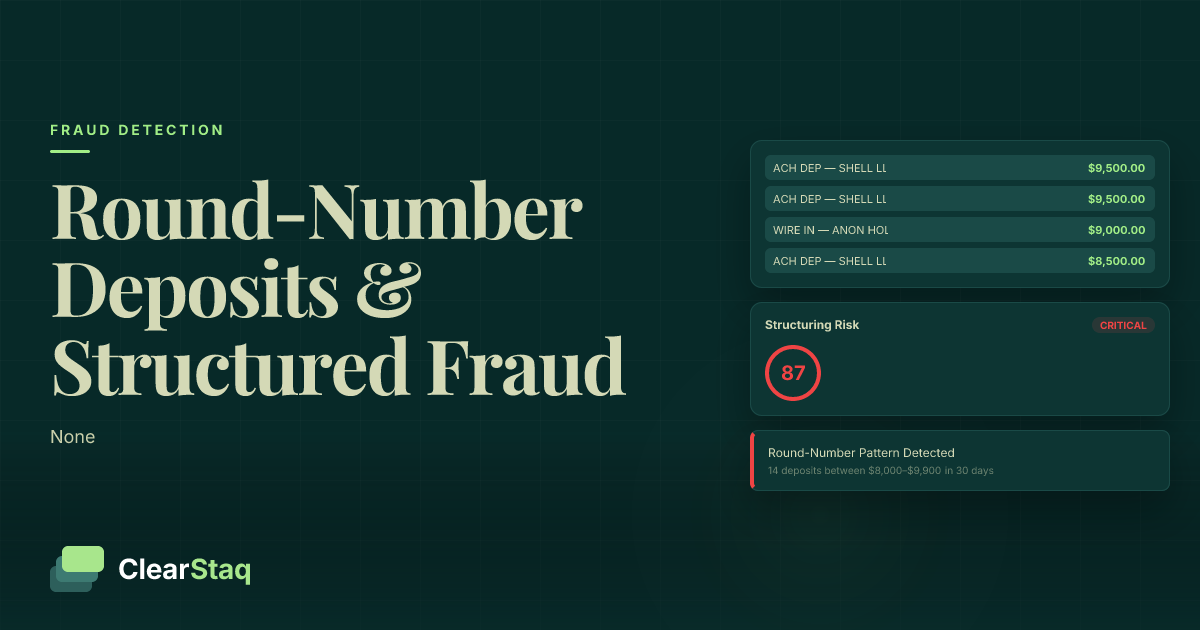
Structuring in crypto exchange transactions surfaces as clusters of deposits, withdrawals, or trades kept just under the $10,000 Currency Transaction Report threshold, often split across multiple accounts or wallets within a 24-48 hour window. Each transaction looks clean in isolation — the pattern only shows up when you aggregate volume, timing, and account linkage across the full customer relationship. Exchanges and the banks that fund them catch it by running velocity checks, wallet clustering, and cross-account aggregation against the same $10,000 line the Bank Secrecy Act sets for banks, not by reviewing single transactions one at a time.
- Structuring in crypto exchange transactions means splitting deposits or withdrawals under $10,000 to dodge CTR filing.
- Detection depends on aggregating linked accounts and wallets across a 24-48 hour window, not single transactions.
- FinCEN has treated crypto exchanges as money services businesses since 2013, so BSA structuring rules apply directly.
- ClearStaq's fraud engine surfaces structuring patterns in bank statement data with 27+ signals in under 5 seconds.
Why this matters
Structuring is a federal crime under 31 U.S.C. § 5324 whether or not the underlying funds are illegal — the act of splitting transactions to avoid a CTR is itself the violation. Crypto exchanges got pulled into this framework once FinCEN classified convertible virtual currency exchangers as money services businesses in 2013, meaning the same $10,000 threshold and Suspicious Activity Report obligations that apply to banks apply to exchanges.
Miss a structuring pattern and the exposure isn't just a missed SAR filing. Lenders extending credit against business bank accounts that route through exchanges inherit the same blind spot — a borrower structuring deposits to hide the true source of funds looks like clean revenue on a surface-level statement review. That's the connection ClearStaq's AML transaction monitoring software for crypto exchanges exists to close.
How do you detect structuring in crypto exchange transactions?
Detection is a five-step process, and it fails the moment any one step is skipped:
- Aggregate across every linked account and wallet the customer controls, not just the one under review.
- Set a rolling 24-48 hour window to catch same-day splits and next-day continuations of the same pattern.
- Flag transactions clustered just under $10,000 — commonly in the $9,000-$9,999 band — as high-priority review items.
- Cross-reference IP addresses, device fingerprints, and shared payment rails across accounts that otherwise look unrelated.
- Check for round-trip activity: a deposit, a fast trade, then a withdrawal to a new wallet within hours.
A SAR gets filed when the pattern meets the suspicion threshold — regardless of whether any single transaction ever touched $10,000. That last point trips up teams that build rules only around the CTR line itself.
Common structuring patterns and what gives them away
| Pattern | What it looks like | Detection signal |
|---|---|---|
| Sub-$10K splitting | Multiple deposits or withdrawals just under $10,000 in a 24-hour span | Aggregate volume across linked accounts exceeding the threshold |
| Multi-wallet layering | Funds routed through 3+ wallets before hitting the exchange | Velocity plus wallet clustering analysis |
| Round-trip trades | Buy-sell cycles that net a near-zero position | Circular transaction flags tied to timing |
| Smurfing via multiple accounts | Same device or IP funding several accounts, each under threshold | Device fingerprint overlap across accounts |
Each row on its own is a weak signal. Two or more overlapping on the same customer in the same week is the pattern compliance teams act on in 2026.
Why structuring detection varies from exchange to exchange
No two platforms catch structuring at the same rate, and the gap usually comes down to a short list of factors:
- KYC tier — verified accounts with full identity data give monitoring systems more to cross-reference than unverified or limited accounts.
- Jurisdiction — U.S. exchanges answer to FinCEN and the BSA; exchanges operating under FATF Travel Rule regimes elsewhere face different reporting triggers.
- Wallet clustering data — access to blockchain analytics that group addresses by control changes how far the aggregation step in detection actually reaches.
- Cross-exchange visibility — a platform that only sees its own transaction history misses patterns split across two or three exchanges.
- Monitoring window — real-time systems catch same-day splits; batch systems running overnight or weekly miss the fastest structuring cycles.
- Bank account linkage — when funding comes through ACH or wire, the bank statement trail behind the deposit adds another layer of evidence beyond the exchange's own ledger.
That last factor is where bank statement analysis and crypto exchange monitoring overlap. A lender or exchange compliance team reviewing the statements behind a funding source needs the same pattern logic used for layered cash deposits in money laundering schemes — the split just happens in fiat before it ever reaches the exchange.
What's the CTR threshold for crypto exchange transactions in 2026?
The CTR threshold for crypto exchange transactions is $10,000, the same figure that applies to banks under the Bank Secrecy Act, because FinCEN classifies convertible virtual currency exchangers as money services businesses. Transactions structured to stay under that line — split same day or across several days — trigger the same reporting obligation a bank would face.
Is structuring the same as smurfing?
Structuring and smurfing describe the same underlying tactic — breaking a large transaction into smaller ones to avoid a reporting threshold — but smurfing usually refers specifically to using multiple people or accounts to execute the split. Structuring is the broader legal term used in the statute; smurfing is the operational method most often used to pull it off.
Can crypto exchanges be fined for missing structuring patterns?
Yes — FinCEN can pursue civil monetary penalties against a money services business under the Bank Secrecy Act for failing to detect and report structuring, separate from any criminal exposure the customer faces. Exact penalty amounts are set case by case through enforcement actions, not a fixed published schedule, which is exactly why exchanges build detection systems rather than relying on manual review.
Bank statement analysis feeds directly into this problem for lenders working adjacent to crypto activity. ClearStaq parses statement data and runs it against 27+ fraud signals in under 5 seconds, surfacing the same split-transaction patterns documented in how to spot structuring patterns in business bank statements — useful when a borrower's funding source runs through an exchange before it hits the business account a lender is underwriting.
Catch structuring before it costs you
Run bank statement data through 27+ fraud signals in under 5 seconds.
FAQ
What is structuring in crypto exchange transactions?
Structuring in crypto exchange transactions is splitting deposits, withdrawals, or trades into amounts under $10,000 to avoid triggering a Currency Transaction Report. It's a federal crime under 31 U.S.C. § 5324 regardless of whether the underlying funds are illegal.
How much does a single structured transaction need to be under to avoid a CTR?
A single transaction needs to stay under $10,000 to avoid an automatic CTR filing, but detection systems flag activity in the $9,000-$9,999 band as a red flag because that's the typical structuring range in 2026.
Do crypto exchanges have to file SARs like banks?
Yes, crypto exchanges classified as money services businesses by FinCEN must file Suspicious Activity Reports for structuring patterns, the same obligation banks carry under the Bank Secrecy Act.
What time window do structuring detection systems use?
Most structuring detection systems use a 24-48 hour rolling window to catch same-day splits and next-day continuations of the same pattern across linked accounts.
Can wallet clustering help detect structuring?
Yes, wallet clustering groups addresses under common control, which extends detection beyond a single account to catch multi-wallet layering that would otherwise look like unrelated activity.
Is structuring illegal even if the money is legitimate?
Yes, structuring is illegal under 31 U.S.C. § 5324 regardless of whether the funds came from a legitimate source. The act of splitting transactions to avoid the $10,000 reporting threshold is the violation itself.
How does structuring detection differ across exchanges?
Detection quality varies with KYC tier, jurisdiction, wallet clustering access, cross-exchange visibility, and whether monitoring runs in real time or in overnight batches.
One last thing
The part most compliance teams miss: structuring is illegal by itself, independent of whether the money is clean. Prosecutors don't have to prove the underlying funds were illicit — they only have to prove the customer split transactions on purpose to dodge the $10,000 line. That's why detection systems in 2026 are built to flag intent patterns (timing, account linkage, device overlap) rather than waiting for a single transaction to cross a dollar amount that will never come.
Related guides
ClearStaq Team
Content Team
The ClearStaq team builds AI-powered tools for bank statement parsing, fraud detection, and income verification.