Layering is the middle stage of money laundering — the point where dirty cash gets pushed through enough transfers that its origin disappears on paper. Lenders, brokers, and CPAs who skip this check during bank statement review end up underwriting accounts that later trigger a SAR, a clawback, or a regulator's phone call.
- Layered cash deposits show up as round-number transfers moved through 3+ accounts within 24-72 hours in 2026 underwriting reviews.
- Structuring below the $10,000 CTR threshold, repeated on a schedule, is the clearest sign to detect layered cash deposits in money laundering schemes.
- Manual review of 12 months of statements misses velocity patterns that parsing software flags in under 5 seconds.
- ClearStaq applies 27+ fraud signals against deposit timing, source mismatches, and shell-company indicators simultaneously.
Why this matters
Layering exists to break the paper trail between placement (getting cash into the system) and integration (spending it as if it's clean). For a bank statement reviewer, that means the account you're underwriting in 2026 might look completely legitimate on the surface — steady deposits, reasonable balances — while the money moving through it originated three accounts upstream.
MCA brokers and non-bank lenders are exposed here more than traditional banks because approval timelines run in hours, not weeks. If your underwriting process doesn't check for structuring patterns before funding, you're relying on the applicant to self-report activity they have every incentive to hide.
CPAs doing quarterly reviews face the same blind spot from the accounting side: a client's books can reconcile perfectly while the underlying bank activity shows classic layering behavior nobody flagged.
What you'll need
- 12 months of business bank statements, not 3 — layering patterns often cycle monthly or quarterly
- Transaction-level detail, including counterparty names and memo fields, not just summary totals
- A list of NAICS codes or business types considered higher-risk for cash-intensive activity
- Access to sanctions and PEP lists if any counterparty names look unfamiliar
- Bank statement parsing software that extracts transaction dates, amounts, and descriptions at scale — manual scanning of 12 months of PDFs is where most reviewers give up early
The steps
1. Identify which stage of laundering you're looking at
Placement is cash entering the account. Layering is money moving between accounts to obscure origin. Integration is the money exiting as "clean" spend — payroll, vendor payments, asset purchases. You're hunting for layering specifically, which means your focus is on transfers between deposits, not the deposits themselves.
Common mistake: treating every large cash deposit as suspicious. Most cash-heavy businesses (restaurants, auto dealers, laundromats) deposit cash routinely and legitimately. The red flag is what happens to that cash 24-72 hours after it lands.
2. Flag round-number deposits followed by rapid outbound transfers
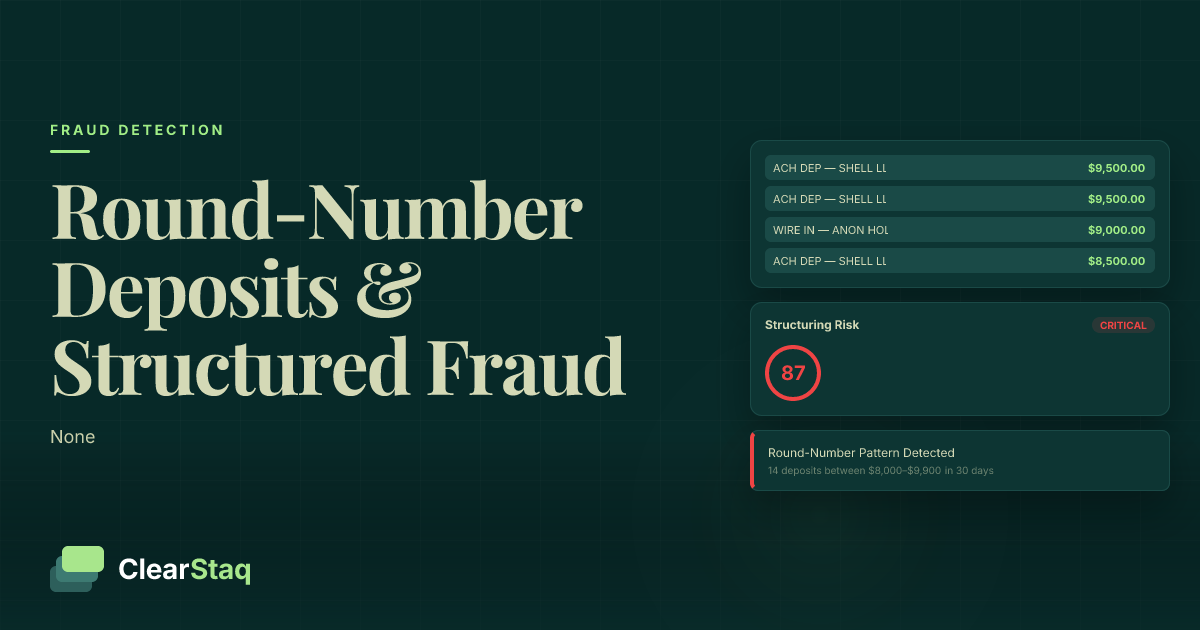
Legitimate business revenue rarely arrives in clean round numbers — $9,500, $9,800, $9,900 repeated weekly is a pattern, not a coincidence. Watch for deposits that get wired or transferred out within one to three business days, especially to accounts with no prior transaction history.
Expected outcome: a timeline showing deposit-to-transfer gaps under 72 hours across multiple months. A single occurrence isn't proof. Three or more in a 12-month window is.
3. Measure deposit-to-withdrawal velocity
Layering accounts often show balances that never accumulate — money in, money out, balance flat. Calculate average days-held per deposit. Legitimate operating accounts typically hold working capital for 15-30 days minimum; layering accounts frequently show 1-5 day holding periods.
Common mistake: comparing velocity against your own benchmark instead of the applicant's stated industry. A freight lender's cash-flow expectations look nothing like a restaurant lender's, so calibrate against the declared business type.
4. Cross-reference deposit sources against declared business activity
If an applicant claims to run a landscaping business but deposits originate from wire transfers labeled "consulting fee" or "loan repayment" from unrelated individuals, that's a source mismatch. Commingled funds between personal and business accounts, or between unrelated businesses, are one of the most common layering tells in MCA underwriting specifically.
Expected outcome: a source-of-funds column next to every deposit over $5,000. Anything that doesn't match the applicant's stated business model gets a manual second look.
5. Test for structuring under the $10,000 CTR threshold
Under the Bank Secrecy Act, cash transactions over $10,000 trigger a Currency Transaction Report. Structuring means splitting deposits into amounts just under that line — $9,200, $9,600, $9,850 — spaced days apart to avoid detection. This is one of the oldest layering techniques and still one of the most common in 2026 underwriting files.
Common mistake: only checking single-day totals. Structuring often spans multiple days at multiple branches, so you need the full monthly ledger, not a snapshot.
6. Trace transfers across multiple accounts or entities
Layering rarely stops at one hop. Money moves from Account A to Account B to Account C, sometimes across entities with different names but the same signer or address. This is where shell company indicators start overlapping with layering detection — a business with no operating expenses, no payroll, and only inbound/outbound transfers is a shell, not a business.
Expected outcome: a simple diagram or table mapping every transfer chain touching the applicant's account in the review period.
7. Screen unfamiliar counterparties before you fund
Any name appearing repeatedly as a transfer counterparty that isn't a known vendor, payroll provider, or customer deserves a sanctions and PEP check before approval. Building this into a repeatable AML transaction monitoring program turns a one-off manual check into a standard underwriting gate.
Common mistake: screening only the applicant, not the counterparties on the statement. The applicant might be clean; the money touching their account might not be.
Automate layered deposit detection
ClearStaq flags layering, structuring, and shell-account patterns in under 5 seconds per statement set.
Troubleshooting
Problem: Round-number deposits turn out to be legitimate recurring payments. Cross-check against invoices or contracts before flagging. Retainer clients and lease payments also arrive in round numbers.
Problem: Statement format makes transaction memos unreadable. Different banks truncate or code memo fields differently, so parsing software built for 900+ bank formats catches detail a manual scan of a scanned PDF will miss entirely.
Problem: 12 months of statements is too much to review manually. This is the single biggest reason layering goes undetected — reviewers cap out at 3-6 months and miss quarterly cycling patterns that only show up over a full year.
Problem: Applicant explains away every red flag verbally. Verbal explanations aren't documentation. Require a written source-of-funds statement for any deposit over $10,000 that doesn't match declared revenue.
Problem: You flag too many false positives and underwriting slows down. Tune your thresholds to the applicant's industry — a construction lender's cash patterns look nothing like a payday lender's, and a single static rule set across all industries produces noise.
Problem: Counterparty names are abbreviated or inconsistent across statements. Normalize names before running sanctions screening; "J Smith LLC" and "John Smith Enterprises" might be the same signer using two accounts.
Tools and resources
- 12 months of full transaction-level bank statements, not summaries
- A documented NAICS-based risk tier for cash-intensive industries
- Sanctions list access for counterparty screening
- Bank statement parsing software that extracts dates, amounts, and memos automatically instead of relying on manual PDF review
- A written escalation policy for structuring and layering flags, so reviewers aren't making judgment calls case-by-case
What to do next
Once layering detection is part of your standard review, the next gap to close is usually check kiting — a related technique using timing between accounts rather than transfer chains. Reviewing check kiting patterns in business bank accounts closes the loop on the other common way funds get shuffled to disguise real balances.
FAQ
What is layering in money laundering?
Layering is the second stage of money laundering, where funds move through multiple accounts or transfers to disguise their origin before placement and integration. It typically involves rapid transfers, round-number amounts, and accounts with no operating history.
How do you detect layered cash deposits in money laundering schemes?
Detect layered cash deposits by tracking deposit-to-transfer velocity, flagging round-number amounts near the $10,000 CTR threshold, and tracing transfer chains across multiple accounts. Parsing 12 months of transaction-level statements catches cycling patterns a 3-month snapshot misses.
What is the CTR threshold for cash deposits?
The Currency Transaction Report threshold is $10,000 under the Bank Secrecy Act. Deposits structured just under that line, repeated across days or weeks, are a classic sign of structuring rather than layering alone.
Is structuring the same as layering?
Structuring and layering are related but distinct: structuring is splitting deposits to avoid CTR filing, while layering is moving the funds through multiple accounts afterward. Structured cash often becomes the source material for a layering scheme.
How many months of bank statements should lenders review for layering?
Lenders should review 12 months of bank statements to catch layering, since many schemes cycle monthly or quarterly. Shorter windows of 3 months routinely miss the repeat structuring and transfer patterns that only appear over a full year.
Can bank statement parsing software catch layering automatically?
Yes, bank statement parsing software can flag layering by scoring transaction velocity, round-number deposits, and transfer chains across accounts automatically. ClearStaq processes statement sets in under 5 seconds against 27+ fraud signals, which is faster than any manual line-by-line review.
What industries see the most layering activity in loan applications?
Cash-intensive industries like restaurants, auto dealers, and construction see the most layering activity because high cash volume makes structured deposits easier to disguise. That doesn't mean every cash-heavy applicant is laundering money — it means the review threshold should be higher for those NAICS codes.
Do CPAs need to check for layering during quarterly reviews?
CPAs should check for layering during quarterly reviews because reconciled books can hide underlying bank activity that shows structuring or rapid transfer chains. A clean P&L doesn't rule out laundering activity sitting in the bank feed.
One last thing
The deposits themselves are rarely the tell — the transfer that happens 48 hours later is. Reviewers who focus only on deposit size in 2026 miss the pattern almost every time; reviewers who track the gap between money landing and money leaving catch it on the first pass.
Related guides
ClearStaq Team
Content Team
The ClearStaq team builds AI-powered tools for bank statement parsing, fraud detection, and income verification.