Check kiting shows up as a timing gap between deposit and clearance — not as a single suspicious transaction, but as a pattern across 60 to 180 days of statements. Catch the pattern early and you avoid funding a business that's floating on money it doesn't actually have.
- Check kiting hides in the gap between deposit and clearance across two or more accounts — look at 90-180 day windows, not single months.
- Same-day or next-day covering deposits that match a check amount within $50-$100 are the clearest tell in 2026 underwriting reviews.
- ClearStaq flags kiting-consistent float patterns across 27+ fraud signals in under 5 seconds per statement set.
- Manual review of 6 months of statements across 3 accounts takes 2-3 hours per file — automation cuts that to minutes.
- Confirmed round-tripping between accounts is grounds to decline, not just flag for follow-up documentation.
Why this matters
Check kiting is float fraud: a borrower deposits a check from Account A into Account B before the check from A actually clears, creating artificial balance that doesn't exist. Underwriters who only glance at ending balances miss it every time — the balance looks fine on the statement date.
The cost isn't hypothetical. A kiting scheme that runs for 30-60 days before a bank catches the bounced check can leave a lender holding a funded loan against a business with real cash flow that's a fraction of what the statements implied. Before you fund, verifying business bank accounts before loan disbursement needs to include a float check, not just an ownership check.
Most kiting schemes in 2026 still involve two or three accounts at different banks, because same-bank transfers clear faster and leave less float window. That's the pattern to build your review process around.
What you'll need
- 90-180 days of statements for every account the borrower discloses, plus any accounts referenced in deposit memos or check images
- Check images or at minimum check numbers, dates, and amounts for every deposit over $1,000
- A way to line up deposit dates against withdrawal dates across accounts side by side — a spreadsheet works, parsing software works faster
- Overdraft and NSF fee history for each account, not just the summary line
- 30-60 minutes minimum per file for a first-pass manual review, more if the borrower holds 3+ accounts
The steps
1. Pull statements across every linked account, not just the primary one
Kiting requires at least two accounts. If the borrower discloses only one, ask for 90 days of statements from any account referenced in deposit descriptions, check memos, or transfer records on that primary account.
A single account's statement will look clean because the fraud lives in the gap between accounts. Skipping this step is the single biggest reason kiting gets missed at underwriting. Common mistake: accepting a borrower's claim that it's the only business account without checking transfer descriptions for a second bank name.
2. Build a deposit-to-withdrawal timeline across accounts
List every deposit over $1,000 in Account A, then check whether a matching or near-matching withdrawal appears in Account B within 1-3 business days, and vice versa. Do this for the full 90-180 day window, not a sample month.
The timeline reveals the round-trip pattern that a monthly balance snapshot hides completely. Expected outcome: a clean borrower shows deposits and withdrawals with no cross-account timing correlation; a kiting pattern shows repeated 1-3 day round trips.
3. Flag same-day or next-day covering deposits
When a check is written against Account A for $8,000 and a deposit of $7,900-$8,100 lands in Account A the same day or the next business day, that's a covering deposit — the classic kiting signature. Amounts don't need to match exactly; a $50-$100 variance still counts as a match once you account for fees.
This is the single clearest signal in a kiting review, and it's the one most manual reviews miss because reviewers look at ending balances, not transaction-level timing. Common mistake: dismissing a covering deposit as normal cash flow because the account never shows a negative balance on the statement date.
4. Check for round-tripping between two or more accounts
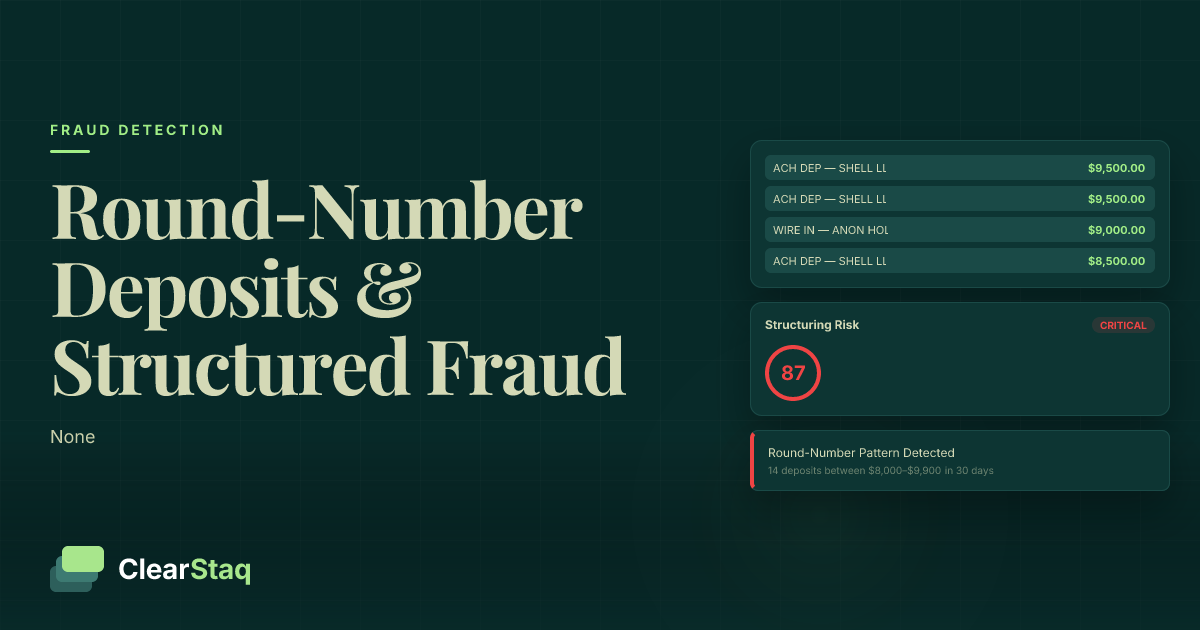
Round-tripping is money moving from Account A to Account B and back to Account A within a short window, often 2-5 business days, with no business purpose attached (no invoice, no payroll memo, no vendor reference). Structuring shows a different signature — deliberately sized deposits under reporting thresholds — so if the pattern looks like structuring instead, the review path changes.
Track the net position across both accounts combined at the end of each day. In genuine kiting, combined balances stay artificially inflated because the same dollars get counted twice during the float window.
5. Watch check numbers and sequencing
Out-of-sequence check numbers, check numbers issued far apart in time relative to their amounts, or a jump from check #1042 to #1890 with no explanation are secondary indicators. Kiting schemes sometimes involve a check register that doesn't match the actual clearing order.
This step rarely stands alone as proof, but combined with timing correlation from steps 2-4, it strengthens the case. Expected outcome: sequential, evenly-spaced check numbers in a clean file; irregular jumps or reuse patterns in a suspicious one.
6. Cross-reference NSF and overdraft fee clusters
A kiting scheme under stress produces NSF fees clustered in short windows — three or four overdraft fees in a 10-day span, then a quiet stretch, then another cluster. Isolated NSF fees happen to legitimate businesses; clustered fees tied to the same accounts you flagged in step 2 are a different story.
Pull the full fee history, not the summary total. A statement showing $0 in NSF fees this month can still sit inside a 90-day window with three clusters in the surrounding months.
7. Calculate float velocity
Float velocity is how fast money cycles between the flagged accounts relative to the account's stated average balance. If $40,000 moves back and forth in a 5-day window on an account with a $15,000 average balance, the velocity ratio flags the file for manual escalation regardless of how the ending balance looks.
This calculation is where automated parsing earns its keep — running it by hand across 180 days and multiple accounts takes real time, and reviewers under deadline pressure skip it.
Automate the kiting check
Run 27+ fraud signals across linked accounts in under 5 seconds per file.
8. Escalate confirmed patterns to a decision, not a follow-up request
Once steps 3-7 line up — covering deposits, round-tripping, fee clusters, and elevated float velocity — the file goes to decline or manual investigation, not to a request for more documentation. Kiting patterns confirmed across a 90-180 day window rarely resolve into a clean explanation.
Troubleshooting
- Balances look fine every statement date, but timing feels off. Check the transaction-level dates, not the period-end balance. Kiting is engineered to look clean on the exact dates statements are pulled.
- Borrower discloses only one account but transfer memos reference another bank. Request statements from the second account before proceeding — this is non-negotiable, not a nice-to-have.
- Deposits and withdrawals are close in amount but never exact. Expect a $50-$100 variance for fees and rounding; exact-dollar matching is the exception, not the rule for real kiting.
- NSF fees are low or zero. Some kiting schemes are sized precisely to avoid triggering overdrafts — the absence of fees doesn't clear the file if steps 2-4 still show round-tripping.
- Reviewer time is limited and the file has 4+ linked accounts. Manual review at 2-3 hours per file doesn't scale past 2-3 accounts reliably; this is where automated cross-account parsing pays for itself.
- Kiting looks like normal intercompany transfers. Legitimate businesses with multiple entities do move money between accounts — the difference is a documented business purpose (invoice, payroll, loan repayment memo) versus none at all.
Tools and resources
- Manual spreadsheet timeline for deposit-vs-withdrawal correlation (fine under 90 days, one account pair)
- Check fraud detection software for banks for automated cross-account float analysis
- Overdraft and NSF fee history reports, pulled separately from the summary statement
- Check image access for amounts over $1,000, to confirm sequencing and payee details
What to do next
Once kiting checks are part of the standard file review, the next bottleneck is usually reviewer time on every other file that isn't flagged. Automating bank statement review for underwriting teams closes that gap — the same parsing pass that catches kiting also handles routine income and expense verification on clean files.
FAQ
What is check kiting and how does it work?
Check kiting is float fraud where a borrower deposits a check from one account into another before the original check clears, creating a temporary artificial balance. It requires at least two accounts and relies on the clearing delay between banks, typically 1-3 business days in 2026.
How long does check kiting take to detect manually?
A manual review across 3 linked accounts and 90-180 days of statements takes 2-3 hours per file. Reviewers who only check single-month statements or one account routinely miss the pattern entirely.
What's the difference between check kiting and structuring?
Check kiting exploits the timing gap between deposit and clearance across accounts, while structuring involves deliberately sizing deposits to stay under reporting thresholds. The two patterns can co-occur, but the transaction signatures differ enough to require separate detection logic.
Can check kiting happen between accounts at the same bank?
Yes, but it's less common because same-bank transfers clear faster, shrinking the float window. Most kiting schemes in 2026 still involve accounts at two or three different banks to maximize the clearing delay.
How much can check kiting cost a lender?
The cost depends on the loan size, but a scheme that runs 30-60 days before detection can leave a lender holding a funded loan against cash flow that's a fraction of what the statements implied. The real exposure is the funded principal, not just fees.
What software detects check kiting automatically?
Fraud detection platforms that parse bank statements across linked accounts and flag float-timing patterns catch kiting faster than manual review. ClearStaq processes statement sets in under 5 seconds and checks for kiting-consistent patterns across 27+ fraud signals.
Is check kiting a federal crime?
Check kiting can constitute bank fraud under federal law when it involves knowingly writing checks against insufficient funds to defraud a financial institution. Lenders that detect a confirmed pattern should route the file to compliance and legal review, not just decline it quietly.
How many bank statements should underwriters review to catch kiting?
Review 90-180 days minimum across every disclosed account. A single month or a single account will not reveal the cross-account timing correlation that defines kiting.
One last thing
The covering-deposit check from step 3 catches more kiting than every other signal combined — if you only have time for one manual check on a file, run that one. Everything else in this process is there to confirm what the covering deposit already told you.
Related guides
ClearStaq Team
Content Team
The ClearStaq team builds AI-powered tools for bank statement parsing, fraud detection, and income verification.