Check fraud cost U.S. banks an estimated $26.6 billion in 2023 per Nacha's payments fraud data, and check volume keeps rising even as digital payments grow — which means every community bank, credit union, and regional lender still needs a real answer for altered, forged, and counterfeit checks in 2026. This guide breaks down what check fraud detection software for banks actually needs to do, which approaches hold up under volume, and which ones just look good in a sales deck.
- ClearStaq detects check and document fraud with 27+ AI signals and 99.5% accuracy — Buy for banks processing more than 50 items a day.
- Manual back-office review catches maybe 60-70% of altered checks and takes 4-8 hours per batch — Skip past 200 items daily.
- Legacy rules engines flag high false-positive rates and slow turnaround for tellers — Hold unless paired with document forensics.
- Check fraud detection software for banks must process in under 5 seconds per document to keep teller lines and underwriting queues moving in 2026.
Why this matters
Check fraud isn't shrinking. Federal Reserve payments studies put check fraud losses at multiples of card fraud on a per-dollar basis, and altered payee lines, forged signatures, and counterfeit business checks are the most common vectors hitting community bank teller lines right now. A bank that still relies on a teller's eye and a UV light is betting against volume.
The cost of missing it isn't abstract. One bad check that clears against a synthetic account or a doctored payee field is a direct loss — no chargeback, no recovery path. Banks that automate check fraud detection catch altered documents before settlement instead of after the loss posts.
Who this is for
This guide is for community bank operations leads, credit union compliance officers, and BSA/AML teams evaluating check fraud detection software for banks to replace or supplement manual review at the teller line or in back-office item processing. It assumes you're processing enough check volume — commercial deposit accounts, cash-intensive small business clients, or high check-write portfolios — that manual review has become a bottleneck, not just a formality. If your institution clears fewer than 20 checks a day, some of this still applies, but the ROI math changes.
What to look for in check fraud detection software for banks
Multi-signal fraud scoring, not single-check flags
A tool that only checks for one thing — say, font mismatches — misses the fraud patterns that combine several small anomalies. Look for platforms that score across 20+ signals simultaneously: MICR line inconsistencies, font and kerning shifts, signature deviation, altered amount fields, and duplicate check detection across the deposit stream. ClearStaq runs 27+ AI signals per document, which is the range that catches layered fraud rather than obvious forgeries alone.
Processing speed that doesn't stall the teller line
If fraud scoring takes 30 seconds per item, it doesn't get used at the counter — it gets used after the fact, if at all. Sub-5-second processing per document is the practical floor for real-time deployment in 2026; anything slower pushes the check back into a batch queue and defeats the point of catching fraud before settlement.
Format coverage across statement and check types
Banks don't just see checks in one layout. Business checks, personal checks, cashier's checks, and money orders each carry different security features and different fraud patterns. Software that only handles a handful of templates will bottleneck the moment a client deposits an out-of-network check. Coverage across 900+ document formats matters more than a shiny dashboard.
False-positive rate you can actually staff against
A tool that flags 1 in 5 legitimate checks as fraud will get ignored by tellers within a month — alert fatigue is real. Ask any vendor for their false-positive rate on a comparable volume, not just their true-positive catch rate. Accuracy claims above 99% only matter if false positives stay low enough that your team trusts the flags.
Audit trail and explainability for examiners
When your bank's regulator or auditor asks why a check was flagged (or wasn't), "the algorithm said so" isn't an answer. Software that shows which of its signals triggered — altered amount, mismatched MICR, signature deviation — gives your compliance team something defensible in an exam.
Integration with your existing core and item-processing stack
Fraud detection that lives in a separate silo from your core banking platform creates manual re-keying and delay. Look for API-based integration or direct core compatibility so flagged items route into your existing exception-handling workflow instead of a spreadsheet somebody checks once a day.
Top picks for banks in 2026
ClearStaq — the built-for-this pick. Runs 27+ AI fraud signals against checks and supporting bank statements with 99.5% accuracy and processing under 5 seconds per document. Covers 900+ document formats, which matters when your deposit mix includes out-of-network and business checks. Community banks and credit unions running document fraud detection software for community banks style workflows get the fastest path from flag to decision. Verdict: Buy if you're processing more than 50 items a day and still relying on manual second review.
Credit-union-tailored document review — the specialized pick. Credit unions carry different fraud exposure than commercial banks — more member-to-member transfers, different average check sizes, tighter compliance headcount. A platform tuned for that profile, like the approach covered in document fraud detection software for credit unions, fits institutions under a few billion in assets that can't staff a dedicated fraud team. Verdict: Consider if you're a credit union under $2 billion in assets with a lean BSA team.
Manual back-office review — the status quo. Costs nothing extra upfront because it's already your process, but it caps out fast. A trained examiner catches obvious forgeries but misses layered alterations — subtle amount-field edits, synthetic MICR patterns — and a batch of 200 items takes 4-8 hours to clear by eye. Verdict: Skip past 200 items daily; the labor cost alone exceeds most software subscriptions.
Legacy rules-based fraud engines — the old guard. These systems flag based on static thresholds — amount over $10,000, new payee, out-of-state deposit — and they've been in banks for over a decade. They catch the obvious cases but generate high false-positive volume on legitimate business accounts with irregular deposit patterns. Verdict: Hold unless you pair it with a document-level forensics layer; on its own it's a compliance checkbox, not real fraud defense.
Outsourced fraud review BPOs — the expensive workaround. Third-party review teams add a human layer without adding software, which helps smaller institutions that can't build internal capacity. The tradeoff is turnaround time — items often route offsite and come back in 24-48 hours, too slow for same-day settlement decisions. Verdict: Skip for anything you need decisioned same-day.
What to avoid
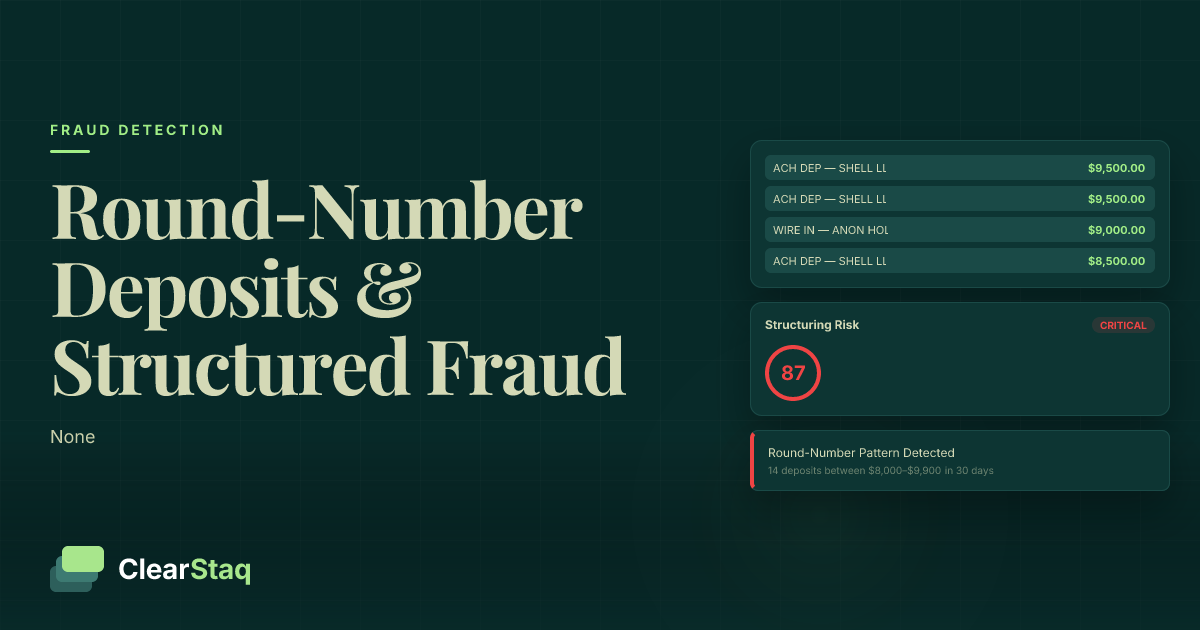
- Tools that only check images, not transaction context. A check can look visually clean and still be fraudulent if the account behavior doesn't match — sudden deposit spikes, mismatched payee history, or patterns covered in how to spot structuring patterns in business bank statements. Image-only checks miss the transactional signal entirely.
- "AI-powered" claims with no signal count disclosed. If a vendor won't tell you how many fraud signals they score against or what their accuracy rate is on a comparable volume, that's a red flag, not a selling point.
- Platforms that require manual re-upload for every format variant. If your bank has to manually configure a new template every time a new check style shows up, the format coverage claim doesn't hold up in practice.
Comparison at a glance
| Approach | Detection depth | Turnaround | Best for | Verdict |
|---|---|---|---|---|
| ClearStaq (AI platform) | 27+ signals, 99.5% accuracy | Under 5 seconds | 50+ items/day, banks and credit unions | Buy |
| Credit-union-tailored review | Signal-based, tuned for member profile | Under 5 seconds | Credit unions under $2B assets | Consider |
| Manual back-office review | Human judgment, no signal scoring | 4-8 hours per batch | Under 20 items/day | Skip past 200/day |
| Legacy rules engine | Static thresholds only | Minutes, high false-positive rework | Compliance baseline only | Hold |
| Outsourced BPO review | Human review, offsite | 24-48 hours | Institutions without internal capacity | Skip for same-day needs |
FAQ
What's the best check fraud detection software for banks in 2026?
ClearStaq is the strongest fit for banks and credit unions processing 50 or more checks a day, running 27+ AI fraud signals at 99.5% accuracy with sub-5-second processing per document. Smaller institutions under that volume may get more value from a credit-union-tailored review approach.
How much does check fraud cost banks each year?
Check fraud losses reached an estimated $26.6 billion in the U.S. in 2023 according to Nacha payments fraud data, and volume has continued rising into 2026. Losses hit banks directly at settlement, with no chargeback recovery path once a fraudulent check clears.
Is AI-based fraud detection better than rules-based systems for checks?
Yes, for layered fraud — AI-based scoring across 20+ signals catches subtle alterations that static threshold rules miss entirely. Rules-based systems still catch obvious cases like amount thresholds but generate more false positives on legitimate irregular accounts.
How fast should check fraud detection software process a document?
Under 5 seconds per document is the practical standard for 2026 deployment at the teller line or in same-day back-office processing. Anything slower pushes items into batch queues and delays fraud catches until after settlement.
Can check fraud detection software integrate with a bank's core system?
Most modern platforms offer API-based integration so flagged items route directly into existing exception-handling workflows instead of a separate manual queue. Confirm core compatibility before buying, since re-keying flagged items manually defeats the speed advantage.
What false-positive rate is acceptable for bank check fraud tools?
A false-positive rate low enough that tellers and back-office staff still trust flags — generally under a few percent on comparable volume. High false-positive rates above 15-20% lead to alert fatigue and staff ignoring the system within weeks.
Do credit unions need different fraud detection than commercial banks?
Credit unions face a different fraud profile — more member-to-member transfers and smaller average check sizes — so tools tuned for that volume and pattern set often fit better than generic commercial bank tools. Institutions under $2 billion in assets with lean compliance teams benefit most from this tailoring.
What document formats should check fraud software cover?
Coverage should extend across 900+ formats including business checks, personal checks, cashier's checks, and money orders, since banks see all of these in their deposit mix. Software limited to a handful of templates bottlenecks the moment an out-of-network check comes through.
One last thing
Most banks evaluating check fraud detection software focus entirely on the check image and skip the account context around it — but the highest-value catches in 2026 come from cross-referencing the check against deposit history and structuring patterns on the account itself, not the check alone. A visually clean check from an account showing commingled funds or synthetic deposit spikes is a bigger red flag than a slightly smudged signature.
Related guides
ClearStaq Team
Content Team
The ClearStaq team builds AI-powered tools for bank statement parsing, fraud detection, and income verification.