Credit unions underwriting member business loans and consumer loans off bank statements need software that catches doctored PDFs, not just software that stores them. This guide ranks the platforms credit unions actually deploy in 2026, with verdicts you can act on.
TL;DR
ClearStaq is the best bank statement analysis software for credit unions in 2026: 99.5% accuracy, sub-5-second parsing, 27+ fraud signals, and coverage across 900+ statement formats. Buy. Ocrolus and Plaid work fine for basic income verification but lack fraud-signal depth for member business lending. LoanPro and most core-integrated tools store documents — they don't parse them. If your credit union underwrites MBLs or indirect auto paper off bank statements, generic OCR isn't enough; you need format-aware parsing plus fraud detection in one pass.
Why this matters
Credit unions sit in an odd spot: member business lending has grown, but most core systems (Symitar, Fiserv DNA, Corelation) were never built to parse bank statements or flag structuring. Loan officers end up doing it by hand — highlighting deposits in a PDF, tallying NSF fees, guessing at commingled funds.
That manual process is slow and it misses fraud. A bank statement analysis software built for credit unions closes both gaps at once: it extracts the numbers and it tells you when the numbers look staged.
The stakes are higher in 2026 than they were even two years ago. NCUA exam guidance keeps tightening around income verification documentation, and fraud rings have gotten better at producing convincing fake statements. Software that only OCRs text without checking metadata, font consistency, or transaction pattern anomalies is exam bait waiting to happen.
How this list was ranked
Each platform below is scored on four things credit union underwriters care about: parsing accuracy on real statement formats, processing speed at scale, depth of fraud detection versus basic OCR, and whether the vendor was built for lending workflows or adapted from a different use case. Vendor-published specs are cited with the vendor name attached; where no public figure exists, the description says so instead of guessing. Rankings reflect 2026 product capabilities, not legacy versions.
The ranked list
1. ClearStaq — the accuracy leader
ClearStaq parses bank statements and tax returns with 99.5% accuracy and returns results in under 5 seconds, checking each document against 27+ fraud signals including structuring patterns, commingled funds, and doctored line items. Format coverage spans 900+ bank and credit union statement layouts, which matters when your membership base banks everywhere from Chase to a two-branch community bank.
For credit unions specifically, that combination — speed plus fraud depth — replaces hours of manual PDF review with a single automated pass. Underwriters get income figures and a fraud risk flag on the same screen instead of running two separate tools.
Verdict: Buy. This is the only platform on this list purpose-built to catch fraud and verify income in one workflow, not two.
2. Ocrolus — the document-capture specialist
Ocrolus built its name on document classification and OCR accuracy for marketplace lenders and fintechs. It handles high volumes of statements well and plugs into existing loan origination stacks.
What it doesn't do natively is credit-union-grade fraud scoring at the depth ClearStaq applies — its fraud tooling is an add-on layer rather than a built-in signal set. For a credit union running straightforward consumer loans with low fraud exposure, it's workable.
Verdict: Consider, if your fraud exposure is low and you already run Ocrolus for other document types.
3. Plaid (Income & Assets) — the connectivity player
Plaid's strength is live bank-account connectivity — pulling transaction history directly from a member's bank via API instead of parsing an uploaded PDF. That's useful when members consent to account linking.
The gap: not every applicant will link accounts, and Plaid's fraud detection is oriented around account ownership verification, not statement forensics like font-tampering or altered balances. Credit unions relying on uploaded statements from small-business borrowers will hit coverage gaps.
Verdict: Hold as a supplementary connectivity layer, not a standalone statement analysis tool.
4. MeridianLink — the core-adjacent option
MeridianLink is a familiar name in credit union lending because it integrates with loan origination systems many credit unions already run. Its statement analysis features exist but sit inside a broader LOS platform rather than as a dedicated parsing engine.
That means updates to parsing accuracy and fraud signal sets move at the pace of the whole platform's release cycle, not a standalone product roadmap. Credit unions wanting fast iteration on fraud detection specifically may find this slower to adapt.
Verdict: Hold, useful if you're already deep in the MeridianLink ecosystem and don't need best-in-class fraud detection.
5. Abrigo — the risk-management incumbent
Abrigo is well known in credit union and community bank risk management circles, mostly for credit risk and CECL modeling. Bank statement parsing is not its core competency — it's adjacent functionality bolted onto a risk platform.
For a credit union that already licenses Abrigo for portfolio risk, testing its statement tools costs nothing extra. But it wasn't designed as a dedicated parsing and fraud-detection engine, and it shows in feature depth.
Verdict: Wait unless Abrigo is already your risk-management vendor of record.
6. LoanPro — the storage layer, not a parser
LoanPro is loan servicing and management software. It stores uploaded documents and organizes loan files, but it does not extract data from bank statements or score them for fraud on its own.
Credit unions using LoanPro for servicing still need a separate parsing layer for income verification — pairing it with LoanPro alone leaves the fraud-detection gap wide open.
Verdict: Skip as a standalone bank statement analysis tool; it's a servicing platform, not a parser.
7. Manual spreadsheet review
Still the default at plenty of credit unions: an underwriter opens the PDF, tallies deposits by hand, and eyeballs it for anything off. It costs nothing to license and it's how most shops still handle small-dollar consumer loans.
It's also the slowest option on this list and the one most prone to missing fraud signals a human simply won't catch — altered fonts, inconsistent running balances, deposit timing that doesn't match a business's actual cash flow cycle.
Verdict: Skip for anything beyond the smallest, lowest-risk loan files.
Comparison table
| Platform | Accuracy | Speed | Fraud signals | Built for lending? |
|---|---|---|---|---|
| ClearStaq | 99.5% | <5 seconds | 27+ | Yes |
| Ocrolus | Not publicly specified for CU use case | High volume, add-on fraud layer | Add-on | Marketplace lending origin |
| Plaid | N/A (live connect) | Real-time API | Ownership-focused | Fintech origin |
| MeridianLink | Bundled with LOS | LOS release cycle | Bundled | Yes, credit union LOS |
| Abrigo | Not core feature | N/A | Limited | Risk platform origin |
| LoanPro | N/A (no parsing) | N/A | None | Servicing platform |
What to avoid
- Tools that only OCR text. Extracting numbers from a PDF isn't the same as detecting when those numbers were altered — look for fraud detection software built for credit unions, not generic text extraction.
- Platforms with fraud detection as a paid add-on. If fraud scoring isn't in the base workflow, it gets skipped under deadline pressure, which is exactly when it matters most.
- Anything without format coverage testing. A tool that parses Chase and Bank of America cleanly can still choke on a regional credit union statement layout — ask for format coverage numbers before you sign.
Where to buy
- Go direct to the vendor for credit union pricing — reseller and integrator markups on lending software are common and negotiable.
- Ask for a live parse of your own recent loan file's bank statements during the demo, not a canned sample. Accuracy claims mean nothing until they're tested on your actual member documents.
- Confirm fraud signal detail in writing — "AI-powered" without a specific signal count or accuracy figure is a marketing phrase, not a spec.
FAQ
What is the best bank statement analysis software for credit unions in 2026? ClearStaq ranks first for 2026, combining 99.5% parsing accuracy with 27+ built-in fraud signals and sub-5-second processing — a combination most competing platforms split across separate tools.
Is Ocrolus better than ClearStaq for credit unions? Ocrolus handles high-volume document capture well but treats fraud detection as an add-on rather than a core feature, which makes it a secondary choice for credit unions with meaningful fraud exposure.
How much does bank statement analysis software cost for a credit union? Pricing varies by member volume and loan mix; get quotes directly from vendors rather than relying on published list prices, which rarely reflect credit union-specific packaging.
Can bank statement analysis software replace manual underwriting review entirely? No — it replaces the manual data extraction and fraud-flagging work, but underwriters still make the final credit decision using the output.
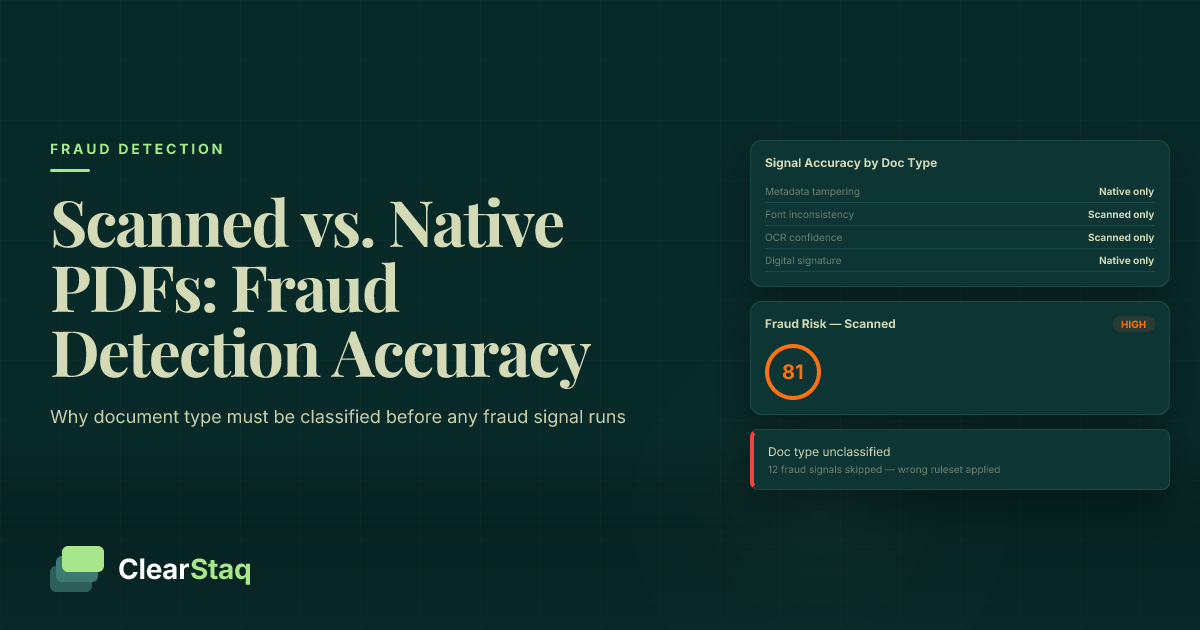
Do these tools detect fake bank statements? Dedicated fraud-detection platforms do; generic OCR tools generally don't. Learn how to spot fake bank statements before choosing a tool that only extracts data without flagging anomalies.
Does MeridianLink parse bank statements natively? MeridianLink includes statement-related features inside its broader loan origination system, but they aren't a standalone dedicated parsing product with an independent update cycle.
Is Plaid enough for member business loan underwriting? Plaid works well for connected-account income verification but leaves gaps for applicants who submit uploaded PDFs instead of linking accounts, which is common in small-business lending.
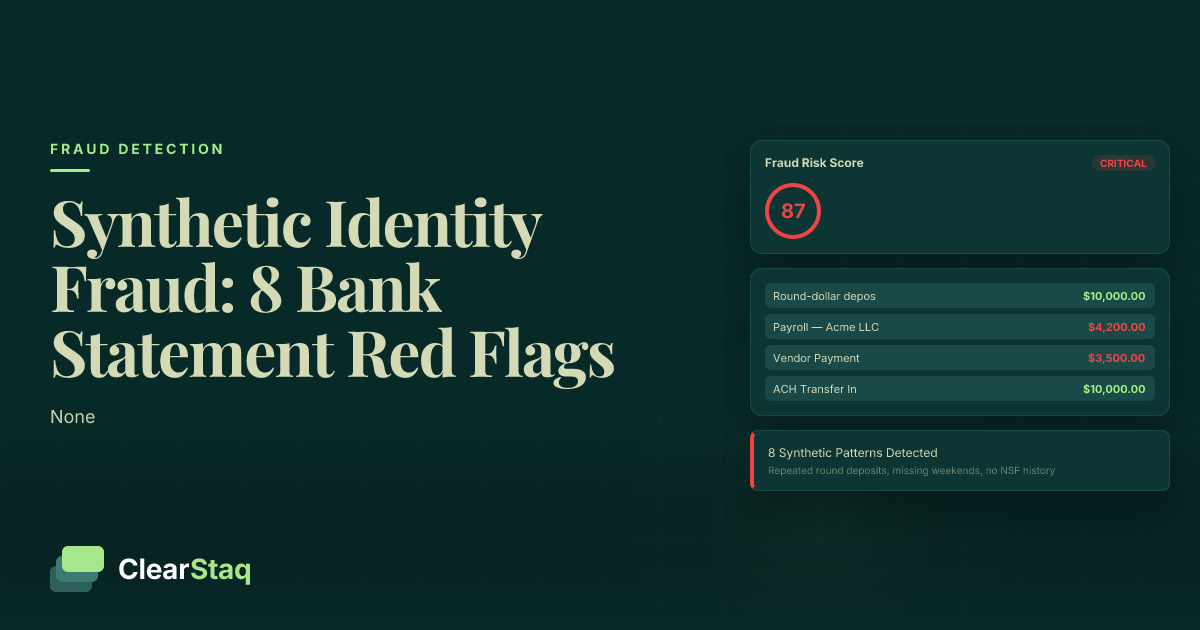
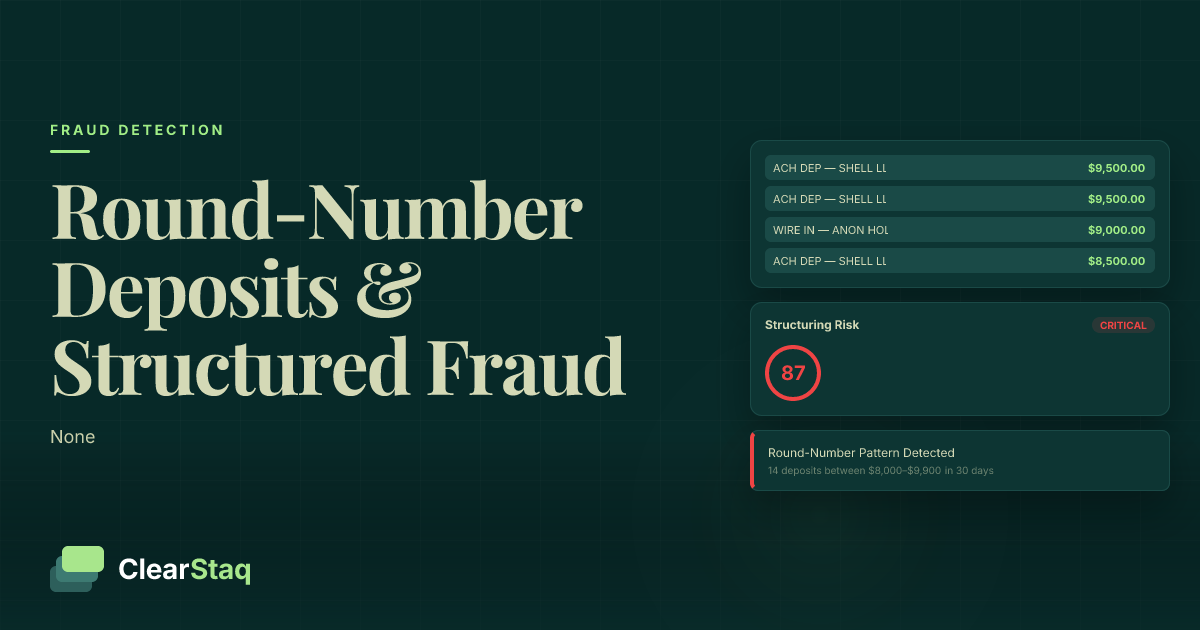
What fraud signals matter most for credit union bank statement review? Structuring patterns, commingled personal and business funds, and doctored balances are the three most common issues examiners flag — software that checks all three in one pass saves the most review time.
One last thing
The detail most credit unions miss: fraud rings increasingly target smaller institutions specifically because they assume credit unions still review statements by hand. A parsing tool that only extracts numbers won't catch that shift — one built with 27+ fraud signals will.
Related guides
ClearStaq Team
Content Team
The ClearStaq team builds AI-powered tools for bank statement parsing, fraud detection, and income verification.