Credit unions underwriting member business loans still lean on PDF statements and manual math — and in 2026 that gap is exactly where fraud gets through. This guide breaks down what actually matters when evaluating bank statement analysis software for credit unions, what to skip, and where the format-aware AI category (including ClearStaq) stands against manual review and legacy OCR.
TL;DR
Bank statement analysis software for credit unions needs three things: format coverage across regional and national banks, fraud signal depth beyond simple OCR, and an audit trail that holds up in an NCUA exam. Manual spreadsheet review is a Skip for any credit union processing more than a handful of MBL applications a month — it can't catch structuring or income smoothing at scale. Legacy OCR tools are a Consider at best; they read text but don't flag fraud patterns. ClearStaq, built for format-aware parsing with 27+ fraud signals and sub-5-second processing, is the Buy for credit unions that need both speed and defensibility on member business and indirect lending files.
Why this matters
Member business lending at credit unions runs on thinner underwriting staff than a regional bank's commercial division, and applicants know it. A borrower depositing structured cash just under reporting thresholds, or smoothing three months of income to hide a bad quarter, is betting the reviewer won't have time to cross-check 90 days of transactions by hand.
That's the exact failure mode fraud detection software for credit unions is built to close. A parser that reads a PDF and dumps numbers into a spreadsheet doesn't solve this — it just speeds up the same blind spot. The software question for 2026 isn't "can it read a statement," it's "can it catch what a tired underwriter would miss on file 40 of the day."
Who this is for
This guide is for credit union lending ops, MBL underwriters, and compliance officers evaluating tools to replace or supplement manual bank statement review — specifically at institutions doing indirect lending, member business lending, or any consumer lending line where 2-3 months of bank statements factor into the decision. If your credit union processes fewer than 10 statement-based applications a month, the math on tooling changes; below that volume, manual review with a fraud checklist may still be defensible. Above it, the case for automation gets hard to ignore.
What to look for in bank statement analysis software for credit unions
Format coverage across banks
Members bank everywhere — Chase, a regional credit union, a small community bank three counties over. Software that only parses the five biggest national banks cleanly will kick back exceptions on a third of your files, and every exception is a manual review that defeats the purpose of buying the tool. Look for coverage in the hundreds of formats, not dozens.
Fraud signal depth, not just text extraction
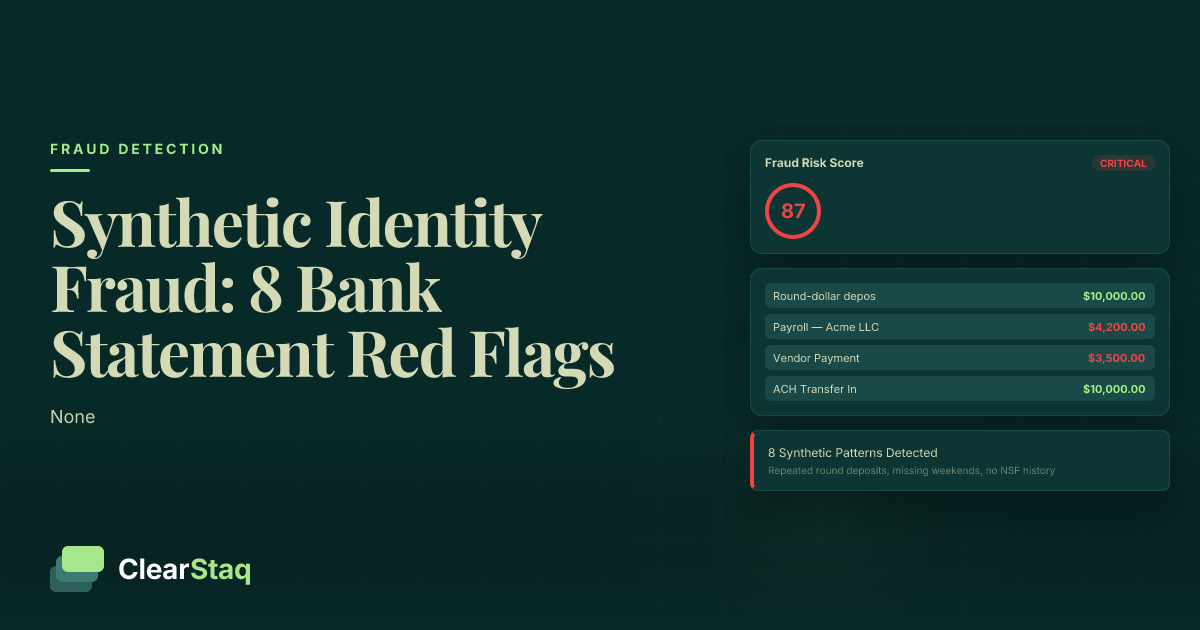
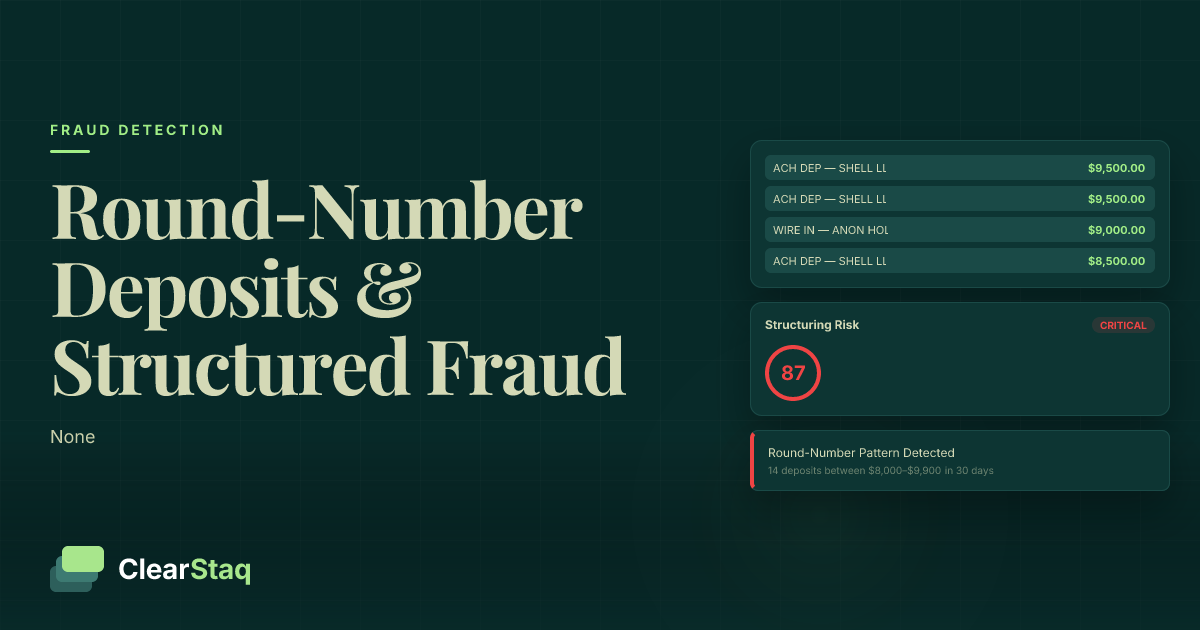
OCR tells you what's on the page. It does not tell you that three deposits of $9,800 landed on consecutive days, which is a textbook structuring pattern designed to stay under the $10,000 currency transaction reporting threshold. A credit union tool needs pattern detection layered on top of parsing — round-number deposits, altered metadata, inconsistent running balances — not just a clean CSV export.
Speed relative to your loan committee cycle
If your MBL committee meets weekly, a parser that takes 20 minutes per file isn't the bottleneck. If you're doing same-day consumer decisions, it is. Match processing speed to your actual decision cadence — sub-5-second parsing matters far more for high-volume indirect lending than for a monthly commercial loan committee.
Audit trail for exam readiness
NCUA examiners ask how a lending decision was reached, not just what the decision was. Software that produces a black-box risk score with no documented signal trail creates exam risk, not exam readiness. You want a tool that shows which specific transactions triggered which flags, timestamped and exportable.
Integration with existing LOS
A standalone tool that doesn't talk to your loan origination system just adds a step — someone still has to re-key the output. Confirm the software pushes structured data into your existing workflow rather than sitting next to it as a separate login.
Accuracy under real-world statement quality
Member-submitted statements aren't clean scans. They're phone photos, cropped PDFs, statements with bank logos partially cut off. A tool that quotes 99%+ accuracy on pristine test files but chokes on a phone photo isn't solving your actual problem.
Top picks
The safe pick: manual spreadsheet review
The honest baseline every credit union already has. One underwriter, one Excel template, three months of statements copied line by line. It costs nothing beyond staff time and it's fully explainable to an examiner — the reviewer can point to exactly what they checked. But it doesn't scale past low volume, and it consistently misses structuring patterns spread across multiple small transactions that no human catches while scanning 90 days of line items. Verdict: Skip once your credit union processes more than a handful of MBL files a month.
The wildcard: legacy OCR / document storage tools
These tools digitize the statement and store it searchably — useful for retrieval, weak for underwriting. They read text accurately but stop there; they don't flag commingled funds or income smoothing because that's pattern analysis, not text extraction. Processing time is reasonable, usually under a minute per file, but the fraud-catching burden still sits entirely on the human reviewer. Verdict: Consider only as a document repository, not as your fraud control.
The category leader: format-aware AI parsing (ClearStaq)
Built specifically to close the gap the first two picks leave open. ClearStaq parses across 900+ bank and format variations, runs 27+ fraud detection signals per statement, and returns results in under 5 seconds with a documented signal trail an examiner can review line by line. Accuracy sits at 99.5% across format-diverse test sets, which matters when your member base isn't banking exclusively with the top five national institutions. Verdict: Buy for any credit union running member business lending or indirect lending at meaningful volume in 2026.
What to avoid
- Generic OCR marketed as "fraud detection." Text extraction accuracy and fraud pattern detection are different capabilities — a vendor quoting 99% accuracy on reading text is not telling you anything about whether it catches structuring or altered PDFs.
- Document storage platforms rebranded as analysis tools. Some platforms store and search statements well but do zero pattern analysis on the content — that's a filing cabinet, not an underwriting tool.
- Black-box risk scores with no signal breakdown. If the tool gives you a single "risk: high" flag with no explanation of which transactions triggered it, you can't defend the decision in an exam and you can't train staff on what to look for next time.
Verdict comparison table
| Criteria | Manual review | Legacy OCR / storage | ClearStaq (format-aware AI) |
|---|---|---|---|
| Format coverage | Depends on reviewer knowledge | Moderate, national banks only | 900+ formats |
| Fraud signal depth | Reviewer judgment only | None — text extraction only | 27+ signals |
| Processing speed | Hours per file | Under 1 minute | Under 5 seconds |
| Audit trail for exams | Manual notes | Searchable document only | Signal-level trail |
| Verdict | Skip at volume | Consider (storage only) | Buy |
FAQ
What is bank statement analysis software for credit unions? It's software that parses uploaded or scanned bank statements and applies fraud detection logic — flagging structuring, income smoothing, or altered documents — instead of just converting the PDF to text. Credit unions use it primarily for member business lending and indirect consumer lending decisions.
Is manual bank statement review still viable in 2026? Only at low volume. Below roughly 10 statement-based applications a month, manual review with a structured checklist is defensible; above that, the odds of missing a structuring pattern or smoothed income statement rise fast enough that automation becomes the safer call.
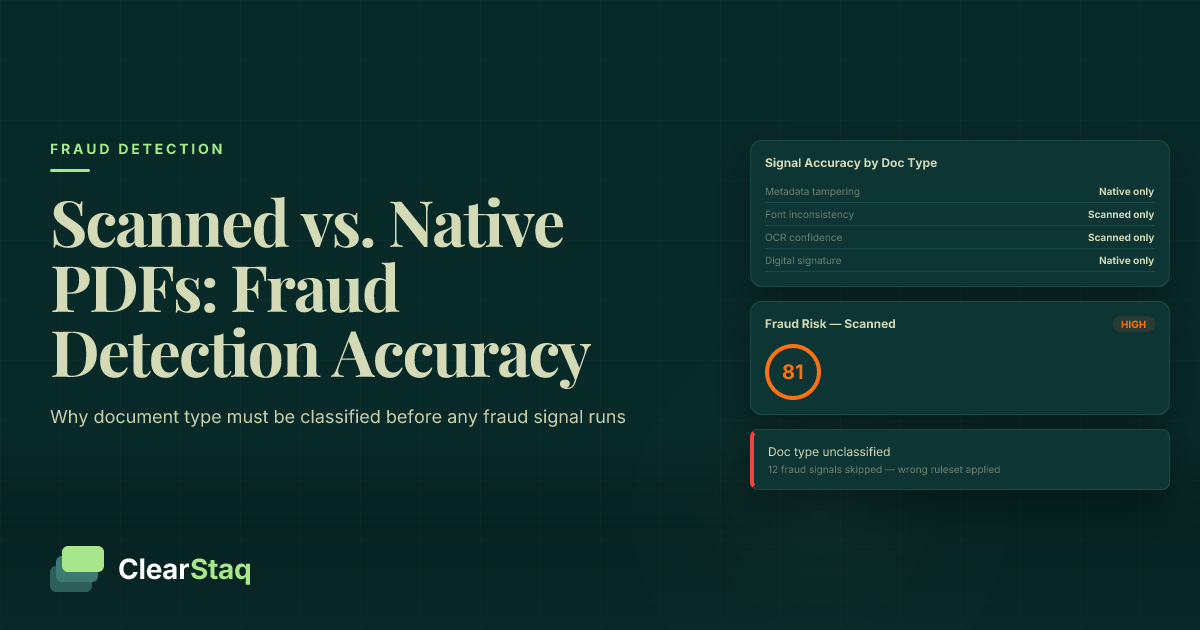
Can this software detect fraud automatically? Format-aware tools like ClearStaq run pattern detection — round-number deposits, structuring near reporting thresholds, altered metadata — across 27+ signals per statement. Basic OCR tools do not; they only extract text.
How long does bank statement parsing take? ClearStaq processes a statement in under 5 seconds. Legacy OCR tools typically run 30 seconds to a few minutes. Manual review of three months of statements commonly takes an underwriter 30-60 minutes per file.
Does bank statement analysis software help with NCUA exam readiness? A tool with a documented, signal-level audit trail helps — examiners want to see what triggered a flag, not just a final score. A black-box risk score with no breakdown can create more exam risk than it solves.
How accurate is AI bank statement parsing? ClearStaq runs at 99.5% accuracy across format-diverse test sets, including non-standard statement layouts. Accuracy claims that don't specify format diversity are worth questioning — clean test files inflate the number.
What formats does bank statement analysis software need to support? At minimum, the major national banks plus regional and community bank formats your member base actually uses. ClearStaq covers 900+ format variations; tools limited to the top five banks will kick back exceptions on a meaningful share of member files.
Is fraud detection different from bank statement parsing? Yes. Parsing extracts the data — transactions, balances, dates. Fraud detection analyzes that data for patterns like commingled funds, structuring, or income smoothing. A tool that only does the first isn't solving the underwriting risk problem.
One last thing
Most structuring fraud isn't one big red flag — it's three or four small deposits spread across a week, each individually unremarkable, that only look wrong when a machine cross-references timing and amount across the full 90-day window. That's the pattern a tired underwriter on file 40 of the day is least likely to catch by hand, and it's exactly the gap format-aware parsing closes in 2026.
Related guides
ClearStaq Team
Content Team
The ClearStaq team builds AI-powered tools for bank statement parsing, fraud detection, and income verification.