Income verification software for insurance premium finance companies parses an applicant's bank statements, tax returns, and pay records to confirm repayment capacity before the loan funds, so the finance company can approve good accounts in minutes instead of days. Premium finance loans run 9-12 months, are collateralized by unearned premium, and cancel automatically if a payment is missed — which means the underwriting window is short and the income signal has to be right the first time.
- ClearStaq processes bank statements and tax documents in under 5 seconds with 99.5% accuracy across 900+ formats.
- Income verification software for insurance premium finance companies must catch fraud fast because loan terms run 9-12 months with automatic cancellation clauses.
- 27+ AI fraud signals flag doctored pay stubs, income smoothing, and shell-account deposits before a premium finance loan funds.
- Manual bank statement review still works at low volume, but it caps out once agent-sourced applications pass a few dozen a month.
Why income verification matters for insurance premium finance companies
Most premium finance volume comes through insurance agents, not direct applicants, which means the finance company rarely meets the borrower and has to trust documents it did not originate. A missed payment does not just risk a charge-off — it triggers a cancellation notice to the carrier, and the unearned premium refund covers principal, not the underwriting cost of the deal.
That structure changes what income verification has to catch. A borrower who looks fine on a static credit pull can still be running negative cash flow that only shows up in 60-90 days of bank statement history. Small commercial accounts — contractors, restaurants, trucking outfits — carry seasonal revenue swings that a single-month snapshot misses entirely, and self-employed applicants routinely submit pay stubs that do not match what actually lands in the account.
Verdict: income verification software for insurance premium finance companies works best when it reads bank statements and tax documents together, because premium finance underwriting in 2026 has no time to wait on a second data pull.
How to build the income verification workflow
Step 1: Pull every income document up front
Do not underwrite off a credit score and a stated income field. Pull the full document set before the file reaches a decision.
- Request 2-3 months of business bank statements, not one
- Collect the most recent tax return or transcript for self-employed and commercial applicants
- Ask for pay stubs or 1099s when the borrower is an individual, not a business entity
- Flag any file missing a document type before it reaches underwriting
- Log the document source, agent-submitted versus borrower-submitted, for later fraud review
Step 2: Read the bank statements for real cash flow, not stated income
Manual review means opening PDFs line by line and tallying deposits against expenses — workable at low volume, painful past 50 files a month. Bank statement analysis software for insurance premium finance replaces that pass with automated categorization of deposits, NSF fees, and recurring debits.
- Separate payroll, transfers, and one-time deposits from operating revenue
- Treat NSF or overdraft fees as a repayment-risk signal, not a footnote
- Normalize monthly averages across the full statement period instead of the best month
- Cross-check stated income on the application against actual deposit totals
- Note any single deposit that accounts for more than a third of monthly revenue
Step 3: Screen every file for fraud signals before funding
This is where ClearStaq's 27+ AI fraud signals do work a single underwriter cannot do at volume: detecting doctored PDFs, income smoothing, and metadata mismatches in seconds instead of a manual eyeball pass. Document fraud detection software for insurance underwriters covers this stage in detail.
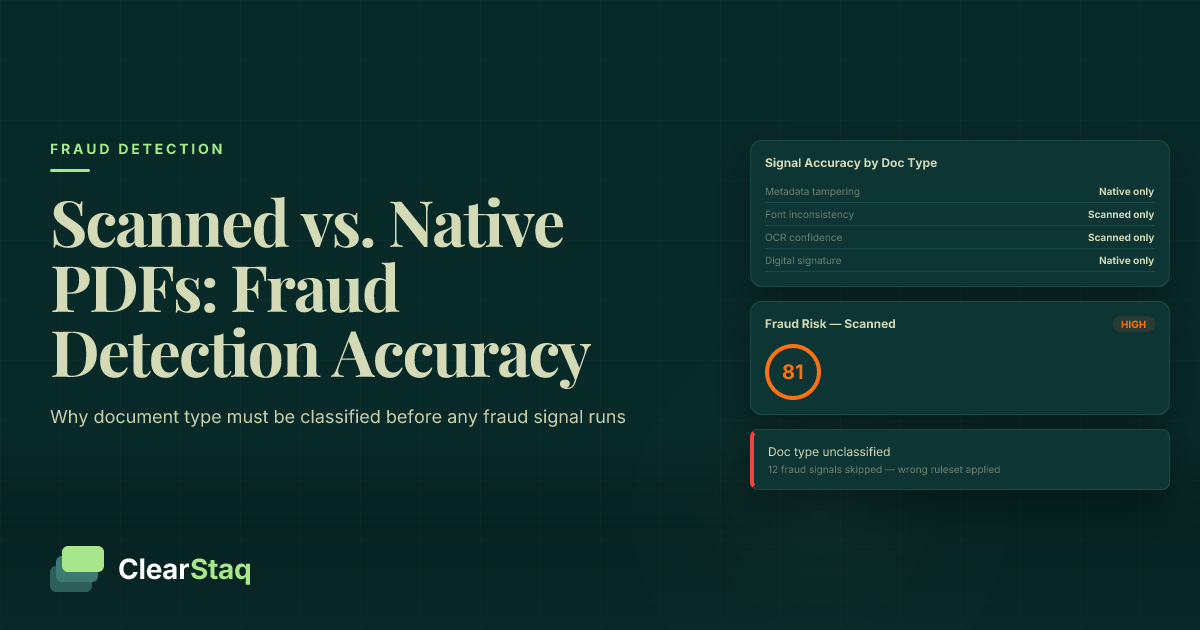
- Check document metadata for edits made after the statement date
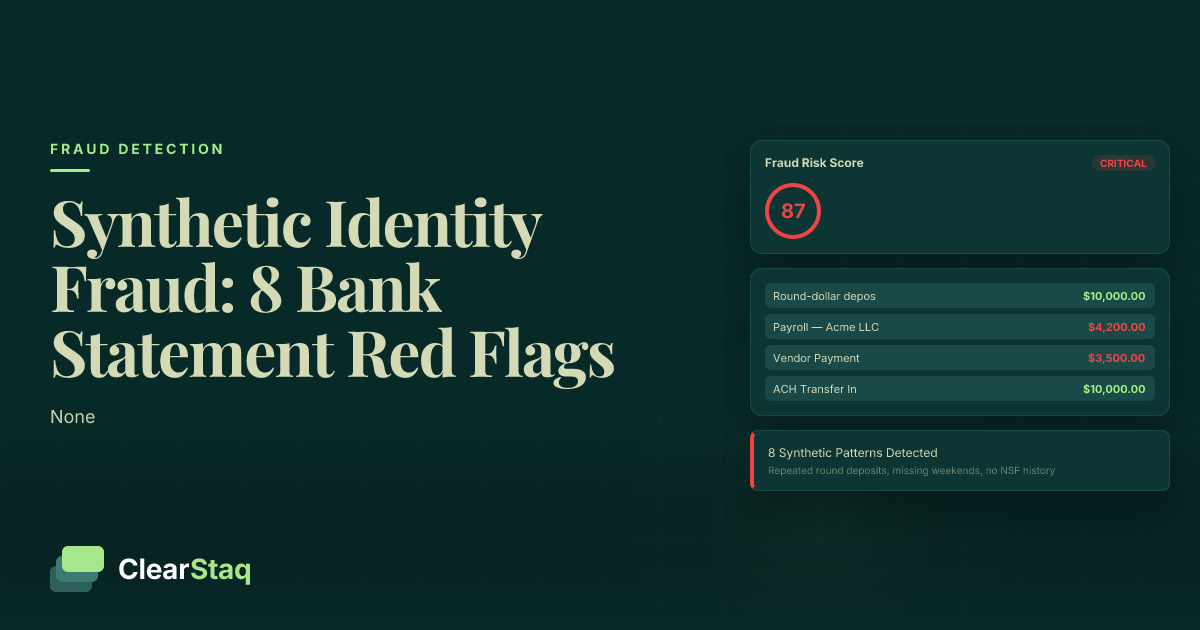
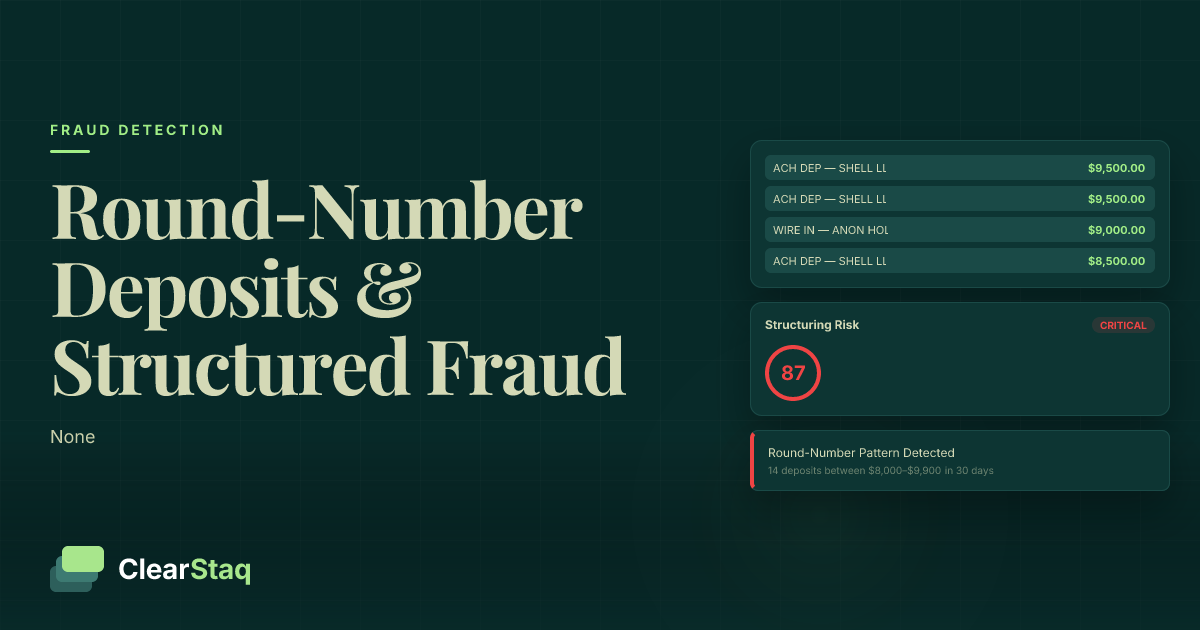
- Flag round-number deposits that do not match a payroll or invoice pattern
- Compare font and formatting consistency across pages of the same statement
- Watch for deposits that land right before submission and disappear right after
- Cross-reference bank routing numbers against known shell-account patterns
Step 4: Score self-employed and seasonal borrowers separately
A flat average across 12 months hides the fact that a landscaping company earns nothing in January and everything in July. Treat seasonal and self-employed files with a different model than salaried W-2 applicants.
- Weight peak-season months separately from off-season months
- Use trailing 12-month averages instead of trailing 3-month for seasonal industries
- Verify 1099 income against actual bank deposits, not the stated 1099 figure alone
- Check for gaps suggesting a business closed and reopened under a new name
Step 5: Automate the decision workflow, not just the document read
Once income and fraud signals are extracted, the file still has to route to a decision. Automating that hand-off is where most of the 95% review-time reduction shows up.
- Set auto-approve thresholds for files that clear every fraud signal and income test
- Route flagged files straight to a senior underwriter instead of a general queue
- Log every decision reason for audit and compliance review
- Push approved terms into the loan origination or agency management system
Step 6: Monitor the loan after it funds
Premium finance risk does not end at funding. A borrower's cash flow can deteriorate in month four and trigger a missed payment long before cancellation paperwork goes out.
- Re-pull bank statements at the 90-day mark for larger commercial accounts
- Watch for new NSF activity that was not present at underwriting
- Flag accounts with declining average balances even while payments stay current
Agents originate most of this volume, and the underwriting logic behind bank statement loans for insurance agents applies directly to how a finance company should score its own agent-sourced book: consistent cash flow beats high cash flow every time a file comes up for renewal in 2026.
Comparing income verification options for premium finance companies
| Option | Best for | Key limitation |
|---|---|---|
| Manual statement review | Very low file volume, single-underwriter shops | Does not scale past a few dozen files a month; slow on seasonal accounts |
| Generic OCR document tools | Digitizing paper files | Extracts text but does not score fraud risk or income patterns |
| Credit bureau data alone | Fast initial screen | Misses real-time cash flow and never catches a doctored document |
| ClearStaq | Agent-sourced, high-volume premium finance underwriting | Needs digital bank statements or tax documents to parse; no value on cash-only files |
Verdict: manual review is fine below a few dozen files a month — past that volume, income verification software for insurance premium finance companies is the only way to hold review time down without adding headcount.
See ClearStaq on your own files
Run a real bank statement through the parser before you decide.
Common mistakes insurance premium finance companies make
- Underwriting off a single month of bank statements. One good month hides a seasonal collapse that surfaces by month four of the loan.
- Trusting agent-submitted documents without a fraud check. Agents are not malicious, but they do not verify what a borrower hands them either.
- Treating self-employed applicants like salaried borrowers. Flat averaging punishes seasonal industries and approves the wrong files.
- Skipping post-funding monitoring. Cancellation risk builds in the months after funding, not at origination.
- Routing flagged files into the same queue as clean ones. That is how a real fraud signal gets buried under low-risk paperwork.
FAQ
What is income verification software for insurance premium finance companies?
It is software that parses an applicant's bank statements, tax returns, and pay documents to confirm repayment capacity before a premium finance loan funds. ClearStaq does this in under 5 seconds per document with 99.5% accuracy.
Why do premium finance loans need faster income verification than other loans?
Premium finance loans run 9-12 months and cancel automatically on a missed payment, so there is no room for a multi-day manual review before the policy is at risk. Fast verification catches bad files before funding rather than after cancellation.
How does fraud detection fit into premium finance underwriting?
Fraud detection screens submitted bank statements and tax documents for doctored PDFs, income smoothing, and metadata mismatches before the loan funds. ClearStaq applies 27+ AI fraud signals to every file at this stage.
Is manual bank statement review enough for a small premium finance company?
Manual review works below a few dozen files a month but stalls past that volume, especially with seasonal or self-employed applicants. Most companies switch to automated parsing once agent-sourced volume climbs.
Can income verification software handle seasonal businesses?
Yes, when it uses trailing 12-month averages instead of a 3-month snapshot. A flat 3-month average misprices risk for landscaping, restaurant, and other businesses with predictable off-seasons.
What documents does income verification software need to work?
Digital bank statements, tax returns or transcripts, and pay stubs or 1099s for individual applicants are the core set. ClearStaq reads across 900+ statement and document formats.
How much does income verification software cut review time?
Automated parsing and fraud screening can cut manual review time by roughly 95% versus a line-by-line read, based on aggregated processing data. The larger the agent-sourced file volume, the more that saving compounds.
Does income verification software replace an underwriter?
No, it scores the file so the underwriter reviews flagged cases instead of every case equally. Clean files auto-route to approval while flagged files go straight to a senior reviewer.
One last thing
The unearned premium refund backing a canceled premium finance loan covers principal only — not the underwriting cost, not the agent commission already paid, and not the income risk that caused the default. That is the real argument for catching bad income data at underwriting in 2026 instead of treating the cancellation clause as a safety net.
Related guides
ClearStaq Team
Content Team
The ClearStaq team builds AI-powered tools for bank statement parsing, fraud detection, and income verification.