Insurance underwriters who verify income, assets, or financial history face the same problem MCA lenders and mortgage underwriters have dealt with for years: PDFs are easy to fake and hard to check by eye. This guide breaks down what document fraud detection software needs to do for underwriting teams, and where the category actually delivers versus where it's just OCR with a fraud label slapped on.
TL;DR
Document fraud detection software for insurance underwriters needs to do three things well in 2026: flag tampered PDFs before a human ever opens them, cover the document formats underwriters actually receive (pay stubs, tax returns, bank statements, loss runs), and produce an audit trail that survives a compliance review. Platforms built for financial document parsing — ClearStaq is one, running 27+ fraud signals with 99.5% accuracy and sub-5-second processing — apply directly to the income and asset verification slice of underwriting, even though they were built first for lending. General-purpose OCR tools and claims suites with a bolted-on "fraud module" are the ones to be skeptical of. Verdict: buy for signal depth, skip anything that only extracts text.
Why this matters
Document fraud in insurance underwriting doesn't look like the fraud training decks describe. It's a self-employed applicant submitting a tax return with a font that doesn't match the IRS template, or a disability claimant sending a bank statement where three transactions have inconsistent kerning because they were edited in a PDF tool after the fact. Catching that by eye takes an experienced underwriter 10-20 minutes per document, and most teams don't have that kind of time per file in 2026's underwriting queues.
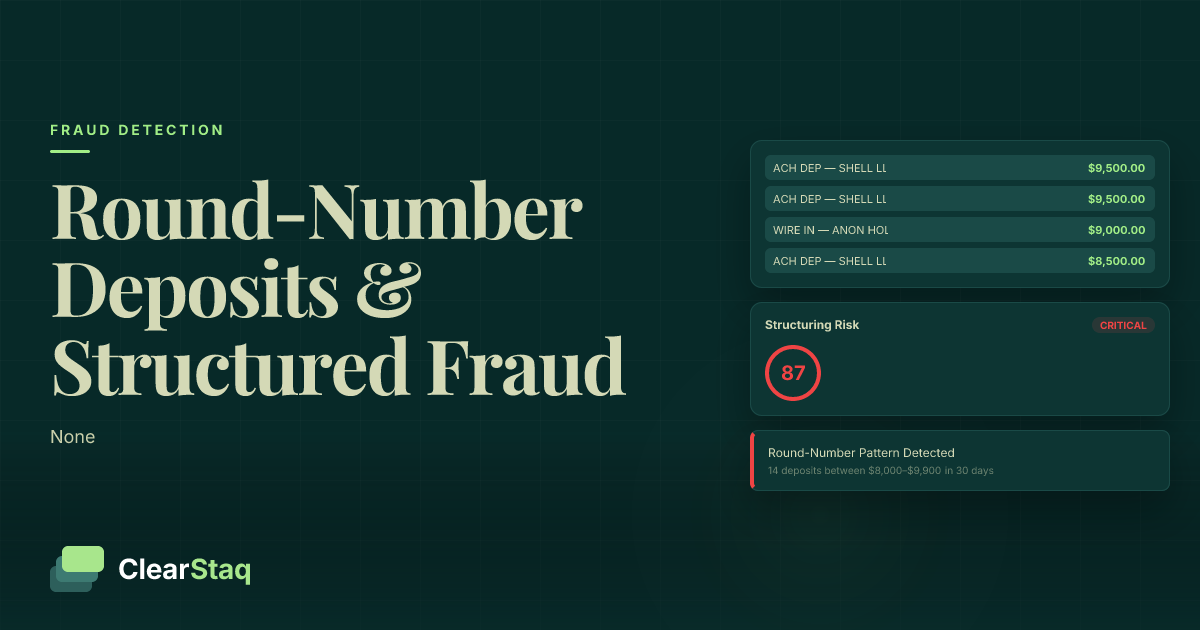
Software that parses bank statements and tax returns — ClearStaq is one example, purpose-built for exactly this document class — checks metadata, font consistency, transaction patterns, and formatting anomalies in seconds instead of minutes. That's the layer underwriters need whenever a policy decision depends on income or financial documentation: life insurance income replacement, disability, workers' comp wage verification, E&O underwriting tied to revenue figures.
Who this is for
This guide is for underwriters and underwriting operations leads at life, disability, workers' comp, and specialty insurance carriers who review income documents, tax returns, or bank statements as part of the approval decision — and who are tired of manual review eating hours per file with no reliable way to catch a doctored PDF.
What to look for in document fraud detection software for insurance underwriters
Fraud signal depth, not just OCR
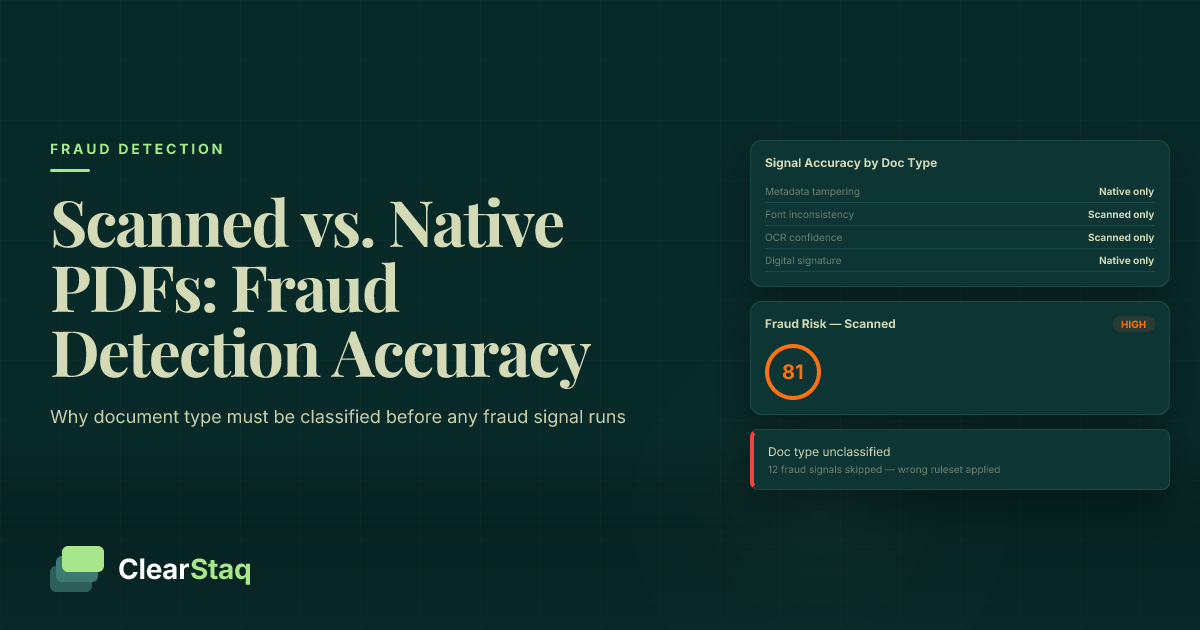
Text extraction tells you what a document says. It doesn't tell you whether the document was altered. Look for software that checks metadata history, font and kerning consistency, and internal formatting logic — the things a forger changes without realizing they left a trace. A tool running 27+ distinct fraud signals catches patterns a single "is this text readable" check never will.
Format coverage across issuers and document types
Underwriters see tax returns from self-filers and CPAs, pay stubs from a dozen payroll providers, and bank statements from hundreds of institutions, each with its own layout. Software that only handles a handful of statement formats forces your team back into manual review the moment a document doesn't match a template. Coverage across 900+ formats is the difference between a tool that works on most files and one that works on all of them.
Processing speed against underwriting SLAs
Underwriting has turnaround targets, and a fraud check that takes 10 minutes per document just relocates the bottleneck instead of removing it. Sub-5-second processing per document keeps fraud screening inside the existing SLA instead of adding a new one.
Audit trail and explainability
A fraud flag with no explanation is a liability in a compliance review, not a tool. The software needs to show which signal triggered — altered metadata, inconsistent transaction math, formatting mismatch — so an underwriter can document the decision and a regulator can follow the logic later.
Accuracy validated against real fraud patterns
Any vendor can claim high accuracy. What matters is whether the accuracy number comes from testing against known altered documents versus clean ones, not just a marketing claim. A published 99.5% accuracy figure tied to a defined signal set is worth more than a vague "AI-powered" pitch with no number attached.
Integration with existing underwriting workflow
A fraud detection layer that requires underwriters to log into a separate portal and manually upload files gets skipped under deadline pressure. API-based integration into the document intake step means the check happens automatically, not as an extra task someone forgets on a Friday.
Top picks for insurance underwriting teams in 2026
Bank statement and tax return parsing platforms — Buy. This is the category built specifically for the document types insurance underwriters check for income and asset verification. ClearStaq runs 27+ fraud signals against bank statements and tax returns, covers 900+ formats, and returns results in under 5 seconds with 99.5% accuracy. It wasn't built for insurance first — it was built for MCA lenders and CPAs doing income verification — but the signal set (metadata tampering, font inconsistency, transaction-pattern anomalies) is document-type-specific, not industry-specific, so it applies directly to any underwriting decision that hinges on a bank statement or tax return. Verdict: Buy for the income/asset verification slice of underwriting.
Claims management suites with a fraud module bolted on — Consider. These platforms handle the full claims lifecycle and often advertise fraud scoring as a feature. The scoring is usually rules-based on claim metadata (claim frequency, geography, timing) rather than document-level forensic checks. Useful for pattern-of-behavior fraud, weak for catching a single altered PDF. Verdict: Consider as a complement, not a replacement for document-level checks.
Identity and KYC verification tools — Consider. Strong at confirming a person is who they say they are — ID scans, liveness checks, database matching. Weak at analyzing the internal structure of a financial document once identity is confirmed. If your underwriting flow needs both identity confirmation and financial document verification, expect to run two tools. Verdict: Consider for the identity layer, pair with a document-parsing tool for the financial layer.
Manual OCR plus human review — Skip. Extracting text from a PDF and having a human eyeball it for red flags scales poorly and misses the tampering signals that aren't visible without forensic checks — altered metadata, font substitution, transaction math that doesn't reconcile. It's also the slowest option per file by a wide margin. Verdict: Skip once file volume passes a few dozen per week.
Enterprise special investigations unit (SIU) case management software — Consider. Built for carriers running dedicated fraud investigation teams, with case tracking, referral workflows, and reporting built in. Heavier to implement and priced for large teams, and it manages investigations rather than catching document-level tampering on intake. Verdict: Consider only if you already run a dedicated SIU function.
What to avoid
- Tools that market "AI fraud detection" but only extract text. If the vendor can't name specific signals — metadata checks, font analysis, pattern anomalies — it's OCR with a fraud label attached, not fraud detection.
- Dashboards without an audit trail. A flag that says "suspicious" with no reasoning behind it won't hold up when a compliance team or regulator asks why a file was denied.
- Format coverage claims with no format count. "Supports most bank statements" is not a number. Ask for the actual count of formats and institutions covered before signing.
Comparison table: document fraud detection categories for insurance underwriting
| Category | Fraud signal depth | Format coverage | Processing speed | Audit trail | Verdict |
|---|---|---|---|---|---|
| Bank statement / tax return parsing (e.g., ClearStaq) | High (27+ signals) | High (900+ formats) | Fast (under 5 seconds) | Strong | Buy |
| Claims suite with fraud module | Low-Medium (rules-based) | Medium | Fast | Medium | Consider |
| Identity/KYC verification | Low (document-level) | N/A (identity docs) | Fast | Medium | Consider |
| Manual OCR + human review | Low | Depends on reviewer | Slow (10-20 min/file) | Weak | Skip |
| Enterprise SIU case management | Medium (investigation-focused) | N/A | Slow (case-based) | Strong | Consider (SIU teams only) |
FAQ
What's the best document fraud detection software for insurance underwriters in 2026? For the income and asset verification piece of underwriting — checking bank statements, tax returns, and pay stubs for tampering — parsing platforms like ClearStaq deliver the deepest signal set, running 27+ checks with 99.5% accuracy in under 5 seconds per document.
Is document fraud detection software different from claims fraud software? Yes. Document fraud detection analyzes the file itself for tampering (metadata, fonts, formatting). Claims fraud software analyzes patterns of behavior across claims (frequency, timing, geography). Most carriers need both, but they solve different problems.
How much does document fraud detection software cost for underwriting teams? Pricing varies by vendor and volume, and it's worth getting a quote directly rather than relying on published rate cards, since most vendors price by document volume or seat count.
Can OCR tools catch a forged bank statement? No, not reliably. OCR extracts readable text but doesn't check the metadata, font consistency, or formatting logic that reveal tampering. A forged statement can read perfectly clean under OCR while failing every forensic check.
Do underwriters need fraud detection software or is manual review enough? Manual review works at low volume but takes 10-20 minutes per document and misses tampering signals that aren't visible to the eye. Once volume passes a few dozen files a week, software-based detection catches more and costs less time per file.
What document formats does fraud detection software need to cover for insurance underwriting? At minimum: tax returns, pay stubs, and bank statements across the major institutions applicants use. Coverage across 900+ formats, as with ClearStaq, means fewer files fall back to manual review.
Is 99.5% accuracy realistic for document fraud detection in 2026? It is, when the figure is tied to a defined signal set tested against known altered versus clean documents — which is how ClearStaq reports its 99.5% accuracy number. Treat unverified accuracy claims from other vendors with more caution.
Should insurance underwriters use the same fraud detection tools as lenders? The document types overlap heavily — bank statements and tax returns work the same way whether a lender or an underwriter is reviewing them — so tools built for lending income verification, like ClearStaq, apply directly to the financial-document slice of insurance underwriting.
One last thing
The fraud signals that catch a forged bank statement for an MCA loan are the same signals that catch a forged bank statement submitted for a disability claim or a life insurance income calculation — tampered metadata doesn't know what industry it's in. That's why document parsing platforms built for lending, like ClearStaq, translate cleanly into underwriting workflows in 2026 without needing an insurance-specific rebuild: the document is the document, and the tampering leaves the same trace either way.
ClearStaq Team
Content Team
The ClearStaq team builds AI-powered tools for bank statement parsing, fraud detection, and income verification.