KYC verification software for insurance carriers checks applicant identity, screens for sanctions and PEP exposure, and verifies the financial documents behind large or cash-value policies before a carrier binds coverage or disburses a premium finance loan. Carriers face a narrower but sharper set of KYC problems than banks: permanent life and annuity products carry AML obligations under federal rule, premium finance arrangements move real money before underwriting is final, and commercial policies often hide ownership behind layered entities.
- KYC verification software for insurance carriers works as a stack: identity checks, sanctions/PEP screening, and financial document verification, not one tool.
- ClearStaq verifies income and source of funds and flags document fraud with 27+ AI signals - pair it with an identity verification vendor, don't replace one with it.
- Premium finance and cash-value life policies need source-of-funds checks that generic KYC tools skip in 2026.
- Manual review holds up to roughly 50 applications a month; past that, carriers need automated document parsing to keep binding timelines intact.
Why KYC verification matters for insurance carriers
FinCEN's 2005 rule requires insurance companies to run anti-money-laundering programs on "covered products" - permanent life insurance, annuity contracts, and other products with cash value or investment features. That means source-of-funds checks aren't optional on the policies carriers write the most premium on.
Premium finance adds a second pressure point. A borrower takes a loan to pay annual premium on a large life policy, and the carrier or its finance partner is underwriting a loan applicant, not just a policyholder. Fabricated income documents or a shell-company premium finance vehicle can slip past identity checks that only confirm a name matches a government ID.
Commercial lines carry a third problem: beneficial ownership. A commercial general liability or property policy written to an LLC with three layers of holding companies needs KYB-style verification, not just KYC on the person who signed the application. ClearStaq parses the bank statements and tax documents behind these applications and scores them against 27+ fraud signals in under 5 seconds - useful context before layering in identity and sanctions checks below.
The KYC verification stack insurance carriers need in 2026
Building this out manually is possible under a certain volume. Past that, the stack below is what separates carriers who catch fraud before binding from carriers who find out during a claim.
Map your KYC obligations across policy lines
Not every policy needs the same depth of check. Term life with no cash value carries lighter AML obligations than a variable annuity.
- List every product line and flag which ones fall under the FinCEN covered-products definition
- Separate premium finance applications from cash-pay applications - they need different document checks
- Flag commercial policies above a chosen premium threshold for beneficial ownership review
- Note which state insurance departments require additional anti-fraud filings
- Build a decision matrix so underwriters know which check applies to which policy type
Verify identity documents before binding coverage
Confirm the applicant is who they say they are before any other check runs. This is table stakes, and it's the one part of KYC most carriers already have in some form.
- Check government ID against a liveness or selfie match for applications taken outside a face-to-face meeting
- Cross-reference the ID address against the application address and flag mismatches
- Confirm the applicant's date of birth against actuarial rating inputs, not just identity
- Route any document that fails automated confidence scoring to manual review
- Keep a timestamped log of every identity check for audit purposes
Screen for sanctions, PEP, and adverse media
Every applicant and every beneficial owner on a commercial policy needs a name run against OFAC and other sanctions lists, plus a politically exposed persons check on large policies.
- Screen at application and re-screen at renewal, not just once at binding
- Set match-confidence thresholds high enough to cut false positives without missing real hits
- Extend screening to named beneficiaries on large life policies, not just the policyholder
- Document every screening result, including near-misses that were cleared manually
- Pull adverse media checks on commercial applicants tied to industries with elevated fraud rates
Verify source of funds and income for large or cash-value policies
This is where most carriers under-invest. A large premium payment or a premium finance loan needs the same income scrutiny a lender applies before approving a loan.
- Pull bank statements covering at least the trailing 3-6 months for premium finance applicants
- Cross-check stated income against deposit patterns in the account
- Flag large, unexplained cash deposits ahead of a premium payment
- Verify tax returns against reported income for high-face-value policies
- Confirm the funding source is the applicant's own account, not a third party structuring payments
Bank statement analysis for insurance premium finance covers the format-level detail on how this check runs when premium finance is in the mix.
Detect document fraud in application paperwork
Applicants and, occasionally, agents submit altered bank statements, doctored tax transcripts, or fabricated pay stubs to get a policy approved or a premium finance loan funded.
- Check for font, alignment, and metadata inconsistencies that flag edited PDFs
- Compare running balances across pages for arithmetic that doesn't reconcile
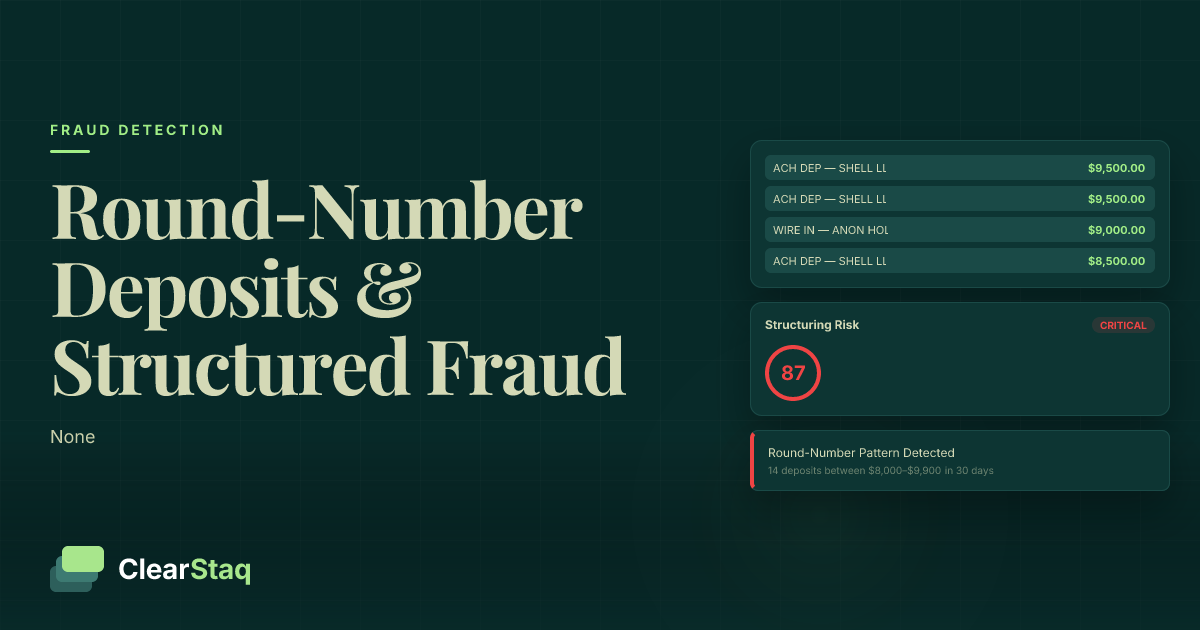
- Flag round-number deposits that don't match typical payroll or business deposit patterns
- Cross-reference bank name and routing number against the stated financial institution's known formats
- Route any document with a low authenticity confidence score to a human underwriter before binding
See ClearStaq's fraud signals in action
27+ AI signals flag fabricated income and bank statement fraud in under 5 seconds.
Monitor for ongoing red flags after binding
KYC doesn't end at issuance. Beneficiary changes, sudden coverage increases, and early large claims all warrant a second look.
- Re-run sanctions screening on any newly added or changed beneficiary
- Flag policies with a claim filed inside the contestability period for underwriting review
- Watch for rapid free-look cancellations tied to the same agent or address
- Track premium finance loans that go delinquent shortly after a large claim payout
- Set an internal threshold for coverage-increase requests that trigger re-verification
Document your KYC decision trail for regulators
State insurance departments and, on covered products, FinCEN examiners want to see the reasoning behind every approval, not just the outcome.
- Log every screening hit, clearance, and manual override with a named reviewer
- Retain source documents and verification results for the period your state requires
- Build a standard file format so an examiner can reconstruct any decision without re-interviewing underwriters
- Run periodic internal audits on a sample of approved policies to catch drift in reviewer judgment
Comparing KYC verification options for insurance carriers
| Option | Best for | Key limitation |
|---|---|---|
| Manual compliance review | Carriers writing under roughly 50 applications a month | Slow during renewal season, inconsistent between reviewers |
| Standalone identity verification (IDV) vendors | Confirming government ID and liveness at application | Doesn't parse bank statements or verify income and source of funds |
| Sanctions/PEP screening tools | Meeting OFAC and PEP screening obligations | Catches list matches, not fabricated financial documents |
| ClearStaq document and fraud layer | Verifying income, source of funds, and catching fabricated bank statements or tax returns on premium finance and large policy applications | Not a full identity verification suite - pairs with an IDV vendor and a sanctions screening tool |
The verdict: no single vendor covers identity, sanctions, and financial document fraud for insurance carriers in 2026 - build the stack from three specialized layers instead of one all-in-one tool.
Common mistakes insurance carriers make on KYC
- Treating KYC as a one-time gate at binding. Beneficiary changes and renewal cycles need re-screening, not a single pass.
- Skipping source-of-funds checks on premium finance deals. A loan-funded premium needs the same income scrutiny a lender applies, and most carriers don't apply it.
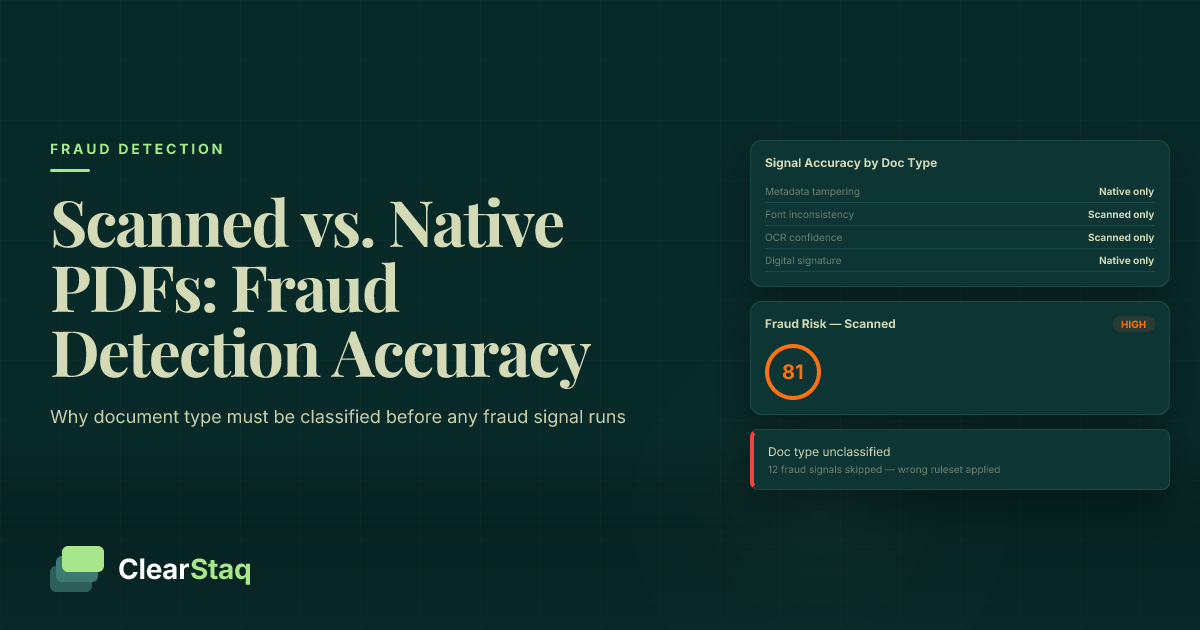
- Accepting scanned financial documents without an authenticity check. A doctored bank statement passes a human glance far more often than it passes format-level parsing.
- Screening only the policyholder on commercial lines. Beneficial owners behind an LLC need the same sanctions and PEP checks as the named applicant.
- Relying on sanctions screening alone. A clean OFAC result says nothing about whether the income documents behind the application are real.
FAQ
What is KYC verification software for insurance carriers?
It's software that checks applicant identity, screens names against sanctions and PEP lists, and verifies the financial documents behind large or cash-value policy applications. Most carriers assemble this from two or three specialized tools rather than one platform.
Do insurance carriers have to comply with AML and KYC rules?
Yes, for covered products. FinCEN's 2005 rule requires AML programs for permanent life insurance, annuity contracts, and other products with cash value or investment features.
Is KYC required for every insurance policy type?
No. Term life with no cash value and most standard property and casualty policies carry lighter obligations than permanent life, annuities, and premium finance arrangements.
How does KYC differ for life insurance versus property and casualty?
Life and annuity products with cash value fall under federal AML covered-products rules and need source-of-funds checks. Property and casualty KYC focuses more on identity confirmation and, on commercial lines, beneficial ownership.
What's the difference between KYC and AML for insurance carriers?
KYC confirms who the applicant is; AML monitors the money behind the policy for signs of laundering, such as unusual premium finance structures or large unexplained cash payments.
How much does KYC verification software cost for insurance carriers?
Pricing varies by application volume and how many layers of the stack - identity, screening, document verification - a carrier needs. Request quotes based on annual application volume rather than assuming a flat rate.
Can insurance carriers use lending-focused KYC and fraud tools?
Yes, for the financial document layer. Bank statement and tax return parsing built for lenders applies directly to premium finance underwriting and large cash-value policy applications.
What documents should insurance carriers verify during onboarding?
Government-issued ID, bank statements covering at least 3-6 months for premium finance or large policies, tax returns for high-face-value applications, and entity documents for commercial policyholders.
One last thing
The gap that costs carriers the most in 2026 isn't the sanctions list miss - it's the fabricated bank statement that never gets a second look because the identity check already came back clean. Identity verification confirms a person; it says nothing about whether their income documents are real. Run financial documents through a fraud-detection layer with format-level checks before the underwriter signs off, especially on any policy funded through premium finance.
Related guides
ClearStaq Team
Content Team
The ClearStaq team builds AI-powered tools for bank statement parsing, fraud detection, and income verification.