Insurance premium finance companies underwrite loans against unpaid insurance premiums, not against cash or inventory, and that changes what your bank statement analysis needs to catch in 2026.
- ClearStaq processes premium finance borrower statements in under 5 seconds with 27+ fraud signals built in - Buy for underwriting teams with same-day binding deadlines.
- Generic OCR tools without fraud logic miss doctored voided checks and commingled funds - Skip for premium finance underwriting.
- Bank statement analysis software for insurance premium finance companies should flag seasonality before it flags a decline - Consider seasonality-aware engines for construction and agriculture books.
- Manual spreadsheet review still runs 4-8 hours per file in 2026 - automated parsing cuts that to minutes.
Why this matters
Premium finance loans carry short terms, thin collateral, and effective dates that don't wait for a manual review queue. If a policyholder's binder needs funding by Friday, a three-day statement review kills the deal or forces you to bind on faith.
That's the gap bank statement analysis software closes for premium finance underwriters. It reads the statement, scores the borrower's cash flow, and flags fraud signals before your team ever opens the PDF - in seconds, not days.
The stakes are different from a typical small-business loan too. A premium finance default doesn't just cost you the loan balance - it can trigger a policy cancellation and leave the insured uninsured mid-term. Underwriting accuracy carries downstream risk that a term loan doesn't.
Who this is for
This guide is for underwriting and risk teams at insurance premium finance companies - the ones financing commercial P&C, E&O, D&O, and workers' comp premiums for agency clients who pay in installments instead of upfront. If your team reviews borrower bank statements to confirm the down payment source, assess repayment capacity, or catch a doctored voided check before disbursement, the criteria below apply directly to you.
What to look for in bank statement analysis software for insurance premium finance companies
Format coverage across bank and agency platforms
Premium finance borrowers bank everywhere - regional banks, credit unions, and agency trust accounts with nonstandard statement layouts. A parser that only reads five major bank formats forces your team back into manual review for the accounts that need the most scrutiny.
Fraud signal depth, not just OCR accuracy
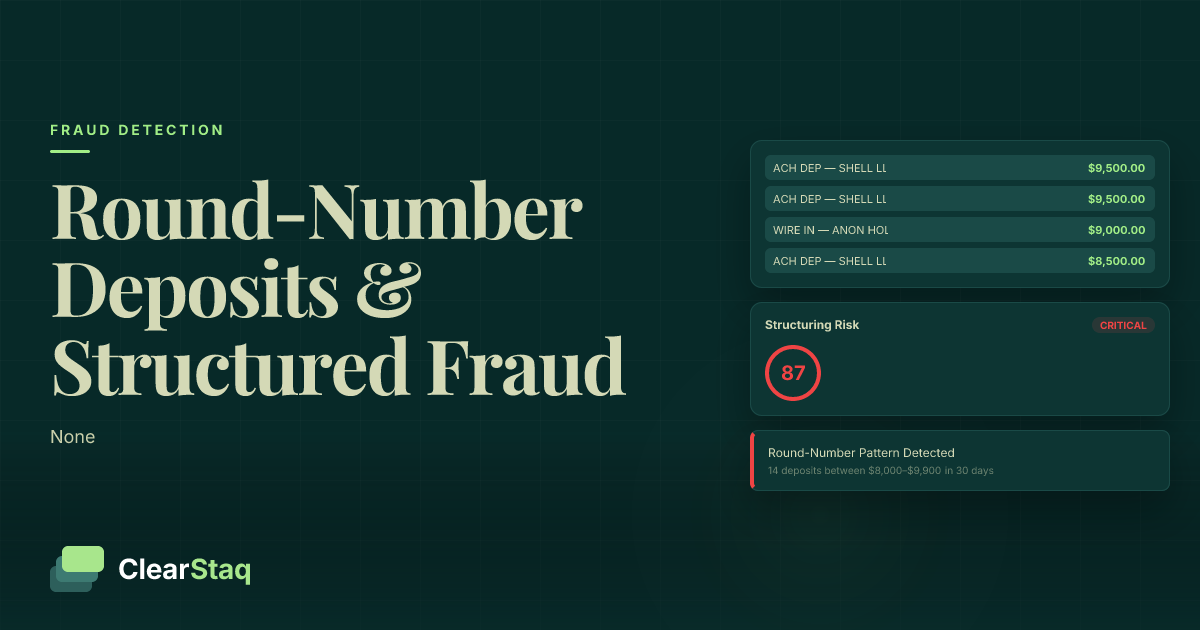
OCR that extracts numbers correctly still misses a doctored balance or an altered voided check. Premium finance underwriting needs signal-level detection - structuring patterns, commingled personal and business funds, and edited PDFs - not just clean text extraction.
Turnaround speed tied to binding deadlines
A policy effective date doesn't move for your underwriting queue. Software that takes hours per file to parse and score creates a bottleneck exactly where speed matters most - between binder issuance and premium disbursement.
Cash flow seasonality for policyholder industries
Construction, agriculture, and hospitality clients show seasonal revenue swings that look like decline if you only view three months of statements. Software that normalizes 12 months of activity protects you from declining a borrower who's simply between busy seasons.
Integration with agency management systems
Parsing output that sits in a standalone dashboard forces double entry into your loan management or agency management system. Software that pushes structured data via API into your existing workflow saves the review time you just gained from faster parsing.
Audit trail for compliance and E&O exposure
State insurance regulators and E&O carriers want documentation of how a premium finance decision was made. Software that logs every fraud signal and cash flow calculation gives you that record without a separate compliance step.
Top picks
The fraud-signal pick: automated document fraud detection Built for underwriters who see borrowers with thin credit files and short banking history. ClearStaq's approach layers document fraud detection for insurance underwriters on top of parsing, running 27+ signals per statement instead of relying on a single red flag. Verdict: Buy for any premium finance shop that funds within 24-48 hours of binding.
The doctored-statement pick: fake statement detection The spec that matters here is detection of altered PDFs and edited balances, not just missing-page checks. Guidance on how to detect fake bank statements in loan applications covers the specific patterns - metadata mismatches, font inconsistencies, altered running totals - that a fraud borrower relies on you not checking. Verdict: Buy for teams financing premiums for new agency relationships without prior payment history.
The seasonality pick: cash flow underwriting engines The number that matters: 12 months of statement data versus the 3-month snapshot most manual reviews use. Cash flow underwriting software for small business lenders shows how normalizing a full year of revenue protects against declining seasonal policyholders during their slow months. Verdict: Consider if your book skews toward contractors, farms, or seasonal retailers.
The skip: generic OCR without a fraud layer Generic OCR extracts text fine but has no fraud scoring underneath it - it will happily hand you clean numbers pulled from an altered statement. It reads fast and looks accurate on the surface, which is exactly why it's dangerous in premium finance underwriting. Verdict: Skip for any file where the down payment source needs verification.
See how fast fraud-aware parsing runs
Check statement parsing and fraud signal detection on your own files.
What to avoid
- Static PDF-to-text tools with no fraud logic. They pass audits on speed but miss the doctored voided checks and altered balances that cause premium finance losses.
- Single-point-in-time statement snapshots. A 60-day window looks like decline for a seasonal contractor and looks like growth for a borrower who just got a one-time deposit. Neither tells you the real repayment picture.
- Manual spreadsheet review as your only fraud check. It costs 4-8 hours per file in 2026 and still misses signals a trained fraud reviewer would need software to catch consistently across volume.
Verdict comparison
| Approach | Speed | Fraud signal depth | Best for | Verdict |
|---|---|---|---|---|
| Fraud-aware parsing | Under 5 seconds | 27+ signals | Same-day binding deadlines | Buy |
| Doctored-statement detection | Minutes | High (metadata + balance checks) | New agency relationships | Buy |
| Seasonality-aware cash flow analysis | Minutes | Moderate | Seasonal policyholder books | Consider |
| Generic OCR, no fraud layer | Seconds | None | Nothing in premium finance | Skip |
| Manual spreadsheet review | 4-8 hours | Reviewer-dependent | Low-volume shops only | Skip |
FAQ
What is bank statement analysis software for insurance premium finance companies?
It's software that parses a policyholder's bank statements to verify income, assess repayment capacity, and flag fraud signals before a premium finance loan funds. In 2026, the better versions score both cash flow and document authenticity in the same pass.
How fast should statement parsing be for premium finance underwriting?
Under 5 seconds per document is achievable with current parsing engines. Anything measured in hours instead of seconds creates a bottleneck between binder issuance and premium disbursement.
What fraud signals matter most for premium finance loans?
Doctored voided checks, altered balances, and commingled personal and business funds top the list because premium finance down payments are a common fraud target. Software with 27+ signals catches patterns a single manual check would miss.
Is manual underwriting still viable for premium finance in 2026?
It's viable at low volume but costs 4-8 hours of review time per file and depends entirely on the reviewer's experience with fraud patterns. Most shops funding more than a handful of policies a week move to automated parsing.
Can bank statement analysis detect commingled personal and business funds?
Yes, format-aware parsers flag transaction patterns that indicate personal and business accounts mixing, which matters because commingled funds distort the cash flow picture a premium finance underwriter relies on.
Do premium finance companies need cash flow seasonality analysis?
Yes if any portion of the book covers seasonal industries like construction, agriculture, or hospitality. A 12-month statement view normalizes revenue and prevents declining a borrower who's simply between busy seasons.
What integrates with agency management systems?
Bank statement parsing software with an API layer pushes structured cash flow and fraud data directly into loan management or agency management systems, avoiding manual double entry.
How much does bank statement analysis software cost for premium finance underwriting?
Pricing varies by volume and by how many fraud signals and integrations are included, so check current terms directly with the vendor rather than assuming a flat rate.
One last thing
The underwriting mistake that costs premium finance companies the most isn't missing a fraud signal - it's declining a good borrower because a 3-month statement snapshot looked worse than a 12-month view would have shown. Fraud detection protects the downside; seasonality-aware cash flow analysis protects the deals you'd otherwise walk away from in 2026.
Related guides
ClearStaq Team
Content Team
The ClearStaq team builds AI-powered tools for bank statement parsing, fraud detection, and income verification.