Underwriting teams still burn 20-40 minutes per file manually reading bank statements line by line — this guide shows the exact workflow to cut that to under a minute using automated parsing and fraud detection in 2026.
TL;DR
Automating bank statement review means replacing manual PDF scanning with software that extracts transactions, flags fraud signals, and calculates income in seconds instead of hours. ClearStaq processes statements in under 5 seconds with 99.5% accuracy across 900+ bank formats, checking 27+ fraud signals including structuring, commingled funds, and doctored balances. Teams running this workflow in 2026 report review time drops by roughly 95% per file. Verdict: Buy if your team reviews more than 20 statements a month — the manual process doesn't scale past that volume without adding headcount.
Why this matters
Manual statement review is the single slowest step in most underwriting pipelines. An underwriter opening a 6-month PDF has to manually total deposits, flag NSF fees, check for round-number transfers that suggest structuring, and cross-reference balances against the stated ending figure — all before touching the actual credit decision.
That's not a skills problem. It's a volume problem. A lending team closing 150 deals a month at 30 minutes per statement review is spending 75 hours just reading PDFs — before underwriting even starts. In 2026, document fraud detection software for fintech lenders closes that gap by parsing the document and surfacing risk signals in the same pass, so the underwriter reviews a summary instead of a stack of pages.
The fraud angle matters as much as the speed angle. Doctored statements, altered PDFs, and income smoothing tricks are common enough that manual review alone misses them at scale — a human skimming for 90 seconds isn't going to catch a transaction that was edited in Photoshop.
What you'll need
- A parsing tool that reads raw statement PDFs — not OCR guesswork. ClearStaq's engine covers 900+ bank formats including Chase, Bank of America, and Wells Fargo layouts natively.
- A fraud signal checklist — structuring, commingled funds, income smoothing, altered metadata. You want 20+ signals checked automatically, not 3.
- API or upload access for your loan origination system, so parsed data lands where underwriters already work instead of a separate tab.
- A defined income calculation method — average monthly deposits, NSF count, and ending balance trend are the three numbers most underwriting teams anchor decisions to.
- Time: initial setup for most teams takes under a day. The workflow itself, once live, runs in under 5 seconds per statement.
The steps
1. Centralize statement intake
Stop accepting PDFs through five different channels — email, portal upload, fax, whatever the broker sends. Route everything through one upload point that feeds directly into your parsing tool.
This matters because scattered intake is why manual review balloons in the first place; someone has to hunt down the file before they can even start reading it. Set a single upload rule: statements come in through the LOS or the parser's API, nowhere else.
Common mistake: allowing brokers to submit screenshots or cropped images instead of the original PDF. Cropped files strip metadata that fraud detection tools rely on to catch alterations.
2. Run automated parsing on every file
Feed the statement into a parser built for financial documents, not a generic OCR tool. ClearStaq processes a statement in under 5 seconds and returns structured transaction data — deposits, withdrawals, fees, ending balance — without a human retyping a single number.
Accuracy here is the whole game. A tool claiming 90% accuracy on transaction extraction still means 1 in 10 line items needs manual correction, which erases most of the time savings. Look for 99%+ accuracy benchmarks before you commit.
Expected outcome: a clean transaction ledger per month, ready for the fraud and income checks in the next step.
3. Screen for fraud signals automatically
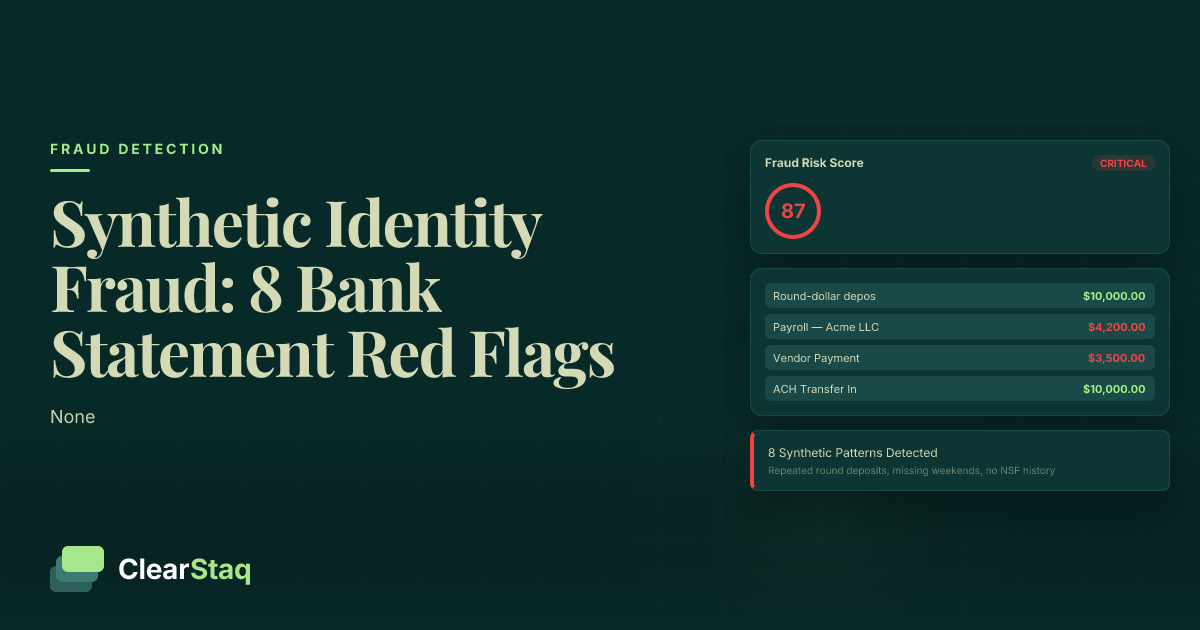
Every statement should pass through a fraud detection layer before an underwriter sees it. This is where structuring patterns, commingled personal and business funds, and doctored balances get flagged instead of missed.
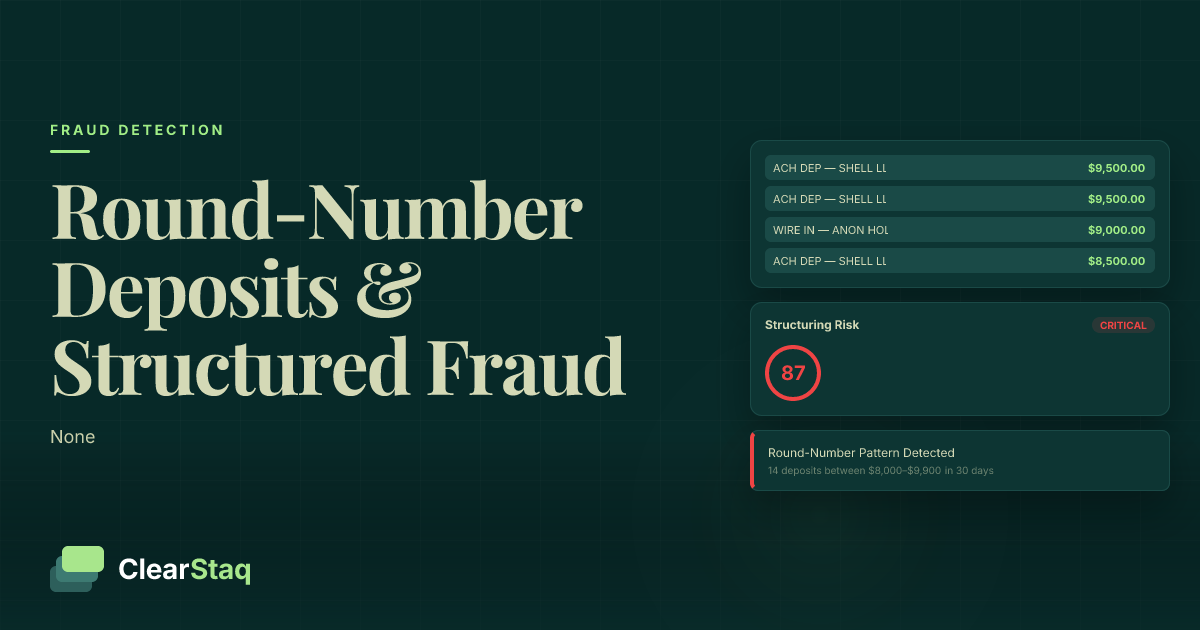
ClearStaq checks 27+ signals per statement — round-dollar deposits just under reporting thresholds, inconsistent running balances, metadata that doesn't match the claimed bank. If your team is manually eyeballing for these, you're catching a fraction of what an automated pass catches. See the structuring pattern breakdown for what these transactions actually look like on paper.
Common mistake: treating fraud screening as optional for "good" applicants. Fraud signals show up across credit tiers — skipping the check on lower-risk files is how the fraudulent ones slip through.
4. Calculate income and cash flow automatically
Once transactions are parsed and flagged, calculate average monthly revenue, NSF frequency, and balance trend without manual math. This is the step that most directly replaces underwriter hours — someone isn't summing 200 line items in a spreadsheet anymore.
For businesses with seasonal revenue, pull 12 months instead of 3. A 3-month snapshot from a landscaping company's slow season understates income by a wide margin, and a 12-month view normalizes that swing correctly.
Expected outcome: a single income figure and cash-flow trend line per applicant, generated the same way every time — no underwriter-to-underwriter variance in how the math gets done.
5. Set automated flag thresholds
Decide upfront what triggers a manual escalation versus an automatic pass. A file with zero fraud signals and stable deposits over 6 months might skip manual review entirely; a file with 2+ fraud flags routes straight to a senior underwriter.
This step is what actually saves the hours — without thresholds, every file still gets a human look regardless of risk, and you've automated the math but not the workload.
Common mistake: setting thresholds too loose, so 80% of files still escalate. Start conservative, then loosen thresholds after you've validated the automated calls against 60-90 days of outcomes.
6. Cross-check against commingled funds and income smoothing
Before final approval, run a specific check for commingled personal and business funds — a huge factor in small business lending where owners route both through one account. Also check for income smoothing, where deposits are timed or split to make revenue look more stable than it is.
The commingled funds detection guide covers the transaction patterns that indicate mixed accounts, and the income smoothing guide covers the deposit-timing tricks that inflate apparent stability.
Expected outcome: a risk-adjusted income figure, not just a raw average — this is the number that should actually drive the credit decision.
7. Route final files with a clean audit trail
Every automated decision needs a record — what was flagged, what threshold triggered escalation, what the parsed data showed. This isn't just compliance hygiene; it's what lets you audit false positives and tighten thresholds over time.
Common mistake: discarding the parsed data after the decision. Keep it. Six months from now you'll want to see why a specific file passed or failed.
Troubleshooting
- Parser misreads a statement format. Not all banks structure statements the same way — regional banks and credit unions in particular use non-standard layouts. Confirm your parsing tool explicitly supports the format; ClearStaq covers 900+ formats but always verify a new bank before trusting the output blind.
- Too many files still escalate to manual review. Your flag thresholds are too conservative. Pull 30 days of escalated files and check how many actually needed a human — recalibrate based on real outcomes, not gut feel.
- Income figure doesn't match what the applicant reported. Check whether the parser is pulling gross deposits or net after transfers between the applicant's own accounts — double-counted internal transfers are the most common cause of inflated income figures.
- Fraud flags feel like false positives. Round-dollar deposits and consistent transfer timing aren't automatically fraud — some businesses legitimately have simple, repetitive cash flow. Review flagged patterns against the underlying business type before dismissing the tool as too aggressive.
- Seasonal businesses get flagged for inconsistent income. Pull the full 12-month statement history instead of 3 months — seasonal swings look like instability in a short window and look normal across a full year.
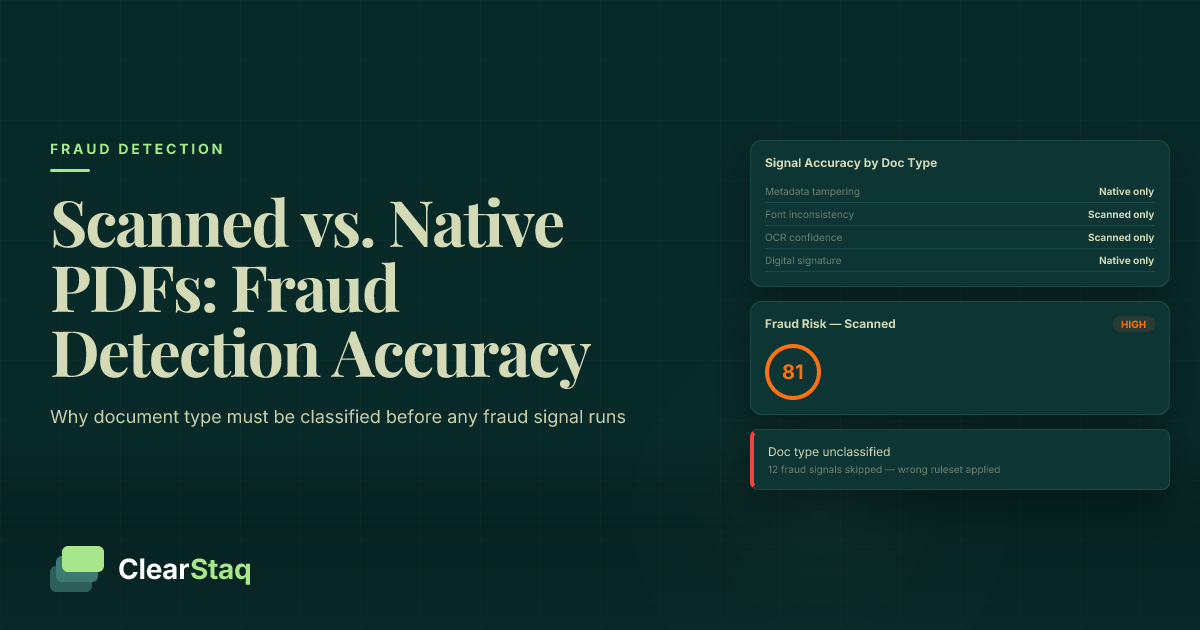
- Statement fails to parse entirely. Usually a corrupted PDF or a scanned image instead of a native digital file. Request the original statement directly from the applicant's bank portal rather than a forwarded copy.
Tools and resources
- ClearStaq — bank statement parsing, income verification, and 27+ fraud signal detection in one workflow
- How to spot structuring patterns in business bank statements
- How to detect commingled funds in business underwriting
- How to detect income smoothing in bank statement underwriting
- Your loan origination system's API documentation, for the intake step
What to do next
Once the review workflow is automated, the next risk to close is fake statements getting past intake entirely. The guide to detecting fake bank statements in loan applications covers the specific tells — font inconsistencies, metadata mismatches, altered running balances — that separate a doctored PDF from a legitimate one.
FAQ
What's the best way to automate bank statement review for underwriting? Route every statement through a parser that extracts transactions and screens for fraud signals in one pass, then set threshold rules so only flagged or high-risk files reach a human underwriter. ClearStaq does this in under 5 seconds per statement with 99.5% accuracy.
Is automated review more accurate than manual review? On transaction extraction, yes — automated parsing at 99%+ accuracy outperforms manual entry, which typically has a 3-5% error rate from fatigue and fast reading. On fraud detection, automated screening checks dozens of signals per file versus the 2-3 a human typically eyeballs.
How much does bank statement automation cost? Pricing varies by provider and volume — check current pricing directly with the vendor rather than relying on a published range, since most tools scale cost with statement volume.
Can automated tools detect doctored bank statements? Yes — tools built for fraud detection check metadata consistency, running balance math, and formatting against known bank templates, catching alterations a visual skim misses. See the fake statement detection guide for the specific patterns.
How long does it take to set up an automated review workflow? Most teams get a parsing and fraud detection tool integrated within a day, since the core setup is connecting an upload point or API to the existing loan origination system.
Does automation replace underwriters entirely? No — it replaces the manual reading and math, not the credit decision. Underwriters still make the final call on flagged files; automation just narrows what reaches them.
What fraud signals matter most in bank statement review? Structuring (transactions kept just under reporting thresholds), commingled personal and business funds, and income smoothing are the three most common patterns in loan and MCA fraud in 2026 — all three are checkable in an automated pass.
Should I use 3 months or 12 months of statements for income verification? 12 months, whenever the applicant's business has any seasonal variation — a 3-month window can understate or overstate income by a wide margin depending on which quarter it captures.
One last thing
The biggest time sink in manual review isn't reading the statement — it's the math afterward. Underwriters spend more time totaling deposits and checking balance consistency than they spend actually judging risk. Automate the arithmetic first; the judgment calls get faster on their own once the numbers are already sitting in front of the underwriter, correct.
Related guides
ClearStaq Team
Content Team
The ClearStaq team builds AI-powered tools for bank statement parsing, fraud detection, and income verification.