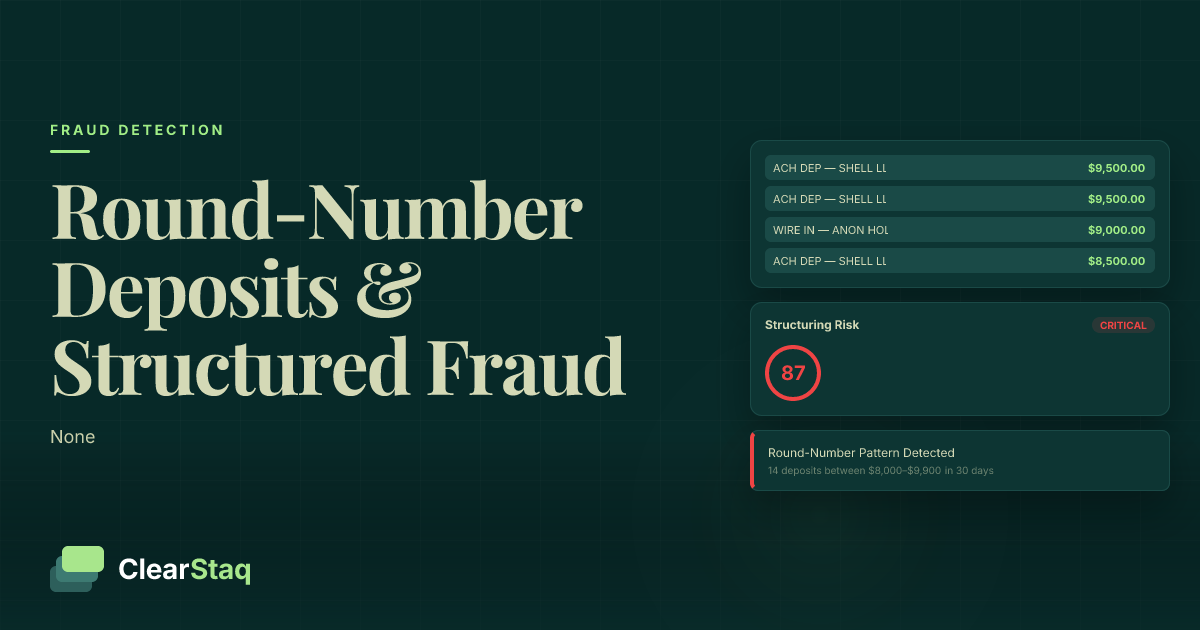
Shell company bank statements pass a first read easily because the numbers look clean — no messy overdrafts, no chaotic categories. That's exactly the problem: real operating businesses leave a messier trail than a shell does, and underwriters who only scan for red flags miss the ones hiding in plain sight.
- Shell company bank statements show clean deposits but no payroll, rent, or utility line items — that gap is the tell.
- Accounts under 90 days old with 3+ high-value round-dollar transfers deserve manual KYB review before funding.
- 27+ AI fraud signals catch commingled funds and pass-through patterns humans miss in a 10-minute skim.
- Verdict: treat missing operating expenses plus a recent EIN as a hard stop, not a soft flag, in 2026 underwriting.
Why this matters
MCA brokers and non-bank lenders fund on projected cash flow, which makes them the preferred target for shell company fraud — the applicant doesn't need years of tax returns, just a few months of bank activity that looks like revenue. A shell account with $180,000 in deposits and zero payroll can pass a glance-level review and still be a hollow shell moving money between related entities to inflate apparent revenue.
The cost of missing it isn't abstract. A funded shell defaults fast because there's no underlying business generating the cash — the money was borrowed, gifted, or routed from another account to make the statement look fundable. Catching it during underwriting, not after the first missed payment, is the only version of this that saves the loan.
What you'll need
- 3-6 months of business bank statements (12 months if the applicant claims seasonal revenue)
- Business registration and EIN issuance date from the applicant's state filing
- Beneficial ownership disclosure (KYB) for any signer on the account
- A tool that flags commingled funds and round-dollar transfer patterns — manual line-by-line review misses velocity patterns that automated signal detection catches
- Access to a sanctions/adverse media screen for the named owners
- 20-30 minutes per file if working manually, under 5 seconds per document with automated fraud detection
The steps
1. Check the account opening date against the application
An account opened 45-60 days before a loan application is a structural red flag, not a coincidence. Shell entities are often stood up specifically to generate a fundable-looking statement, so the account age tells you more than the balance does.
Pull the earliest transaction date on the statement and compare it to the business formation date on the state filing. A gap under 90 days between formation, account opening, and loan application is the single strongest single-variable predictor of a shell setup. Common mistake: underwriters check formation date but skip the bank account opening date, which is often the more recent — and more telling — of the two.
2. Map the money flow for pass-through patterns
Real operating revenue arrives from many counterparties — customers, clients, marketplaces. Shell accounts show the opposite: a small number of large deposits from one or two related entities, often followed by near-identical withdrawals within 24-48 hours.
This is textbook commingled funds behavior — money moving through the account rather than being generated by it. Flag any account where deposit-to-withdrawal timing is under 2 days on more than 30% of transactions. Common mistake: reviewers treat high account activity as a positive revenue signal without checking whether the funds actually stay.
3. Look for the absence of operating expenses
Every real business bleeds cash on the boring stuff: payroll, rent, utilities, insurance, supplier invoices. A statement with six figures in deposits and no recurring debits for any of these is a business that doesn't actually operate.
Run a line-item scan for recurring categories — even a small business spends $500-2,000/month on utilities and rent combined in most markets. Zero hits across 3+ months is disqualifying on its own. Common mistake: underwriters focus on deposit totals and skip the expense side entirely, which is where the shell pattern actually shows up.
4. Verify beneficial ownership and registered agent overlap
Shell networks reuse the same registered agents, addresses, and signers across multiple entities to save setup cost. Pull the KYB filing and check whether the registered agent address matches other loan files you've seen in the last 6-12 months.
Cross-reference the beneficial owner's name against any other applications in your pipeline — a signer connected to 3+ "different" businesses at the same address in 2026 is running a shell farm, not a business. Common mistake: KYB gets treated as a checkbox instead of a cross-file search.
5. Screen for round-dollar recurring transfers
Real customer payments rarely land on exact round numbers — invoices carry cents, tax amounts, discounts. Shell accounts frequently show transfers in clean denominations ($5,000.00, $10,000.00, $25,000.00) on a recurring schedule.
Flag any account where 40%+ of deposits are round-dollar amounts over $1,000. Structuring behavior below reporting thresholds shows a related but distinct pattern — see how to spot structuring patterns for the deposit-splitting variant. Common mistake: round numbers get dismissed as "just how this business invoices."
6. Cross-check EIN issuance date and tax filing history
A business claiming 2-3 years of operating history should have an EIN issued years ago, not months. Pull the IRS EIN confirmation letter date and compare it against the claimed years in business on the loan application.
An EIN issued within 90 days of the loan application, paired with claimed multi-year revenue, is a documentation mismatch worth an automatic decline pending explanation. Common mistake: EIN date gets checked at onboarding but never re-verified against the specific loan application's claimed timeline.
7. Run the file through automated fraud signal detection
Manual review catches maybe 3-4 of these patterns in a 20-minute pass. Automated detection scanning 27+ signals catches commingled funds, round-dollar clustering, velocity anomalies, and account age mismatches simultaneously, in under 5 seconds per statement.
Use the automated pass as a second opinion, not a replacement — flag any file scoring in the top risk tier for manual review before funding decisions. Common mistake: teams run automated checks post-funding instead of pre-approval, which defeats the purpose entirely.
Catch shell company patterns before funding
Scan bank statements for 27+ fraud signals in under 5 seconds.
Troubleshooting
The applicant provides 12 months of statements with no gaps, but the business is only 4 months old. Statement dates can be edited or spliced — verify the statement's issuing bank format against known layouts, and check page numbering continuity for insertions.
Deposits look diverse but all trace to the same downstream withdrawal account. This is layered commingling. Trace the withdrawal destination account number, not just the source — shells often use 2-3 intermediary accounts to obscure the pass-through.
KYB shows a legitimate-looking business address, but it's a UPS Store or virtual office. Cross-check the address against a mail-forwarding service list — virtual addresses at commercial mailbox providers are a common registered-agent workaround in 2026 shell setups.
The account shows real-looking payroll but the amounts never change and hit on the same date regardless of weekends. Real payroll shifts around bank holidays and weekends. Fixed-date, fixed-amount "payroll" that ignores the calendar is often a scripted transfer, not an actual pay run.
Revenue looks seasonal and legitimate, but every "customer" deposit is the same dollar amount. Genuine customer revenue varies by invoice. Uniform deposit amounts across a claimed diverse customer base is a fabricated statement pattern — see how to detect fake bank statements for the full signal list.
Tools and resources
- State business registration search (formation date, registered agent)
- IRS EIN Verification Letter (CP 575) for issuance date cross-check
- Commingled funds detection guide
- Structuring pattern detection guide
- Automated fraud signal scanning covering 27+ risk indicators per statement, with 99.5% parsing accuracy across 900+ formats as of 2026
What to do next
Once a file clears shell company screening, the next risk layer is income smoothing — applicants who mask revenue volatility to look more stable than they are. Read how to detect income smoothing in bank statement underwriting before final approval.
FAQ
What is a shell company bank statement in lending?
A shell company bank statement shows deposits and balances from an entity with no real operating activity — no payroll, no rent, no diverse customer base — usually created to make a loan applicant look fundable in 2026 underwriting.
How long should a business bank account be open before funding?
Most non-bank lenders in 2026 treat accounts under 90 days old as high-risk, especially when the claimed years-in-business doesn't match the account or EIN issuance date.
What's the fastest red flag for a shell company account?
Missing recurring operating expenses — no payroll, rent, or utility debits over 3+ months of statements — is the fastest single red flag, faster to check than deposit patterns.
Can automated tools catch shell companies better than manual review?
Automated fraud detection scanning 27+ signals catches commingled funds, round-dollar clustering, and velocity anomalies simultaneously in under 5 seconds, versus 20-30 minutes for a manual line-by-line pass.
Is a round-dollar deposit always a fraud signal?
Not always, but 40%+ of deposits landing on clean round numbers over $1,000 correlates strongly with shell or structuring patterns rather than normal customer invoicing.
What is KYB verification and why does it matter for shell detection?
KYB (Know Your Business) verification cross-checks beneficial ownership, registered agent, and business address against other filings — it catches signers reusing the same address across multiple 'different' entities.
Does a clean-looking statement mean the business is legitimate?
No — clean, gap-free statements with no chargebacks or overdrafts are actually a common shell pattern, since real businesses show more transactional noise than a fabricated one.
One last thing
The single most overlooked signal in 2026 shell company reviews isn't the money — it's the calendar. Payroll that lands on the same date every month regardless of weekends or bank holidays isn't payroll; it's a scripted transfer dressed up to look like one.
Related guides
ClearStaq Team
Content Team
The ClearStaq team builds AI-powered tools for bank statement parsing, fraud detection, and income verification.