Gig income doesn't move in a straight line — a rideshare driver's deposits swing 40-60% month to month, and a DoorDash courier's Tuesday might look nothing like their Saturday. Detecting real income volatility versus fraud-masked income in these bank statements requires a different read than a W-2 borrower's file, and this guide walks through exactly how to do it.
- Detect income volatility in gig economy bank statements by mapping 90-180 days of deposits against platform payout patterns, not monthly totals.
- A coefficient of variation above 35% on gig deposits is normal — flag anything smoothed to under 10%, since that often signals manipulation.
- ClearStaq processes gig statements in under 5 seconds and flags 27+ fraud signals including deposit smoothing and round-number clustering.
- Cross-reference platform names (Uber, Lyft, Instacart, DoorDash) against deposit memos before trusting a self-reported income figure.
Why this matters
Gig workers now make up a growing share of loan and MCA applications, and their income doesn't fit the steady-paycheck model most underwriting workflows were built on. Treat a rideshare driver's statement like a salaried applicant's and you'll either reject someone whose income is genuinely fine, or approve someone who smoothed out a bad month with a transfer from a second account.
The fix isn't more manual review — it's reading volatility as a signal instead of noise. A driver who earns $3,200 one month and $5,100 the next isn't necessarily a risk. A driver whose deposits land at exactly $4,150 every single month, on the same date, with round numbers, probably is.
What you'll need
- 3-6 months of bank statements minimum; 12 months if the applicant works a seasonal platform like ride-hailing or delivery during holiday surges
- A list of known gig platform payout identifiers (Uber, Lyft, DoorDash, Instacart, Amazon Flex, TaskRabbit) to match against deposit memos
- A statement parsing tool that extracts transaction-level data, not just monthly summaries — gig economy bank statement analysis software built for this exact use case saves the manual line-item work
- A baseline volatility threshold for the platform type (rideshare, delivery, freelance marketplace) to compare against
- 20-30 minutes per file if you're doing it manually, under 5 seconds if you're parsing it with software
The steps
1. Pull the full deposit history, not the summary
Monthly totals hide the pattern that actually matters. A $4,000 month made of eight large deposits reads completely differently from one made of forty small ones.
Extract every individual deposit with date, amount, and originating description for the full statement window. This is the raw data every later step depends on, and skipping it means you're working from an average that could mask real swings.
Common mistake: Relying on a summary PDF from the applicant instead of the actual transaction-level export. Summaries can be edited far more easily than raw bank data.
2. Tag deposits by platform source
Match each deposit's memo line against known gig platform identifiers — "UBER TRIP," "DOORDASH PAY," "INSTACART," "AMZ FLEX." Deposits that don't match any recognized platform but claim to be gig income need a second look.
This step separates real platform payouts from manually entered "income" that never touched a verified processor. It's also where you catch someone claiming three gig jobs but only showing deposits from one.
Common mistake: Accepting any deposit near payday as platform income without checking the memo. Personal transfers and cash deposits get miscounted as earnings more often than lenders expect.
3. Calculate the coefficient of variation
Divide the standard deviation of monthly gig income by the mean, then multiply by 100 to get a percentage. This is your volatility score, and it's more useful than a raw high/low range because it normalizes for income level.
For most rideshare and delivery drivers, a coefficient of variation between 25% and 50% is normal in 2026 — seasonal demand, weather, and platform surge pricing all drive that swing. A score under 10% on someone claiming full-time gig work is the flag, not the low variance itself being reassuring.
Common mistake: Treating high volatility alone as a red flag. It's the opposite pattern — unnaturally smooth income — that correlates with manipulation.
4. Check for deposit smoothing and round-number clustering
Look for deposits landing on suspiciously consistent dates and amounts across months — the 1st and 15th, always $2,500, always from an account with no platform identifier. Real gig payouts follow the platform's payment schedule (weekly for Uber, near-daily for Instacart batch payouts), not a landlord's rent schedule.
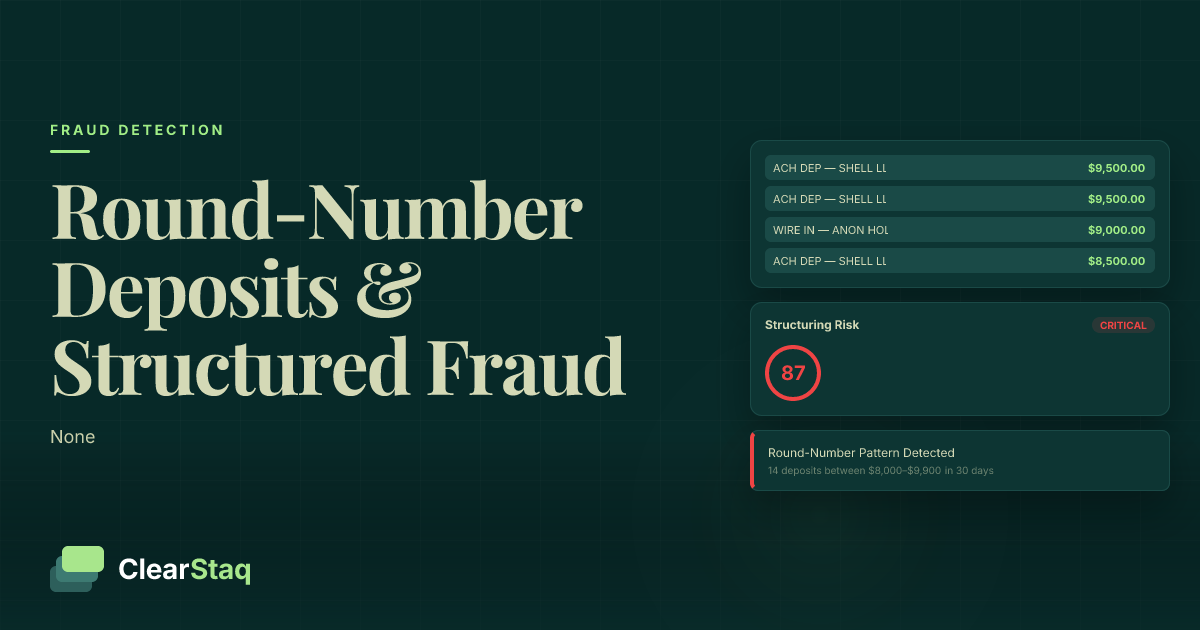
Round numbers are the tell. Platform payouts almost never land on exact hundreds or thousands because they're calculated from trip fares, tips, and fees. A pattern of $2,000.00, $2,000.00, $2,000.00 across three months on a rideshare account is a manufactured deposit, not an Uber payout.
Common mistake: Assuming a "stable" income pattern is good news. On a gig account specifically, stability without a matching platform trail is the strongest fraud signal you'll find.
5. Compare deposit frequency against the platform's actual payout cadence
Uber and Lyft typically pay out weekly; Instacart and DoorDash batch daily or every few days. If an applicant claims full-time Uber driving but shows only two deposits a month, either the platform relationship is part-time or the statement is incomplete.
Cross-check frequency against claimed hours. Someone reporting 40 hours a week on a single delivery app should show a deposit cadence that matches that platform's payout schedule, not a monthly lump sum.
Common mistake: Averaging deposit frequency across the whole statement window instead of checking month by month — a driver who was full-time for three months and inactive for three more will average out to a misleading "part-time" cadence.
6. Normalize for seasonal platforms
Rideshare and delivery income spikes around holidays, bad weather, and major events. A driver's December might run 50% above their September baseline purely from surge pricing and volume, with nothing suspicious about it.
Pull 12 months where possible instead of the standard 3, and weight the volatility calculation against known seasonal patterns for the platform type rather than flagging every peak month as an anomaly.
Common mistake: Underwriting off a 3-month window that happens to capture only the slow season, which understates true annual income and can wrongly decline a qualified applicant.
7. Flag multi-platform income that doesn't reconcile
Applicants working three or four gig platforms simultaneously are common in 2026, and their combined income is often more stable than any single platform's feed because the swings offset each other. But this only holds if every claimed platform actually shows deposits.
If someone lists Uber, DoorDash, and Instacart as income sources but the statement only shows two, that's a documentation gap worth resolving before approval — not an automatic decline, but a request for the missing statement.
Common mistake: Averaging claimed multi-platform income without verifying each source individually, which lets a thin file pass as diversified income.
Automate gig income verification
Parse gig economy statements and flag volatility patterns in under 5 seconds.
Troubleshooting
- Deposits don't match any known platform memo format. Some gig platforms route payouts through third-party processors like Stripe or Branch, so the memo won't say "Uber" directly — check for processor names and cross-reference against the applicant's stated platforms.
- Volatility score looks normal but something feels off. Check deposit dates against the platform's actual payout calendar; a coefficient of variation can look fine while still hiding a manually inserted deposit smoothing the average.
- Applicant has 12 platforms listed but only 2 show consistent income. Weight the verified platforms heavier and treat unverified ones as supplementary, not primary, income.
- Statement shows a big one-time deposit that skews the whole average. Isolate it and recalculate volatility without it — a single tax refund or loan disbursement shouldn't be read as gig income.
- Income smoothing suspected but hard to prove manually. This is where income smoothing detection patterns from parsing software catch what a manual eyeball review misses — the fraud signal is often statistical, not visual.
- Marketplace payouts (Etsy, eBay, Airbnb) mixed in with gig driving income. Separate them by platform type before calculating volatility, since marketplace payout cadence differs entirely from rideshare cadence — see how to verify marketplace payouts for working capital loans for the breakdown.
Tools and resources
- Transaction-level bank statement export (not a summary PDF)
- A platform payout schedule reference for the applicant's stated gig work
- Gig economy bank statement analysis software that extracts line items and flags anomalies automatically
- Gig economy driver income verification for auto financing for the auto-lending-specific version of this workflow
- A spreadsheet or parsing tool that calculates coefficient of variation without manual math
What to do next
Once you've flagged the volatility pattern and ruled out smoothing, the next step is turning that into a usable income figure for underwriting. Read how to verify self-employed income for loan underwriting for the full method of converting volatile deposit histories into a defensible average income number.
FAQ
What counts as normal income volatility for gig workers?
A coefficient of variation between 25% and 50% on monthly gig deposits is normal in 2026 for rideshare and delivery drivers. Anything below 10% on someone claiming full-time gig work usually means the income was smoothed or manufactured rather than earned that way.
How many months of bank statements do you need to detect income volatility?
Three months is the minimum, but 12 months gives a far more accurate picture for seasonal gig platforms. A short window can catch either a peak or a slow season and misrepresent true annual income.
Is high volatility in gig bank statements a red flag for lenders?
No — high volatility is expected and normal for gig income. The actual red flag is unnaturally smooth, round-number deposits that don't match any platform's payout schedule.
How do you tell if a gig income deposit is fake?
Check the deposit memo against known platform identifiers and compare the deposit date and amount against that platform's actual payout cadence. Round numbers, no platform trail, and suspiciously consistent timing are the strongest signs of a manufactured deposit.
Can gig workers with multiple platforms have more stable income?
Yes, income across three or four platforms often smooths out because slow periods on one platform overlap with busy periods on another. But every claimed platform needs to show verified deposits, not just the strongest one.
How fast can bank statement parsing software detect volatility patterns?
Format-aware parsing tools can process a gig economy bank statement and surface volatility and fraud signals in under 5 seconds, compared to 20-30 minutes for manual line-item review.
Do rideshare and delivery platforms have different payout schedules?
Yes, Uber and Lyft typically pay weekly while DoorDash and Instacart often batch payouts daily or every few days. Matching deposit frequency to the correct platform schedule is essential before flagging any pattern as suspicious.
What's the biggest mistake lenders make with gig income underwriting?
Treating gig income like a W-2 paycheck and expecting monthly consistency. The real risk signal is the opposite of what most lenders assume — deposits that are too consistent, not too volatile.
One last thing
The deposit pattern most underwriters flag as a red flag — big swings between months — is actually the healthiest sign a gig income statement can show. The pattern that should trigger a second look is the one that looks clean: identical amounts, identical dates, no platform trail. In 2026, with gig platforms driving daily and weekly payouts instead of monthly paychecks, a genuinely smooth statement is rarer than a genuinely volatile one, and rarer still without a reason.
Related guides
ClearStaq Team
Content Team
The ClearStaq team builds AI-powered tools for bank statement parsing, fraud detection, and income verification.